 Skip to content

A sibling inherits an Oak Cliff bungalow after a parent dies without a will. The mortgage still shows the parent's name, the family never opened probate, and a buyer or lender now wants proof that the surviving family members own the house. In Dallas County, the answer may involve an affidavit of heirship, but the filing location, family-history details, witness qualifications, and timing all matter.
The key point is simple: an affidavit of heirship is recorded in the Dallas County real property records, not filed through the probate intake lane. It can help establish a chain of title, but it doesn't itself transfer title, eliminate creditor issues, or guarantee that a title company will insure a sale. Texas Estates Code § 203.001 also gives a properly recorded affidavit an important evidentiary effect only after it has been of record for five years or more in qualifying deed records. Dallas County's probate guidance and the statute should be read together before a family chooses this route.
Table of Contents
- When an Affidavit of Heirship Fits Your Dallas Situation
- What Your Affidavit Needs to Include and Who Signs
- Filing the Affidavit with Dallas County Real Property Records
- How the Five-Year Rule Protects the Chain of Title
- When the Affidavit Is Not Enough on Its Own
- Common Mistakes Dallas Families Make With Heirship Affidavits
- Practical Next Steps for Dallas County Heirs
When an Affidavit of Heirship Fits Your Dallas Situation
An affidavit of heirship is a sworn statement identifying the people who inherited from someone who died without a will, commonly called dying intestate. The document describes the decedent's family history, marital status, children, and relevant property. It's then recorded in the county's deed or real property records so future title examiners can see the claimed path from the deceased owner to the heirs. TexasLawHelp's explanation of affidavits of heirship describes the process as a lower-cost alternative to a formal heirship determination in appropriate cases.
For the Oak Cliff family, a properly prepared affidavit may help clear a title cloud before the house is sold, refinanced, or transferred. It creates a public record supporting the identity of the heirs. The family may still need follow-up deeds signed by the heirs, lender coordination, and title-company approval because the affidavit is evidence of heirship, not a deed conveying the property.
The right fact pattern
This approach generally fits best when the decedent had no will, the heirs are known, everyone agrees about the family history, and no unresolved estate dispute threatens the property. It can be practical where the central issue is documenting inheritance of a Dallas County home rather than administering a complicated estate.
That shortcut has limits. An affidavit doesn't decide a dispute between siblings, confirm that no later will exists, resolve creditor claims, or provide the same finality as a court judgment. A title company may also ask for more documentation even when the affidavit was signed and recorded correctly.
Scope matters: Before preparing the document, identify whether the family needs a record of heirship or a court order that conclusively determines ownership. Those are different solutions.
A tract located in more than one county creates another filing concern. Texas guidance indicates that duplicate recordings may be needed in each county affected by property crossing county lines. The relevant county is tied to the land's location, not merely the county where the decedent lived. Texas legislative materials discussing county real-property recording reinforce that property-specific rule.
What Your Affidavit Needs to Include and Who Signs
A usable affidavit depends on complete, accurate family history. Texas Estates Code § 203.002 addresses the information an affidavit of heirship should contain, while § 203.001 governs the later evidentiary effect of a qualifying recorded affidavit. A family shouldn't treat a downloadable form as finished merely because it has signature lines.
Choosing the affiant and witnesses
The affiant is the person swearing that the information is true. Often that's an heir who knows the family history best, although the right choice depends on who has reliable personal knowledge. The document also needs two disinterested witnesses, meaning people who know the decedent and family but don't stand to inherit or gain financially from the property.
A longtime neighbor, family friend, or colleague may be a better witness than a relative with an interest in the estate. The witnesses should be able to explain how they know the family and should review the document carefully before signing. Each required signature must be properly acknowledged or sworn before a notary.
Family facts and property identification
The affidavit should identify:
- The decedent: Use the full legal name and accurately state the date and place of death.
- Marriage history: Include the relevant marriages, divorces, and surviving-spouse information.
- Children and descendants: List every child, including children who died earlier, and identify descendants when that fact affects inheritance.
- The property: Use the Dallas County legal description, such as the lot, block, subdivision, or other description shown in the recorded deed.
- Inheritance facts: State the family-history facts supporting why the listed people are heirs.
A death certificate proves the death event and can support the filing, but it doesn't replace the affidavit's broader account of marriages, children, and heir identity. Attaching a certified death certificate as an exhibit can make the recording package easier for a title examiner to understand, but the affidavit still must stand on its own as a properly sworn document.
Accuracy is more than a clerical concern. An omitted child, incorrect divorce history, or incomplete legal description can leave the chain of title vulnerable when the family later tries to sell or refinance.
Filing the Affidavit with Dallas County Real Property Records
Dallas County directs filers of an affidavit of heirship tied to real property to the County Clerk's Recording Division, rather than the Probate Division. The county identifies the Records Building at 500 Elm Street, Suite 2100, Dallas, Texas 75202, with recording hours of 8:00 a.m. to 4:30 p.m., Monday through Friday. Dallas County's filing guidance explains why the property-recording system is the correct lane.
That distinction matters because an affidavit of heirship is meant to create a public chain-of-title record for land. It isn't, by itself, an application opening a probate case.
Assemble the recording package
Before going to the Records Building or using an available recording method, confirm that the package includes:
- The original affidavit: It should be complete, signed, sworn, and ready for recording.
- Notarial documentation: The acknowledgment or jurat must be properly completed, including required seals.
- Death documentation: Include a certified copy of the death certificate when the title company or recording process requires supporting proof.
- A precise legal description: Confirm the description against the recorded deed, not just a street address or an old closing statement.
- A copy for your records: Keep a complete copy of everything submitted.
At the recording window, the practical objective is to submit the document through the property records lane, pay the applicable recording charge, and obtain the recorded reference, such as an instrument number, along with a conformed copy if available. Filing procedures and accepted submission methods can change, so confirm current requirements before traveling.
Dallas families can review the building's role and records functions through this guide to the Dallas County Records Building and what is filed there.
Problems that commonly cause delays
Missing notarial seals, incomplete certificates, witness signatures that don't satisfy the disinterested-witness requirement, and mismatched legal descriptions can all create problems. A clerk's acceptance also doesn't mean a title underwriter has agreed to insure the title. Recording is the public-filing step, not the final title-company decision.
How the Five-Year Rule Protects the Chain of Title
Texas Estates Code § 203.001 gives a properly executed and recorded affidavit of heirship a significant legal benefit after it has been of record for five years or more in the deed records of a county connected to the property or the decedent's residence. At that point, the affidavit may serve as prima facie evidence, meaning evidence sufficient on its face unless challenged with contrary proof. The text of Texas Estates Code § 203.001 describes this threshold.
The rule doesn't magically convert the affidavit into a deed. Instead, it strengthens the evidentiary position of the family and the recorded chain of title. The facts may include family history, genealogy, marital status, and heir identity, along with the facts used to determine who inherited under Texas law.
Why recording promptly helps
Suppose a family records an accurate affidavit and a buyer reviews the title six years later. The five-year milestone may give the title examiner stronger evidence to evaluate the claimed heirship. By contrast, if the family seeks a refinance in year two, the lender's title company may request additional proof, a court proceeding, corrective documents, or other underwriting support because the statutory evidentiary threshold hasn't been reached.
The rule is tied to the date the qualifying document becomes of record. That makes prompt recording important even if the family doesn't plan to sell immediately. A recorded affidavit begins building the public history that a future buyer, lender, or title examiner will review.
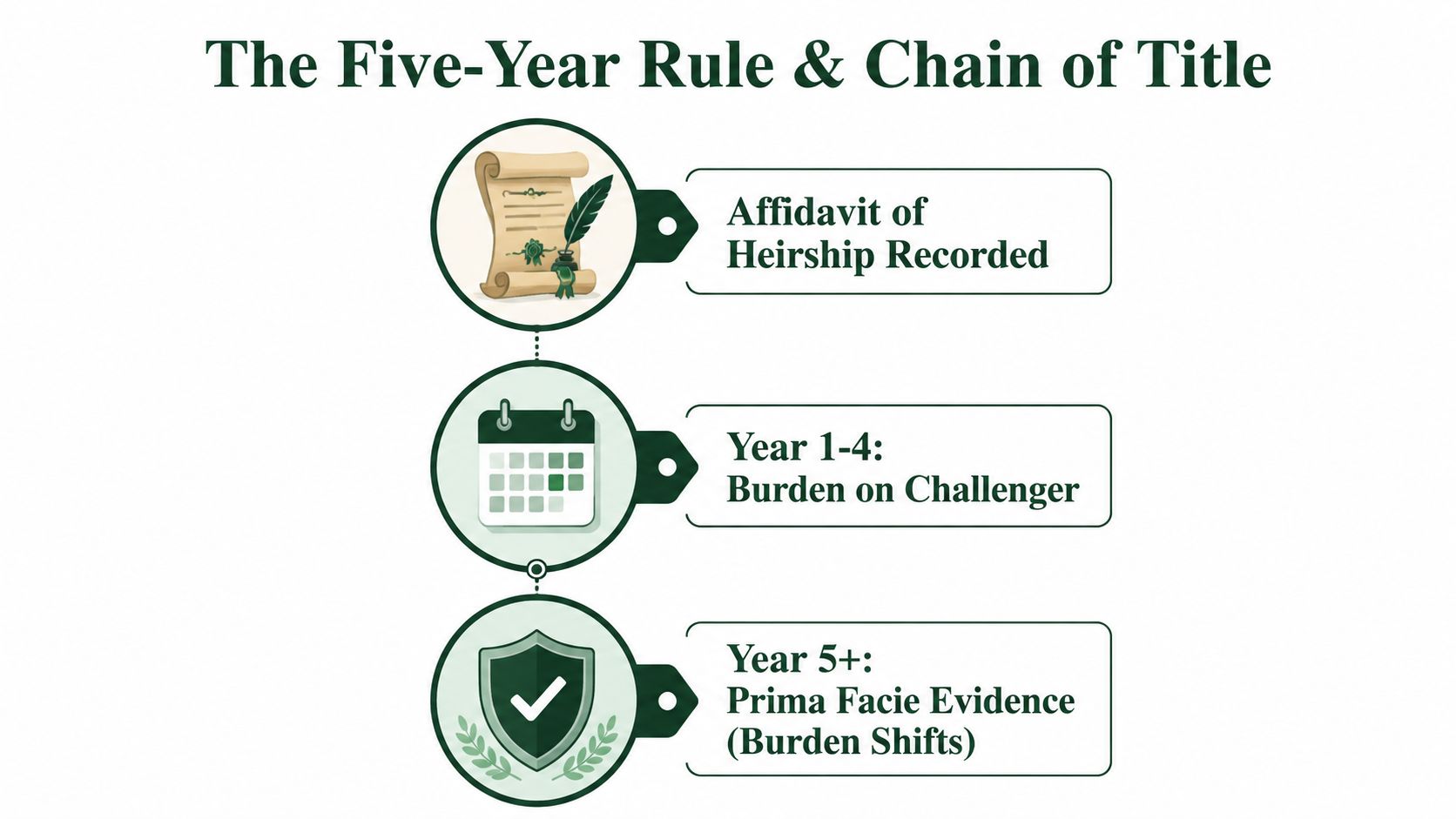
The presumption remains limited. It doesn't establish that a later-discovered will is invalid, eliminate an undisclosed creditor's rights, or prevent a person with contrary evidence from challenging the stated facts. Title companies still assess the entire chain, the family history, liens, and the nature of the proposed transaction.
For a visual explanation of how the timeline affects title review, watch this related overview:
When the Affidavit Is Not Enough on Its Own
An affidavit of heirship works as a record-based solution, not as a universal substitute for probate. Families should pause before recording when facts suggest that a court needs to resolve ownership, protect creditors, or determine whether every heir has been identified.
A contested or undisclosed will is a major warning sign. So is a missing heir, an unknown child, or a family member whose location and consent can't be established. Disagreements among siblings also make the affidavit risky because the document records sworn assertions, but it doesn't adjudicate which side is correct.
Red flags that change the analysis
Potential creditor claims deserve attention as well. The estate may involve debts, tax obligations, liens, or possible Medicaid-related recovery issues. An affidavit doesn't erase those claims simply because the property is identified and the heirs sign the document.
Families sometimes confuse an affidavit of heirship with a small estate affidavit under Texas Estates Code § 205.001. These are separate tools with different purposes. The small estate procedure has a $50,000 cap under the stated statutory framework, as reflected in this Texas Estates Code reference, while an affidavit of heirship doesn't operate as a general substitute for a court determination. Neither method resolves a contested descent.
Property characteristics can also require closer review. Mineral interests, disputed homestead rights, tax-foreclosed parcels, multiple ownership interests, or an unclear prior deed may create issues that a family can't solve through a simple affidavit.
| Situation | Affidavit of Heirship | Probate Required |
|---|---|---|
| Known heirs, no dispute, and a straightforward intestate property transfer | May provide useful recorded evidence for title review | Not necessarily |
| A will exists and someone needs the will recognized | Usually not the correct primary solution | Often, depending on the circumstances |
| A child, spouse, or other potential heir is missing or disputed | Risky because the affidavit doesn't decide the dispute | A court proceeding may be needed |
| Creditor, tax, or estate-administration issues remain open | Doesn't resolve those claims | Probate or another court process may be appropriate |
| Title company requires a binding heirship determination | Recording alone may not satisfy underwriting | Consider a court determination or probate procedure |
When the facts point toward court involvement, review the Dallas County muniment of title filing location only as part of a broader strategy. A muniment of title generally relates to a will-based probate path, so it isn't automatically interchangeable with an affidavit of heirship.
Common Mistakes Dallas Families Make With Heirship Affidavits
A North Dallas family loses its father and tries to settle a Lake Highlands rental using a form downloaded from the internet. The family knows the property address and remembers the major family events, so the document feels finished. The title company finds several defects before the transaction can move forward.
First, one witness is a co-owner of the rental. That person has a financial interest and doesn't fit the role of a disinterested witness. Second, the affidavit says the decedent was married at death, even though he had divorced and later remarried. That inaccurate marital history creates uncertainty about which spouse held rights and which family facts control inheritance.
The third error is the property description. The family copied an outdated lot and block reference from an old closing document rather than checking the current deed in Dallas County records. A street address can identify a house for everyday purposes, but title work depends on the legally recognized parcel description.
Safeguards before notarization
- Use independent witnesses: Choose two non-heirs who personally knew the decedent and family.
- Verify the family tree: Check every spouse, child, deceased child, and relevant death date against reliable family records, funeral programs, and obituaries.
- Confirm the deed: Pull the recorded deed by instrument number and compare the legal description line by line.
- Review before signing: Correct inconsistencies before anyone appears before the notary.
These errors can lead to a corrective affidavit, further proof, or a demand for probate. The problem often appears when the family is already under contract, which leaves little room for relaxed fact-checking.
Practical Next Steps for Dallas County Heirs
Start with the documents that show both the family history and the property's current record. Gather the decedent's death certificate, the latest deed showing how title was held, a current Dallas Central Appraisal District tax statement, and any will or family record that may confirm the heirs.
Then review the Dallas County public records for prior deeds of trust, liens, and other recorded instruments affecting the property. A mortgage in the decedent's name doesn't disappear at death. The title company needs to understand the loan, payoff status, and recorded liens before it can evaluate a sale or refinance.
Use the title company early
Call the title company expected to issue the owner's policy before the family spends time finalizing a transaction. Ask whether its underwriter will consider the recorded affidavit based on the property's facts and recording history, or whether it will demand a court order. That conversation can identify the obstacle before a buyer's closing date is approaching.
A Dallas probate attorney can review the heirship tree where prior marriages, community-property interests, possible undisclosed children, or conflicting family accounts complicate the record. If the family may need an ad litem appointment or a formal heirship proceeding, understanding the potential Dallas County heirship proceeding attorney ad litem cost can help with planning, although the actual expense depends on the proceeding and facts.
After the affidavit is accurately drafted, properly notarized, and recorded, coordinate the next documents and accounts. That may include deeds signed by the heirs, mortgage payoff information, homeowner insurance updates, and records showing who is responsible for the property. Don't assume recording alone completes the transfer or makes every future transaction insurable.
The Law Office of Bryan Fagan, PLLC can help Dallas County families evaluate whether an affidavit of heirship fits, prepare for title-company review, and determine when probate or a court heirship proceeding is safer. Visit The Law Office of Bryan Fagan, PLLC to learn about the firm's Dallas probate and estate-planning services and request a consultation about your inherited property.
