 Skip to content

Dallas County's published divorce filing fee is $350.00 for a case with no children and $401.00 for a case with children, including Domestic Relations Office-related fees. The Dallas County District Clerk administers these charges through the George L. Allen, Sr. Courts Building.
You may be sitting at your kitchen table with a divorce petition ready to file, trying to determine whether the amount on your payment screen is the complete cost or only the first court charge. The answer matters because filing opens the case, but it doesn't necessarily pay for service, copies, mediation, or other case-specific expenses.
This guide translates the Dallas County District Clerk divorce filing fee schedule into a practical reference for residents filing in Dallas County Family District Courts. It explains which fee category applies, what the clerk's charge generally represents, how separate expenses can arise, what to do if you can't afford the upfront payment, and how to verify Dallas County filing information before submitting your papers.
Table of Contents
- Quick Answer to Your Dallas County Divorce Filing Cost Question
- Dallas County District Clerk Divorce Filing Fee Schedule at a Glance
- What Your Filing Fee Covers and What It Does Not
- Common Additional Expenses Beyond the Filing Fee
- Fee Waivers and Indigence Options in Dallas County
- Where and How to Pay Your Dallas County Divorce Filing Fees
- What Happens After You File and Pay in Dallas County
- Quick Reference and Cross References for Dallas County Filers
Quick Answer to Your Dallas County Divorce Filing Cost Question
The current Dallas County schedule separates divorce filings into two categories. A divorce without children costs $350.00, while a divorce with children costs $401.00. The children-involved amount includes Domestic Relations Office-related fees, so the schedule isn't treating the presence of minor children as a minor administrative detail. It places the case in a different filing category. You can verify the published amounts in the Dallas County civil and family filing fee schedule.
The distinction usually turns on whether the divorce case involves minor children whose parentage, conservatorship, possession and access, child support, or medical support must be addressed. A married couple with no children falls into the no-children category. A couple seeking orders concerning their children falls into the children-involved category, even if they already agree on parenting arrangements.
The fee is the beginning, not the whole budget
Paying the clerk's filing charge starts the court case, but it doesn't automatically cover every expense connected with moving the case forward. Depending on the circumstances, you may also need to account for citation and service, certified copies, court reporter services, mediation, parenting-related services, or fees connected with a court-appointed professional.
An uncontested divorce with cooperative service and a complete agreement may have a simpler cost path. A contested divorce involving temporary orders, disputed possession, child support, business ownership, real estate, retirement assets, or hidden-property concerns can require substantially more legal work and separate expenses. The filing schedule alone can't predict the total.
Practical rule: Treat the clerk's amount as the cost of getting the case filed, not as a quote for the entire divorce.
Where Dallas County filers begin
The Dallas County District Clerk's civil and family filing information is administered at the George L. Allen, Sr. Courts Building, located at 600 Commerce Street, Suite 103, Dallas, Texas 75202. The published main telephone number is (214) 653-7307, as shown on the Dallas County District Clerk civil fees page.
Before filing, identify whether your case includes children, review the current county schedule, and determine whether the other spouse will accept a waiver of service or must be formally served. If finances are tight, review the fee-waiver process before assuming you must pay the listed charge at the filing window.
Dallas County District Clerk Divorce Filing Fee Schedule at a Glance
The table below is the fastest way to identify the applicable published charge. It focuses on the divorce filing categories shown by Dallas County, rather than attempting to estimate attorney fees or every expense that may arise later.
Dallas County District Clerk Divorce Filing Fees by Case Type
| Case Type | Clerk Filing Fee | Notes |
|---|---|---|
| Divorce without children | $350.00 | Published Dallas County civil and family filing charge for a divorce case with no children |
| Divorce with children | $401.00 | Includes Domestic Relations Office-related fees, according to the county schedule |
The difference between the two listed categories is $51.00, calculated from the published amounts. That difference reflects the county's separate treatment of cases involving children. It doesn't mean every family will have identical legal expenses after filing, because parenting disputes, child support questions, temporary orders, and enforcement concerns can require different work.
How to read the schedule
Look for the divorce category that matches the structure of your case. “Without children” means the case doesn't require the court to enter orders concerning children. “With children” means the divorce includes children-related issues that fall within the court's family-law orders.
The Domestic Relations Office reference is especially important. The county identifies that component as included in the children-involved figure, so a filer shouldn't assume the listed amount is merely a higher clerk processing charge with no explanation. It reflects the county's published fee structure for family cases involving children.
Fees can change. Dallas County's official schedule should be checked close to the time you file rather than relying on an older blog post, a prior receipt, or a friend's experience. The District Clerk's official civil fees information is the appropriate place to confirm current filing instructions and office information.
Historical context without using an old fee as a budget
An archived Dallas County schedule dated October 11, 2011 listed $297.00 for divorce without children and $348.00 for divorce with children. Compared with the current published schedule, each category has increased by $53.00. The historical record demonstrates why an older fee chart shouldn't be used as a current payment instruction. It also shows that Dallas County has maintained separate categories for divorces with and without children over time. The archived Dallas County civil and family fee schedule is useful for that historical comparison, not for determining what you owe today.
What Your Filing Fee Covers and What It Does Not
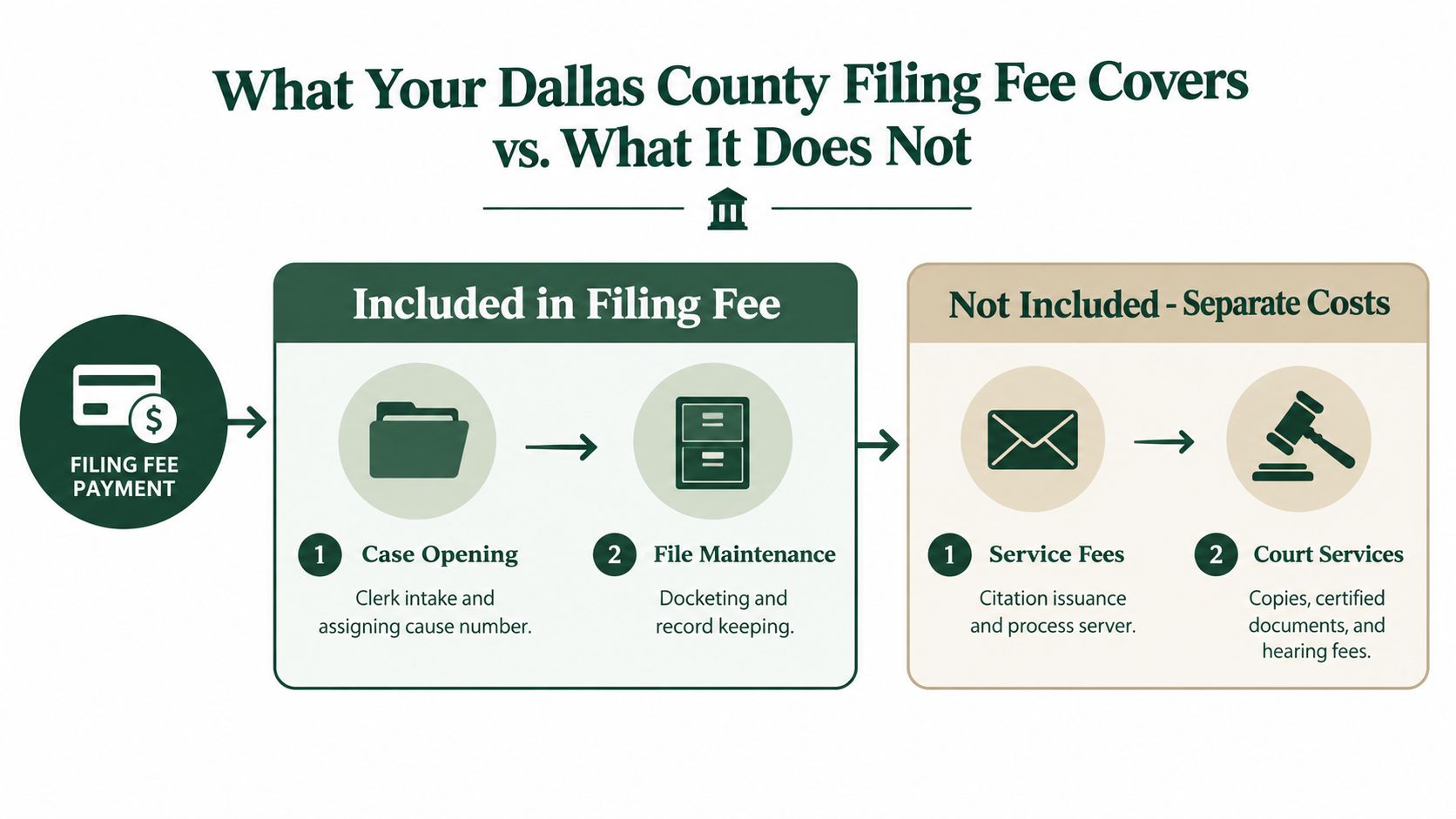
A filing fee is the charge paid to the clerk to submit the initiating papers and open the court case. In practical terms, the clerk receives the documents, processes the filing, and maintains the court record. Filing creates the case record, but it doesn't resolve the divorce and doesn't complete notice to the other spouse.
Included in the basic filing function
The published divorce charge is connected to the clerk's intake and case administration. That generally means the filing is accepted into the civil and family court system, a case record is created, and subsequent pleadings can be associated with that case.
For a divorce involving children, the schedule states that the $401.00 amount includes Domestic Relations Office-related fees. That inclusion doesn't mean every child-related service or every later professional expense is covered. It means the county has incorporated the identified Domestic Relations Office component into the listed filing amount.
Separate expenses require separate planning
Service is a different function from filing. The clerk may issue citation, but a sheriff, constable, or private process server may charge separately to deliver the papers. A spouse who signs an appropriate waiver of service may change that practical cost path, but the waiver must be prepared and completed correctly.
Copies and certified documents are also separate concerns. You may need certified paperwork for another agency, a financial institution, a title company, or post-divorce implementation. Mediation, court reporter services, and court-appointed professionals are not automatically included in the base filing charge.
Consider a Dallas spouse filing an uncontested case. The person pays the applicable clerk fee, prepares service paperwork, and learns that the other spouse is willing to sign a waiver. That case may avoid a process server, but the parties could still incur costs for document preparation, copies, mediation, or legal representation. The filing payment is the first transaction, not a guarantee that no other charge will appear.
Common Additional Expenses Beyond the Filing Fee
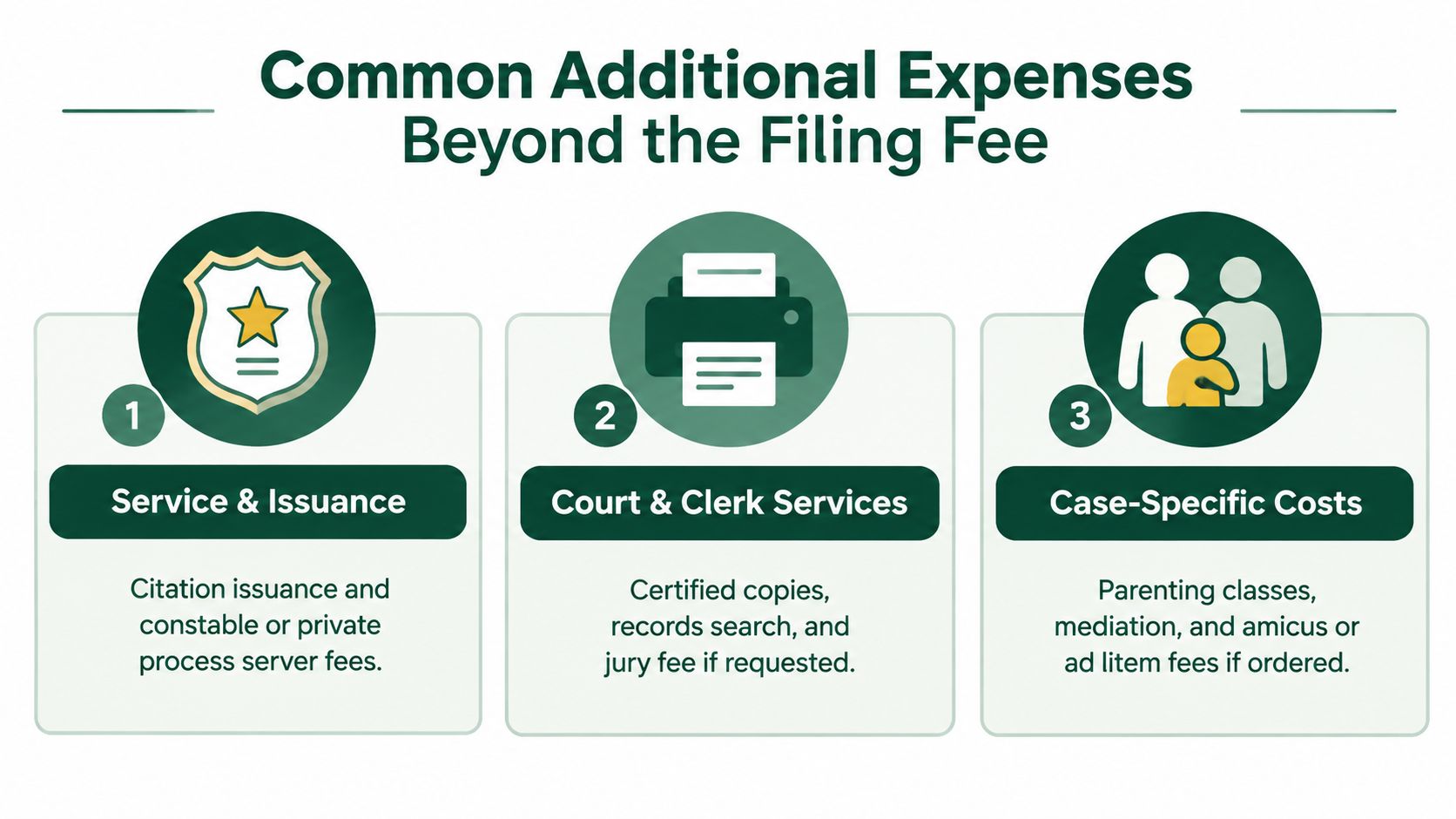
After the case opens, costs tend to fall into several categories. Some depend on how the other spouse is notified. Others depend on whether the parties disagree, whether children are involved, or whether the court needs help evaluating a disputed issue.
A practical decision matrix
| Situation | Expenses that may become relevant | Why it matters |
|---|---|---|
| Cooperative spouse who signs a waiver | Document preparation and possible copies | Formal service may not be necessary, but paperwork still must be completed properly |
| Spouse who must be formally notified | Citation issuance and sheriff, constable, or private process server charges | Notice requires a separate delivery process |
| Need for official court records | Copies or certified copies | Certified documents often serve a different purpose from ordinary file copies |
| Disputed divorce or custody case | Mediation, court reporter services, and additional legal preparation | Disagreement creates hearings, negotiation, and evidence requirements |
| Case involving complex assets | Financial review, valuation, tracing, or expert-related work | Businesses, professional practices, real estate, equity compensation, and retirement assets can require detailed analysis |
| Child-related dispute | Parenting-related services or court-appointed professionals | The court may address conservatorship, possession, support, or safety concerns |
Contested and uncontested cases follow different cost paths
An uncontested divorce may involve fewer hearings and less evidence. That can reduce the number of events that generate separate expenses, but “uncontested” doesn't mean no work is required. The final agreement still needs clear language covering property, debt, maintenance if applicable, and child-related terms when children are involved.
A contested case can generate expenses through temporary orders, discovery, mediation, depositions, court reporter services, and trial preparation. A high-asset divorce may require careful review of business records, separate-property tracing, reimbursement claims, real estate interests, stock or equity compensation, retirement accounts, and disputed transfers. Those are legal and financial work categories, not charges included in the clerk's filing schedule.
Ask what triggers each expense
Before authorizing an additional service, ask who charges for it, what event causes the charge, whether it is required or strategic, and whether the amount can change. A process server's work is different from attorney preparation. A certified copy is different from a regular copy. Mediation is different from a court-ordered evaluation.
This question-based approach makes your budget more useful than adding an unsupported cushion to the filing fee. It also helps you understand which decisions are procedural necessities and which are responses to the facts of your case.
Fee Waivers and Indigence Options in Dallas County
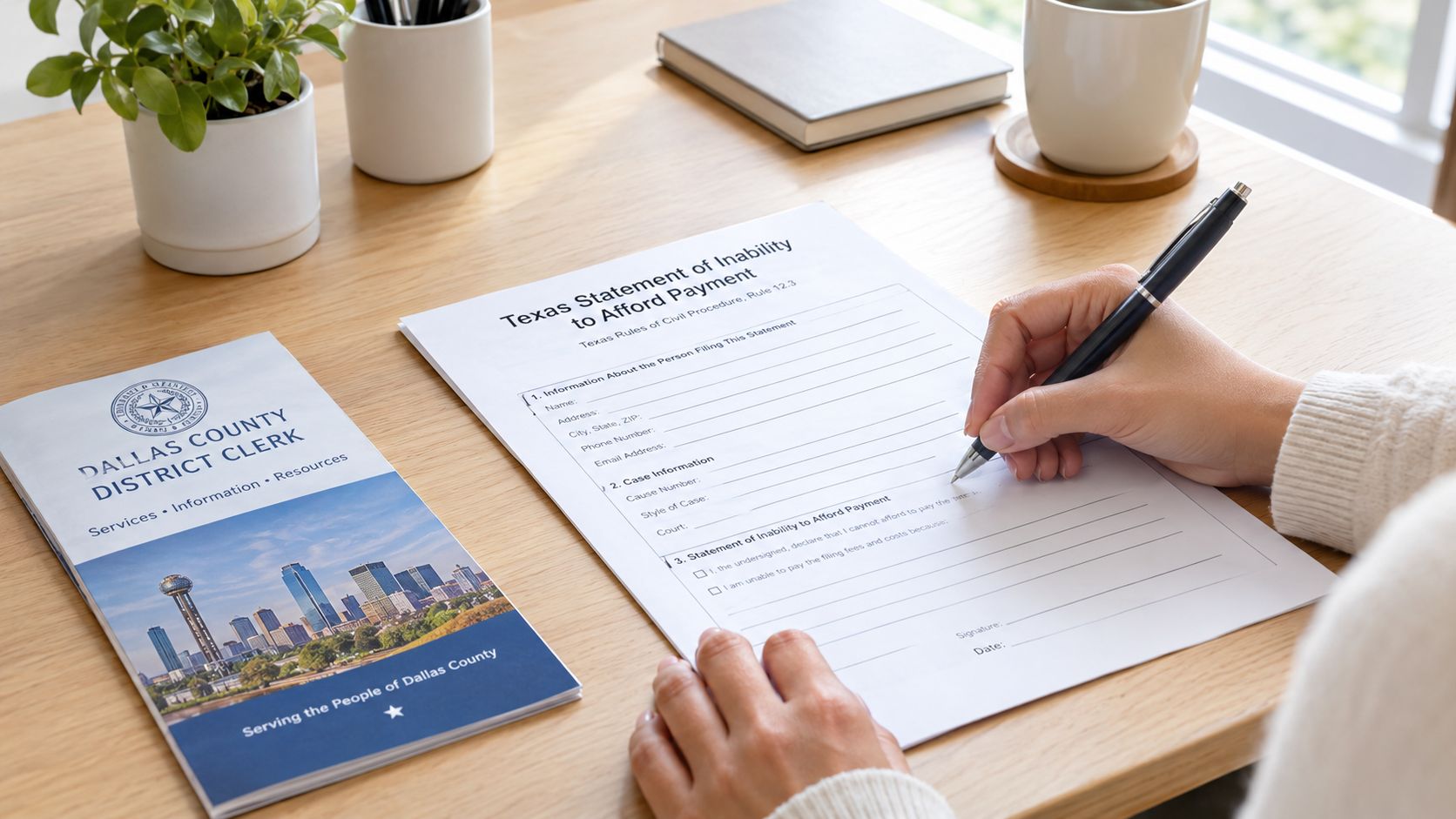
If you can't afford the filing charge, Texas provides a process commonly handled through a Statement of Inability to Afford Payment of Court Costs. This is not an automatic waiver. You must provide financial information, and the clerk or court reviews the request under the applicable process.
What the statement does
The statement allows a person to explain why paying court costs would create a financial hardship. The information may concern income, household resources, regular expenses, dependents, property, and other financial circumstances. Accuracy matters. A vague explanation or incomplete answer can create delay or lead to questions about the request.
File the statement with the initiating divorce papers if you need relief from paying the filing charge upfront. Keep a complete copy of everything submitted, including the date of filing and any confirmation received.
Review and possible contest
The court may accept the statement, request additional information, or face a contest from the opposing party. If the other spouse contests the request, you may need to explain your financial circumstances through the procedure provided by the court. Eligibility depends on the facts of your finances and the court's review, not on whether the listed fee feels difficult to pay.
A waiver of court costs also doesn't necessarily eliminate every third-party expense. Service by a private process server, certified copies, mediation, and professional fees may involve different entities and different authority. Ask specifically which costs the approved order addresses.
Avoid common filing mistakes
- Complete every requested field: Don't leave financial questions unexplained.
- Use consistent information: Make sure the figures and household details match the documents you submit elsewhere.
- Keep proof of filing: Save stamped copies, electronic confirmations, and notices from the clerk or court.
- Ask about disputed costs: Determine whether a waiver applies to filing, service, copies, or another charge.
- Use current forms: Obtain the appropriate form and instructions through official Texas court resources or confirm the current process with the Dallas County filing office.
A family-law attorney can explain how the request fits into your filing strategy, but no attorney can promise that the court will approve it.
Where and How to Pay Your Dallas County Divorce Filing Fees
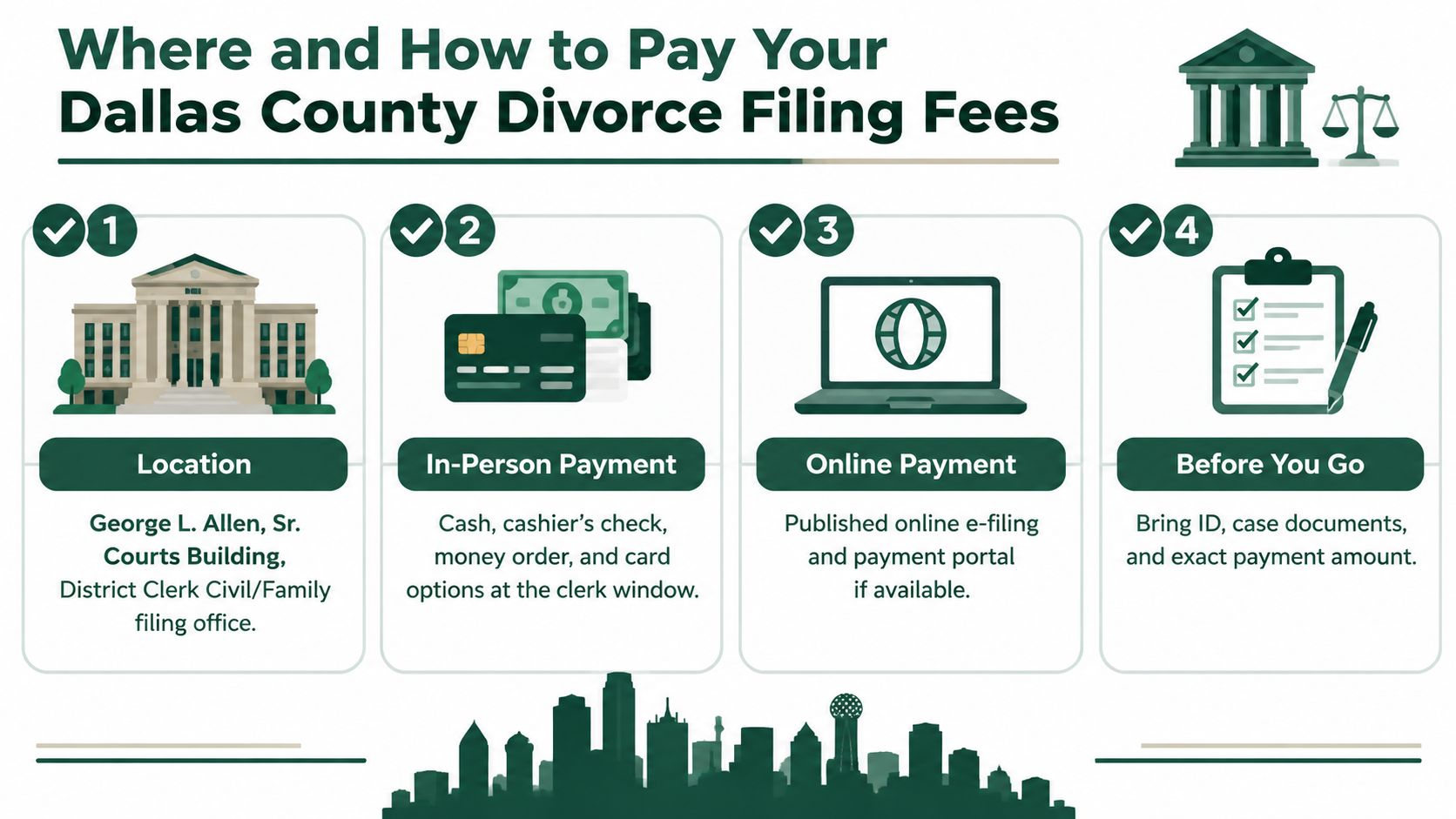
Dallas County identifies the civil and family filing office at the George L. Allen, Sr. Courts Building, 600 Commerce Street, Suite 103, Dallas, Texas 75202. The District Clerk's published main telephone number is (214) 653-7307. Confirm current office procedures before traveling, especially if you're relying on a particular payment method or filing channel.
In-person preparation
Bring the documents you intend to file, a form of identification if requested, and a payment method accepted by the clerk at the time of filing. Don't assume that a payment method described by an older resource remains available. The county's official civil fees page is the safer place to verify current instructions.
If you need a waiver, bring the completed Statement of Inability to Afford Payment of Court Costs rather than arriving with no plan for the payment issue. The clerk may have filing requirements that affect how the statement is submitted with the petition.
Keep your receipt and any file-stamped copy. Those records help confirm that the payment was applied to the correct filing and preserve the information you may need when asking about the case.
Electronic filing and payment
Electronic filing can be convenient, but the payment screen and filing submission are separate points to review. Confirm that the documents are attached to the correct case, that the case category reflects whether children are involved, and that the payment confirmation corresponds to the submission.
If the system rejects a filing, save the rejection notice and determine whether the filing fee was processed or merely authorized. Don't submit duplicate payments without confirming what happened to the first transaction.
For courthouse and records orientation, consult this guide to Dallas County records building resources.
Before visiting or filing electronically, verify the current schedule, payment options, filing requirements, and any local instructions directly with Dallas County. The county's published location information is the controlling starting point for that verification.
What Happens After You File and Pay in Dallas County
Payment doesn't end the filing process. It moves the case into the procedural steps required to notify the other spouse, establish a response opportunity, address temporary needs, exchange information, and reach a final resolution.
Service and the response
After filing, the other spouse generally must receive legal notice unless the rules allow a properly executed waiver or another authorized method. Service is not the same as sending a text, email, or informal copy of the petition. Improper service can delay the case and create additional expense if the papers must be corrected and delivered again.
Once service or waiver is handled, the responding spouse may file an answer and possibly a counterpetition. The exact response deadline depends on the method and date of service, so don't rely on a calendar shortcut without checking the applicable Texas rules or obtaining legal guidance.
Temporary orders and case preparation
A spouse may need temporary orders concerning possession of the home, payment of bills, access to children, child support, spousal support, or restrictions on property transfers while the divorce remains pending. A protective order or emergency request raises separate safety and procedural concerns and should be handled promptly.
The parties may exchange financial information through discovery. In a straightforward case, the documents may be limited. In a high-asset case, counsel may need to examine business ownership, professional-practice revenue, real estate, retirement accounts, separate-property claims, tracing records, reimbursement claims, and possible hidden assets.
Before agreeing to a division: Make sure you understand how the proposed terms will be implemented, not merely how they sound in the decree.
Settlement, prove-up, or trial
Many cases resolve through negotiation or mediation. A settlement still requires a properly drafted final decree and any related documents needed to transfer property, divide retirement interests, establish support, or implement parenting terms.
If the parties don't reach agreement, the case may proceed to hearings or trial. If they do agree, an uncontested matter may be presented for final approval through the procedure required by the assigned court. Local court requirements can vary, so filing a fee doesn't guarantee that the case will be finalized without an appearance or additional submissions.
For courthouse orientation, review this resource on where Dallas County family cases are heard. If a decree later needs enforcement, modification, or appeal, those are new legal steps with their own requirements and possible costs.
Quick Reference and Cross References for Dallas County Filers
Use this checklist before filing:
- Identify the case category: Decide whether the divorce involves children.
- Verify the current charge: Check the Dallas County schedule immediately before filing.
- Prepare service paperwork: Determine whether formal service or a waiver is likely.
- Review waiver eligibility: Complete a Statement of Inability to Afford Payment of Court Costs if appropriate.
- Save payment records: Keep receipts, electronic confirmations, and file-stamped documents.
- Budget beyond filing: Consider service, copies, mediation, hearings, and case-specific professional expenses.
- Protect financial records: Gather information about homes, accounts, debts, businesses, compensation, and retirement interests.
- Plan for children: Address conservatorship, possession and access, child support, and medical support clearly.
Current fee reference
| Filing category | Published amount |
|---|---|
| Divorce without children | $350.00 |
| Divorce with children | $401.00, including Domestic Relations Office-related fees |
The archived October 11, 2011 schedule listed $297.00 without children and $348.00 with children. Each category is $53.00 higher on the current published schedule than on that archived schedule. Use the current county schedule for payment decisions, not the historical figures.
Dallas resources to keep nearby
The District Clerk's civil and family fee information identifies the George L. Allen, Sr. Courts Building as the relevant filing location. Residents in Dallas, North Dallas, Garland, Mesquite, and other parts of Dallas County should confirm which county's court system applies when a city crosses county lines or when the parties and children live in different locations.
For location questions involving Dallas County facilities, consult this guide to Dallas County subcourthouse locations. For legal questions beyond the filing amount, related topics may include temporary orders, child custody, possession and visitation, child support, enforcement, relocation, protective orders, property division, business-owner divorce, separate property, and family-law appeals.
Verify the latest fee schedule before submitting your petition. If your case involves children, safety concerns, disputed property, a closely held business, retirement assets, or uncertainty about service, speak with a qualified Texas family-law attorney before filing documents that could affect your rights.
The Law Office of Bryan Fagan, PLLC can help Dallas County residents understand the filing process, prepare for service and temporary orders, and evaluate divorce issues involving children or complex property. Visit The Law Office of Bryan Fagan, PLLC to learn about available family-law resources and request guidance for your specific situation.
