 Skip to content
You filed a motion in your Dallas County custody, divorce, child-support, or enforcement case, but no hearing date has appeared. Calling the clerk hasn't solved the problem, and an email to a general county address may go nowhere. The practical answer to Dallas County family court coordinator how to set a hearing is simple: first identify the court assigned to your case, then follow that court's setting procedure.
Dallas County doesn't use one universal hearing-setting desk for family cases. The Family District Courts handle divorce, custody, child support, adoption, paternity, protective orders, and termination of parental rights from the George L. Allen, Sr. Courts Building at 600 Commerce Street in Dallas, but each assigned court can use its own coordinator, clerk procedure, docket rules, or hearing request form. Dallas County's Family District Courts page is the right starting point, but you still need to verify the policy for your specific court and matter.
Table of Contents
- What the Dallas County Family Court Coordinator Actually Does
- Finding Your Assigned Court and the Right Coordinator
- Filing the Motion and Serving the Notice of Hearing
- How Dallas County Hearing Settings Actually Work by Court
- Comparing Dallas County Family Court Setting Methods
- Common Mistakes Dallas Litigants Make When Setting a Hearing
- Practical Next Steps Before and on Your Hearing Day
What the Dallas County Family Court Coordinator Actually Does
A Dallas family-court coordinator is the administrative bridge between the judge, the parties, lawyers, clerks, and the docket. The coordinator isn't the judge and can't decide whether your motion should be granted. The coordinator helps move a properly filed request into the court's scheduling process.
That distinction matters. The Dallas County family system has seven family district courts, the 254th, 255th, 256th, 301st, 302nd, 303rd, and 330th. The assigned court, not the county where you filed, generally determines where your hearing request goes and what format it must follow. Texas Law Help's Dallas County family district court guide identifies the courts, courthouse location, business hours, and family-law matters handled in this system.
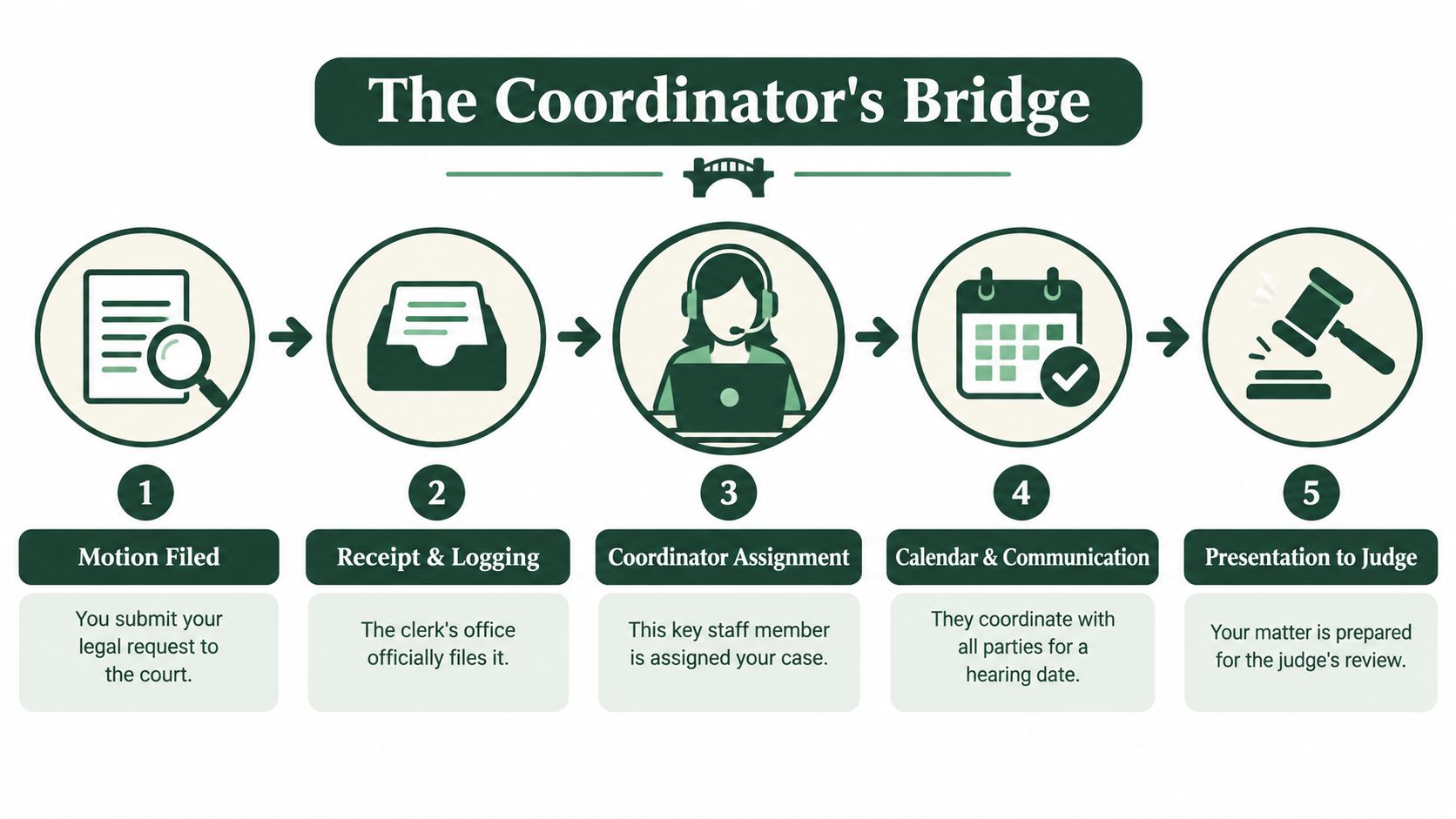
What the coordinator can and cannot do
The coordinator may receive hearing requests, communicate available docket times, identify missing scheduling information, and help place an approved matter on the judge's calendar. Some courts also require proposed orders, copying opposing counsel, or use of a dedicated request form.
The coordinator cannot give you legal advice, decide how to word your motion, sign an order on the judge's behalf, or eliminate a notice requirement. If your hearing notice is defective or the opposing party wasn't properly served, the coordinator can't cure that legal problem for you.
Practical rule: Filing a motion isn't the same as setting a hearing. You generally need both a filed request and a court-approved date and time.
Dallas County family district courts are open Monday through Friday from 8 a.m. to 4:30 p.m., and the broader family-court administration line is listed as (214) 653-7301 for scheduling and procedural questions. Dallas County's court-records guidance also makes clear that hearing requests should be directed to the coordinator for the specific assigned court. The clerk's records office doesn't replace that coordinator.
Finding Your Assigned Court and the Right Coordinator
Start with the case documents already in your possession. Look at the cause number, prior temporary orders, docket notices, or pleadings for the court assignment. If you're unsure, use the Dallas County District Clerk's court-records resources to locate the case and confirm the assigned court.
The Family District Courts are associated with the George L. Allen, Sr. Courts Building at 600 Commerce Street, Dallas, Texas 75202. Don't assume, however, that every family-law filing or hearing uses the same courtroom, floor, coordinator, or remote-appearance procedure. The court's published page and the coordinator's current instructions control.
Use the assigned court number as your decision point
Once you know whether your case is in the 254th, 255th, 256th, 301st, 302nd, 303rd, or 330th District Court, locate that court's page on the Dallas County website. The 254th District Court, for example, lists Court Coordinator Cassandra Coleman at (214) 653-6741 and [email protected]. Its published information also states that pretrial hearings are held through Zoom using Judge Brown's afternoon Zoom meeting ID 974 2677 7489. The 254th District Court's official page is the appropriate place to verify those details before relying on them.
Some courts publish coordinator email instructions. Others direct parties to a clerk or form for a particular docket. County Courts at Law with family matters can have a separate intake path, so don't send a district-court request because your case involves custody or support.
| Court | Building / Address | Coordinator Email | Phone |
|---|---|---|---|
| 254th District Court | George L. Allen, Sr. Courts Building, 600 Commerce Street, Dallas, Texas 75202 | [email protected] | (214) 653-6741 |
| 301st District Court | Verify the current court page and setting policy | Use the current court-published contact | Verify with the court |
| 302nd District Court | George L. Allen, Sr. Courts Building, 600 Commerce Street, Dallas, Texas 75202 | Use the current court-published contact | Verify with the court |
| 303rd District Court | Verify the current court page and setting policy | Use the current court-published contact | Verify with the court |
| 330th District Court | Verify the current court page and setting policy | Use the current court-published contact | Verify with the court |
For a matter assigned to the 330th District Court, review the court-specific docket procedures before contacting staff. The Dallas County 330th District Court family docket guide can help you identify the issues to confirm, but you should still check the current county instructions.
Filing the Motion and Serving the Notice of Hearing
The setting process usually begins with the underlying motion, not the coordinator's calendar. If you're seeking temporary orders, a modification, enforcement, protective relief, or another family-law remedy, prepare the correct pleading and supporting documents first. A motion to modify, an enforcement motion, and an Order to Appear serve different purposes, so using the wrong form can create a problem before scheduling even begins.
Build the filing package carefully
Use the applicable Texas family-law forms and sign or verify the pleading when the form or rule requires it. Then prepare the Notice of Hearing. Dallas County's official Notice of Hearing form requires precise information, including the hearing date, time, court floor, and courthouse address.
Your notice should also match the actual setting. If the court approves a Zoom appearance, use the court's current remote-hearing information. Don't insert a virtual link based on an old email or another case. The notice should identify the case and parties, state the specific date and time, include the required signature or pro se contact information, and contain the certificate of service required for your filing.
The filing route may include:
File the motion package. Use the Dallas County District Clerk's filing process, such as the courthouse filing window or Texas e-filing through an authorized service provider. Confirm whether mailing is accepted for the particular filing and whether the clerk has additional requirements.
Obtain a setting through the assigned court. Send the filed motion, proposed dates, Notice of Hearing, and any required proposed order to the assigned coordinator, clerk, or hearing request form process.
Serve the other parties. Texas Rule of Civil Procedure 21 generally requires three days' notice for a motion hearing unless another rule or court order applies. Texas Law Help's Dallas County court guidance explains the common distinction between regular and expedited hearings. For a regular hearing, the motion is generally filed with a Notice of Hearing attached. For an emergency or expedited matter, file the motion first, then contact the clerk or appropriate court staff for a time.
Send confirmation back to the court. Once a date is approved, provide the coordinator with the filed notice and proof that required service was completed.
The notice period isn't a suggestion. A date that looks available can still fail if the opposing party received insufficient notice or the notice lists the wrong courthouse, floor, or time.
How Dallas County Hearing Settings Actually Work by Court
Dallas County's procedures are court-specific and docket-specific. That's why a setting method that worked for a divorce prove-up may not work for a contested custody enforcement hearing, temporary orders matter, trial setting, or associate-judge docket.
The 302nd District Court's published docket-control order gives a concrete example of how structured the calendar can be. Its temporary-orders, TRO, and motion dockets are listed for Monday and Tuesday at 9:00 a.m. and Wednesday at 1:30 p.m. The same order lists CPS docket on Wednesday at 9:00 a.m., a self-represented litigants' docket on Thursday at 9:00 a.m., and special sets on Tuesday, Thursday, and Friday at 1:30 p.m. It also identifies contempt and trial blocks. The 302nd District Court docket-control order shows why parties must match the requested relief to the court's available docket.
Three practical setting models
The 301st District Court's published materials show that one setting may be obtained by emailing the coordinator, copying opposing counsel or the self-represented party, and putting the cause number in the subject line. Another setting sheet for that court says the associate judge's docket is set by calling the clerk. The 301st court policies also distinguish between emailing for a Judge Brown setting, walking an Order to Appear through for signature, and obtaining trial settings at a pretrial hearing. The 301st District Court policies are a useful example of why one assumed process can be wrong.
The 302nd court's fixed docket blocks mean the request must fit the relevant category. A party seeking temporary orders should not ask for a general trial setting and expect staff to sort out the difference.
County Courts at Law can use a different system. County Court at Law No. 5 states that motions are no longer set by the Clerk's Office and must be requested through a dedicated Hearing Request Form. The court lists coordinator Raychel Smith at (214) 653-6503 and [email protected]. The Dallas County Court at Law No. 5 page is a concrete reminder to verify the exact court before filing.
For a separate district-court example, consult the Dallas County 256th District Court family docket procedures and compare them with the instructions for your own assigned court.
Comparing Dallas County Family Court Setting Methods
The most useful way to approach the process is to treat it as a decision tree. Identify the court first. Identify the docket type second. Then use only the setting method that court publishes for that matter.
| Court | Setting Method | Who to Contact | Proposed Order Required? | Typical Lead Time |
|---|---|---|---|---|
| Family District Court | Court-specific coordinator instructions, which may include email or another approved submission method | Coordinator for the assigned court | Depends on the court and matter | Confirm with the assigned court |
| 301st District Court | Coordinator email for some settings, clerk contact for some associate-judge matters, and distinct procedures for Orders to Appear or trials | Coordinator or clerk, depending on docket | May be required for the requested matter | Confirm with the court |
| 302nd District Court | Request must fit the published docket-control structure and the court's current instructions | Assigned court coordinator or designated court contact | Confirm before submitting | Confirm with the court |
| County Court at Law No. 4 | Dedicated hearing request process may apply instead of Clerk's Office scheduling | Court's published coordinator or hearing-request contact | Follow the current form instructions | Confirm with the court |
| County Court at Law No. 5 | Dedicated Hearing Request Form for motions | Raychel Smith, (214) 653-6503, [email protected] | Follow the form and court instructions | Confirm with the court |
Don't treat the table as a substitute for checking the current policy. It gives you the correct framework, but local procedures can change, and different dockets within the same court can use different routes.
Match the request to the relief
A temporary-orders request, CPS matter, contempt proceeding, modification, prove-up, and trial may not share a calendar. Fixed docket windows can control when the court hears each category. The request should state what relief is sought, how long the hearing is expected to take, whether the matter is agreed or contested, and whether special scheduling facts exist.
Before you email: Put the cause number in the subject line, identify the precise relief requested, attach the filed motion, and ask whether the proposed date is tentative or confirmed.
Common Mistakes Dallas Litigants Make When Setting a Hearing
Most failed setting requests aren't caused by complicated law. They fail because someone skips a small procedural step and assumes court staff will repair it.
The first mistake is filing the motion and waiting for the court to assign a date automatically. Dallas County's coordinator-driven workflow usually requires the party to contact the assigned court through its stated process. A generic message to the clerk may not reach the person who controls the docket.
The second is serving notice too late. Texas Rule of Civil Procedure 21 generally requires three days' notice for a motion hearing, subject to exceptions. Count carefully, check whether the court applies a different requirement, and don't assume that emailing a document automatically completes every service obligation.
The errors that cause preventable resets
Wrong setting channel: Calling the clerk for a contested docket controlled by the coordinator can send your request to the wrong place.
Incomplete notice: A missing hearing floor, courthouse address, time, or date can make the notice inconsistent with the approved setting. Dallas County's form requires those details to be completed precisely.
No proof of service: A coordinator may have no basis to treat the setting as ready if the certificate of service or other proof is missing.
Unclear confirmation: An email acknowledging receipt isn't necessarily a confirmed hearing date. Ask directly whether the setting is firm, tentative, or awaiting approval.
Missing proposed order: Some courts require a draft order or an Order to Appear process. Attach what the current court policy requires instead of assuming the judge will create it later.
Read the local court instructions, confirm the method in writing, and send the corrected notice as soon as the date is approved. If the other party challenges service, custody is contested, or the request involves contempt or emergency relief, a Dallas family-law attorney can help you avoid making the hearing itself vulnerable.
Practical Next Steps Before and on Your Hearing Day
Use a final check before you rely on any Dallas County hearing date. Call the assigned coordinator or clerk to confirm the court number, current submission method, remote-appearance rules, and any standing-order changes. The Dallas County family district courts list regular business hours from 8 a.m. to 4:30 p.m., so make the call early enough to correct a problem before the hearing date approaches.
Prepare the file, not just the calendar request
Bring or organize the documents that support the relief you're asking for:
- Filed motion: Keep the file-stamped copy available.
- Notice of Hearing: Bring the version matching the confirmed date, time, location, and appearance method.
- Proof of service: Include the certificate and any supporting delivery record.
- Proposed order: Provide the draft if the court's procedure requires one.
- Evidence and witness information: Organize documents and identify the testimony relevant to the requested relief.
- Prior orders: Bring the orders the judge may need to interpret or enforce.
On hearing day, dress appropriately, carry photo identification, and arrive early enough to clear security. If your hearing is at the George L. Allen, Sr. Courts Building, review the Dallas courthouse guide for family cases before leaving home. Check in with the coordinator's office, follow courtroom rules, and keep notes about what the judge orders.
A ruling usually needs a written order that accurately reflects what happened. Obtain the signed order, file it with the appropriate clerk, and serve the other parties as required. If the judge changes a prior custody, support, possession, or enforcement arrangement, have a lawyer review the order before you assume the hearing is finished.
The Law Office of Bryan Fagan, PLLC offers Dallas family-law representation for divorce, child custody, child support, adoption, property division, mediation, and related court proceedings. If you're unsure which Dallas County coordinator, clerk, or hearing request form applies to your case, visit The Law Office of Bryan Fagan, PLLC to review your options and request a consultation.
