 Skip to content

In Dallas County heirship cases, the filing fee schedule calls for a $600 deposit toward the attorney ad litem, while the court later sets the final fee under Texas Estates Code section 53.104 based on what the work required. The $600 is the predictable starting payment, not automatically the attorney's complete compensation.
A Dallas resident dies without a will, leaving a modest estate, a house, and three siblings. One sibling has been missing for years, and the family wants to establish who legally inherits before selling or transferring the property. The filing may look straightforward, but the unknown sibling creates a legal obligation for the probate court to protect that person's potential interest.
That's where an attorney ad litem comes in. This lawyer isn't the family's personal attorney and doesn't represent the applicant's preferred outcome. The court appoints the lawyer to investigate and protect the interests of heirs whose identities or locations are unknown.
Dallas County's probate fee schedule expressly includes a $600 deposit for possible payment to the court-appointed attorney ad litem in a combined application for administration and determination of heirship. The county's general orders also address deposits for attorneys ad litem, while Texas Estates Code section 53.104 requires the court to determine reasonable compensation and tax the approved amount as costs of the probate proceeding.

What the deposit means at filing
The deposit gives the court a funding mechanism for the initial ad litem work. It may cover the lawyer's early review of the application, family information, service issues, and the first investigation into whether unknown or missing heirs exist.
It doesn't guarantee that the case will end at that amount. A simple matter may require limited work. A case involving incomplete family records, multiple branches of a family tree, or an heir who cannot be located may require more time and documentation.
The applicant should budget for the deposit before filing and ask counsel how additional fees may be handled. Families can also review what is filed at the Dallas County Records Building so they understand the difference between probate filings and other county records.
Table of Contents
- What the deposit means at filing
- What an Attorney Ad Litem Does in a Texas Heirship Proceeding
- When Dallas County Courts Must and May Appoint an Attorney Ad Litem
- Typical Attorney Ad Litem Cost Ranges in Dallas County Heirship Cases
- How Dallas County Courts Set Approve and Challenge Ad Litem Fees
- Common Misconceptions About Heirship Ad Litem Costs
- Practical Steps for Heirs and Where to Get Help in Dallas County
What an Attorney Ad Litem Does in a Texas Heirship Proceeding
An attorney ad litem serves as a court-appointed lawyer for people whose interests could be affected by the heirship judgment but who aren't adequately represented in the proceeding. In the central unknown-heir situation, Texas law requires the court to appoint one. The lawyer's responsibility is to investigate the family structure and report relevant findings to the probate court.
That role differs from the applicant's attorney. The applicant's lawyer prepares and presents the requested heirship application. The ad litem independently examines whether the proposed family tree appears complete and whether the evidence supports the identities and shares presented to the court.
It also differs from the administrator or executor. An administrator manages estate property and debts after appointment. The ad litem protects potentially affected heirs during the heirship determination.
The investigation can involve more than one family record
Consider a Dallas father with four adult children. One child has died, leaving a minor niece whose family line must be traced. Another child is an absent half-sibling living outside Texas. The court may need reliable information about marriages, deaths, parentage, descendants, and current locations before it can enter a complete heirship judgment.
The ad litem may review:
- Family affidavits: Statements describing the decedent's marriages, children, siblings, and descendants.
- Vital records: Death certificates and other documents that help confirm relationships and explain why a deceased heir's descendants may inherit.
- Address information: Available details showing where a missing or out-of-state heir may be found.
- Filed pleadings: The application, citations, waivers, exhibits, and proposed judgment.
- Hearing evidence: Testimony and documents offered to prove the family tree.
The lawyer may communicate with relatives, review available records, and identify gaps that need attention. The ad litem doesn't decide who inherits. The probate judge makes that determination after considering the evidence and the lawyer's position.
A person who believes their own share is threatened may still need separate counsel. The ad litem's duty is to the protected class identified by the appointment, not to provide individualized advice to every family member.
When Dallas County Courts Must and May Appoint an Attorney Ad Litem
Texas law requires an attorney ad litem when heirs are unknown or cannot be located. The appointment protects people who may have inheritance rights but cannot receive meaningful notice or participate in the proceeding. Texas Estates Code section 202.009 addresses the appointment requirement in heirship proceedings.
The mandatory situation is clear when the application identifies an heir whose name or location is unknown. The court may also require an ad litem when an heir's address cannot be ascertained after a diligent search, or when an unborn or otherwise unascertained person could hold an interest.
Mandatory and discretionary appointments
A court may expand protection when an heir is incapacitated or when a minor's interests conflict with the interests of the adult presenting the application. The precise appointment depends on the facts and the court's order.
| Appointment Scenario | Statutory Basis | Dallas County Practice |
|---|---|---|
| Unknown heir | Texas Estates Code section 202.009 requires representation for an unknown heir | The appointment focuses on investigating and protecting the unknown heir's possible interest |
| Missing or unlocatable heir | The statute addresses heirs whose names or locations are unknown | The court may require information showing the family made a diligent effort to identify or locate the person |
| Unborn or unascertained heir | The proceeding must protect an interest that cannot yet be represented personally | The ad litem may examine the family line and proposed judgment for gaps |
| Incapacitated heir | The court may expand the appointment when necessary to protect the heir | The order may define whether the lawyer's work extends beyond the basic heirship inquiry |
| Minor with a conflict | The court may require separate protection when a parent's interests conflict with the minor's | The court may address the conflict through a separate appointment or expanded protective role |
Dallas County maintains probate-court workflows for heirship appointments, but applicants shouldn't assume every case follows an identical sequence. The assigned court and appointment order matter. The Dallas County probate court guide can help families identify the relevant court before filing.
Read the appointment order carefully
The appointment order controls the ad litem's assignment. It may identify a particular heir class, describe the investigation, or limit what the lawyer must do. A narrow assignment can keep the work focused. A broad assignment may require additional research, communications, and court participation.
Don't estimate cost from the title alone. Ask to review the appointment order and determine which people and issues fall within its scope.
Typical Attorney Ad Litem Cost Ranges in Dallas County Heirship Cases
The most useful Dallas starting point is the $600 deposit listed in the county probate fee schedule for possible ad litem compensation. Statewide Texas probate references describe attorney ad litem costs in heirship matters as often falling between $350 and $1,500, and another Texas probate reference describes a common benchmark of approximately $500 to $600 for the first three hours, followed by about $150 per hour afterward in county-paid cases. These figures come from summaries of Texas practice, not a Dallas County promise of a final fee.
The practical answer is that the deposit and the final fee are separate stages. The deposit funds initial work. The court later reviews the lawyer's requested compensation and decides what amount is reasonable and necessary.
A cost comparison by case type
| Case Type | Initial Deposit | Typical Final Fee | Cost Drivers |
|---|---|---|---|
| Simple heirship with one missing heir | $600 deposit under the Dallas County fee schedule | Must be set by the court after reviewing the work | Limited family history, straightforward documents, successful notice or location efforts |
| Contested proceeding with several unknown or minor heirs | $600 deposit under the Dallas County fee schedule | May exceed the initial deposit | Multiple family branches, conflicting evidence, additional investigation, court appearances |
| Complex heirship involving skipped generations, business interests, or creditor disputes | $600 deposit under the Dallas County fee schedule | Requires individualized court review | Difficult lineage questions, disputed ownership, extensive records, coordination with other representatives |
The court's review matters because ad litem compensation is not a negotiated market rate. The lawyer may submit time records and request payment for work performed, but the judge must determine reasonable compensation under the statute.
A family should also avoid treating the statewide range as a quote. The actual work may be modest when the family tree is documented and the missing heir is identified quickly. It may be more substantial when records are incomplete, a relationship is disputed, or the lawyer must address issues outside the basic application.
Practical rule: Budget for the Dallas County deposit at filing, then ask early how the lawyer will document additional work and how the court will review it.
The estate's size doesn't automatically determine the ad litem fee. The relevant question is what the appointment required and whether the requested work was reasonably necessary to protect the affected heir or heirs.
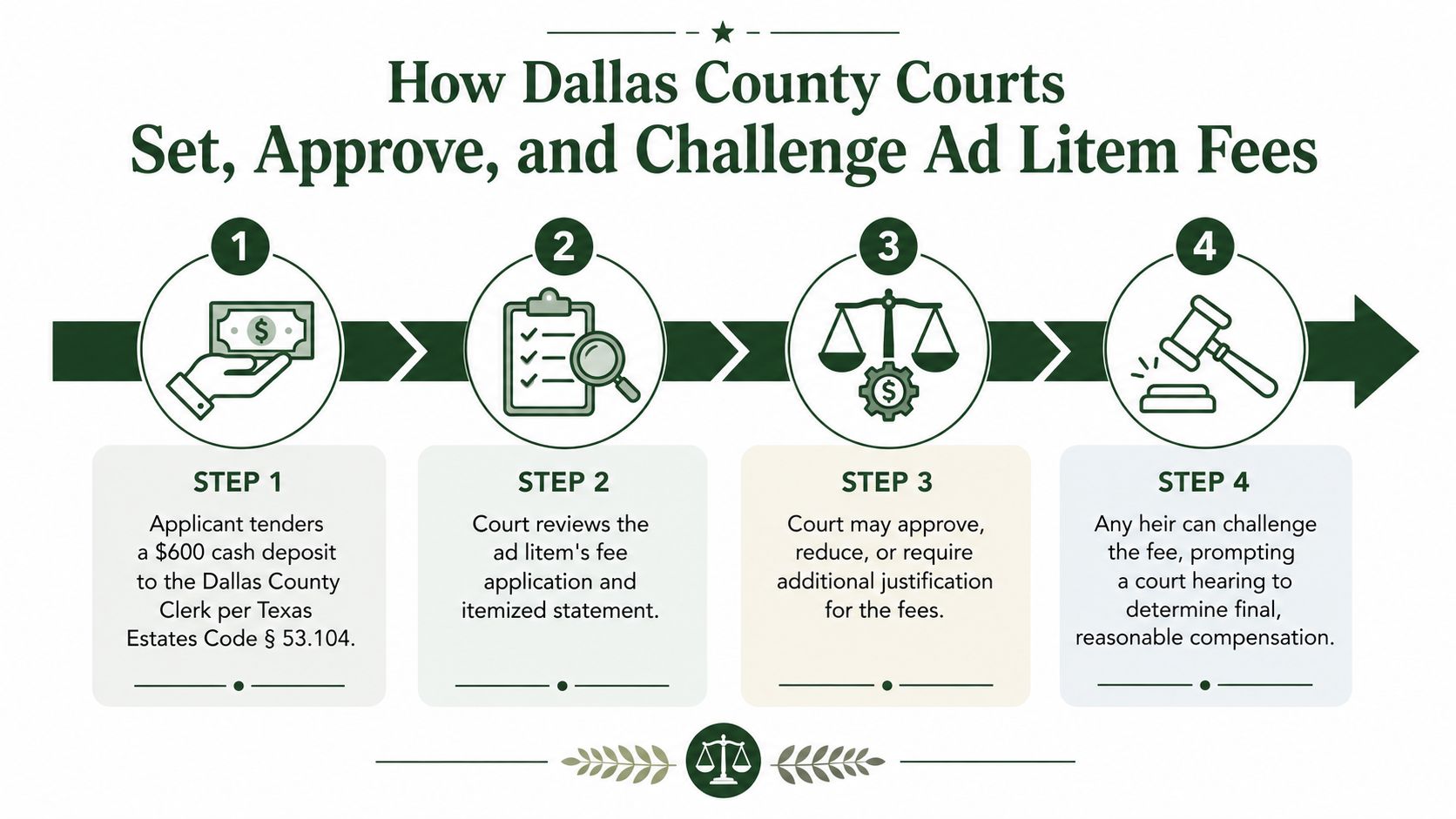
How Dallas County Courts Set Approve and Challenge Ad Litem Fees
The Dallas County process starts with the deposit connected to the appointment. The court controls the final amount under Texas Estates Code section 53.104, rather than allowing the lawyer and applicant to establish an unrestricted private fee.
The attorney ad litem generally submits a fee request supported by time records or an itemized statement. The request should identify the work performed, the time spent, and the services the lawyer believes were reasonably necessary for the appointment.
The court reviews the work, not just the request
A probate judge may review the fee application on the docket or at a hearing, depending on the court's procedure and the posture of the case. The judge can approve the request, reduce it, or require additional explanation before entering an order.
Useful questions include:
- What did the lawyer investigate? The billing should connect the work to the unknown, missing, unborn, or otherwise protected heir.
- Was the work necessary? Research unrelated to the appointment may not support compensation.
- Was the time reasonable? The court can evaluate whether the amount of work fits the complexity of the assignment.
- Does the request account for the deposit? The initial payment should be credited in the final accounting.
- Who pays after approval? The order should address how the approved amount is taxed and collected.
The statute provides that approved compensation is taxed as costs in the probate proceeding. When the estate has assets available, payment may come from the estate. In certain circumstances, the court may order payment by a party or from funds held in the court registry.
Objecting to an excessive request
An heir or applicant who believes the request is excessive should not rely on an informal complaint. A meaningful objection should identify the disputed entries and ask the court for an itemized billing or supporting explanation.
The objection may address:
- Unrelated work: Time that doesn't serve the ad litem's assigned protective role.
- Duplicated efforts: Tasks repeated without a clear reason.
- Insufficient detail: Entries that don't explain what the lawyer did.
- Unreasonable time: A request that appears disproportionate to the family history and issues.
- Scope problems: Work beyond the appointment order without court authorization.
The court may consider the lawyer's experience, the complexity of the issues, the work required, and comparable local compensation practices. Filing an objection doesn't guarantee a reduction. It does preserve the issue for judicial review instead of leaving the request unanswered.
Common Misconceptions About Heirship Ad Litem Costs
Families often focus on the first payment and miss the court-controlled nature of the entire process. The result is confusion about who owes the money, whether the appointment can be refused, and what happens when the estate has little cash.
The deposit is not automatically the final fee
The Dallas County deposit is an initial funding requirement. It isn't a promise that the ad litem will receive exactly that amount, and it doesn't cap compensation when the court determines that additional reasonable work was necessary.
A straightforward case may stay close to the deposit. A matter involving missing records, multiple heir branches, or contested relationships may require a larger fee request. The judge reviews the request before approving the final amount.
The fee usually isn't a personal bill to one heir
Under Texas Estates Code section 53.104, approved compensation is taxed as a cost of the probate proceeding. When estate assets are available, the estate generally bears the approved cost rather than one heir paying the lawyer directly as personal counsel.
That doesn't mean a family can ignore the issue. If estate funds are unavailable, the court may address payment through a party or registry funds in the circumstances allowed by law. The payment order matters.
Ignoring the appointment won't make it disappear
The court can appoint an ad litem to protect an absent or unknown heir. The affected person doesn't need to agree before the court creates that protective representation.
Likewise, the applicant cannot omit a difficult relative from the family tree and avoid the appointment. An incomplete application can create notice problems, delay the hearing, and undermine the reliability of the proposed judgment.
The ad litem isn't the applicant's private lawyer
The ad litem may agree with the family's proposed heirship findings, but that agreement must follow an independent review. A family member who wants advice about their own inheritance, a disputed family tree, or a settlement should consider hiring separate counsel.
The appointment also doesn't eliminate the need for accurate evidence. The lawyer can investigate, but the applicant still needs to provide the court with the information and documents supporting the requested determination.
Practical Steps for Heirs and Where to Get Help in Dallas County
Start with the family records, not the filing form. An heirship application depends on a complete account of the decedent's relationships, descendants, property, and possible heirs. Missing information can lead to an expanded investigation and avoidable fee disputes.
Build a filing packet before contacting the clerk
Gather these materials:
- Death certificate: Obtain the document needed to establish the decedent's death and support the probate filing.
- Family information: List every known spouse, child, parent, sibling, descendant, and potentially related heir, including people who are deceased or difficult to locate.
- Address history: Record last-known addresses, phone numbers, email addresses, employers, and relatives who may know how to contact an absent heir.
- Relationship documents: Collect marriage records, birth records, death certificates, divorce records, and prior heirship documents when available.
- Property records: Identify Dallas County real estate, financial accounts, vehicles, business interests, and other assets that may require a court determination.
- Family tree: Prepare a visual family tree and mark every uncertainty instead of guessing.
- Fee budget: Set aside the $600 Dallas County ad litem deposit, while recognizing that the final court-approved fee depends on the work required.
A small estate isn't automatically a simple heirship case. A house may have a straightforward title history, or it may involve prior marriages, deceased children, unknown descendants, or conflicting ownership records.
Ask focused procedural questions
The Dallas County Probate Court clerk can help with filing information and the status of documents, but the clerk can't advise you on what legal strategy to choose. Ask where the application is filed, whether an appointment order has been entered, whether a fee request is on file, and how the court handles notice of a fee review.
For filing-location information, review the Dallas County probate court filing guide. The George L. Allen Sr. Courts Building is the relevant Dallas County courthouse resource identified for probate filings, but confirm current clerk procedures before appearing or submitting documents.
Decide when separate counsel is necessary
Independent counsel becomes especially useful when an heir disputes the proposed family tree, challenges the characterization of property, objects to the ad litem's work, or believes another family member is withholding information. The ad litem cannot act as the personal advocate for every person involved.
A Dallas probate lawyer can review the application, evaluate whether a determination of heirship is the right procedure, prepare evidence, communicate about the appointment, and present a focused objection if the fee request lacks adequate support. The lawyer can also explain how heirship issues interact with administration, real estate transfers, creditor claims, or business ownership.
The Law Office of Bryan Fagan, PLLC offers Dallas probate guidance for heirship determinations, attorney ad litem appointments, fee objections, and related estate administration questions. Visit The Law Office of Bryan Fagan, PLLC to request case-specific guidance about your Dallas County proceeding and the costs you should address before filing.
