 Skip to content

Dallas County assigns probate cases randomly across Probate Court No. 1, Probate Court No. 2, and Probate Court No. 3, and the easiest way to confirm the assigned court is through the County Clerk's case number lookup. If you're standing there with a death certificate, a will, or guardianship papers and you're trying to figure out which downtown courtroom hears the matter, that assignment is the part that matters first.
A lot of people assume the court number is just a label. In Dallas County, it's more practical than that. The assigned court controls the hearing path, the judge who signs orders, and the coordinator you need to contact, so getting it right saves time and prevents avoidable mistakes at the George Allen Courts Building.
Table of Contents
- Why Knowing the Right Probate Court Matters in Dallas County
- The Three Dallas County Probate Courts at a Glance
- How Random Assignment Works Under Dallas Local Rules
- How to Confirm Which Court Is Assigned to Your Case
- Special Case Assignments and What Changes
- What to Do If Assignment Looks Wrong or Needs Transfer
- Practical Next Steps for Dallas County Families
Why Knowing the Right Probate Court Matters in Dallas County
An adult child can head downtown with a death certificate, a will, or guardianship papers and still end up at the wrong window if they treat every probate case the same way. Dallas County does not run probate that way. The county says its three statutory probate courts handle wills, estates, guardianships, and related mental health matters, so the first step is to match the case to the court that has it (Dallas County Probate Courts).
The court number changes who handles your next step
The practical question is not whether a probate court exists. It is which court was assigned to the file. Dallas County's probate division says the assigned court conducts hearings, while the County Clerk keeps the file, and the hearing date comes from the docket coordinator for that assigned court, not from the clerk (Dallas County Probate Courts information page). The court number is the address for the next step in the case.
A wrong courtroom can cost more than a missed elevator ride. It can send a person to the wrong coordinator, the wrong hearing settings, and the wrong filing path.
Practical rule: if you show up in the wrong probate court, you can lose a morning, miss a setting, or create a filing problem that has to be fixed later.
That point matters in family disputes too. A guardianship, a will contest, or an estate dispute often turns on who may act, who must appear, and where the matter is heard. If a family member is trying to open a case after a death, the first move is to confirm the assigned court, not to guess from the court number on a directory or a form.
Why the assigned court affects your contact path
The assigned court also tells you who to call when a procedure question comes up. It affects which coordinator answers docket questions, where physical filings are routed inside the courthouse, and which orders carry the case header. In a busy county like Dallas, that keeps the file in one place instead of letting it drift between offices.
A simple example helps. Two families can both have probate matters in downtown Dallas, but one file may be scheduled before a different judge, on a different docket, with a different coordinator handling the hearing calendar. That is why the assigned court matters before anyone files, appears, or waits for notice.
Confirming the assigned court before filing or appearing helps prevent scheduling delays and keeps the case on the correct docket from the start.
The Three Dallas County Probate Courts at a Glance
A family showing up for a probate matter in downtown Dallas usually wants one plain answer. Which court is this case in, and where do we go from here?
Dallas County runs that system through Probate Court No. 1, Probate Court No. 2, and Probate Court No. 3. All three sit in the George Allen Courts Building at 600 Commerce Street in downtown Dallas, and each court has its own 7th-floor suite, judge, and associate judge, as shown by the county. For a quick orientation to the building before a visit, see the guide to the George Allen, Sr. Courts Building.
What the three courts share
The three courts operate inside the same courthouse and the same county probate system. They also hear the same broad kinds of matters, including wills, estates, guardianships, and related mental health matters. So the court number does not tell you a different subject area. It tells you which courtroom path your file follows.
That distinction matters because a probate case is not handled as one anonymous county file. It moves through one assigned court, much like a school office may route different students to different counselors even though they all attend the same school. The shared courthouse can make the system look unified, but each court still manages its own docket and case flow.
How the courts differ in practice
The differences show up in day-to-day handling. Each court has its own docket, coordinator, and assigned cases, which means two Dallas families can both say they have “probate” matters and still deal with different staff, hearing calendars, and follow-up questions. Once a case is assigned, that court becomes the place to check for setting details and procedure questions.
| Court | Location | Jurisdiction Focus | Typical Contact |
|---|---|---|---|
| Probate Court No. 1 | George Allen Courts Building, downtown Dallas | Wills, estates, guardianships, related probate matters | Assigned court coordinator |
| Probate Court No. 2 | George Allen Courts Building, downtown Dallas | Wills, estates, guardianships, related probate matters | Assigned court coordinator |
| Probate Court No. 3 | George Allen Courts Building, downtown Dallas | Wills, estates, guardianships, related probate matters, plus special mental health assignments | Assigned court coordinator |
Probate Court No. 3 has the added special mental health assignments noted by the county, so that is one practical difference families may see. Even so, the bigger point is simpler. The hearing path runs through the assigned court inside the George Allen building, not through a single public counter that handles every probate file the same way.
How Random Assignment Works Under Dallas Local Rules
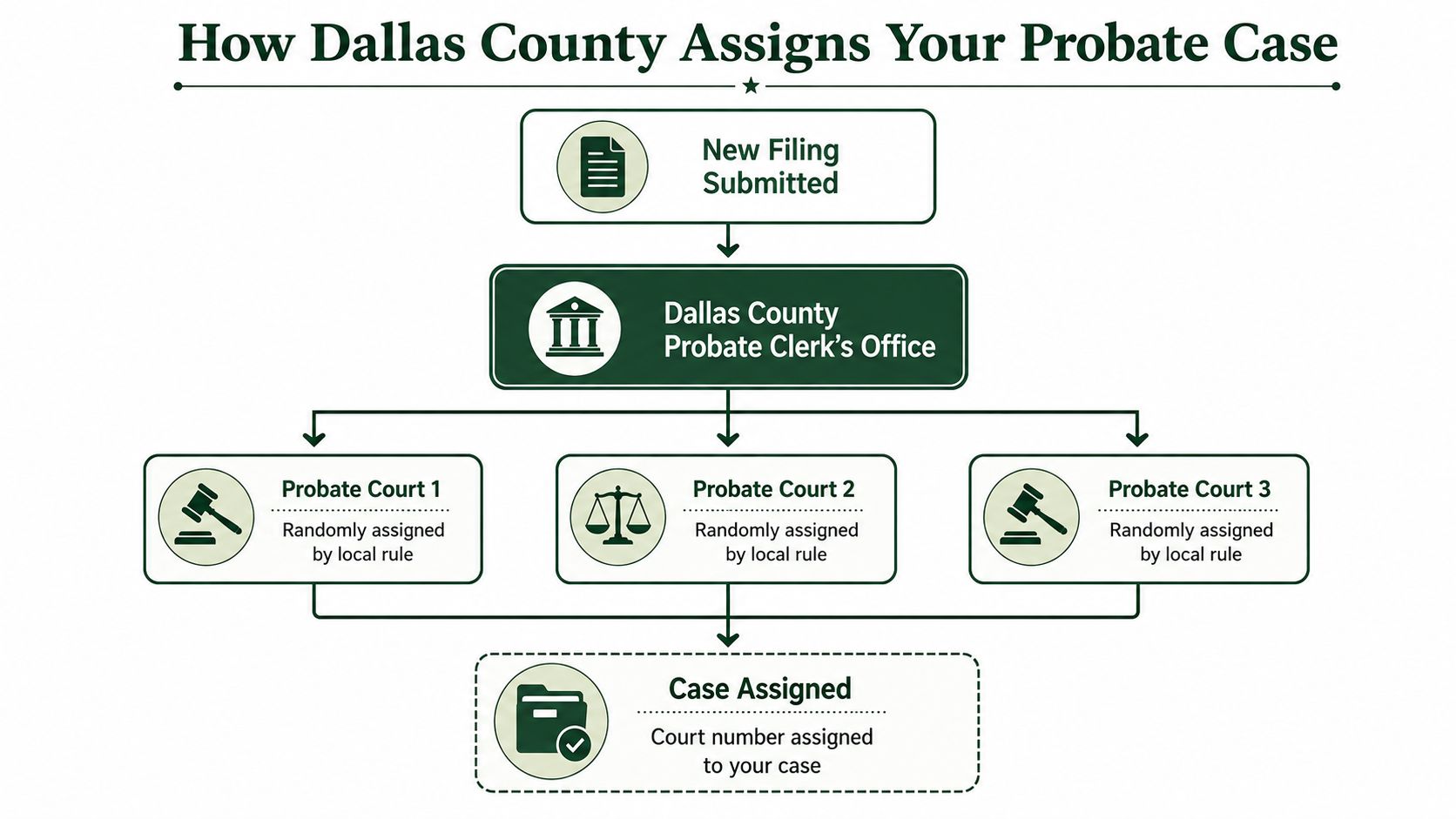
If you walk into the probate process expecting to pick Probate Court No. 1, No. 2, or No. 3, Dallas County does not work that way. Filings go through the probate clerk and are assigned in random order under the local rules, with the court distribution handled by the county's assignment system. Some matters also must return to the same court that entered an earlier order.
What random assignment means in real life
A new probate or guardianship filing gets routed by the system, not by preference. A family cannot request a court because a relative had a smooth experience there, and a lawyer cannot steer a routine filing to a preferred courtroom just because it seems easier.
The purpose is to balance the docket. The local rules refer to judges' distribution percentages, so the assignment method is not necessarily a simple even split among the three courts. Those percentages can change with court administration, but the filer's job stays the same, follow the assignment that the clerk's office gives the case.
When the case goes back to the original court
Continuity matters too. If a filing attacks, avoids, modifies, or sets aside a judgment, order, or decree of a Dallas statutory probate court, the local rules send it back to the court that entered the earlier order. That keeps later disputes in the same courtroom that already handled the matter.
The rule is about consistency. Once a probate judge enters an order, later challenges to that order usually belong in the same court.
What you'll see on the paperwork
The assigned court usually appears in the case number and again in later orders. That is why the court number on the file header matters more than what a courthouse directory says. Once the case lands in a court, that number becomes part of the file's identity for the rest of the matter.
How to Confirm Which Court Is Assigned to Your Case
A family can walk into a Dallas County probate matter holding the right papers and still check the wrong courtroom first. The courthouse directory only shows where courts sit. Your assigned court is the one tied to the file. Confirm that assignment in order, starting with the case number, then the clerk's record, then the courtroom notice.
Start with the case number and file-stamped papers
Look at the petition, the file stamp, or any filing notice you received. The assigned court usually appears in the file record, and the case number often shows it too. If you have the filing copy in front of you, the court digit or docket header is usually the quickest clue.
Then check the County Clerk record
The County Clerk keeps the file, so the online record is the next place to verify the assignment. Use the case number if you have it, or search by name if you do not. A clear division listing in the record usually answers the question for a first-time filer who wants to avoid showing up in the wrong place.
If you are trying to understand what records are typically filed at the county building, the firm's overview of what gets filed at the Dallas County Records Building can help you connect the paperwork to the office that handles it.
Call the docket coordinator if the record is unclear
Sometimes the portal does not settle the issue. In that situation, call the assigned court's docket coordinator and have the full case number, party names, filing date, and the question ready before you dial. That keeps the call focused and reduces the chance of being sent back for missing information.
Practical rule: ask the coordinator to confirm the assigned court, not to guess which court sounds likely based on the issue.
Check the hearing notice before you travel
The hearing notice should list the courtroom location and the judge. If the notice and the record do not match, stop and confirm again before heading downtown. A mismatch usually means you have either an older notice or a record that has not been read carefully enough.
Families often find that the assignment becomes clear once they check the documents in this order. The file tells the story, and the court number on the paperwork is the one that controls where the case is heard.
Special Case Assignments and What Changes
A family may file in Dallas County and still end up in a specific probate court because some matters follow a special assignment rule instead of the ordinary random rotation. Dallas County's local probate rules state that all mental illness cases are assigned to Probate Court No. 3 (Dallas County local probate rules for mental illness assignments). That is the clearest example of why the assigned court matters. It affects where the hearing is set, which coordinator or docket path you contact, and how quickly you can confirm the next step.
Mental health matters do not rotate like ordinary filings
A mental health commitment case follows a narrower path from the start. It does not move through the same random pool as a routine estate filing. For a caregiver or family member, that difference can save time and avoid a trip to the wrong courtroom.
The practical point is simple. If the filing involves mental illness, the assignment rule points it to Probate Court No. 3. The court number is not just a label on paper. It tells you which judge's docket controls the hearing and which staff will handle questions about setting or noticing the case.
Related filings can follow different tracks
Other probate filings can be tied to a prior order or to the kind of relief requested. A challenge to, or request to modify, an earlier Dallas statutory probate court order may stay with the court that entered that order. Ordinary new probate filings, by contrast, are randomly assigned among Probate Courts No. 1, No. 2, and No. 3.
That difference matters because a single family file can contain more than one issue. A guardianship request may sit beside a mental health concern, but the special rule can control the assignment anyway. The court path depends on the type of proceeding, the earlier order, and the relief being asked for.
| Case Type | Assigned Court | Rule Basis |
|---|---|---|
| Mental illness commitment matter | Probate Court No. 3 | Dallas County local probate rules |
| Proceeding attacking or modifying a prior Dallas statutory probate court order | Same court that entered the prior order | Dallas County local probate rules |
| Ordinary new probate filing | Randomly assigned among Probate Courts No. 1, No. 2, and No. 3 | Dallas County local probate rules |
A good filing strategy starts with the assignment, not with the assumption that any probate court can hear any probate matter. If the case involves a mental health component, or if it asks a court to revisit an earlier order, the assigned court may already be fixed by local rule. That is the detail that helps a resident avoid sending papers, calls, and hearing prep to the wrong place.
What to Do If Assignment Looks Wrong or Needs Transfer
Maria thought her guardianship case should have gone to Probate Court No. 3 because the family was also dealing with a mental health issue. The filing showed Probate Court No. 1. Her first instinct was to panic, but the better move was to verify the assignment before doing anything else.
Step one, confirm the record
She checked the County Clerk portal using the case number and compared that to the file-stamped petition. If the portal and the petition matched, then the question wasn't whether the file existed. It was whether the assignment needed correction under the local rules.
Step two, ask the assigned court coordinator
Maria then contacted the assigned court's coordinator and asked whether the matter should be transferred based on the type of case. That call matters because sometimes what looks wrong on paper is just a misunderstanding about the assignment rule, while in other situations the filing really does need to move.
Step three, file the appropriate motion if needed
If the case type requires a transfer, a motion to transfer is the formal way to raise it. The motion should explain why the current assignment doesn't fit the local rule and attach supporting information. If the court denies transfer, the objection should be made promptly, ideally at the first hearing where the issue can be raised on the record.
Don't wait and hope the mistake fixes itself. Court assignments usually need to be addressed directly, with the file in front of the judge or coordinator.
Step four, keep your notes
Maria wrote down each phone call, the date, the name of the person she spoke with, and what was said. That habit helps if someone later asks why the issue was raised, when it was raised, or whether the family followed through.
The one thing she did not do was assume every odd-looking assignment was an error. Sometimes the local rule sends a matter exactly where it should go. That's why the order of operations matters, verify first, then challenge only if the record or the rule supports it.
Practical Next Steps for Dallas County Families
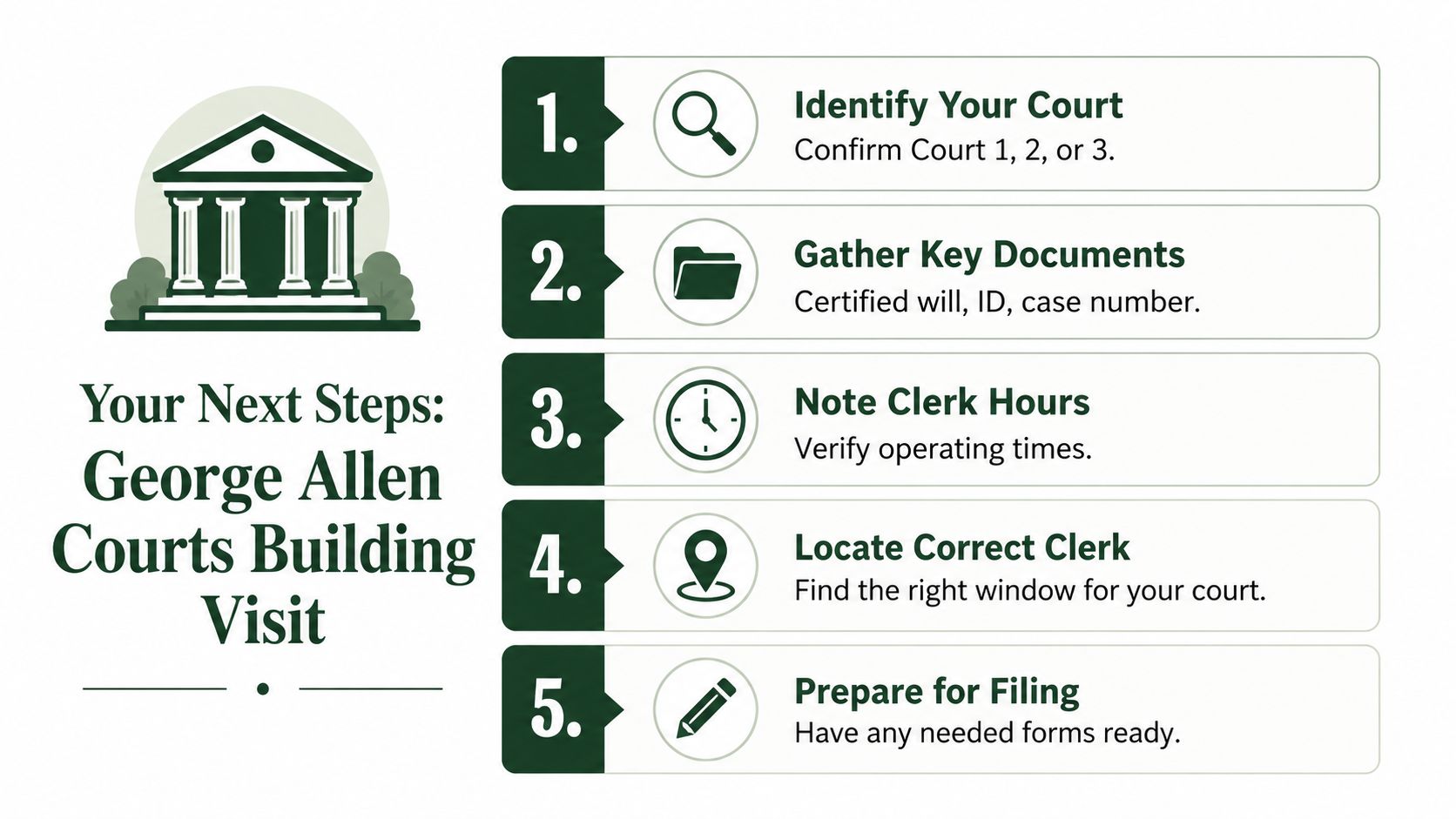
Once you know which Dallas County probate court is assigned to the case, the job becomes more manageable. The next step is not to flood the courthouse with paperwork you haven't checked. It's to gather the right documents, confirm the court, and show up ready to speak with the right person.
What to bring to the clerk window
Bring the documents that help the clerk identify the file quickly:
- Certified death certificate if the matter is tied to an estate.
- Original will or filed copy if a will is being probated.
- Government-issued ID so you can identify yourself if needed.
- Proposed order or filing packet if you're ready to submit a new request.
- Payment method for any required filing fees.
What to have ready before calling the docket coordinator
When you call, keep the details tight and practical:
- Full case number if you have it.
- Party names exactly as they appear on the file.
- Filing date so staff can find the right record.
- One clear question about the hearing, assignment, or setting.
The more precise the question, the faster the answer. A coordinator can usually help with procedure, but not with legal strategy, so your goal is to confirm the hearing path, not to argue the case on the phone.
When it makes sense to get legal help
Some probate matters are straightforward. Others get complicated quickly, especially contested wills, urgent guardianships, mental health commitments, estate disputes, and cases involving significant property or family conflict. In those situations, a Dallas County probate attorney can help you avoid procedural mistakes that create delay.
If you're still sorting through whether a probate filing is even necessary, the firm's Dallas probate practice area page is a good place to start gathering context. Dallas County's three-court system applies to guardianship and mental health matters too, so confirming the court through the Clerk before you file is still the safest move.
The Law Office of Bryan Fagan, PLLC helps Dallas and Dallas County families sort out probate, guardianship, and other court-related questions with practical guidance rooted in local process. If you want help confirming the assigned court, understanding what to file next, or handling a more complicated probate dispute, visit The Law Office of Bryan Fagan, PLLC to connect with a Dallas office resource that can walk you through the next step.
