 Skip to content

In Dallas County, probate applications are filed with the Dallas County Clerk's Probate Courts Division on the 7th Floor of the George L. Allen, Sr. Courts Building at 600 Commerce Street in downtown Dallas, and any application that involves a will must be filed electronically. If you're standing at home with a death certificate, a will, and a stack of forms, that filing point is the place to start, not the individual judge's courtroom.
That matters because probate is one of those courthouse processes where the first filing decision shapes everything that follows. A case can be perfectly good on the facts and still get slowed down by the wrong venue, the wrong document format, or the wrong follow-up step after the clerk accepts it.
Table of Contents
- Where Dallas County Probate Applications Are Filed
- Inside the George Allen Courts Building
- E-Filing and the Three-Day Original Will Rule
- Application Types, Forms, and Filing Fees
- What Happens After You File
- Common Mistakes That Delay Dallas Probate Filings
- Your Next Step After Filing a Dallas Probate Application
Where Dallas County Probate Applications Are Filed
The filing counter for a Dallas County probate case is the Dallas County Clerk's Probate Courts Division at the George L. Allen, Sr. Courts Building, 600 Commerce Street, 7th Floor, Suite 400, Dallas, Texas 75202. Public hours are 8:00 a.m. to 4:30 p.m. Monday through Friday, except court-approved holidays, and the County Clerk lists a direct probate line at (214) 653-7099 and probate service questions at (214) 653-7573. Dallas County probate filing information
That filing counter receives the application first. The individual probate courts handle hearings after assignment, which is why the clerk's office and the courtroom are related but not the same stop on the calendar. If you want a practical court map, the Dallas County guide on which probate court hears a case is a useful companion to the filing question.
Start with venue, not just paperwork
A Dallas filing only makes sense if Dallas County is the correct venue. If the decedent lived in another county, filing at the George Allen building can waste time and force a refile in the correct county. That's the first mistake people make when they assume the nearest courthouse is automatically the right one.
Practical rule: file where venue belongs first, then worry about the hearing date. A clean filing in the wrong county still creates delay.
Dallas County's probate system is centralized in downtown Dallas, but the location doesn't change the underlying venue rules. The clerk's office is there to receive the application, and the court system then takes over for notice, assignment, and hearing. That distinction matters in family situations too, especially when a probate issue overlaps with divorce, child custody, or later property division disputes.
Know what you're actually filing
An application starts the case. It is not the same thing as a hearing, an order, or letters of authority. For a will case, the filing asks the court to admit the will and appoint the proper representative. For a no-will estate, the filing asks the court to appoint an administrator.
That's why the courthouse address alone doesn't solve the problem. You still need the right kind of application, the right supporting documents, and, in a will case, the required electronic filing format. Dallas County's probate system works best when the filing package matches the relief requested from the start.
Inside the George Allen Courts Building
If you are filing a Dallas County probate application in person, you are heading to the George L. Allen, Sr. Courts Building downtown at 600 Commerce Street. Probate intake is handled on the 7th Floor, and the probate courts operate from the same complex. Dallas County lists Probate Court No. 1 at Suite 100, Probate Court No. 2 at Suite 200, and Probate Court No. 3 at Suite 300. George Allen Courts Building family courts resource
The address is only part of the job. What matters on filing day is knowing which floor, which counter, and which court you will deal with after intake. If you are bringing paper documents, the clerk's office on the 7th Floor receives the application first, then the case gets routed through the probate system.
What to expect when you walk in
Security comes before the counter, so leave room for screening, parking, and finding the right elevator bank. A calm filing usually comes down to preparation. Have the application package organized, and if you are carrying the original will, keep it with the confirmation materials so you can hand over everything without sorting through papers at the window.
The courthouse process follows a clear order:
- Start at the probate filing counter. That is where intake happens.
- Send hearing and follow-up questions to the assigned probate court. The clerk at intake does not handle the case after filing.
- Keep each document set separate and labeled. Mixed papers slow the review and create avoidable confusion.
Dallas County's probate hours are 8:00 a.m. to 4:30 p.m., Monday through Friday. Filings brought in person before 4:00 p.m. get same-day file-stamping. That can help if you are trying to get a case opened before the day ends, but only if the packet is complete when you arrive.
Probate cases in Dallas are not assigned by choice or by convenience. The court system routes the matter after filing, and that random assignment shapes where your hearing will land. Once the application is accepted, the next deadlines start to matter, including the inventory deadline and the notice window for creditors. If the filing is sloppy at the counter, every step after that tends to slow down.
A good courthouse visit is not flashy. It is organized, timely, and tied to the right floor, the right suite, and the right filing path.
E-Filing and the Three-Day Original Will Rule
A will case in Dallas County starts on the computer, but it does not end there. If the application includes a will, the filing must go through e-filing, and the application and the will must be uploaded as two separate PDF documents in the same envelope. Dallas County's probate e-filing procedures and forms spell out that separation because a combined upload can slow intake or lead to rejection.
The next step is paper. Once the e-filed submission is accepted, the original wet-ink will must reach the Probate Courts Division within three business days. Dallas County says the original can be brought to the 7th Floor counter or sent with the confirmation number that ties it to the accepted filing. The digital filing opens the case, but the original will still controls the record.
Why the original still matters
A scan does not replace the original when the court needs to verify the will itself. The clerk wants the signed paper document in hand quickly, not later. If the original arrives late, the case can sit even though the electronic filing went through.
That is also why Dallas County probate filing takes more than a simple upload. The file has to connect the electronic submission, the original will, and the court record that will later support the hearing and any follow-up orders. If you want to see how that filing path fits into the courthouse system, a guide to what records the Dallas County Records Building handles helps put the probate counter in context.
Fee and delivery basics
Portal charges may apply through the e-filing provider, and the in-person intake process still expects the paper and digital versions to match. For the original-will drop-off, bring a payment method the clerk's office accepts for routine filing-related transactions, so you can finish the visit without a second trip. If the PDF formatting or envelope setup looks off, stop and fix it before you upload.
Simple filing rule: the court wants the digital version, the original will, and the confirmation number to line up exactly.
A will case leaves little room for sloppiness. File the documents cleanly, deliver the original on time, and the case moves on to the next stage instead of stalling at intake.
Application Types, Forms, and Filing Fees
Dallas County probate filings usually fall into a few common categories, and each one asks for a different package of supporting documents. The most familiar is an application to probate a will and request letters testamentary. Another common filing is an application for letters of administration when there is no will. Families also use a Small Estate Affidavit in certain situations, and Dallas County's probate materials identify an emergency application route when property is at risk. Dallas County probate know-before guidance
The difference between these filings is not academic. The clerk needs enough information to route the case correctly, and the judge needs the right documents to decide whether the requested relief fits the estate. A missing death certificate or a poorly prepared witness affidavit can slow a case that should have been straightforward.
The most common filing packages
A solid probate packet usually centers on a few key documents:
- Death certificate. This confirms the decedent's death and anchors the filing.
- Original will and any codicils. Those are required in a will case.
- Heirship or witness support. Dallas County's materials call for supporting proof in cases that depend on witnesses or heir information.
- Identification for the proposed representative. The court needs to know who is asking to be appointed.
The county's “Know Before You Come” guidance also states that a Small Estate Affidavit requires a $360 filing fee, and that the application must be complete, signed, notarized, and supported by two disinterested witnesses. That fee is a useful benchmark because it shows that even simplified probate work has a real filing cost, and standard probate applications generally cost more. Exact fees should still be confirmed with the clerk before submission.
Choosing the right filing
A will case is the right fit when there is a valid will and the applicant wants the court to recognize it. An administration case is more likely when there is no will, or when the will does not fully answer the appointment question. A Small Estate Affidavit can be useful in the right fact pattern, but it is not a universal shortcut.
| Dallas County Probate Applications at a Glance | |||
|---|---|---|---|
| Application Type | When Used | Key Documents Required | Approximate Filing Fee |
| Application to Probate Will | A will exists and the estate needs court recognition | Original will, death certificate, proposed representative details | Confirm with clerk |
| Application for Letters of Administration | No will, or administration is needed without a will-based appointment | Death certificate, heir information, supporting affidavits | Confirm with clerk |
| Small Estate Affidavit | Simplified route for qualifying estates | Complete affidavit, notarization, two disinterested witnesses | $360 |
| Emergency Application | Property is at risk and immediate relief is needed | Facts showing the emergency, supporting probate documents | Confirm with clerk |
What Happens After You File
Once the Dallas County Clerk accepts the application, the case is not placed directly in front of a judge by choice. Dallas County's local probate rules say cases are assigned in random order, and an application for immediate or temporary relief generally can't be presented to a judge until it has been filed and assigned. That structure matters when a family thinks a quick walk to a courtroom will speed things up. Dallas County local probate rules
After assignment, the court handles the next probate steps in order. That is why the filing stage and the hearing stage are different. The clerk gets the case into the system, and the assigned probate court handles the relief request that follows.
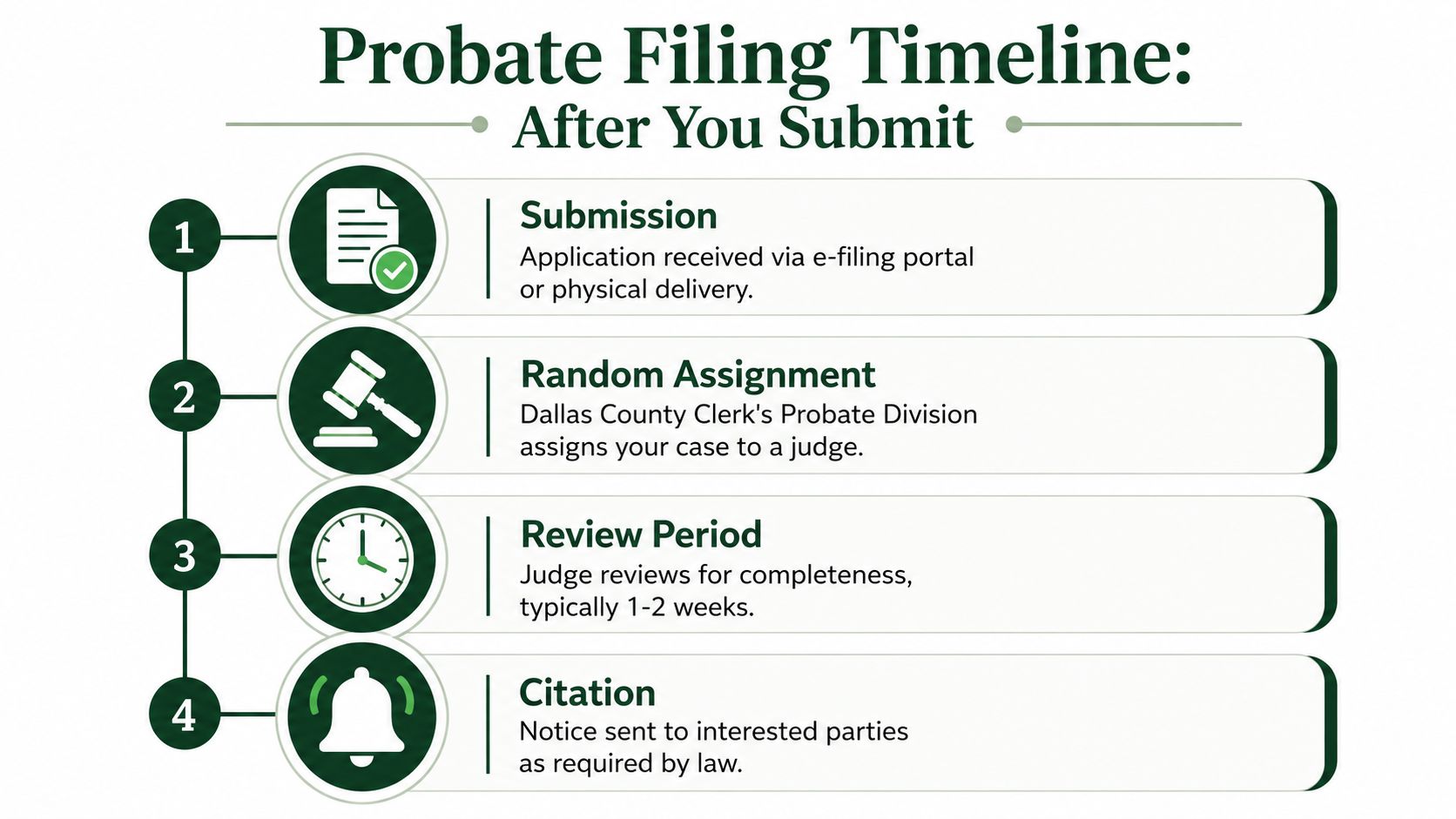
The deadlines that come after letters issue
When the court issues letters testamentary or letters of administration, the personal representative has a new set of obligations. Dallas County's probate guidance says the inventory is generally due within 90 days after appointment, and notice to creditors must be published within 30 days after receiving letters. Those dates shape the pace of the administration because missing them can complicate an estate that was otherwise moving normally.
A practical filing habit helps here: keep the case moving from the moment the application is accepted. The filing is only the beginning, and the work after appointment often matters more than the hearing itself. If an estate includes real property, bank accounts, or disputed assets, the inventory and creditor notice deadlines become part of the strategy.
Why random assignment changes strategy
Random assignment means you can't assume one probate court will hear your matter just because you've heard from another family about a smoother result elsewhere. You need to be ready for any assigned statutory probate court in the county. That's especially true for lawyers and families who need to preserve flexibility in contested matters.
Don't build the case around one courtroom. Build it so any assigned probate court can take the file and understand it quickly.
That approach also matters in family law-adjacent probate situations, such as disputes over inherited property, business interests, or property that may later affect divorce or custody-related finances. The filing may begin with the clerk, but the long-term result depends on how cleanly the post-filing process is handled.
Common Mistakes That Delay Dallas Probate Filings
The biggest delay I see is venue confusion. If the decedent lived in Collin, Tarrant, Denton, or Rockwall County, Dallas County is usually not the right filing location just because it's more convenient. Filing in the wrong county can mean starting over, and that wastes time even when the underlying case is valid.
The next common problem is the document format. Dallas County's e-filing workflow for will cases requires the application and the will to be uploaded as separate PDFs in the same filing. A single combined file or a mislabeled packet can create rejection risk before the court ever looks at the substance. That's the kind of mistake that feels small on a screen and becomes expensive at the courthouse.
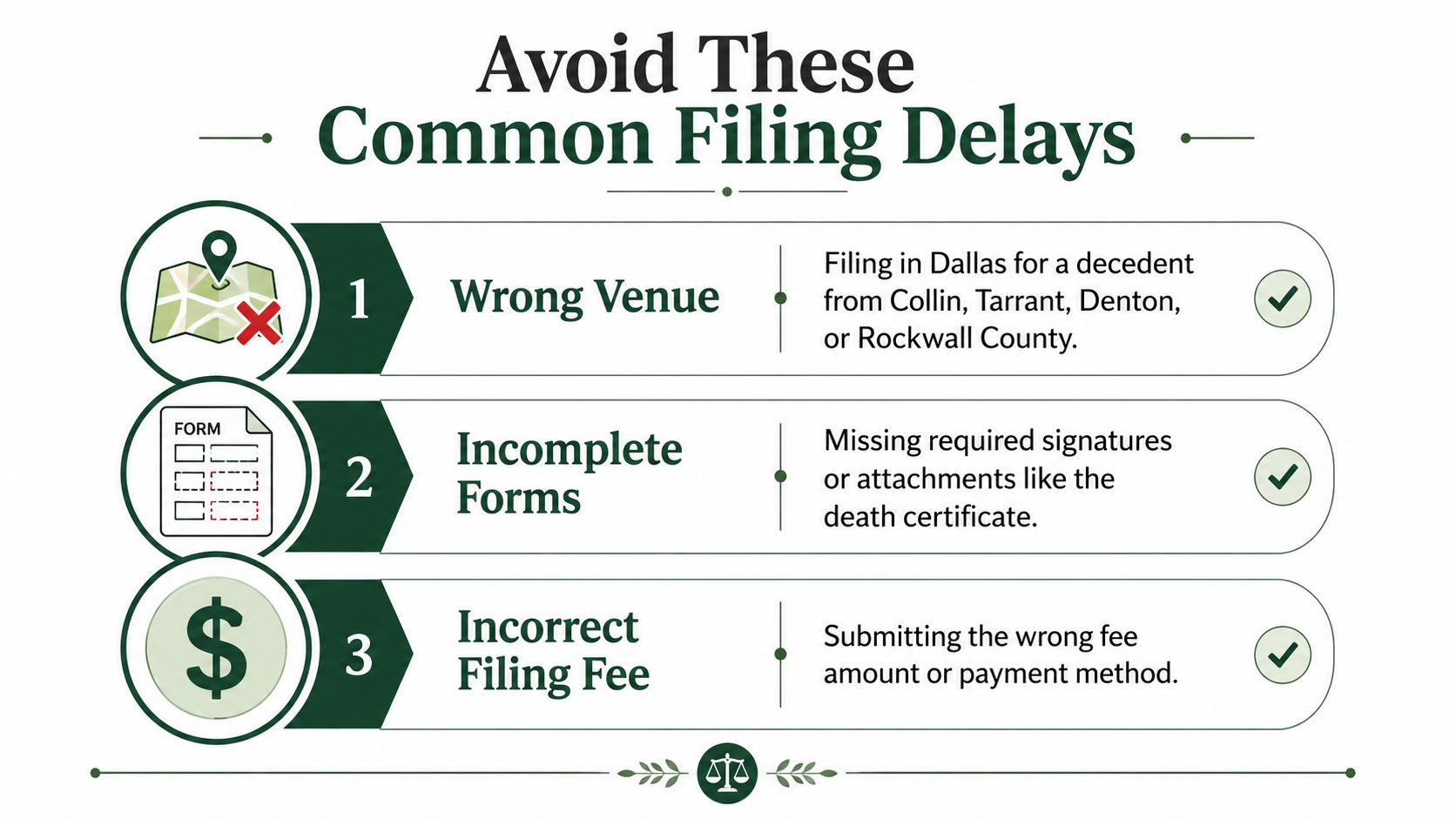
Small issues that create big delays
Several other problems show up again and again:
- Missing notarization. If the application or affidavit needs notarization, a plain signature isn't enough.
- Incomplete witness support. Some filings need witnesses or heir-related proof, and leaving that out can stall the packet.
- No current address for the proposed representative. The clerk and court need accurate contact details.
- Skipping the citation step. Probate notice rules still matter even when the family expects no opposition.
- Trying to jump ahead of assignment. Emergency relief still has to fit the court's assignment process.
A family member who assumes “the judge will sort it out later” usually loses time. The clerk's office is looking for a file that can move, not one that needs to be rebuilt after submission. If a case includes a will, the original must also make its way to the Probate Courts Division on time.
Use a final submission checklist
Before you click submit in the Tyler Odyssey eFileTexas portal, make sure the packet includes the right court, the right case type, the separate PDFs, and the supporting documents that match the requested relief. If the filing involves a will, confirm the original will delivery plan before you finish the upload. For Dallas families handling both probate and family law concerns, that final check is often the difference between moving forward and waiting on a rejection notice.
Your Next Step After Filing a Dallas Probate Application
After the application is filed and accepted, staying ahead of the court calendar and the estate deadlines is the key task. Make sure you have a file-stamped copy of the application, the conformed copy of the will if one was filed, and a clean record of which probate court the case was assigned to. If those items aren't organized, the rest of the administration gets harder than it needs to be.
The next practical move is to calendar the 90-day inventory deadline and the 30-day creditor notice window immediately. Those dates matter because they affect administration duties, and they can shape how quickly the estate moves toward distribution. If a will contest is even a possibility, it's wise to get legal advice before letters are issued, since the posture of the case can narrow once the representative is qualified.
For routine administrations, the work often includes form preparation, e-filing oversight, and follow-through after the courthouse accepts the case. In estates that involve real property, deed transfers may come later, and some estates also require federal tax attention if the size of the estate raises that issue. The key is not to treat the filing as the finish line.
When you meet with a probate lawyer, bring the death certificate, the original will, a list of heirs, and a rough inventory of the assets. That gives counsel enough information to identify the right Dallas County filing path and the likely next filings. If the probate issue connects to divorce, children, or a larger family dispute, bringing the probate facts into the family law strategy early can save time later.
If you need help with a Dallas County probate filing or you're not sure whether your case belongs in Dallas at all, The Law Office of Bryan Fagan, PLLC can help you sort out the filing path, the court assignment process, and the next steps after the clerk accepts the application. Visit The Law Office of Bryan Fagan, PLLC to connect with a Dallas legal team that works with probate and family-related court matters in the county.
