 Skip to content

Dallas County's standard base filing fee for most new probate matters is $360.00, but the total cost increases when the case requires citations and notices. A small estate filing also requires the $360.00 filing fee at the time of filing, along with a death certificate.
A family member may have just died, and you're gathering the original will, death certificate, account statements, and property records while trying to determine what the Dallas County Clerk will charge. The clerk's published fee schedule gives you a reliable starting point, but the receipt may include separate charges for posting, publication, or citation issuance.
The practical rule is simple: budget for the base filing fee first, then identify every notice and citation the particular probate path requires. That approach helps prevent a rejected filing, an incomplete payment, or an unpleasant surprise at the clerk's counter.
Table of Contents
- Navigating Dallas County Probate Filing Costs
- The Standard Base Filing Fee Schedule
- Citations Notices and Add-On Charges
- Realistic Cost Scenarios for Common Estates
- Payment Methods and Will Deposit Requirements
- Where and How to File in Dallas County
- Fee Waivers and Indigency Considerations
- Probate Fee Glossary and Cross-References
- Next Steps for Dallas County Estate Administration
Navigating Dallas County Probate Filing Costs
The Dallas County Clerk uses a consolidated fee structure for common probate openings. Rather than publishing a different basic opening charge for every type of estate administration, Dallas County lists a $360.00 base amount for new probate matters effective January 1, 2026. The county's probate fees and payment information is the place to confirm the current schedule before filing.
That amount is only the starting point. A case may also require a posted notice, citation by publication, or individual citation issuances. Those services are separate line items, and they depend on the facts and procedural route involved.
Start with the correct probate path
Before paying anything, identify what you're asking the court to do. A will admission, independent administration, dependent administration, determination of heirship, and small estate filing don't all involve the same documents or notice requirements. Choosing the wrong application can create delay and may require additional work to correct the filing.
Dallas County has three statutory probate courts located in the George L. Allen, Sr. Courts Building. The clerk's probate division handles filings and records, while the assigned probate court handles the judicial proceeding. Families often benefit from reviewing which Dallas County probate court may hear the case before preparing the application.
Practical rule: Don't treat the $360.00 charge as the complete cost of opening every estate. Treat it as the published baseline, then check the notice requirements for the application you plan to file.
The Standard Base Filing Fee Schedule
The first budget figure for many Dallas County probate applications is the $360.00 base filing amount. The county's 2026 probate fee schedule applies that same consolidated charge to several application types, combining local and state base fees into one published amount.
| Application Type | Base Filing Cost |
|---|---|
| Independent administration | $360.00 |
| Dependent administration | $360.00 |
| Community administration | $360.00 |
| No administration | $360.00 |
| Determination of heirship | $360.00 |
| Combined administration and heirship | $360.00 |
| Probate of a foreign will | $360.00 |
| Application to open a safe deposit box | $360.00 |
These amounts appear in the Dallas County Probate Fee Schedule effective January 1, 2026. The schedule gives families a reliable starting point, but it does not represent the final cost of every estate. Citations, posted notices, publication, will deposits, certified copies, and other case-specific services can increase the clerk's charges.
Why the base amount matters
The filing fee alone does not distinguish independent administration from dependent administration. Both begin with the same $360.00 base filing cost. Their total expenses can diverge later because court supervision, required notices, attorney work, and the estate's complexity differ.
A determination of heirship and a combined administration and heirship proceeding also carry the same listed base amount. That does not mean the proceedings cost the same overall. A case involving several heirs or additional notice requirements may generate more add-on charges than a straightforward application.
Use the table to answer one question: “What must be paid to file this application?” Then prepare a separate estimate for the services the case may require after filing. That approach prevents the standard fee from being mistaken for an all-in probate budget and leaves room for the administrative costs that commonly surprise families.
Citations Notices and Add-On Charges
The standard filing fee rarely reflects the full clerk bill. Separate charges arise when the court requires notice to interested people, citation service, or another filing-related step. These add-ons are the hidden costs families should budget before submitting an application.
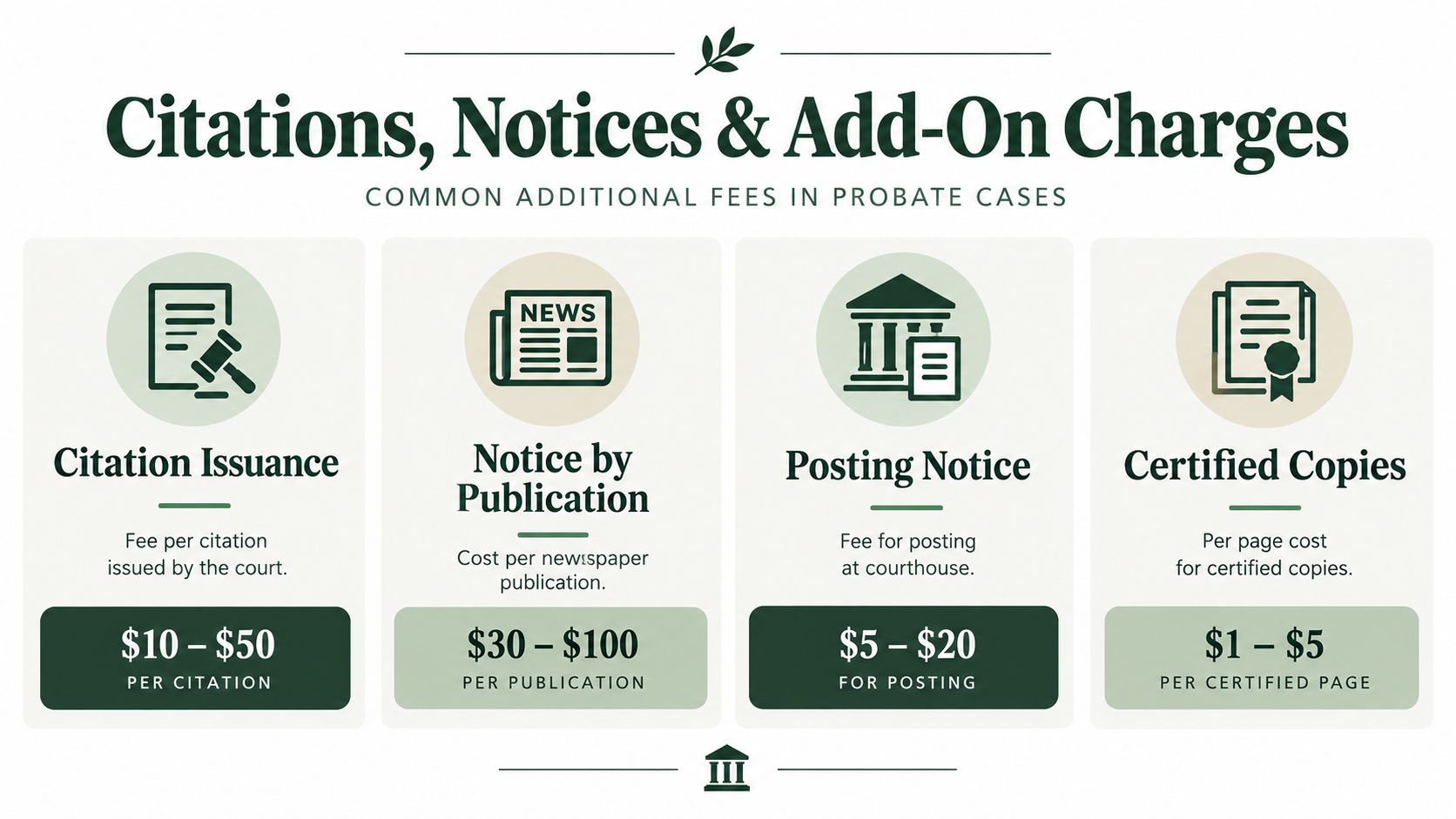
For filings involving posting or published citation, Dallas County lists:
- Posted notice: $20.
- Citation by publication: $65.
- Citation issuance: $8 for each citation issued.
These figures appear in the county's published probate fee schedule. The required notice depends on the proceeding and the people whose interests must be addressed. One posted notice creates a different receipt from a case requiring publication and several citations.
Separate the clerk charges from other expenses
Posted notice and citation issuance are clerk charges. Publication can involve a newspaper or another publication vendor, and its price depends on the arrangement. Review the clerk receipt separately from invoices for publication, service, or attorney work.
Heirship proceedings need close cost planning. The court must address heirs who may be unknown or difficult to locate, so the case can require more notice-related work than a routine will admission. The base filing category may remain the same, while the total administrative bill increases.
Ask three questions before filing: Which notices does the application require? Who must receive them? Does the clerk need more than one citation issuance? Those answers provide a more useful budget than the base fee alone.
The Dallas County Clerk also lists a $5 fee for depositing a will, and the deposit requires a copy of identification. This service is separate from opening a probate case. Include it as its own line item when estimating clerk charges, especially if the original will is being deposited before or apart from the probate filing.
Realistic Cost Scenarios for Common Estates
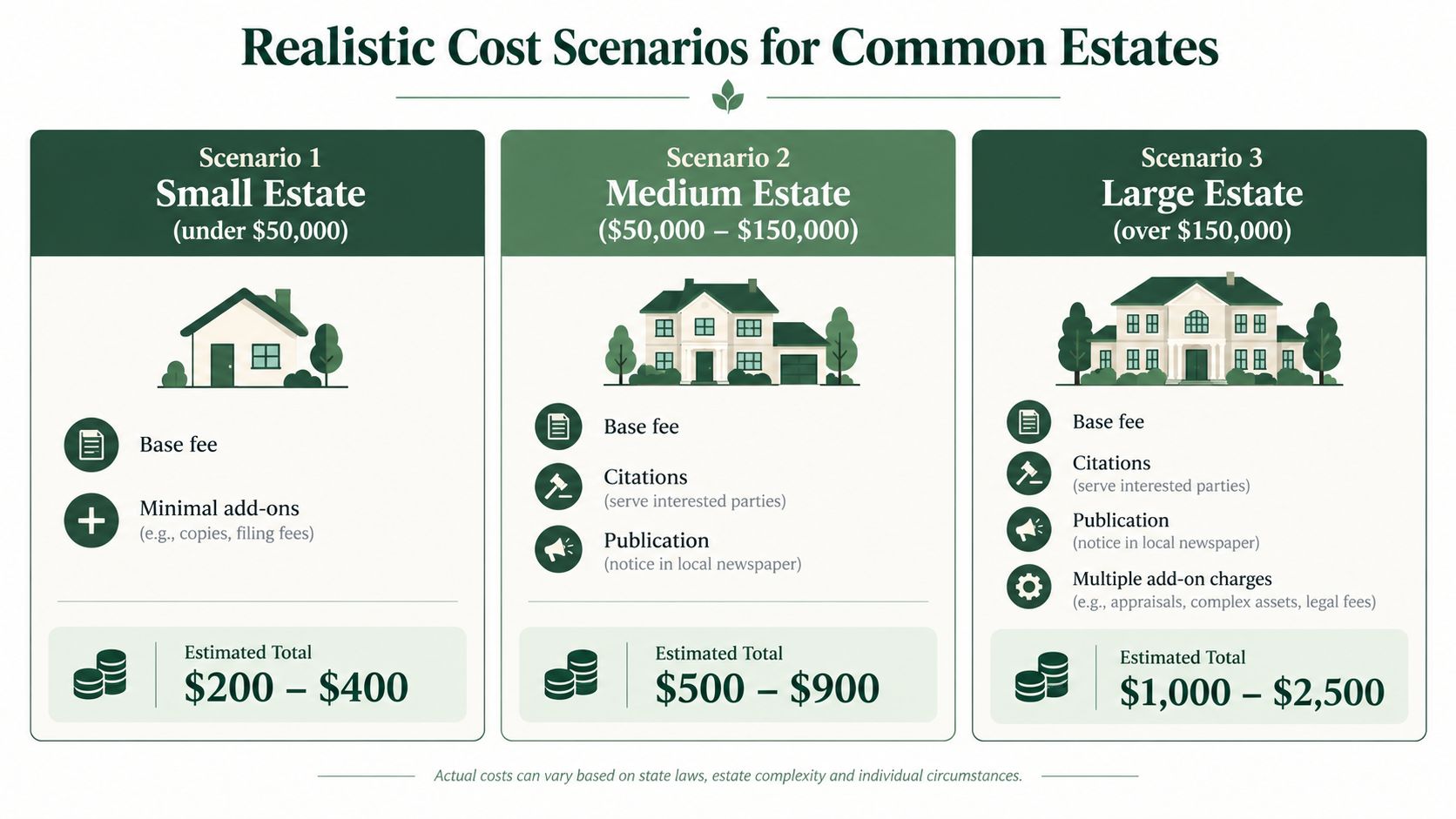
A reliable Dallas County budget starts with the base filing charge, then adds the notices, citations, deposits, and professional services the specific estate requires. The examples below are hypothetical planning illustrations, not fixed quotes. They use the published Dallas County charges to show why families filing in the same county can receive different final totals.
A small estate filing
A family using the small estate procedure must bring a death certificate and pay the $360.00 filing fee at filing, according to Dallas County guidance summarized in this Dallas County small-estate resource. If the filing does not require additional citation or posting services, the clerk-related starting cost remains the base fee.
Calling an estate “small” does not eliminate that charge. Dallas County still requires the base amount when the small estate filing is submitted. Budget for the filing fee first, then confirm whether the case requires any separate notice or service.
An independent administration
For an uncontested independent administration, assume the application carries the standard base fee and the clerk requires a posted notice. The initial clerk total would be the $360.00 base filing fee plus the $20 posted notice fee, before any other selected or required service.
If the application also requires citation issuance, each issuance adds $8. Publication may create a separate expense, and its amount depends on the publication arrangement. The clerk receipt should be reviewed separately from publication invoices, service charges, and attorney fees.
This scenario is common, but it is not a complete quote. Confirm the number of citations and notices before filing so the family has funds available for the full clerk transaction.
A more involved heirship or dependent administration
A dependent administration or heirship proceeding can require more notice work and closer procedural attention. If the filing requires the base charge, a posted notice, citation by publication, and one citation issuance, the listed clerk charges would be $360.00 plus $20, $65, and $8. That example totals $453.00 in listed charges, before separate publication expenses or professional fees.
Uncertain heirs, missing beneficiaries, and inheritance disputes can increase the administrative work beyond the base filing amount. Review the proposed procedure before selecting a filing path. A Dallas County heirship proceeding attorney ad litem cost resource explains why these matters may involve additional professional and procedural expenses.
Payment Methods and Will Deposit Requirements
A complete application can still stall at the clerk's office if the filer brings the wrong documents or an incomplete payment. Confirm the accepted payment methods and submission process before filing, especially when the transaction includes citations, notices, or a will deposit.
Opening a case is different from depositing a will
Depositing a will with the clerk preserves it for recordkeeping. It does not open probate or begin full estate administration. Dallas County guidance requires a copy of identification and a $5 fee for a will deposit.
A small estate filing follows a different process. The filer must provide a death certificate and the $360.00 filing fee at the time of filing. Depositing the will alone does not replace the application, hearing, or other requirements for opening the case.

Use a filing-day checklist
Prepare these items before submitting anything:
- Identification copy: Required for a will deposit.
- Original will: Secure the original and decide whether you are depositing it or filing it with a probate application.
- Death certificate: Required for a small estate filing and commonly needed for other probate documents.
- Payment confirmation: Match the payment to the filing type, plus any selected citations or notices.
- Names and contact information: Accurate details help the clerk and court process required notices.
The base filing amount is only one part of the transaction. Citations, notices, and a separate will deposit can add charges, so confirm the full amount before submitting payment.
Payment procedures can change. Verify the currently accepted methods with the Dallas County Clerk before appearing at the office or sending documents through an electronic filing portal. Keep the receipt and compare it with any later invoices for publication, service, or professional fees.
Where and How to File in Dallas County
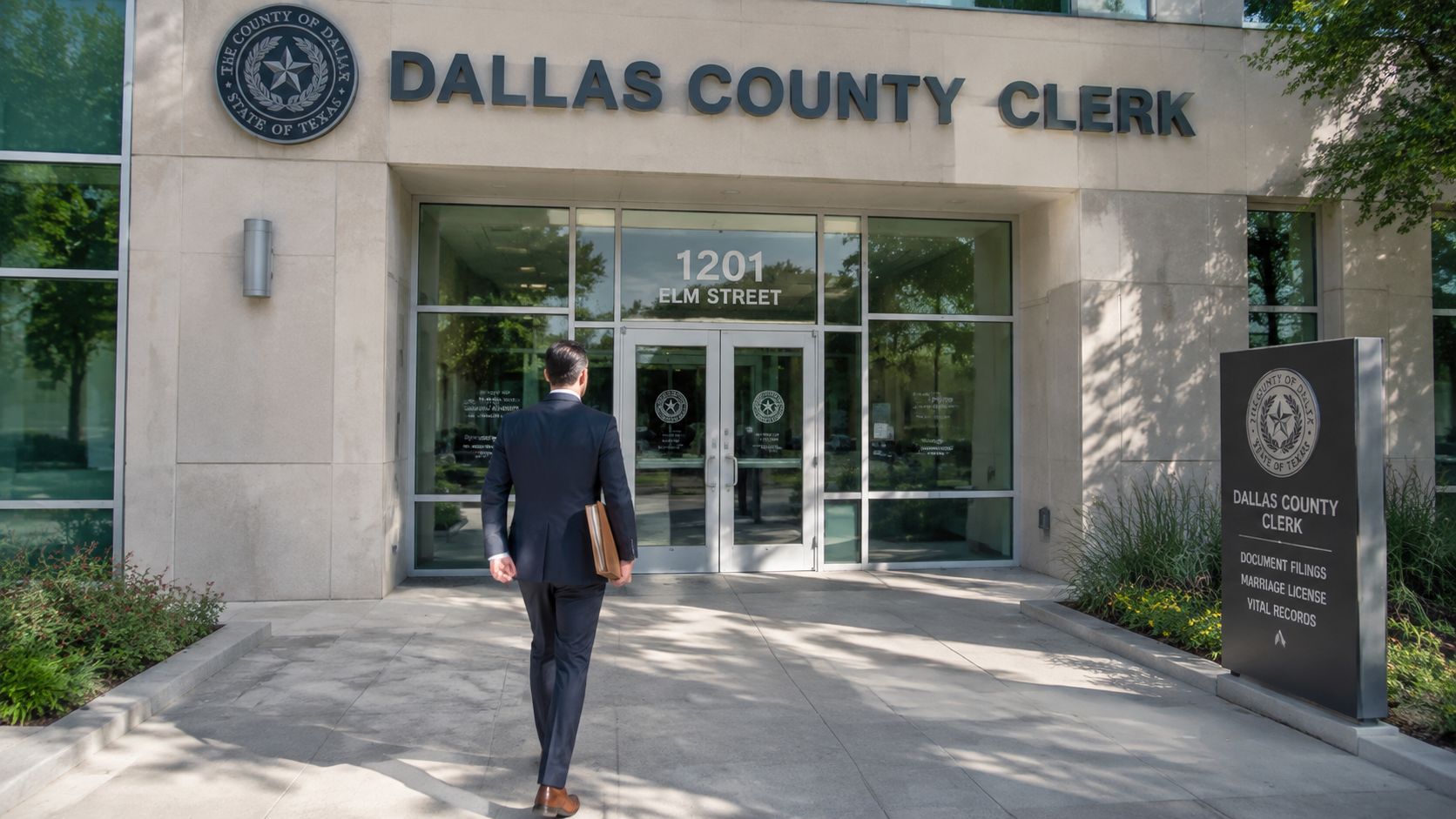
Dallas County probate filings are handled through the County Clerk's probate division and assigned to one of the county's statutory probate courts. The three probate courts are located in the George L. Allen, Sr. Courts Building in downtown Dallas, so a family member who goes to the wrong Dallas courthouse may lose time before reaching the correct filing division.
Physical filing and electronic submission
Attorneys generally submit probate filings through the Texas electronic filing system. A self-represented filer may also need to use electronic filing or should confirm the available process with the clerk before preparing the case. The original will may require separate delivery to the County Clerk's office, so uploading a document doesn't necessarily replace delivering the original.
A family in North Dallas, Oak Cliff, Garland, or another Dallas County community should focus on county jurisdiction, not merely the city name. Cities can cross county lines, and the proper probate venue depends on facts such as the decedent's residence and the location of relevant property.
For location-specific preparation, review where to file an application in Dallas County probate court. Before traveling downtown, verify the clerk's current office instructions, hours, filing pathway, and document-delivery requirements.
Fee Waivers and Indigency Considerations
A person who can't afford court costs may assume the clerk will automatically waive the probate filing fee. That assumption is unsafe. Requests to proceed without paying court costs generally require a sworn showing of inability to pay, and the court decides whether the request satisfies the applicable legal standard.
Probate also presents a practical complication that doesn't arise in the same way in every civil case. The proceeding concerns an estate, and the estate may own assets that can ultimately pay proper administration expenses. A family member may have little cash personally while the estate contains real property, accounts, or other assets that require administration.
Ask before filing, not after rejection
If paying the base filing fee would create a serious hardship, ask the clerk or a probate attorney about the current procedure for an affidavit of inability to pay court costs. Don't omit the fee from the filing and hope the application is accepted.
The court may review the financial information provided and may distinguish between the applicant's personal finances and the estate's resources. Whether a waiver is available depends on the facts, the request, and the court's determination.
A fee concern should be addressed before filing because an incomplete payment can delay the case at the very first administrative step.
Keep copies of any affidavit, financial information, and clerk correspondence. If the estate has no accessible funds, explain that circumstance accurately rather than assuming that “no cash on hand” automatically means “no court costs.”
Probate Fee Glossary and Cross-References
The Dallas County fee schedule uses terms that can be confusing when a family is reading it for the first time. These definitions help connect the application name to the likely administrative task.
Common application terms
Independent administration: A form of estate administration in which the personal representative generally operates with less routine court supervision than in a dependent administration. The Dallas County fee schedule lists it among the applications carrying the consolidated base filing amount.
Dependent administration: A court-supervised administration. The same base filing category doesn't mean the overall estate will cost the same as a simpler matter because supervision, filings, and professional work can differ.
Community administration: An application associated with administration by a surviving spouse in circumstances recognized by Texas probate law. Dallas County lists it under the same base filing amount.
No administration: A procedure for transferring or handling an estate without appointing an administrator in the same manner as a traditional administration, when the facts and law permit it.
Heirship and notice language
Determination of heirship: A proceeding used to establish who legally inherited from a person who died without a will or when heirship must be determined. The base filing amount is listed in the fee schedule, but citations and notice requirements can add expense.
Combined administration and heirship: A filing that addresses both the identity of heirs and administration of the estate. Its name signals that the case may involve more than one legal question.
Citation by publication: A published legal notice used when the procedure requires public notice. Dallas County lists a $65 citation-by-publication fee, separate from the base filing amount.
Citation issuance: The clerk's issuance of a citation. Dallas County lists $8 for each citation issuance, so the number required matters.
Posted notice: Notice posted through the clerk's process. The county lists a $20 posted notice fee for applicable initial filings.
Will deposit: Depositing a will with the clerk rather than treating the deposit as the full probate application. Dallas County requires identification and a $5 fee for this service.
Reading the fee schedule this way helps you connect a technical label with an actual cost event. The application determines the baseline, while the notice and citation needs shape the add-on total.
Next Steps for Dallas County Estate Administration
Start by securing the original will and obtaining the death certificate. Then prepare a basic list of heirs, beneficiaries, real estate, financial accounts, vehicles, business interests, and known debts. This information helps identify whether the estate may need a small estate filing, independent administration, dependent administration, heirship proceeding, or another route.
Next, confirm the proper Dallas County filing location and current clerk requirements. Review the application carefully before paying the fee. A filing that uses the wrong probate procedure can create more than a paperwork problem. It may require correction, additional notices, or a new application strategy.
Make the budget specific
Use the county's $360.00 base fee as the starting point for most new probate matters, then ask:
- Which notices are required: Determine whether the application requires posting or publication.
- How many citations are needed: Each issuance carries its own listed charge.
- Is a will being deposited: Include the identification copy and separate deposit fee.
- Does the estate involve disputed heirs: Consider whether heirship issues may require additional court involvement.
- Are estate assets complex: Business ownership, real estate, retirement accounts, creditor disputes, or unclear ownership can affect the legal work even when the clerk's base fee stays the same.
The Law Office of Bryan Fagan, PLLC offers probate and estate administration services through its Dallas office, including assistance with selecting the filing path, preparing documents, and addressing Dallas County clerk requirements. Families with case-specific questions should obtain legal guidance before filing rather than relying solely on a fee table.
The Law Office of Bryan Fagan, PLLC can help you evaluate the appropriate Dallas County probate procedure and plan for the base fee, citations, notices, and other filing requirements. Contact the firm with your documents and estate questions so you can take the next step with a clearer understanding of the process.
