 Skip to content
A Dallas parent receives a text from opposing counsel the night before a scheduled custody trial: the other side will agree to move the case. That sounds reassuring until the parent checks the docket and realizes no judge has signed an order, no hearing has been set, and nobody has confirmed what happens at docket call.
In Dallas County family cases, an agreement between lawyers doesn't automatically reset a trial setting. The court still controls the docket, local rules control the required notice and filings, and individual family courts may impose additional procedures. The answer becomes more demanding once the case has been on file for one year.
This guide explains the Dallas County reset and continuance local rules for a family case, including what to do immediately, what “agreed” really means, how docket call works, and which documents may be needed in the 302nd and 160th District Courts.
Table of Contents
- When a Dallas Family Case Hits a Scheduling Snag
- Reset, Continuance, and Pass in Plain English
- The Dallas County Family Local Rule on Continuances
- How Individual Family Judges Tighten the Rule
- Timing, Deadlines, and the Pretrial Clock
- What Happens at Docket Call If You Stay Silent
- Paperwork, Sample Language, and a Reset Checklist
- Practical Next Steps for Dallas County Families
When a Dallas Family Case Hits a Scheduling Snag
Suppose your divorce or custody case is set for trial in the 302nd or 160th District Court. The other lawyer texts that the parties can agree to a reset because discovery is incomplete, mediation was delayed, a custody evaluation isn't finished, or a key witness is unavailable. You may reasonably think the trial is off.
Treat that message as a starting point, not a completed reset.
What to do before the scheduled setting
First, preserve the message and ask opposing counsel to identify the exact procedural step being taken. Is there a written motion for continuance? Has a hearing been requested? Has the court supplied a new date? Is there a proposed order waiting for the judge's signature?
Next, check the court's docket-call schedule and the applicable policies for the assigned family court. Contacting the clerk or coordinator can help you understand filing status and available settings, but court staff generally can't give legal advice or replace a signed order. If nobody confirms that the case has been removed from the docket, prepare to appear or ensure that your lawyer appears.
A missed announcement can create serious problems. Dallas County's local rules state that failing to make an announcement at docket call can be treated as consent to pass, postpone, reset, or dismiss the case for want of prosecution the following week. Dallas County's published civil district court local rules are therefore not background reading. They can affect what happens to your divorce, custody, support, or enforcement case that day.
Practical rule: Until the court grants the request or the docket clearly reflects the effective change, assume the existing setting remains active.
The most important hinge is the one-year mark. Before that point, a scheduling request may sometimes be handled through an announced agreement and the court's ordinary docket procedures. Once the case has been on file for one year, Dallas procedure turns the friendly reset into formal motion practice requiring written client approval and court action.
Reset, Continuance, and Pass in Plain English
People often use reset, continuance, and pass as though they mean the same thing. In Dallas family litigation, the practical result may overlap, but the procedural route can differ.
A reset usually means moving a hearing or trial to a later date. A continuance is the formal postponement request presented to the court. In many Dallas family matters, lawyers use the two words interchangeably, but a continuance typically requires a written motion, notice, and an order.
A pass is commonly used for a short procedural deferral when the case is called. The case may not be tried at that moment, and the court may direct the parties to return later or place the matter on another setting. A pass isn't a substitute for a signed continuance order when the court's policy requires a written motion and judicial approval.
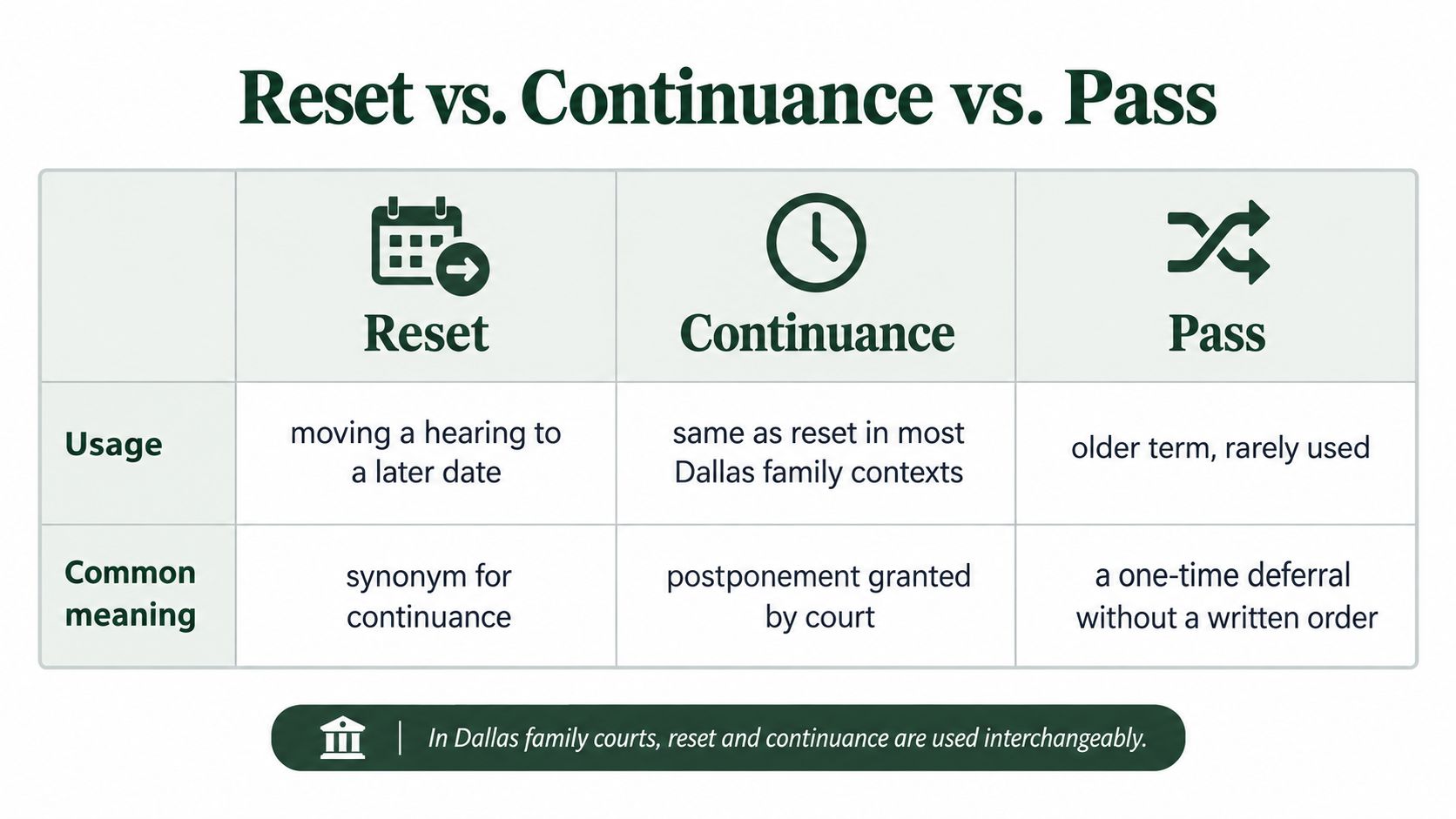
Why the label affects your next move
The terminology matters because it can determine what the clerk, coordinator, and judge expect to see:
- Reset: A later docket date may need to be supplied or confirmed by the court, followed by an order.
- Continuance: The request generally proceeds through a written motion, notice, and court approval.
- Pass: The court may handle the request at docket call, but that doesn't guarantee a new trial date or eliminate the need for later paperwork.
Don't assume that a lawyer's text saying “we agreed to reset” answers the filing-fee question, the hearing question, or the proposed-order question. Filing fees can depend on the filing and the court's requirements, and self-represented parties should confirm current clerk procedures rather than rely on informal advice.
The safest approach is to ask for the exact docket entry, hearing setting, and signed order. If those items don't exist, the original date may still control.
The Dallas County Family Local Rule on Continuances
Dallas County family local rules make trial continuances difficult once a trial setting exists. The county rule provides that a request to pass, postpone, or reset a trial generally won't be granted unless all parties consent, or the parties who don't consent have received notice and an opportunity to object. The Dallas County family-court continuance rule should be read with the assigned court's own procedures.
That structure creates two paths. If everyone consents, the court may consider the agreement. If someone objects, the requesting party must show that the nonconsenting parties received notice and had a chance to respond. Either way, the judge remains in control of the setting.
The one-year procedural hinge
The rule becomes substantially stricter after a case has been on file for one year. At that point, the case may not be reset for a party except through a written motion for continuance, personally approved by the client in writing and granted by the court.
That requirement matters in a Dallas divorce with extended discovery, disputed business records, delayed mediation, a custody evaluation, or unresolved tracing issues. A lawyer can't rely on an informal agreement alone. The file should show the client's written approval, the motion, the required notice, and the court's ruling.
The local rule also treats the docket-call announcement as significant. Failing to announce can operate as consent to pass, postpone, reset, or even dismiss the case for want of prosecution the following week. Silence isn't a reliable way to preserve a trial setting or avoid responsibility for what happens next.
What counsel must calculate
A continuance request has several separate timing questions:
- When must the motion be filed? The answer depends on the assigned court's policies and the hearing setting.
- When can the motion be heard? A request that can't be presented before trial may not remove the case from the trial docket.
- Which deadlines change? A new trial date doesn't automatically reopen discovery, extend disclosures, or move every pretrial obligation.
- What does the order say? The order should identify the affected setting and make clear whether any deadlines are changed.
A Dallas family-law lawyer should also compare the local rule with the applicable Texas Rules of Civil Procedure and the assigned court's current policies. If mediation or another pretrial obligation remains outstanding, review the court's procedures and Dallas County mediation requirements before final trial early rather than treating mediation as an issue that can be fixed after the reset.
How Individual Family Judges Tighten the Rule
Countywide rules are only the baseline. The assigned family court may require more paperwork, earlier filing, a particular type of hearing, or a court-supplied trial date.
The 302nd District Court provides a clear example. Its published policies state that once a case has a trial setting, a continuance or reset requires the judge's approval. The court also states that a case can't be removed from the docket without specific agreement communicated to the court before the hearing begins or before the court grants a continuance. Motions for continuance must be in writing and accompanied by an order, and the motion must be served on all parties before trial.
The 160th District Court adds another important warning for older cases. Its policies state that a case pending more than one year may require a motion signed by all requesting parties and counsel, and the court may require a hearing even when the motion is agreed. If the motion isn't filed in time to obtain a hearing before trial, the case can remain on the trial docket until reached, with the motion considered at that point.
| Court | Written motion required | Proposed order required | Client signature required | Hearing even when agreed |
|---|---|---|---|---|
| 302nd District Court | Yes, under its published trial procedures | Yes | Confirm the current court-specific requirement | Judge approval remains necessary |
| 160th District Court | Yes, especially for cases older than one year | Court procedures require a proposed order for requested relief | May be required for older cases | The court may require a hearing for an agreed motion in an older case |
These requirements can change, so counsel should verify the current policy for the assigned court and setting. A signed stipulation between lawyers may establish agreement, but it doesn't itself move the trial date.
An agreed motion is still a motion. The court must accept it and enter the order that changes the docket.
The practical distinction is especially important in custody modifications, enforcement actions, and temporary-orders disputes. A parent who assumes opposing counsel's consent is enough may fail to prepare for the existing setting, while the judge still expects an announcement or a properly presented motion.
For related Dallas family-court procedure, review the Dallas County 301st District Court family docket procedures and then confirm the requirements for your own assigned court.
Timing, Deadlines, and the Pretrial Clock
A continuance request should be treated as a timed filing project, not a last-minute conversation. Counsel first identifies why the existing setting is unworkable, then checks the local rule, reviews the assigned judge's policy, prepares the motion and proposed order, serves the other parties, obtains a hearing setting, and confirms whether the case remains on the docket.
A request filed shortly before trial can fail for a procedural reason even when the underlying problem is legitimate. If the court can't hear the motion before the existing trial date, the case may remain set until the judge reaches it.
How a reset affects other deadlines
Assume counsel files a motion about two weeks before trial and asks to move the matter roughly three months later. That new date doesn't automatically answer whether the parties must exchange updated exhibits, revise witness lists, complete mediation, or attend another pretrial conference. The requested order should address those points expressly when relief is needed.
Dallas County court policies also show why order language matters. Some courts provide that a reset or continuance of 30 days or less, or a reset occurring less than three months after discovery-deadline expiration, doesn't otherwise change pretrial deadlines unless the order says otherwise. The 160th District Court's published policies illustrate the operational importance of checking whether the new order changes the procedural clock.
A last-minute oral request may move the appearance date while leaving discovery obligations intact. That can compress preparation for financial tracing, custody evaluations, third-party records, or retirement-account documentation. A new trial date is not the same as a new discovery period.
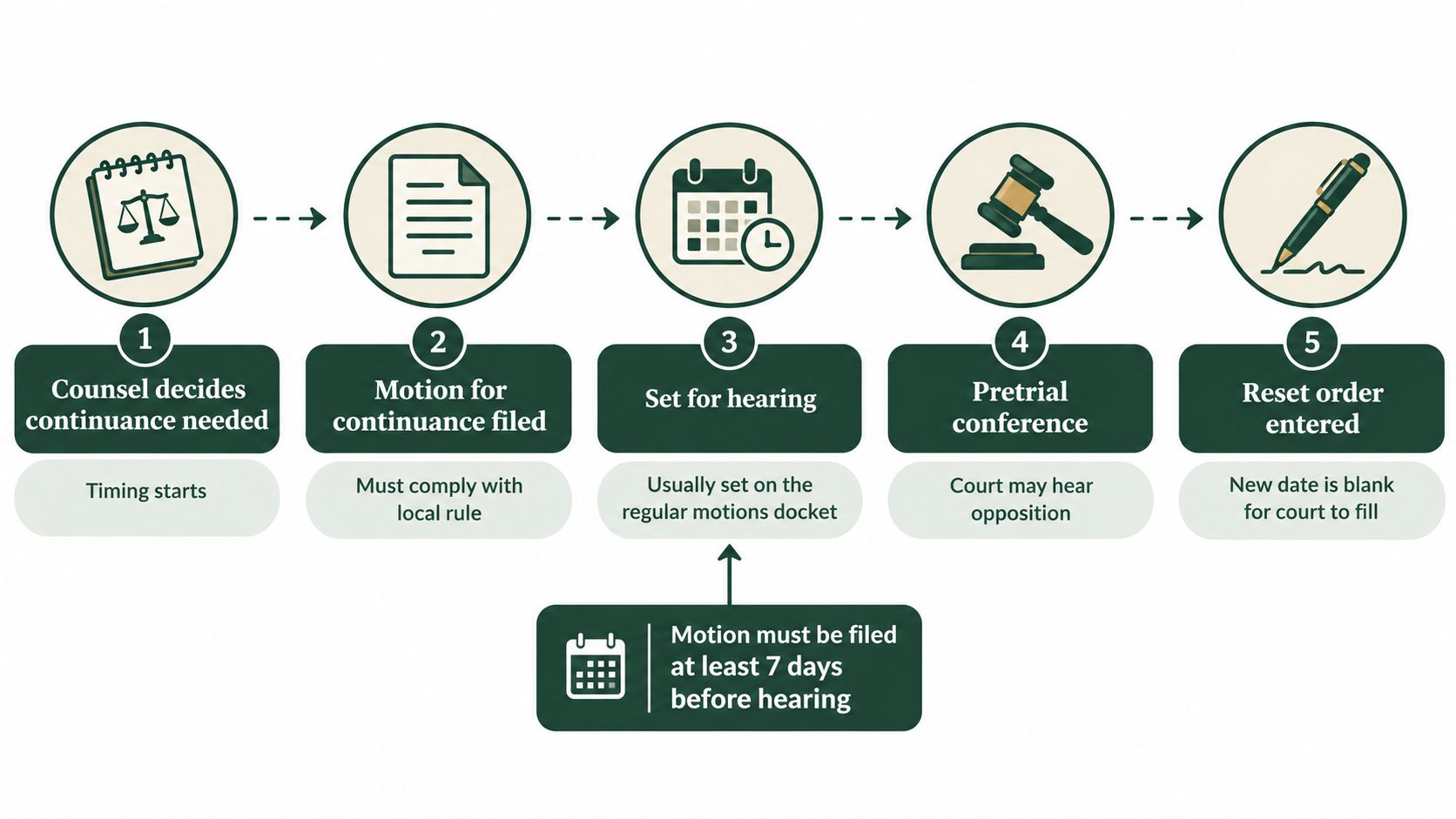
The flowchart's sequence captures the practical order: decide, file, set the motion for hearing, attend the hearing, and obtain the signed order. Don't treat the filing receipt as proof that the trial has moved. Until the court grants relief, keep preparing for the existing setting.
What Happens at Docket Call If You Stay Silent
Docket call is not a background administrative event. The court or coordinator calls the case, and counsel must make the required announcement. Depending on the matter and the court's procedures, the announcement may address readiness, an agreement, a request for continuance, or another action the court needs to know before managing the docket.
Consider two hypothetical Dallas cases.
In the first, counsel arrives late and doesn't announce. The other side also hasn't presented a written motion. The court may treat the lack of announcement under the local rule as consent to pass, postpone, reset, or expose the case to dismissal-for-want-of-prosecution risk the following week. The parent may leave without a trial date and without knowing whether additional action is required.
In the second, counsel files a written motion before docket call, serves the opposing party, obtains a hearing setting, and appears with a proposed order. Both sides announce their agreement, but counsel still waits for the judge to grant the motion and enter the order. That approach creates a record and gives the court a clear procedural path.
Why “agreed” can still be incomplete
An agreement announced from counsel table is not identical to an announced continuance supported by a pending written motion. The first may tell the judge that no party objects. The second also gives the judge the documents needed to decide what setting moves, whether deadlines change, and what date should appear on the order.
Silence is particularly dangerous in a divorce or custody case because the consequences can reach the merits. A missed call can affect trial readiness, dismissal risk, temporary-order schedules, possession disputes, or an enforcement hearing involving alleged violations of an existing order.
If the case is set, someone needs to make the announcement. If a reset is requested, someone needs to verify the court's ruling.
Paperwork, Sample Language, and a Reset Checklist
A Dallas family-court continuance file should be assembled before the hearing, not handed to the judge as an afterthought. The core packet commonly includes a written motion, a proposed order, proof that the other parties received notice or service, and a hearing notice when the court requires a hearing.
For a case beyond the one-year threshold, add the client's written approval to the motion. The document should make clear that the client personally authorizes the request, rather than leaving the court to infer authority from counsel's signature.
Core documents to prepare
- Written motion: Identify the case, current setting, reason for the request, consent or objection status, and the relief requested.
- Proposed order: Identify the setting being moved and leave the replacement date for the court to supply when the coordinator, rather than counsel, controls available trial dates.
- Certificate of conference: State when counsel contacted the opposing party, the response, and whether the request is agreed or opposed.
- Client approval: Include the client's written approval when the case has been on file for more than one year.
- Notice and service proof: Show that the parties received the motion and any hearing information required by the court.
A short order provision might read:
“The Court GRANTS the Motion for Continuance and resets the hearing currently set for [date]. The replacement setting and any changed pretrial deadlines shall be stated by separate court order.”
That language is only an example. The actual order should match the assigned court's policy and the relief the judge grants.
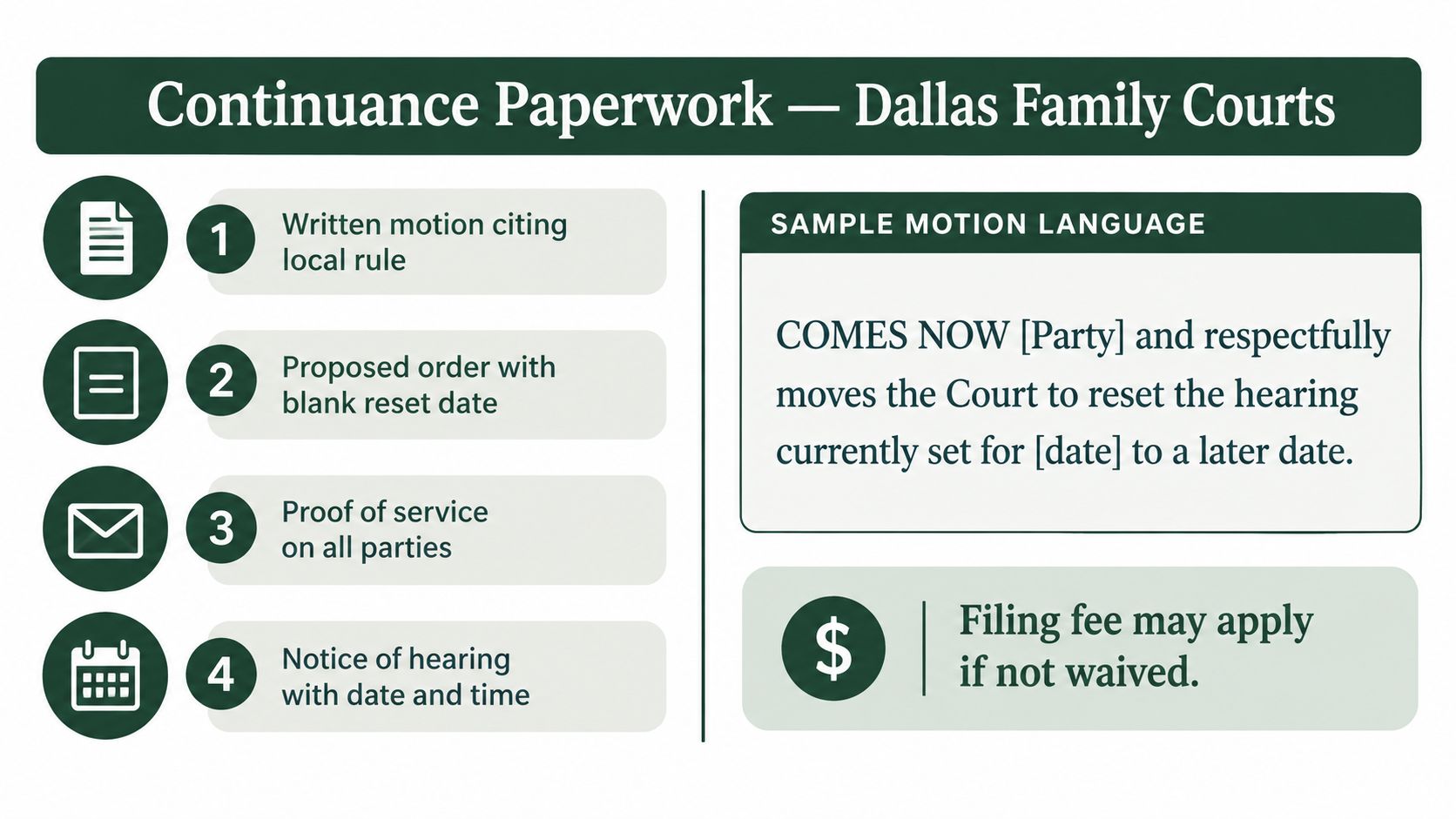
County rule versus courtroom practice
| County rule baseline | Court-specific addition |
|---|---|
| Consent by all parties, or notice and opportunity to object | Written motion may be required even for an agreed reset |
| Written motion and client approval after the one-year mark | Proposed order may be required with the motion |
| Court must grant the request | Hearing may be required for an older agreed case |
| Docket-call announcement matters | The court may require a new date supplied through its coordinator |
File through the authorized eFile process, confirm that the clerk accepted the filing, and check whether the motion was set for hearing. Self-represented parties can consult Dallas County pro se family-law forms and filing resources, but forms don't eliminate the need to follow the assigned court's local procedures.
Practical Next Steps for Dallas County Families
A denied continuance doesn't end your options, but it changes the immediate task. Begin preparing for the existing trial, custody hearing, enforcement proceeding, or temporary-orders setting unless the court enters another order.
Ask counsel to identify the reason for denial and whether the record should include findings or other clarification. If the ruling effectively ends the case or prevents meaningful relief, discuss whether an interlocutory appeal or another appellate remedy is legally available. Appellate options are highly fact-specific, and a denial by itself doesn't automatically create a right to immediate review.
If the continuance is granted, obtain the new date in writing and locate the signed reset order. Then review every deadline. Discovery, mediation, exhibits, witness lists, pretrial conferences, financial disclosures, and custody-related evaluations may not move automatically.
A practical Dallas follow-up list
- Confirm the docket: Verify that the new setting appears in the court's records.
- Read the order: Check whether it changes discovery, mediation, exchange, or pretrial deadlines.
- Calendar the next event: Include docket call, the new hearing, and every stated deadline.
- Notify the necessary people: Tell clients, witnesses, experts, and anyone coordinating records.
- Keep preparing: Don't stop trial preparation until the court's order makes the change effective.
Dallas residents can seek procedural information from the clerk's office at the George L. Allen, Sr. Courts Building, consult the Dallas County Law Library self-help desk, or look for Dallas Bar Association pro se family-law clinic resources. These sources may help with general process questions, but staff and self-help materials can't evaluate the evidence in a contested divorce, custody, support, relocation, protective-order, CPS, adoption, property-division, or appeal matter.

A parent or spouse facing a setting should gather the docket information, every scheduling message, the latest order, and the reason a reset is needed before speaking with counsel. The Law Office of Bryan Fagan, PLLC offers Dallas family-law consultations and can review the status of a requested reset or continuance, including the one-year issue and court-specific paperwork. Visit The Law Office of Bryan Fagan, PLLC to connect the scheduling problem with a practical plan for your Dallas County case.
