 Skip to content
If you are facing a criminal first appearance at the Frank Crowley Courts Building, you'll pass through security, check the digital docket on the second floor, report to your assigned courtroom or the County Clerk's office, and have your identity confirmed while the case timeline begins. The building is at 133 N. Riverfront Boulevard in Dallas, and your first date usually isn't a trial or a decision about guilt.
You may be holding a court notice, bond paperwork, or an attorney's message while trying to decide where to go. The most common mistake is assuming every Dallas County court matter belongs at Frank Crowley. Criminal cases generally route through Frank Crowley, while divorce, custody, child support, and other family-law matters are handled through the George L. Allen, Sr. Courts Building.

Table of Contents
- Understanding Your First Court Date at Frank Crowley Courts Building
- Arriving at the Courthouse and Passing Security
- Checking the Digital Docket and Finding Your Courtroom
- Distinguishing Criminal Courts from Family Courts in Dallas County
- What Happens During Your First Court Appearance
- Documents and Preparation Needed Before Court
- Next Steps After Your First Court Date
Understanding Your First Court Date at Frank Crowley Courts Building
Maria receives a notice telling her to appear in Dallas County criminal court. She knows the address, but not what will happen after she walks through the doors. She worries that the date means she'll immediately testify, face a jury, or receive a final ruling.
That fear is understandable, but a first appearance is commonly a procedural event. The court confirms who you are, checks the case assignment, and begins organizing the formal timeline. The case may later involve additional settings, plea discussions, or trial scheduling, but the first date usually isn't a determination of guilt or innocence. Dallas County's criminal-court operations remain centered at Frank Crowley, including criminal court records and clerk services, as described in Dallas County criminal-court information.
Why the courthouse matters
Frank Crowley is Dallas County's criminal-courts hub. The building was completed in 1966 as the Criminal Courts Building and renamed in 1983 for former Dallas County Commissioner Frank Crowley, who served from 1949 to 1974. Its history reflects Dallas County's move toward a large, centralized facility for high-volume court administration.
That centralized design explains why your first date can feel more like controlled routing than a traditional courtroom drama. The courthouse must identify the case, direct you to the proper courtroom, and coordinate the first procedural steps.
Practical rule: Your notice controls. Confirm the case type, courthouse address, courtroom assignment, and appearance date before leaving home.
If your matter involves divorce, custody, child support, possession, enforcement, or temporary orders, don't automatically follow criminal-court directions. Family cases generally belong at the George L. Allen, Sr. Courts Building, where the Dallas County family district courts operate.
Arriving at the Courthouse and Passing Security
Frank Crowley Courts Building is located at 133 N. Riverfront Boulevard in Dallas. Dallas County advises jurors to arrive about 45 minutes early because every visitor must pass through security screening, and heavy docket traffic can slow the process. The county's jury-services guidance explains the need to allow time for entry and screening.
Follow this arrival sequence
Leave extra time. Traffic, parking, elevators, and security can all affect when you reach the courtroom. Arriving early gives you time to read the docket and correct a routing problem without rushing.
Bring only what you need. Expect screening at the entrance. Avoid bringing weapons or other prohibited items, and don't assume a pocketknife or defensive spray will be permitted.
Complete screening calmly. Security personnel may inspect bags and direct visitors through screening equipment. Keep your identification and court papers accessible.
Move to the correct floor. The county's courthouse layout places sheriff, evidence, and related criminal-justice functions on the first floor. The digital docket for a defendant making a first appearance is located on the second floor.
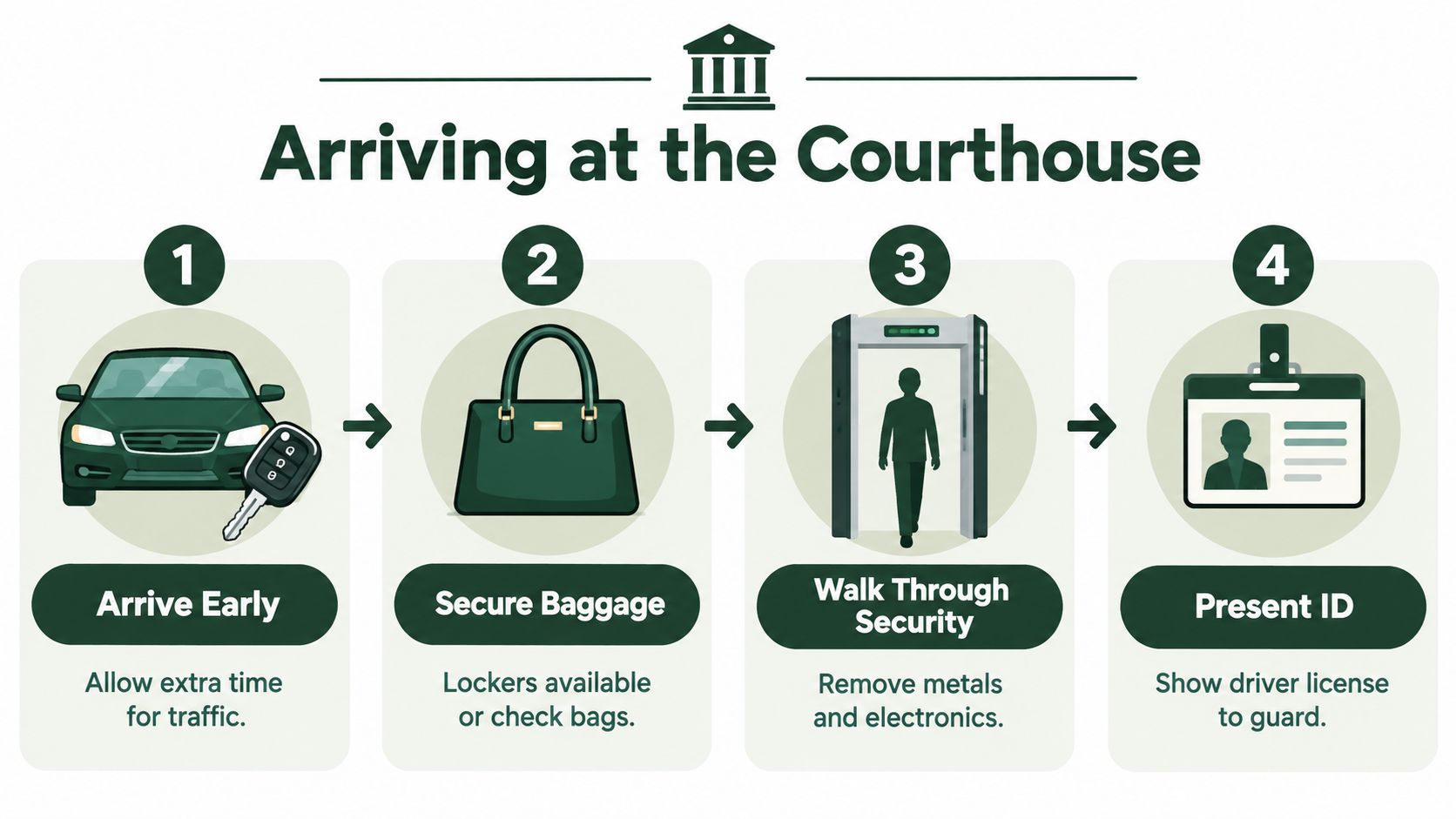
Wear clean, court-appropriate clothing and silence your phone before entering a courtroom. You don't need to perform for the judge, but respectful clothing and conduct help you avoid an unnecessary distraction.
If your case is filed in another Dallas County location, review the Dallas County subcourthouse locations in Garland, Richardson, and Mesquite before traveling. A city may be in Dallas County while a particular filing or court function is assigned elsewhere.
Checking the Digital Docket and Finding Your Courtroom
After security, the next question is simple: where is your case? Dallas County directs a defendant making a first appearance to the digital docket on the second floor of Frank Crowley Courts Building.
The process has two paths:
- Your name appears on the docket. Go to the assigned courtroom and follow the courtroom's instructions.
- Your name does not appear. Report to the County Clerk's office in Room A-1 for assistance.
This routing system matters because you shouldn't guess which courtroom to enter. The centralized docket helps connect the defendant, case assignment, courtroom, and bond conditions at the start of the case. Dallas County describes this process in its criminal-courts first-appearance FAQ.
A practical example
Suppose Daniel arrives with a notice but doesn't see his name on the second-floor digital docket. He shouldn't walk from courtroom to courtroom asking whether the judge has his case. He should go to Room A-1 and ask the County Clerk's office to help identify the correct next step.
If Daniel's name does appear, the docket should direct him to the assigned court. He may still wait before the case is called, particularly when the docket is busy. Waiting doesn't necessarily mean something is wrong, and a first setting may end with the court confirming the assignment and setting another date.
Bring your notice and identification while checking the docket. If the information seems inconsistent, tell the clerk or your lawyer rather than relying on assumptions.
A missing name is a routing problem to report, not a reason to leave.
The first appearance begins the formal case timeline. Later settings may address negotiations, motions, evidence, or trial scheduling, depending on the case and the decisions made by the parties and court.
Distinguishing Criminal Courts from Family Courts in Dallas County
The names sound similar enough to cause real confusion. Frank Crowley Courts Building is at 133 N. Riverfront Boulevard and serves as Dallas County's criminal-courts hub. The George L. Allen, Sr. Courts Building is at 600 Commerce Street, Suite 103, Dallas, Texas 75202, and serves as the main Dallas County family-law filing hub.
Use the case type as your first guide
| If your matter involves | Start with |
|---|---|
| A criminal charge or criminal first appearance | Frank Crowley Courts Building |
| Divorce, custody, child support, or family filings | George L. Allen, Sr. Courts Building |
| Family pleadings filed without counsel | The District Clerk's designated family and civil filing locations |
Family litigants may file family pleadings at the filing counter identified by the Dallas County District Clerk. Self-represented litigants may also file paper pleadings at the Pearl C. Smith Civil File Desk on the first floor west of the George L. Allen building. Pleadings that don't require a fee may be filed at the clerk's window adjacent to the court where the case is heard, according to Dallas County family filing guidance.

The George L. Allen building contains multiple numbered family district courts rather than one generic family courtroom. Dallas County listings place the 301st District Court on the 3rd Floor New Tower, the 256th District Court on the 4th Floor New Tower, the 302nd District Court on the 4th Floor West Tower, the 330th District Court on the 3rd Floor New Tower, the 255th District Court on the 4th Floor New Tower, and the 303rd District Court on the 4th Floor New Tower. The county's George L. Allen family-court guide can help readers understand that assignment structure.
Dallas County lists courthouse hours as 8:00 a.m. to 4:30 p.m. Even if you know the correct building, verify the assigned court and floor before arriving.
What Happens During Your First Court Appearance
A criminal first appearance generally starts with administrative questions. The court or clerk confirms identity, checks the case assignment, and begins the formal progression toward later settings. Depending on the case, the next date may relate to further announcements, negotiations, motions, or trial scheduling.
The court may not take testimony or decide the entire case that day. Your job is to arrive, check in as directed, listen carefully, and follow your attorney's instructions. Don't discuss the facts of your case with strangers in hallways, elevators, or public waiting areas.
Family cases follow a different path
A family-law first setting may involve temporary orders rather than a criminal appearance. Temporary orders can address immediate arrangements while a divorce or child-related case continues. Texas Family Code section 105.001 gives courts broad authority to issue temporary orders for a child's safety and welfare, including temporary conservatorship, temporary support, restrictions on disturbing the peace, geographical limits on removing a child, and reasonable attorney's fees and expenses. The text of Texas Family Code section 105.001 also contains important limits.
Unless there is a verified pleading or supporting affidavit under the Texas Rules of Civil Procedure, the court may not issue an order attaching the child's body, taking the child into the possession of the court or a court-designated person, or excluding a parent from possession or access. That qualification matters when a parent believes an emergency requires immediate restrictions.
Consider a parent who files a custody case and asks for temporary possession terms. The judge may address temporary conservatorship, support, or geographic restrictions, but the precise relief depends on the pleadings, evidence, service, and applicable procedure. A first family hearing can be significant, but it doesn't automatically decide every issue in the final case.
For divorce cases, early hearings may also involve temporary financial arrangements, possession of property, or payment of expenses. A business owner or executive should gather financial records early because ownership interests, retirement assets, investment property, stock compensation, separate-property tracing, and reimbursement claims can affect later property-division decisions.
Documents and Preparation Needed Before Court
Preparation starts with the paper that brought you to court. Read the notice rather than relying on a text message, memory, or an old email. Confirm whether the matter is criminal or family, then match the courthouse and courtroom information to the case.
Organize a small court folder
- Identification: Carry a current government-issued photo ID and keep it easy to reach during entry.
- Court notice: Bring the summons, citation, setting notice, or other document that identifies the appearance.
- Case papers: Include pleadings, bond paperwork, temporary orders, service documents, and correspondence related to the setting.
- Written questions: Note what you need to ask your attorney about the next date, documents, restrictions, or required preparation.
- Relevant records: For family matters, organize financial statements, parenting information, communications, and records that relate directly to the issues before the court.

Don't bring a stack of unrelated documents and expect the court to review everything immediately. A better approach is to separate urgent materials from background records and tell your lawyer what each document shows.
For a Dallas County family case, filing location can matter as much as hearing preparation. The District Clerk identifies the George L. Allen building as a family filing hub, while additional records and filing functions may be addressed through other county offices. The Dallas County records-building guide can help you distinguish courthouse services before making an in-person trip.
The first date is part of a longer timeline, so write down what happens before leaving. Record the next setting, documents requested, restrictions imposed, and questions your lawyer says need follow-up. If the court resets the matter, that isn't the same as dismissal, victory, or failure. It usually means the case requires another procedural step.
Next Steps After Your First Court Date
When the first date ends, don't judge the entire case by how brief or confusing the appearance felt. A criminal matter may move toward another setting, negotiations, motions, or trial scheduling. A family matter may move into temporary orders, discovery, mediation, settlement discussions, or trial preparation.
For example, a Dallas parent may leave a temporary-orders hearing with a temporary possession arrangement but still need to exchange financial information and prepare for later issues. A spouse with a closely held business may need to collect company records, tax information, ownership documents, retirement statements, and evidence supporting separate-property claims. Those tasks can shape property division without being fully resolved at the first appearance.
Questions to answer promptly
- What did the court order, and when does it take effect?
- What is the next setting for?
- Does anyone need to file or serve another document?
- Are temporary orders, enforcement, modification, relocation, CPS, or protective-order issues developing?
- Could a post-judgment enforcement or modification issue require separate action?
- If the court entered an appealable ruling, should an attorney evaluate appellate options and deadlines?
Don't assume a family order is self-executing in every practical respect. Possession exchanges, support payments, property transfers, retirement-account implementation, and business-related obligations can create disputes after an order is signed. Case-specific advice is especially important when safety, children, concealed assets, high income, or a contested business valuation is involved.
Before your consultation, gather the notice, docket information, existing orders, and a concise timeline. A Dallas family-law attorney can help identify which courthouse applies, what the first setting means, and which decisions deserve attention before the next date.
The Law Office of Bryan Fagan, PLLC offers guidance on Dallas divorce, custody, child support, temporary orders, enforcement, relocation, and complex property matters. If you're unsure whether your appearance belongs at Frank Crowley or the George L. Allen building, visit The Law Office of Bryan Fagan, PLLC to learn about available Dallas family-law resources and request a consultation.
