 Skip to content
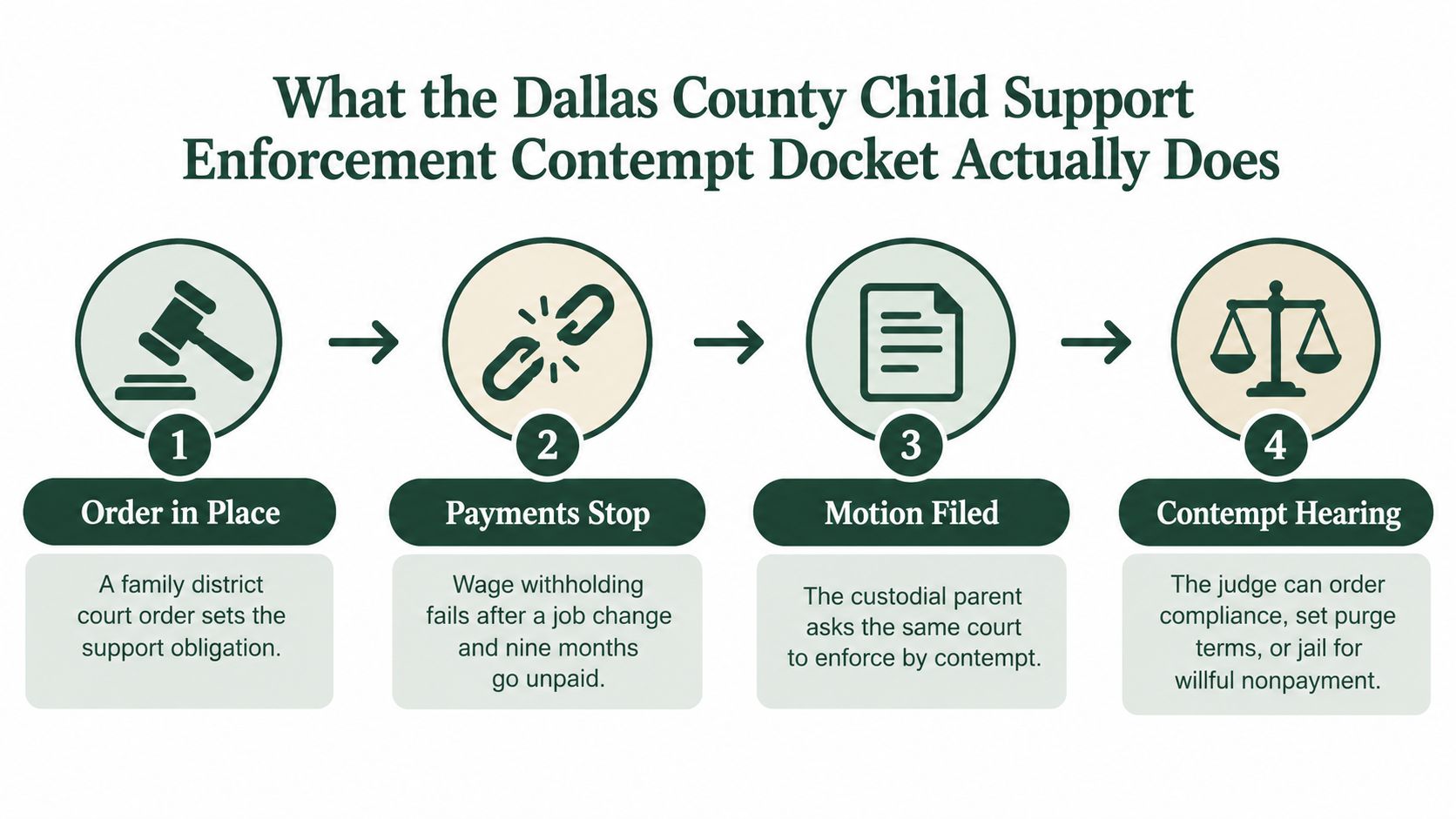
Maria lives in Pleasant Grove and has a child support order from a Dallas County family district court. Her former husband changed jobs, wage withholding stopped, and payments have now gone unpaid for months. She has a court order, but the money still isn't arriving. Her next question is practical: What does the Dallas County child support enforcement contempt docket do, and how does she get the case in front of a judge?
The answer is that contempt is a formal court-enforcement process for a parent who allegedly violated a support order. It isn't the same as asking the Dallas County registry to process payments or asking the Texas Attorney General to pursue administrative remedies. A contempt motion asks the court that issued or maintains jurisdiction over the support order to address specific violations, determine whether they were willful, and impose an authorized remedy.
Table of Contents
- What the Dallas County Child Support Enforcement Contempt Docket Actually Does
- Who Can File a Contempt Motion and How Dallas County Cases Get Enforced
- How to Place a Child Support Case on the Contempt Docket in Dallas County
- Evidence and Documents to Bring to a Dallas County Contempt Hearing
- Possible Outcomes and Sanctions After a Contempt Finding
- Defenses and Common Mistakes That Derail Contempt Motions
- Next Steps After a Contempt Hearing and When to Talk to an Attorney
What the Dallas County Child Support Enforcement Contempt Docket Actually Does
The Dallas County child support enforcement contempt docket gives the family district courts a structured way to hear alleged violations of child support orders. A parent who stops paying may face a motion that identifies each missed obligation, the amount due, and the payment history supporting the allegation. The court then decides whether the evidence establishes contempt and what relief, if any, is legally available.
Contempt can be civil, criminal, or both in the way the court structures the proceeding. Civil contempt is generally purgeable, meaning the respondent may avoid confinement by complying with a payment condition set by the court. Criminal contempt punishes past disobedience. Texas Family Code Chapter 157 governs child support enforcement proceedings, and the court must protect the respondent's due process rights before imposing confinement.
Practical rule: A missed payment doesn't automatically equal contempt. The motion must connect the missed payment to a valid order, a specific violation, proper notice, and evidence that supports the requested relief.
The docket exists because administrative tools don't solve every enforcement problem. Wage withholding, liens, license remedies, and the Attorney General's enforcement program may help collect support, but a private enforcement motion gives the family court a direct role when a parent continues to disregard the order. Dallas County explains that cases finalized before October 1, 2005 generally operate differently from later cases enrolled in its C.A.R.E. program, which uses the Attorney General's computer system to monitor and enforce orders automatically. A registry-only case has no monitoring, enforcement, or automatic wage garnishment, according to Dallas County's child support office.
For a local overview of the court process, see the Dallas County Title IV-D child support court docket resource. The George L. Allen, Sr. Courts Building is a familiar location for Dallas County civil and family court business, but a party must confirm the assigned court, filing instructions, and hearing location before appearing.
Who Can File a Contempt Motion and How Dallas County Cases Get Enforced
A child support contempt case can arise through different enforcement channels. The custodial parent may pursue enforcement privately. A governmental assignee may have an interest in support assigned for public benefits. The Texas Attorney General's Child Support Division may also pursue enforcement in a case it administers.
The first question is not just “Who is owed money?” It's how the case is being administered. Dallas County distinguishes between cases that are only set up to receive and disburse payments and cases receiving active monitoring and enforcement through C.A.R.E. The county states that a registry-only case doesn't include monitoring, enforcement, or automatic wage garnishment. That distinction affects whether a parent should expect the government to file enforcement or whether a private motion is necessary.
Registry-only and full-enforcement paths
| Path | Who files contempt | Cost | Docket route |
|---|---|---|---|
| Registry-only case | Usually the private party seeking enforcement | Filing and service expenses may apply, unless the party qualifies for relief | File in the court with continuing, exclusive jurisdiction |
| Full-enforcement C.A.R.E. case | The Office of the Attorney General may pursue enforcement | The OAG may provide enforcement services without charging the applicant for that service | Coordinate with the OAG and the assigned family district court |
The Attorney General's Child Support Division is Texas's state enforcement agency. Its available remedies may include contempt, probation, and possible incarceration, as described in the agency's child support enforcement guidance. Administrative enforcement and private courtroom enforcement can exist alongside each other, but they aren't interchangeable.
A parent should review the existing order, payment records, and correspondence from Dallas County or the OAG before deciding what to file. The Dallas County child support payment process can help identify whether the case is routed through a registry or an active enforcement program. Don't assume that an agency case automatically means an enforcement motion is already pending.
How to Place a Child Support Case on the Contempt Docket in Dallas County
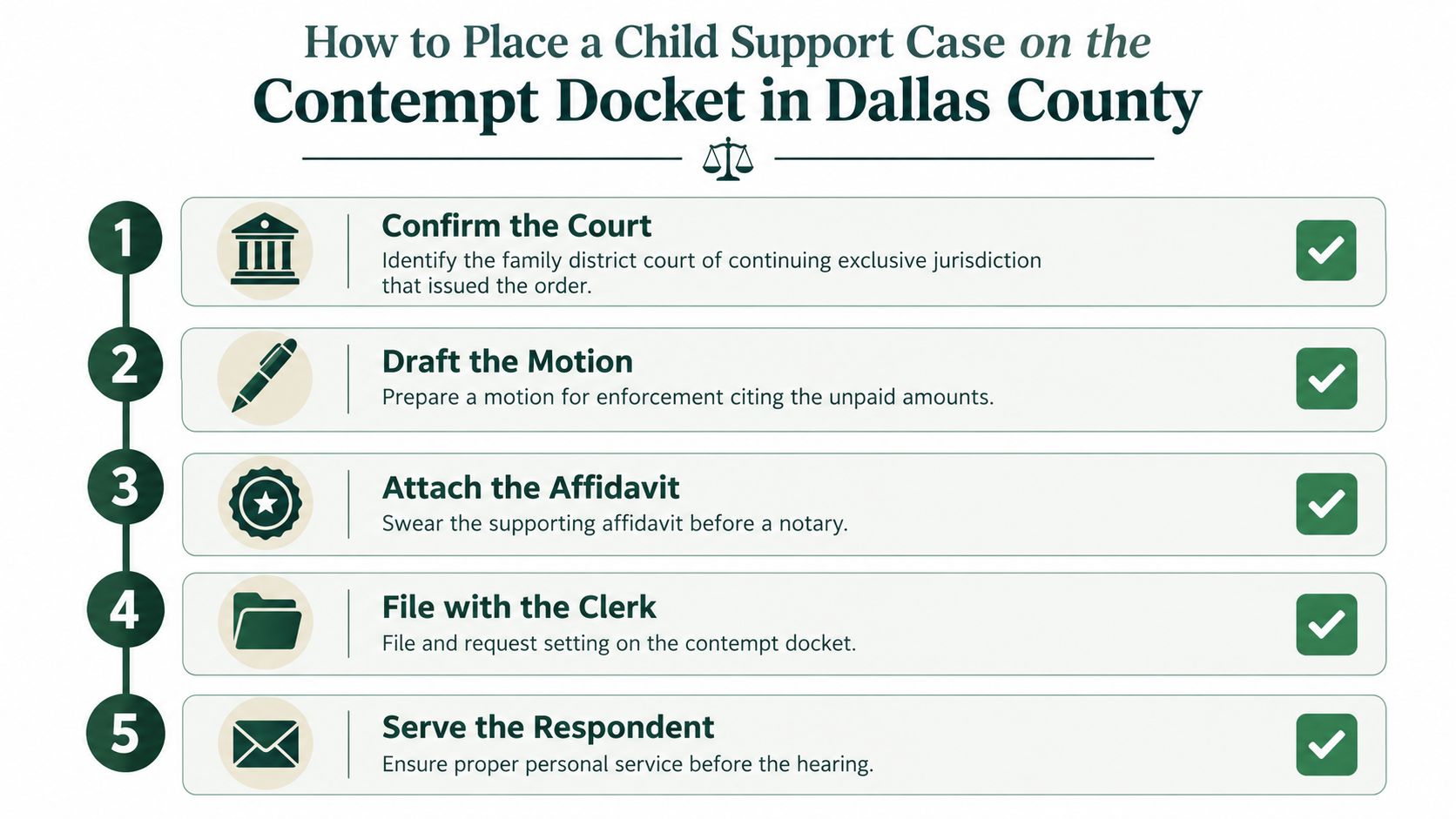
The filing process starts with jurisdiction, not with the courthouse line. A contempt motion generally belongs in the court of continuing, exclusive jurisdiction, usually the Texas family district court that issued the original support order. A move to Garland, Mesquite, Lancaster, or outside Dallas County doesn't automatically transfer that jurisdiction.
Start with the correct court and pleading
Read the prior order and confirm the cause number, court designation, parties, and support provisions. The motion must plead violations with enough detail for the respondent and the judge to understand what allegedly happened. Texas Family Code §157.002 requires specific allegations, including the obligation, the date or period of noncompliance, and the amount claimed.
The filing commonly includes:
- Motion for enforcement. Identify the order, the provision allegedly violated, each missed payment, and the relief requested.
- Verified payment history. Use a clear ledger that separates the amount ordered, payments credited, and balance claimed.
- Order to show cause. This gives the respondent notice of the allegations and hearing.
- Proposed contempt and commitment orders. Dallas County practice materials call for a proposed contempt order and order of commitment before a contempt hearing will be heard.
- Service materials. The respondent must receive legally sufficient notice and service before the court can impose contempt sanctions.
Don't rely on a vague statement such as “support hasn't been paid for a long time.” That language may communicate the problem, but it doesn't give the court a violation-by-violation record to decide.
File, coordinate, and serve carefully
A filing may be submitted through eFileTexas to the Dallas County District Clerk. Confirm the current clerk instructions, applicable fees, and indigency procedures before submission. The District Clerk's office is associated with the George L. Allen, Sr. Courts Building at 600 Commerce Street, but the court coordinator should confirm the proper courtroom and docket setting rather than relying on an old notice or an informal schedule.
Service deserves the same attention as the pleading. Texas Family Code §157.061 contains service requirements for enforcement proceedings, and the precise method may depend on the relief requested and the respondent's location. Use a Dallas County constable or qualified process server when appropriate, and keep the return of service.
The Dallas County family court coordinator hearing guide is a useful starting point for confirming local setting information. Court calendars and filing practices can change, so call the assigned coordinator before filing if the notice, online docket, or prior correspondence leaves any doubt.
Evidence and Documents to Bring to a Dallas County Contempt Hearing
A contempt hearing turns on proof. Bring documents that let the judge move from the original order to the alleged violation without guessing. The petitioner should organize the file before arriving at the courthouse, not while the case is being called.
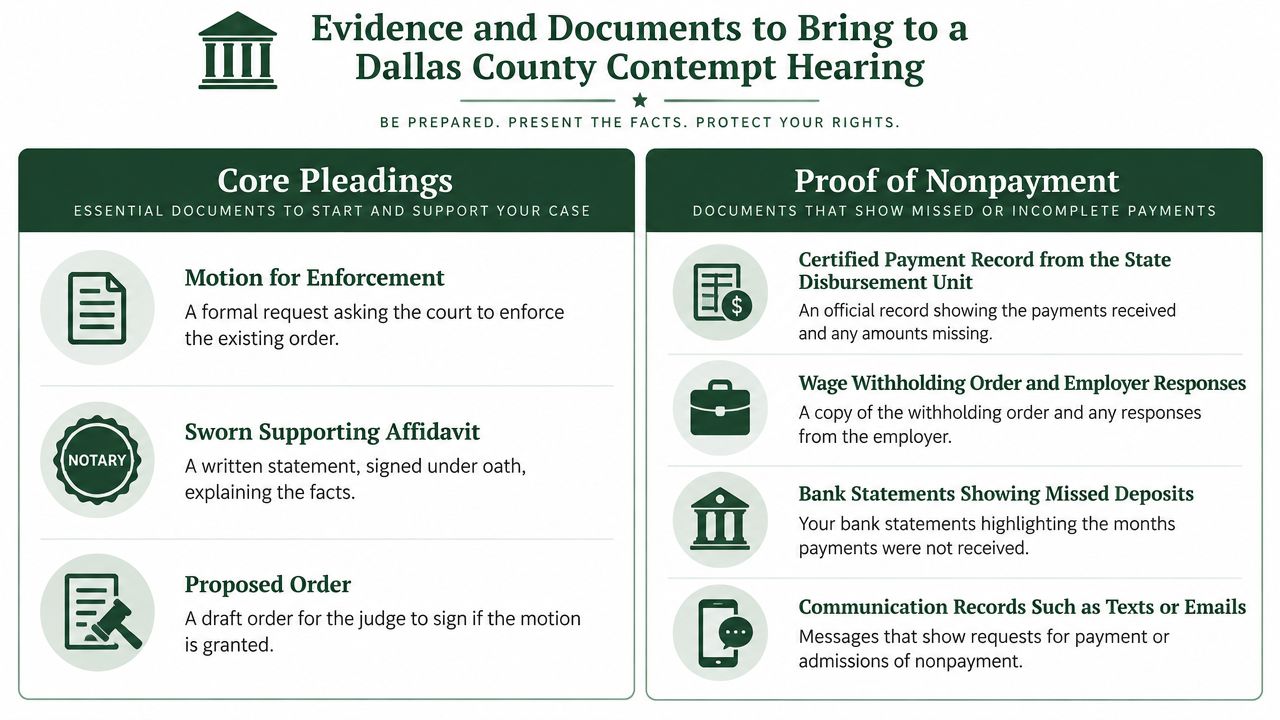
The core court file
Bring the following:
- Original support order: Include the final decree, modification order, or other enforceable order containing the payment obligation.
- Motion for enforcement: Bring the filed version, including attachments and file-stamped confirmation.
- Sworn affidavit: The supporting affidavit should be properly sworn before a notary and should match the allegations in the motion.
- Proposed order package: Include the proposed contempt order and order of commitment, with requested payment and confinement conditions completed for the court's review.
- Proof of service: Bring the citation, return, waiver, or other evidence showing legally sufficient notice.
Payment and ability-to-pay evidence
A payment ledger from the Dallas County child support registry is central when payments were supposed to pass through that system. If the matter runs through C.A.R.E., obtain the OAG payment history as well. Compare the ledger against bank statements, canceled checks, money-transfer records, and any direct payments that may not appear in the registry.
Employer records may also matter. Wage withholding orders, employer responses, and evidence of a job change can help explain why withholding stopped, but they don't by themselves prove willful contempt. Text messages or emails may show that the respondent knew about the order, acknowledged the balance, refused payment, or proposed a payment arrangement.
Bring proof of identity and jurisdiction, including the prior order and documents needed to connect the parties and children to the case. Make labeled copies for the judge, the opposing party, and the clerk. A binder organized by order, pleadings, service, payment history, financial records, and communications is far more useful than a stack of screenshots.
Possible Outcomes and Sanctions After a Contempt Finding
The court's options depend on the pleaded violations, the evidence, the requested relief, and the respondent's ability to comply. A contempt finding doesn't guarantee jail, and a payment plan doesn't erase the underlying arrears.
Texas Family Code Chapter 157 permits significant sanctions. Dallas County and the Texas State Law Library describe child support contempt as a remedy that may include up to six months in jail, a fine of up to $500 for each violation, attorney's fees, and court costs. Those limits and remedies are summarized in Dallas County's general child support enforcement FAQ and the Texas State Law Library's contempt explanation.
How courts may structure relief
A judge may order a payment condition that allows the respondent to avoid confinement by completing specified compliance steps. The order must state the purge condition clearly. Depending on the facts, the court may also address ongoing support, attorney's fees, court costs, and collection mechanisms that operate after the hearing.
| Outcome | Effect on respondent | Texas authority |
|---|---|---|
| Purge condition | Requires payment or another defined act to avoid confinement | Texas Family Code Chapter 157 |
| Confinement | May include jail for qualifying contempt violations | Texas Family Code §157.166 and related provisions |
| Fine | May reach $500 for each violation | Dallas County and Texas State Law Library materials |
| Fees and costs | May require payment of attorney's fees and court costs | Texas Family Code §157.167 |
| Administrative collection | May continue through withholding, license remedies, or other enforcement tools | Texas Attorney General Child Support Division |
The limitations rule matters. Under Texas Family Code §157.005, contempt jurisdiction for confinement is preserved only when the enforcement motion is filed no later than two years after the child becomes an adult or after support terminates. Recovery of arrears through a money judgment extends to 10 years under the same statute, subject to the statute's requirements and exceptions. The Texas Family Code text should be reviewed with the actual order and dates.
A large arrearage can remain collectible even when jail-based contempt is unavailable. That distinction is why filing strategy matters.
Defenses and Common Mistakes That Derail Contempt Motions
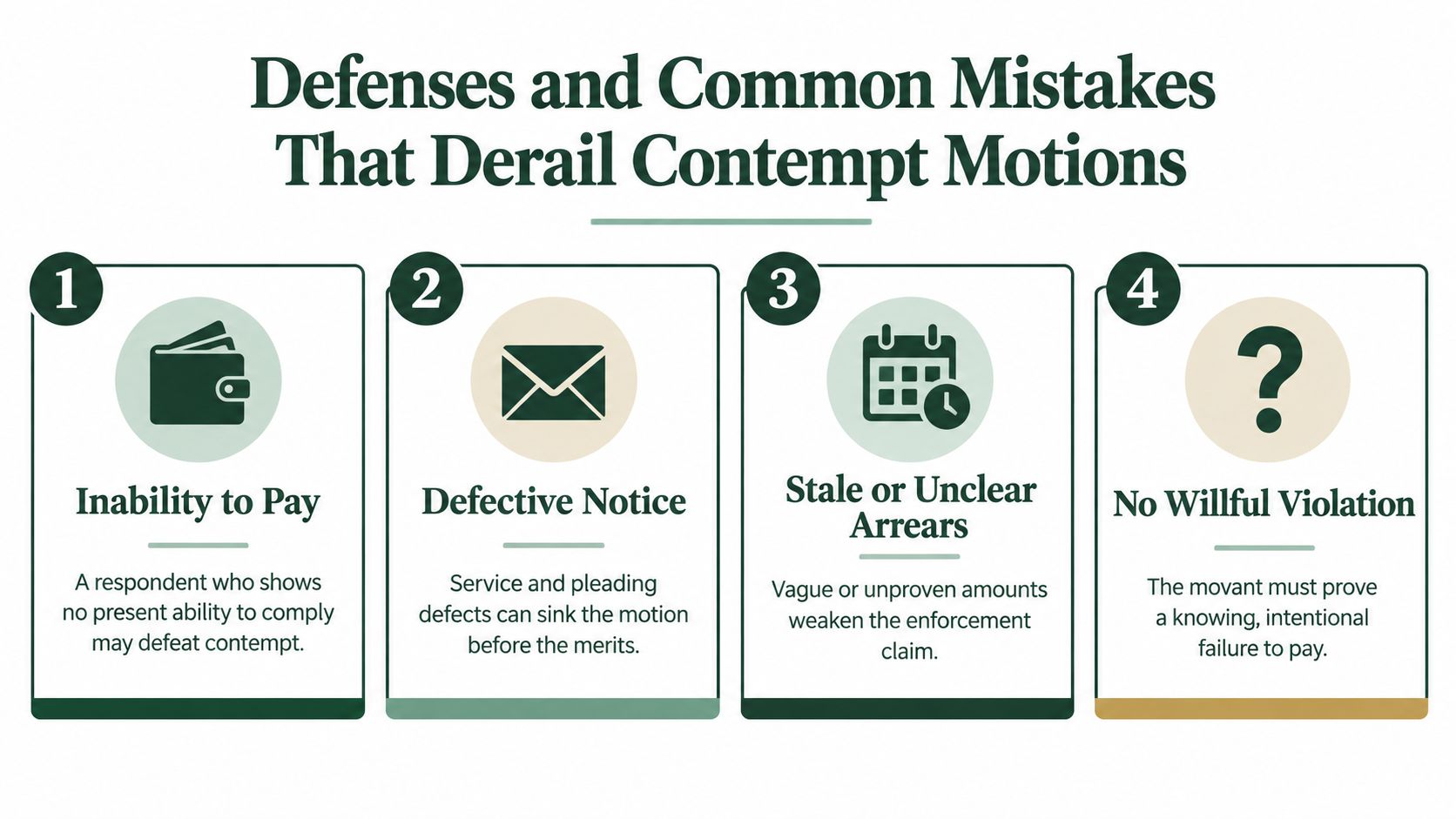
A contempt motion can fail before the judge reaches the amount of arrears. The most serious errors involve defective notice, unclear allegations, weak payment proof, or a record that doesn't establish a willful violation.
The respondent's strongest factual defense
Inability to pay is not the same as refusing to pay. A respondent should gather termination notices, disability records, job-search evidence, bank statements, proof of housing and necessary expenses, and records of partial payments. The issue is whether the evidence shows a present inability to comply and whether the respondent made reasonable efforts, not merely whether the respondent currently has limited funds.
A parent who changed jobs may have a different defense from a parent who hid income or ignored repeated notices. The court can evaluate employment history, available resources, payment efforts, and the explanation for each missed obligation.
Defects that create dismissal or delay
- Vague allegations: The motion should identify the controlling order, the provision violated, dates, amounts, and unpaid balances.
- Unreliable ledger: Payment records should account for credits, withholding, direct payments, and disputed entries.
- Improper verification: A statement that isn't properly sworn may not support the relief requested.
- Insufficient service: A respondent needs legally adequate notice and service before the court can impose contempt punishment.
- Late confinement request: A motion filed outside the Texas Family Code §157.005 confinement period may support money-judgment relief but not jail-based relief.
- Missing proposed orders: An incomplete pre-hearing package can prevent the matter from being ready for the contempt docket.
A payment dispute needs a reconciled ledger, not a guess based on the last deposit.
The petitioner should correct defects before requesting a hearing. The respondent should file a focused response and bring evidence rather than relying on a general denial. A continuance or dismissal may be appropriate in some cases, but the outcome depends on the pleading, service, record, and court's ruling.
Next Steps After a Contempt Hearing and When to Talk to an Attorney
After the hearing, follow the written order, not an informal conversation in the hallway. If the judge finds contempt and imposes a purge condition, make the required payment through the designated Dallas County registry or other method stated in the order, keep proof of every transaction, and avoid creating new violations.
If the court dismisses the motion, that doesn't necessarily end every collection option. The remaining choices may include a new enforcement strategy based on properly documented violations, a modification under Texas Family Code Chapter 156 when circumstances support changing the order, or a writ of execution against property where legally available. A dismissal based on pleading or service defects is different from a decision that the alleged violations weren't proven.
When legal help is justified
Speak with a Dallas County family law attorney promptly when:
- The order is unclear: Conflicting language about support, medical support, credits, or effective dates can change the calculation.
- The arrears are disputed: A payment ledger must be reconciled before anyone asks the court for confinement.
- The case involves interstate enforcement: UIFSA issues can affect registration, jurisdiction, modification, and enforcement.
- Administrative remedies are escalating: License suspension or other OAG action may require a coordinated response.
- A purge order is unaffordable: The respondent needs evidence and a legally sound proposal before accepting conditions that can't be met.
- The case involves additional family disputes: Custody modification, possession, relocation, protective orders, or paternity issues can change the practical strategy.
The Dallas County District Clerk's enforcement desk and the assigned family court coordinator can provide procedural information, but clerks can't choose a legal strategy or tell you how a judge will rule. Bring the order, payment history, notices, and prior filings to a consultation so the attorney can assess jurisdiction, deadlines, proof, and the difference between contempt and other collection remedies.
The Law Office of Bryan Fagan, PLLC offers Dallas County family-court enforcement representation, including preparation for child support contempt hearings and review of orders and payment histories. Visit The Law Office of Bryan Fagan, PLLC to request case-specific guidance from the firm's Dallas office.
