 Skip to content
Felony cases in Dallas County are heard by the county's 17 felony district courts, with proceedings centralized at the Frank Crowley Courts Building. There isn't one Dallas County criminal district court that hears every felony, because the felony docket is divided among those courts.
A family member may have been arrested, received paperwork mentioning “District Court,” or found a case number that doesn't clearly identify the courtroom. Searching for “Dallas County criminal district court which one hears felonies” usually reflects two separate concerns: which level of court has authority over the charge, and which numbered court has the individual case. The distinction matters because it affects where the case is filed, which clerk maintains the records, where hearings occur, and how the family tracks the next setting.
Table of Contents
- Which Dallas County Court Actually Hears Felonies
- How Dallas County Splits Felony and Misdemeanor Cases
- Inside the 17 Felony District Courts
- What Happens After a Felony Case Is Filed in Dallas
- Finding Your Court Number and Docket in Dallas County
- Felony vs Misdemeanor Courts in Dallas County Compared
- Practical Next Steps for Dallas County Residents
Which Dallas County Court Actually Hears Felonies
The direct answer is the Dallas County felony district-court system. Dallas County's official criminal courts information states that each of its 17 Criminal District Courts has original jurisdiction over all felony cases. The District Clerk explains that its Criminal Section supports those district courts when they receive felony matters from the Dallas County Grand Jury. See the Dallas County Criminal District Courts information and the District Clerk's Criminal Section description.
That means the answer isn't “Criminal District Court No. 3” or “the 194th District Court” for every case. Those are individual courts within a larger county system. A particular felony is assigned to one court, but the assignment depends on the case and the county's docket administration.
Why the wording on the paperwork matters
Suppose your brother was arrested in Dallas, and his paperwork refers to a criminal district court without naming a judge. That usually tells you the case is on the felony track, but it may not tell you everything you need to know about the next hearing. The specific court number, case number, courtroom, and setting date still need to be confirmed through the District Clerk or the assigned attorney.
The phrase “district court” can also confuse families handling a divorce or custody matter at the same time. Dallas County family district courts are district courts too, but they handle family-law disputes, not felony prosecutions. A criminal felony case belongs in the criminal district-court system at Frank Crowley.
Practical rule: First identify whether the case is a felony or misdemeanor. Then identify the specific court assigned to that case.
The distinction between felony and misdemeanor jurisdiction answers the first question. The docket and clerk records answer the second.
How Dallas County Splits Felony and Misdemeanor Cases
A felony is generally a criminal offense that can carry more than one year in state prison. Texas felony classifications range from state jail felonies through capital felonies, but the exact classification and punishment depend on the charge and the facts. Because felony cases carry the possibility of state imprisonment, Texas assigns original jurisdiction over them to district courts.
Dallas County's official court-records materials draw the local line clearly: felony matters received from the grand jury go to district courts, while county criminal courts handle misdemeanor matters. The Dallas County Court Records page is useful because it addresses the distinction many people need when they're trying to locate a case.
County criminal courts generally handle misdemeanor prosecutions, while the 17 Criminal District Courts handle felony cases. A misdemeanor may still be serious, especially when a person faces jail exposure, a protective order, driving consequences, or restrictions affecting employment and family life. But it follows a different court track from an indicted felony.
| Case Type | Court | Typical Offense Class | Location |
|---|---|---|---|
| Felony | Dallas County Criminal District Courts | State jail felony through capital felony classifications, depending on the charge | Frank Crowley Courts Building |
| Misdemeanor | Dallas County Criminal Courts | Class A, B, and C misdemeanors, depending on the offense | Dallas County criminal court facilities |
The court level is a jurisdictional issue, not merely an administrative label. If a case is filed as a misdemeanor, the County Clerk's criminal records system may be the appropriate place to look. If a grand jury returns a felony indictment, the District Clerk's criminal section and felony records system become central to tracking the case.
Why families often search for the wrong court
A parent may hear that an arrest happened at the county jail and assume the case belongs in a county criminal court. Another family member may see the word “district” and assume the case is a civil lawsuit or family-law proceeding. The charge level, not the building alone, determines which court system is relevant.
A charge can also develop as prosecutors review evidence. Don't rely only on the arrest description. Confirm the filed case, indictment status, and assigned court from official Dallas County records or counsel handling the matter.
Inside the 17 Felony District Courts
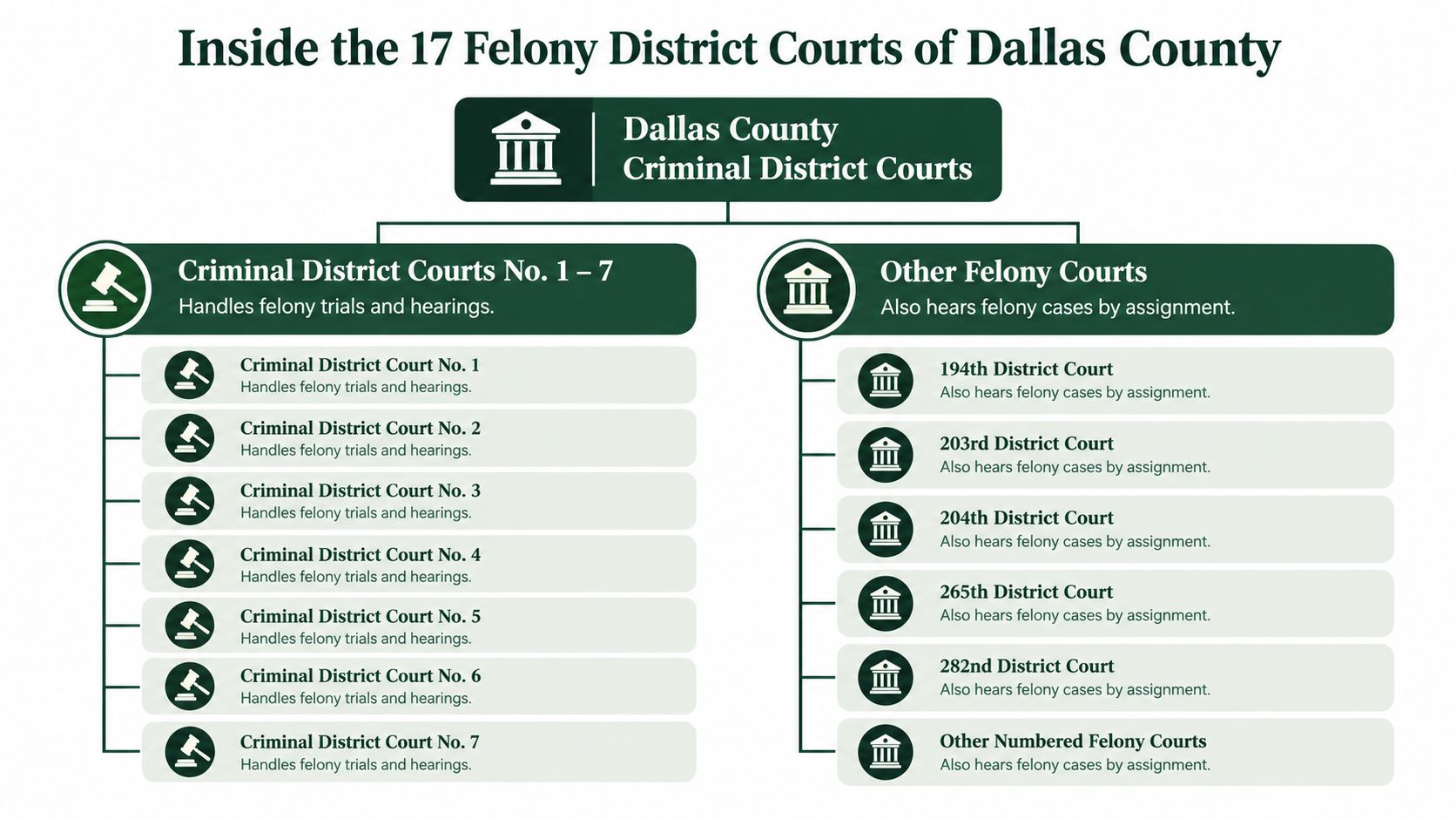
Dallas County's felony system includes Criminal District Courts Nos. 1 through 7, along with additional numbered district courts that hear felony matters. Official county materials identify the system as 17 district courts handling felony criminal matters. The county's court-identification materials also show that felony courts use court designations and shorthand codes for scheduling, records, and case tracking. Review the Dallas County court identification codes when a record contains an unfamiliar designation.
The individual courts aren't interchangeable from a family member's perspective. Each case has an assigned court, and that assignment determines where the docket is maintained and which courtroom handles hearings. A case may be assigned to Criminal District Court No. 1 through No. 7 or to another numbered felony district court, such as the 194th, 204th, 282nd, or 363rd.
Assignment is different from venue
Venue usually concerns the county where the alleged offense occurred. If the offense occurred in Dallas County, the prosecution is generally handled through Dallas County's criminal court system, subject to the legal rules and facts that apply to the case. Assignment, by contrast, concerns which individual felony court receives the filed matter.
The county's materials describe felony processing as centralized at the Frank Crowley Courts Building, 133 N. Riverfront Boulevard. Centralization helps explain why people from different Dallas County communities may report to the same complex even though their arrests occurred in different cities.
The building is centralized, but the case is still tied to a particular court number and docket.
The presiding administrative structure distributes cases among the felony courts. Don't assume that the arresting agency, the defendant's home address, or the courthouse entrance determines the assigned judge. Check the official docket and court records instead.
What Happens After a Felony Case Is Filed in Dallas
A felony case can involve several stages, and the order or timing can vary with the charge, bond status, evidence, motions, and court scheduling. The broad path begins with an arrest and booking, proceeds through grand-jury review, and then moves into the assigned felony district court if an indictment is returned.
The Frank Crowley Courts Building at 133 N. Riverfront Boulevard is the central location for felony criminal processing. The District Clerk's Criminal Section and Felony Records Desk serve the felony district courts there, according to Dallas County's District Clerk resources.
A family member will usually encounter these stages:
- Booking and bond: After arrest, the person is processed, and bond conditions may be established through the criminal system.
- Grand-jury review: The grand jury considers whether to return an indictment. An indictment is the formal charging document that moves the felony case forward.
- Arraignment or initial court setting: The defendant appears before the assigned court, hears the charge, and enters a plea or addresses the next procedural setting.
- Pretrial litigation: Counsel may address discovery, evidentiary issues, motions to suppress, bond concerns, and other questions before trial.
- Negotiation: The defense and prosecution may discuss a possible resolution. A family should not treat negotiations as a guaranteed outcome.
- Trial or plea: The case may resolve through a plea agreement or proceed before a judge or jury.
- Sentencing: If there's a conviction or negotiated plea requiring punishment, the court handles sentencing under the applicable law.

Families often feel lost because a “court date” may be a status setting rather than a trial. Read the notice carefully, confirm whether attendance is required, and ask counsel what the hearing is designed to accomplish. The Dallas County records-building guide can also help explain how local county records offices fit into the process.
Finding Your Court Number and Docket in Dallas County
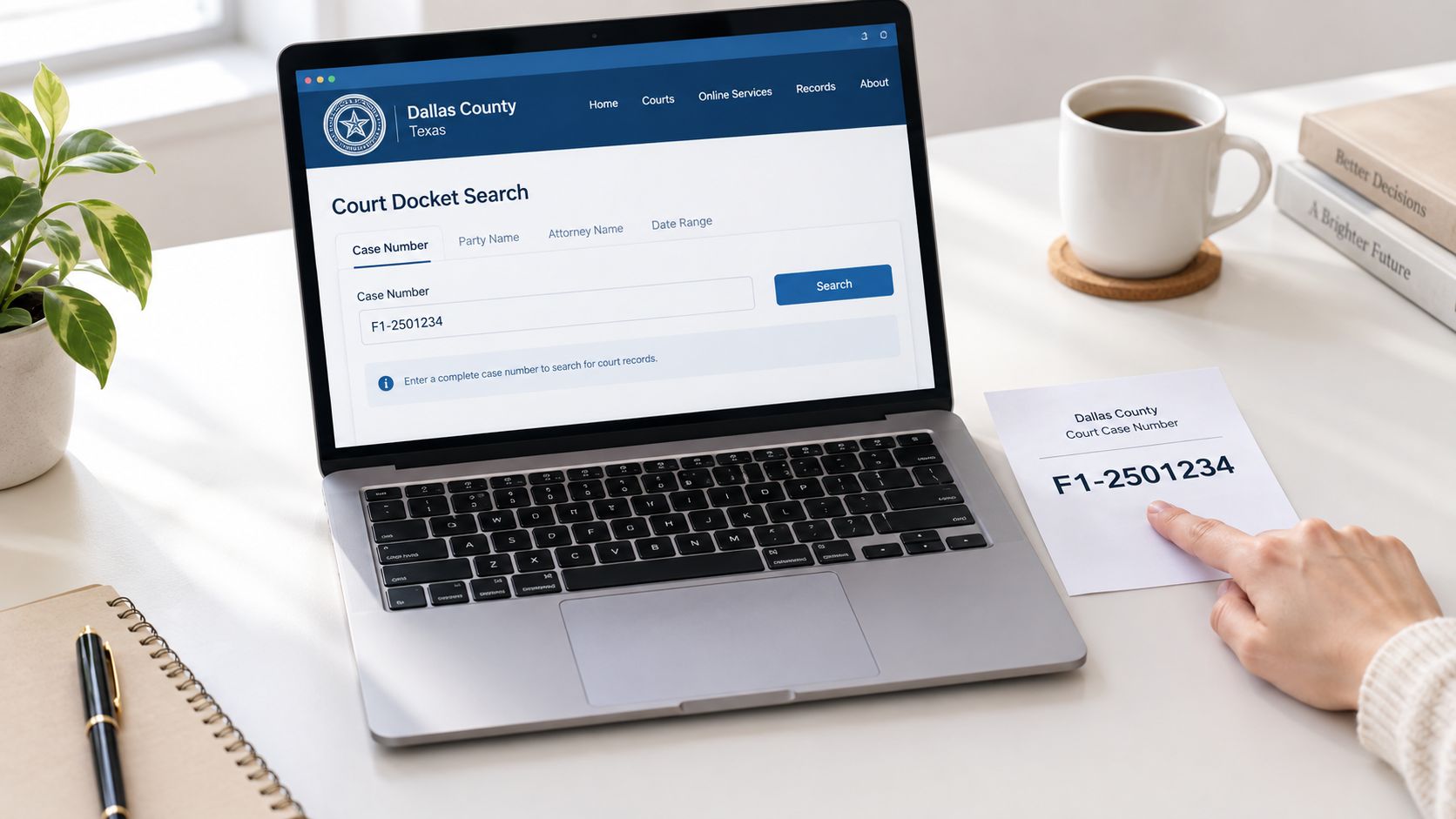
Once a felony case enters the district-court system, the most useful identifying information is usually the defendant's full name, case number, assigned court, and next setting date. The indictment or court paperwork may identify the court directly, but documents can arrive at different points, especially while the case is moving from arrest through formal filing.
Dallas County's online criminal-record tools may allow a search by name or case number. A search result can show events such as an arraignment, a bond-related entry, a pretrial conference, a motion, a plea setting, or a disposition. Those labels don't always explain what happened in plain English, so don't assume that a docket entry means the case ended.
Use the right clerk's office
The District Clerk maintains felony criminal records and serves the felony district courts. The County Clerk handles county-level records, including the misdemeanor criminal court side of the system. Searching the wrong clerk's database can make a case appear missing when the actual issue is that the searcher is using the wrong record system.
If the online result is incomplete or confusing, contact the clerk's office or ask the assigned attorney to confirm the next setting. Dallas County's official felony-records information identifies the Criminal Section, felony records services, and collections operations at Frank Crowley, with separate functions for records and court business.
For residents who need local access information outside downtown, the Dallas County subcourthouse locations may help with county services. A subcourthouse won't change the felony court assignment, but it can clarify where other county transactions are available.
Read docket entries cautiously
A hearing date may be reset, a motion may be pending, or an entry may reflect a routine administrative action. Verify the current setting before traveling to the courthouse. Court information can change, and the most reliable answer for a specific case comes from the court record, the clerk, or the defendant's attorney.
Felony vs Misdemeanor Courts in Dallas County Compared
The felony and misdemeanor systems share a Dallas County courthouse environment, but they aren't the same legal track. A person charged with a misdemeanor generally deals with a county criminal court, while a person formally indicted for a felony proceeds in a Criminal District Court.
That distinction affects the record custodian, the court number, the charging path, and the possible trial process. It also explains why two people arrested in the same Dallas neighborhood may later receive instructions from different clerks and different courtrooms.
| Feature | Felony District Courts | Misdemeanor County Criminal Courts |
|---|---|---|
| Court authority | Original jurisdiction over felony cases | Handles county-level misdemeanor matters |
| Formal charging path | Felony matters received from the Dallas County Grand Jury | Misdemeanor filing and county-court proceedings |
| Records office | Dallas County District Clerk's Criminal Section | Dallas County Clerk's criminal records system |
| Court location | Frank Crowley Courts Building | Dallas County criminal court facilities |
| Case tracking | Felony court designation and district-court docket | County criminal court designation and docket |
| Possible resolution | Plea, dismissal, trial, or other lawful disposition | Plea, dismissal, trial, or other lawful disposition |
A felony trial and a misdemeanor trial can also involve different procedural requirements. The precise jury, punishment range, discovery obligations, and hearing sequence depend on the charge and the applicable Texas law. Don't rely on a general internet comparison to make a decision about a specific case.
Why the distinction affects the family
If someone is facing a felony, family members may need to track a district-court docket, help collect records for counsel, understand bond restrictions, and plan transportation to Frank Crowley. If the matter is a misdemeanor, the correct clerk and court may be different even though the arrest occurred in the same county.
Charges can also carry serious consequences for employment, housing, immigration, firearms rights, professional licensing, and family-law disputes. A criminal allegation may become relevant in a Dallas divorce, custody modification, protective-order proceeding, or CPS matter, but the criminal and family cases remain separate proceedings. Don't assume that information filed in one case automatically resolves the other.
Practical Next Steps for Dallas County Residents
After you identify the felony court, focus on preserving options rather than trying to argue the case yourself. The defendant should avoid discussing the facts with investigators, alleged victims, witnesses, or prosecutors without advice from a Texas-licensed criminal defense attorney. Even conversations that seem informal can affect the defense.
Build a reliable case file
Collect the arrest paperwork, bond documents, indictment if available, court notices, jail information, and every message from counsel or the court. Keep a written calendar of settings and conditions. If the defendant has restrictions involving travel, contact, residence, employment, or testing, follow the written order exactly unless the court changes it.
Ask counsel to explain:
- The assigned court: Confirm the court number, judge, case number, and next setting.
- The evidence: Ask how discovery will be obtained and reviewed.
- The bond terms: Understand every condition and the consequences of a violation.
- The immediate decisions: Discuss whether counsel needs to preserve video, records, messages, witness information, or other evidence.
- Family-law effects: If a divorce, custody, CPS matter, or protective order is pending, tell both attorneys about the criminal case.
The Texas State Bar attorney-lookup and discipline resources can help you verify licensing and publicly available disciplinary information. Dallas County residents who qualify may also contact the Dallas County Public Defender's Office. A person who doesn't qualify for appointed representation can ask about private counsel or the Dallas Bar Association's Lawyer Referral Service, including whether a lower-cost consultation is available.
Prepare for the courthouse
Frank Crowley is a busy public building, and security screening takes time. Confirm the courtroom before leaving home, bring identification and case paperwork, dress appropriately for court, and arrange transportation to 133 N. Riverfront Boulevard. Don't miss a setting because a family member misunderstood whether it was an announcement, motion hearing, plea setting, or trial.
Dallas County Community Supervision and Corrections may also be relevant to pretrial services or supervision-related requirements, depending on the case and court orders. The assigned attorney should explain which agency handles a particular condition and how compliance is documented.
The Dallas criminal law FAQ provides general information about criminal-defense questions, but online information can't determine what a specific defendant should do. If the case also affects divorce, custody, support, property division, or parental rights, coordinate advice across the criminal and family-law proceedings before signing an agreement or making a statement.
The Law Office of Bryan Fagan, PLLC offers consultations about Dallas County felony defense and can help a family understand the assigned court, docket, bond conditions, and available defense options. Visit The Law Office of Bryan Fagan, PLLC to request information about connecting with a Texas attorney regarding the next step in the case.
