 Skip to content
You've made the decision to seek protection, but the practical question is now urgent: where do you file a Dallas County protective order application? If you're standing in your kitchen with court forms, police reports, or threatening messages on your phone, the answer isn't always just “go to Frank Crowley.”
Dallas County has two genuine filing routes. You may self-file with the Dallas County District Clerk at the Frank Crowley Courts Building, or you may seek assistance from the Dallas County District Attorney's Protective Orders division at that same building. A pending divorce or custody case can change where the application belongs, even when you live in Dallas County.
Table of Contents
- What You Need to Know Before You Walk Into the Courthouse
- Texas Venue Rules for Protective Orders
- Two Filing Routes in Dallas County
- Filing Day at the Frank Crowley Courts Building
- Emergency and After-Hours Relief
- Forms and Documents to Bring
- How a Pending Dallas County Divorce Changes Where You File
What You Need to Know Before You Walk Into the Courthouse
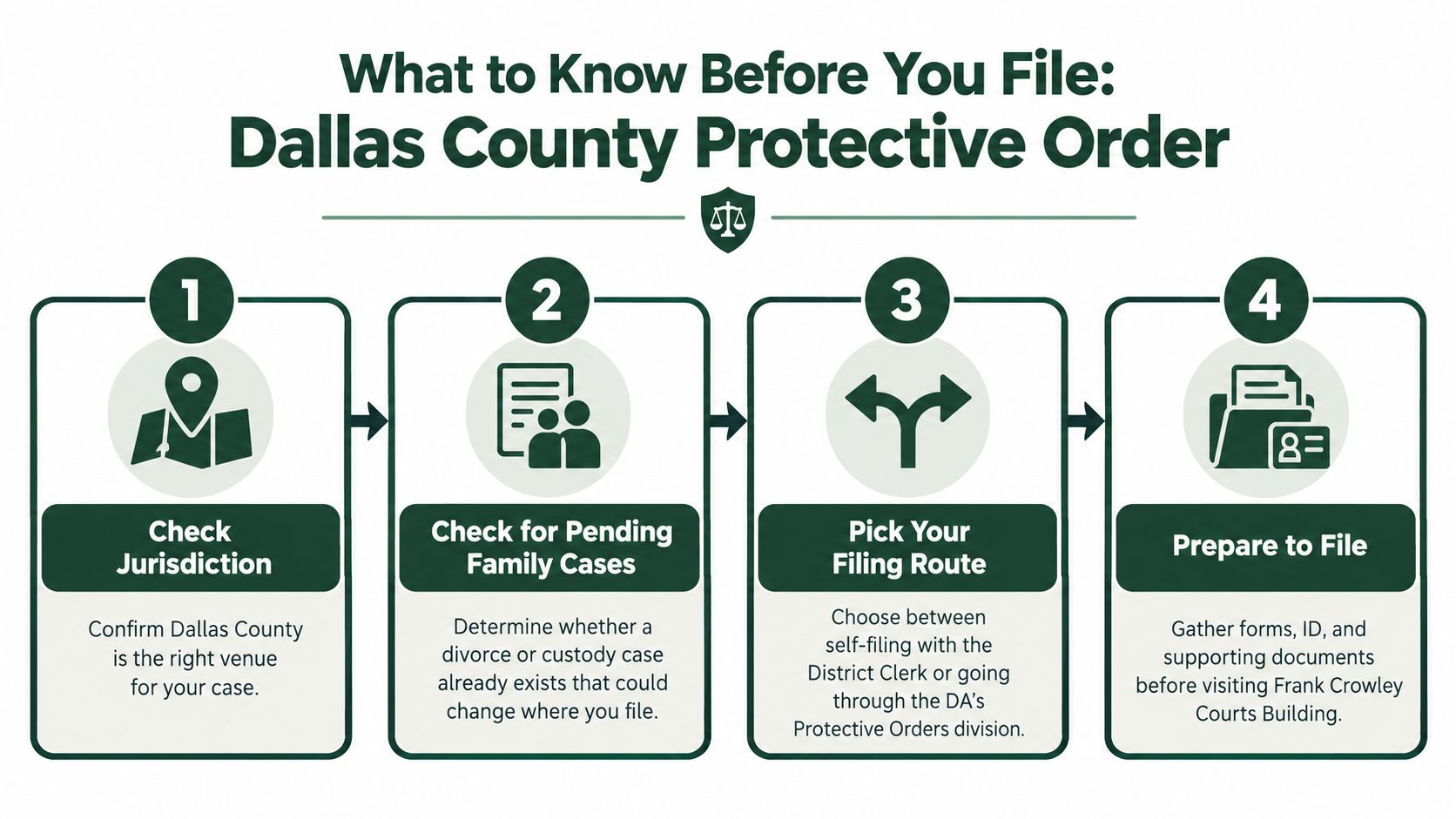
Suppose you live in Dallas, recently experienced family violence, and want to file for protection. Before you drive downtown, answer three questions: Does Dallas County qualify as the proper venue? Is there already a divorce, custody, or SAPCR case pending? Which filing route makes sense for your circumstances?
The phrase “where to file” describes more than an address. It involves venue, meaning the legally proper county or court for the application. If you choose the wrong venue, the court may redirect the filing or require you to file again. That can create delay at a time when you need a clear path.
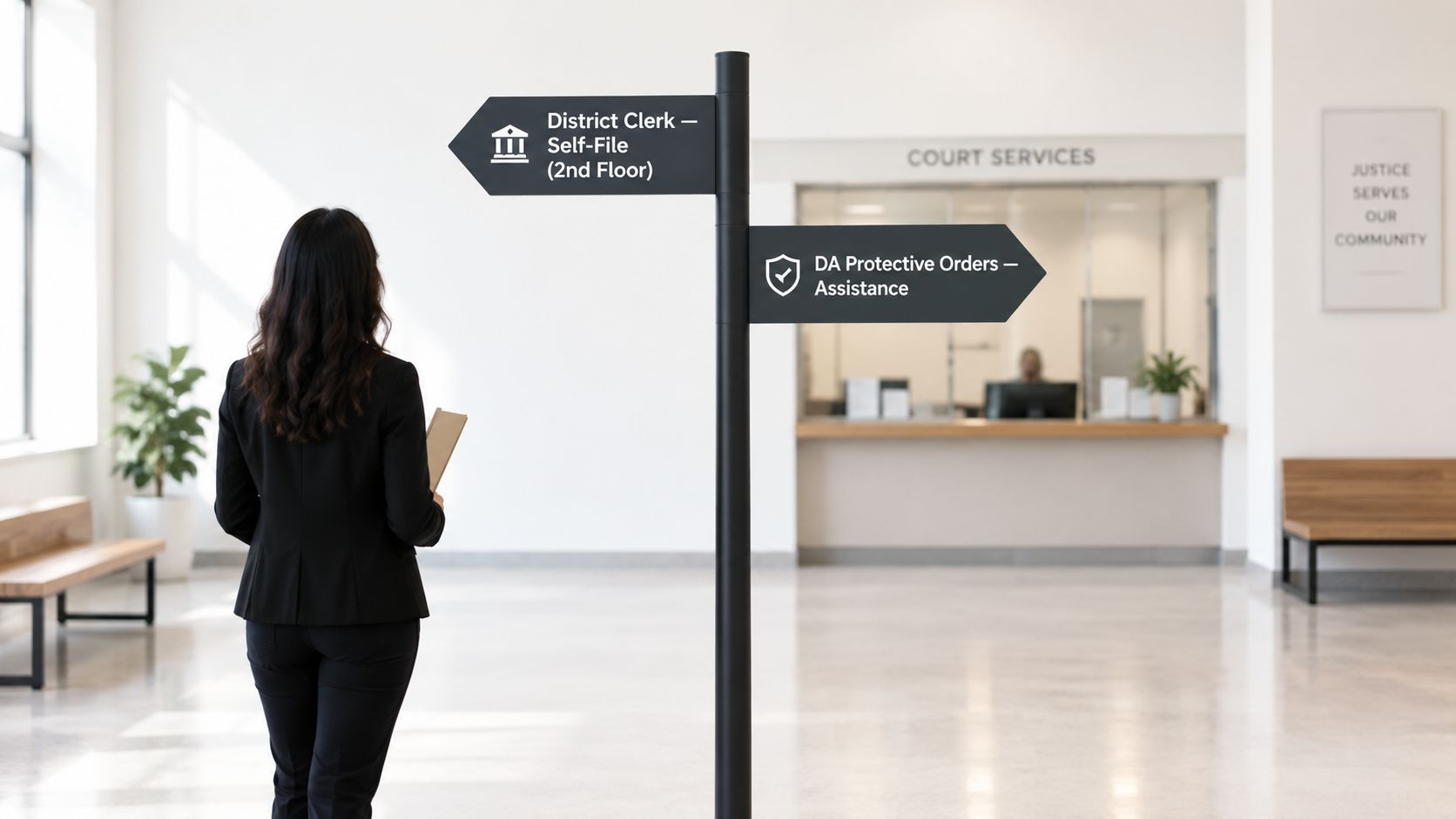
The two Dallas County options
You can generally choose between these routes when Dallas County is the appropriate venue:
- Self-filing with the District Clerk: A self-represented applicant submits the application at the service window on the second floor of the Frank Crowley Courts Building.
- DA-assisted filing: The Dallas County District Attorney's Protective Orders division can assist eligible applicants and may file the application on the applicant's behalf.
These routes aren't interchangeable. The District Clerk accepts filings, but the clerk's office doesn't complete forms and doesn't provide legal advice. The District Attorney's office offers a different level of assistance for qualifying protective-order applicants.
Practical rule: Don't select a filing route until you've checked whether a divorce or custody case is already pending.
A person with no existing family case may be able to use the general District Clerk window or seek DA assistance. A person already involved in a Dallas County divorce or SAPCR may need the application connected to that existing family case instead. The rest of the filing decision turns on that distinction.
Texas Venue Rules for Protective Orders
Texas law recognizes several possible venues for a protective-order application. The Texas State Law Library explains that an application may be filed in the county where the applicant lives, where the respondent lives, or where the alleged offense occurred. When a divorce or custody case already exists, the application generally follows the same county or court handling that case. See the Texas State Law Library guidance on getting a protective order.
In plain English, start with these four categories:
- The county where you live. Dallas County may be appropriate if you reside there.
- The county where the respondent lives. The respondent is the person you're asking the court to restrict.
- Any county where the alleged offense occurred. An incident occurring in Dallas County may support filing there even if one person lives elsewhere.
- The county or court connected to an existing divorce or custody case. A pending family case can control the filing location.
The fourth category is where many people make a costly assumption. A person may live in Dallas County and still need to file through the family court handling an existing divorce or custody matter. Venue isn't merely a matter of convenience. It determines whether the court receiving the application is the proper court to act.
How to identify your likely venue
Ask yourself:
- Where do I currently live?
- Where does the person I'm seeking protection from live?
- Where did the alleged family violence or other qualifying conduct happen?
- Has either person already filed for divorce, custody, or a SAPCR?
If there's no pending family case, one of the first three categories may support filing in Dallas County. If there is an active divorce or custody case, don't assume the general filing window is the correct destination. Pull out the existing case information and determine which Dallas County family court is handling it before submitting a new application.
Two Filing Routes in Dallas County
The typical search for a Dallas County protective order application where to file expects one address. The more accurate answer is that both filing routes are located at the Frank Crowley Courts Building, but they serve different purposes.
Route one is self-filing with the District Clerk
A self-represented applicant may file at the Dallas County District Clerk's service window on the second floor of the Frank Crowley Courts Building, 133 N. Riverfront Boulevard. The District Clerk identifies the filing hours as 8:00 a.m. to 4:00 p.m. The clerk's office can receive the paperwork, but it cannot help complete the forms or give legal advice. Those limitations are stated in the Dallas County District Clerk's protective-order FAQ.
This route may fit a person whose facts are straightforward, who has identified the correct venue, and who feels able to complete the application without legal assistance. Filing the documents is different from evaluating the legal allegations, choosing requested restrictions, or deciding how a protective order may affect a pending custody case.
Route two is assistance through the District Attorney
The Dallas County District Attorney's Protective Orders division also operates at Frank Crowley, 133 N. Riverfront Boulevard. The office can assist with applications for qualifying situations and may file on an applicant's behalf without a fee, according to Dallas County's Protective Orders division information.
The DA-assisted route may be more useful when you need help understanding the application process, organizing the allegations, or determining whether the office can assist with your circumstances. It doesn't turn the DA's office into your private family lawyer. The office's role is different from representing you in every issue involving divorce, property, child support, or long-term custody strategy.
| Filing route | Location | Practical distinction |
|---|---|---|
| Self-filing | Second-floor District Clerk service window | You submit the application, but the clerk doesn't complete forms or give legal advice |
| DA-assisted filing | District Attorney's Protective Orders division at Frank Crowley | The office may assist qualifying applicants and may file on the applicant's behalf |
If your protective-order request overlaps with a divorce, custody dispute, or other family case, review the George L. Allen, Sr. Courts Building and where family cases are heard before assuming Frank Crowley's general intake window is the next stop.
Filing Day at the Frank Crowley Courts Building
Frank Crowley Courts Building is at 133 N. Riverfront Boulevard in Dallas. For a self-filed application, the Dallas County District Clerk identifies the second-floor service window as the filing location, with service available between 8:00 a.m. and 4:00 p.m. You'll want to allow enough time to find the correct floor, organize your documents, and review your application before you submit it.
Bring the information needed to complete the application accurately. Keep your identification and documents together in a folder, and keep copies or photographs of anything you submit when possible. If you're working with the DA's office, ask that office what materials it wants you to provide before filing day.
What the clerk can do
The clerk's role is administrative. The office receives and processes filings, but it isn't a substitute for a lawyer or protective-order advocate. The District Clerk cannot fill out the forms, explain your legal rights, or advise you about what restrictions to request.
The clerk also can't promise that a judge will grant an order. A filing places your request into the court process. It doesn't decide the outcome.
What happens after submission
Once the application is accepted, it moves through the court's process for review. The court, not the intake clerk, determines what happens next, including whether a hearing is scheduled and what notice or service steps are required.
Before you go, read the Frank Crowley Courts Building guide for your first court date so the building itself feels less unfamiliar. That preparation matters when you're already managing fear, disrupted routines, and difficult communication with the other person.
If a pending divorce or custody case exists, stop before using the general service window. The existing case may determine which family court should receive the application, as discussed below.
Emergency and After-Hours Relief
The regular filing window won't fit every situation. If someone is outside your home, making immediate threats, or creating a crisis after the courthouse closes, focus first on immediate safety and contact law enforcement or emergency services when necessary. A courthouse filing should not delay a response to an immediate danger.
Texas protective-order procedure can include emergency requests for temporary relief. In an appropriate emergency, a judge may consider an ex parte request, meaning the respondent isn't present when the request is first reviewed. That relief is limited and depends on the facts presented to the judge. Filing a request doesn't guarantee that temporary protection will issue.
When the regular route makes sense
Use the regular Dallas County process when you can safely wait for the courthouse intake process and organize the information the application requires. You may choose self-filing or ask whether the District Attorney's Protective Orders division can assist.
Keep the two decisions separate:
- Safety decision: What do you need to do right now to stay safe?
- Filing decision: Which Dallas County office or family court has the authority to receive the application?
If children are involved, think about where they are, who can safely accompany you, and whether the other person may learn about your location. Don't announce your filing plans if doing so could increase the danger.
When a pending case complicates the emergency route
An existing divorce or custody case can affect where the application belongs even when the situation is urgent. Tell the DA's office, law enforcement, or an attorney that the family case exists. Give them the case information if you have it, and explain whether the alleged conduct involves the children, exchanges, visitation, or a current court order.
Emergency relief and the eventual protective-order case may also intersect with custody and possession issues. A protective order can affect how parents communicate and exercise existing rights, so the filing should fit the broader family-law circumstances rather than operate as an isolated courthouse visit.
Forms and Documents to Bring
The Texas Judicial System makes standardized protective-order application forms available through its court system resources. You can review the forms before filing so you understand the information the court will ask you to provide. If you're unsure whether a form fits your situation, don't guess just because it appears in an online search.
Build a factual timeline
Write down the events in chronological order. Use concrete details rather than conclusions such as “they're dangerous” or “the situation is getting worse.”
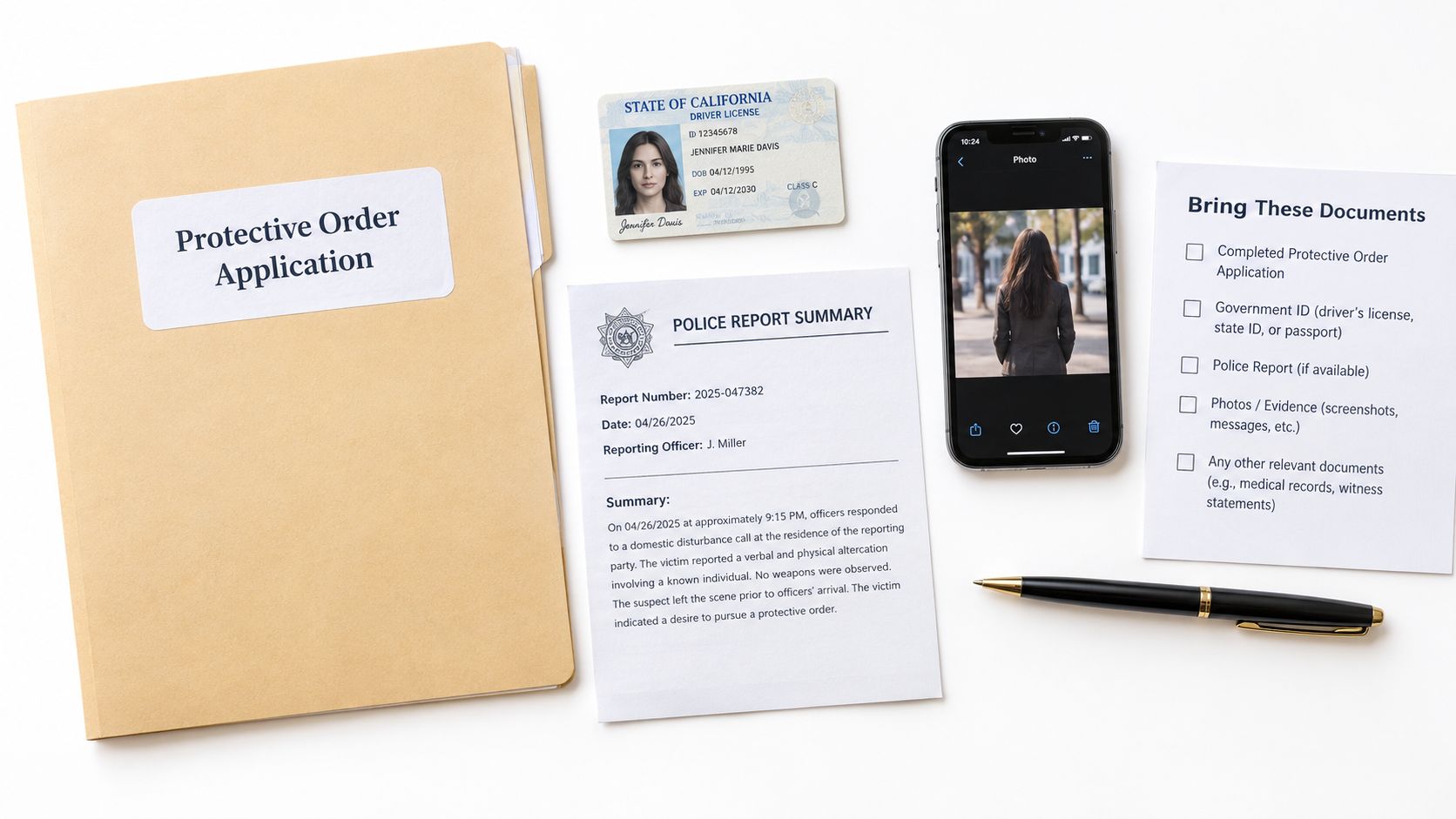
Your preparation folder should include, when available:
- Names and identifying information: Use the correct legal names and provide addresses or other identifying details requested by the form.
- Incident details: Record dates, locations, what happened, what was said, and whether children or other witnesses were present.
- Prior reports: Gather police report information, incident numbers, or records from earlier calls if you have them.
- Messages and recordings: Preserve threatening texts, emails, voicemails, social-media messages, and call information without editing the original material.
- Photos and medical records: Keep photographs of injuries or property damage and records connected to treatment.
- Existing orders: Include divorce decrees, custody orders, temporary orders, or prior protective orders that may affect the situation.
Avoid preventable filing problems
The most damaging mistakes usually involve incomplete facts or a missed connection to an existing family case. Don't minimize an event because you're worried you won't be believed, but don't add speculation that you can't explain or support.
Check that:
- The application identifies the correct respondent.
- The alleged conduct is described in specific, understandable language.
- Relevant children and existing court orders are disclosed.
- Dallas County is a proper venue under the facts.
- You understand whether you're self-filing or asking the DA's office to assist.
For people who are handling a broader family-law matter without counsel, the Dallas County pro se family-law forms resource may help you locate court paperwork. Forms can organize information, but they can't analyze venue, safety risks, conflicting orders, or the effect of a protective order on a divorce or custody strategy.
How a Pending Dallas County Divorce Changes Where You File
Consider a Dallas County resident who filed for divorce last month. The spouse then sends threats and appears at the home. The resident still lives in Dallas County, but the pending divorce changes the filing analysis.
The person shouldn't automatically treat the protective-order application as a new, unrelated filing at the general District Clerk window. When a divorce or SAPCR is already pending in Dallas County, the protective-order application generally needs to be filed in the family court where that case is pending. Dallas County addresses this issue in its Family Violence Protective Orders brochure.
Why the existing case matters
A family court already has the divorce or custody case before it. The protective-order request may involve the same spouses, children, possession schedule, residence, communication, or temporary orders. Filing in the connected family court helps place related issues before the court responsible for the existing matter.
That doesn't mean every applicant must already have a lawyer. If an attorney is handling the divorce, the application generally goes through the court where the divorce was filed. If the person is self-represented, the Dallas County District Attorney's office may still assist with filing in the family case.
A person can lose time by relying on a single-address answer. Frank Crowley may be the building where assistance or filing begins, but the pending family case can determine the court destination. Tell the DA's office about the existing case before submitting anything, and bring the case information if you have it.
The case number is not a minor detail. It can help court personnel identify the pending family matter and direct the application to the appropriate court.
A practical decision sequence
Use this order:
- First, identify the existing case. Confirm whether it's a divorce, SAPCR, or another custody proceeding.
- Next, identify representation. If an attorney represents you in the family case, contact that attorney before filing. If you're self-represented, ask the DA's Protective Orders division whether it can assist.
- Then, explain the immediate facts. Tell the intake office whether children, visitation, exchanges, or current temporary orders are involved.
- Finally, verify the filing destination. Don't assume that being a Dallas County resident answers the question by itself.
After filing, the court process may involve judicial review, a hearing, and notice or service to the respondent. The exact sequence depends on the application, the relief requested, the court's action, and whether the respondent has been served. Keep your contact information current and pay close attention to every notice from the court.
At a hearing, the applicant should be prepared to explain the alleged conduct and why protection is requested. The respondent may have an opportunity to respond. Bring organized evidence and follow any safety instructions offered by the court or advocate. Don't miss a scheduled hearing, and don't assume the other person's failure to cooperate means the case will resolve automatically.
A protective order may also interact with temporary orders, possession and visitation, child support, communication provisions, or other parts of a pending divorce or custody case. If circumstances change, ask about the proper procedure rather than informally ignoring an order or making private changes to an existing parenting arrangement.
Self-filing can be workable when the facts are simple and no family case is pending. A consultation with a Dallas family-law attorney is worth considering when there's an active divorce or SAPCR, prior court orders, disputed custody, complicated service issues, or a serious safety concern. The legal question isn't only where to place the paperwork. It's also how that filing fits with the family case already affecting your children, home, finances, and court obligations.
The Law Office of Bryan Fagan, PLLC offers Dallas family-law guidance for protective orders, divorce, custody, temporary orders, and related court issues. If you need help deciding whether to self-file or address a protective-order request within an existing family case, visit The Law Office of Bryan Fagan, PLLC to learn about your next step.
