 Skip to content
You may be trying to protect yourself and your children after a violent incident while also facing a divorce, custody dispute, CPS contact, or an existing visitation order. You may have a police report, but no clear explanation of what happens next. The Dallas County District Attorney Family Violence Division intake process is one part of the response, and understanding its limits can help you make safer decisions in both criminal and family court.
A police report doesn't automatically become a criminal case, and a criminal case doesn't decide every custody or property issue. The District Attorney evaluates potential criminal charges, while the Dallas County Family District Courts address conservatorship, possession, support, divorce, and other family-law remedies. Those systems can affect one another, but they aren't interchangeable.
Table of Contents
- Understanding the Dallas County District Attorney Family Violence Division Intake
- How to Report an Incident and Contact the Intake Division
- The Screening Process and Charging Decisions
- Protective Orders and the 90-Day Geographic Rule
- Interplay Between Criminal Charges, CPS, and Family Court
- Common Outcomes and Timelines for Family Violence Cases
- Practical Next Steps and When to Hire a Dallas Attorney
Understanding the Dallas County District Attorney Family Violence Division Intake
A physical incident can put you in two legal systems at once. Police may respond, investigate, arrest someone, collect statements, and prepare a report. The District Attorney's office then reviews that information through a separate prosecutorial process. Police action and prosecutorial intake are separate decisions. That distinction matters if a divorce, custody case, visitation order, or CPS inquiry is already pending.
The Family Violence Division is a specialized unit within the Dallas County Criminal District Attorney's Office. Dallas County identifies it as serving victims of family violence, dating violence, stalking, and sexual assault who seek protective orders. Its role connects criminal enforcement with victim support and protective-order work. It does not replace the family court's authority over conservatorship, possession, support, divorce, or long-term parenting arrangements. Dallas County identifies the Family Violence Division and its protective-order role.
What intake actually does
Intake is the first prosecutorial screening point. Prosecutors and staff may review the police information, available evidence, the relationship between the people involved, injuries, threats, witness accounts, and other legal issues raised by the report. The matter may proceed, require more investigation, be routed to another criminal division, or lack enough support for prosecution at that stage.
The unit handles more than minor domestic disputes. Dallas County's annual report describes its Family Violence Unit as addressing intimate-partner violence and offenses ranging from assaults and stalking to aggravated robbery, murder, and capital murder. In 2021, the office received 1,369 cases and rejected 19, about 1%. That office-wide figure does not predict what will happen with an individual family-violence report. Read the Dallas County Criminal District Attorney's 2021 annual report.
Practical rule: A credible, serious report may still require additional evidence before prosecutors decide how to proceed.
Contact with the DA does not solve every family-law problem. A criminal prosecutor represents the State, not the survivor personally, and does not handle the full range of custody, support, property, divorce, or parenting disputes. Treat intake as one part of a safety plan. Consult family-law counsel promptly if criminal allegations overlap with a custody case, CPS involvement, or an existing visitation order.
How to Report an Incident and Contact the Intake Division
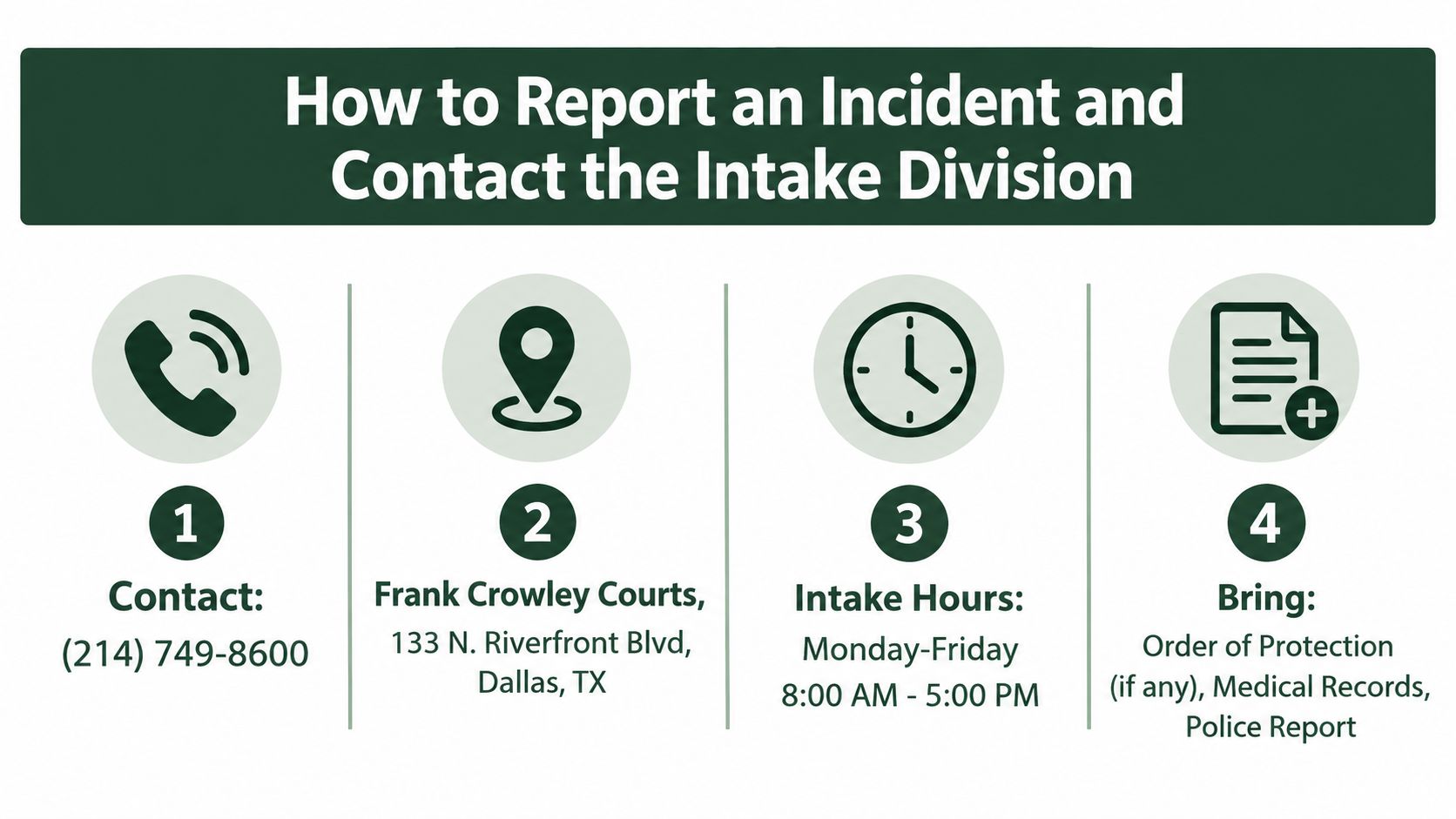
If an emergency is happening, call 911. Don't wait for a prosecutor's office to respond when you or a child faces immediate danger. After the immediate safety issue is addressed, organize the information that will help Dallas County staff identify the correct case and division.
Dallas County lists the Family Violence Division contacts as (214) 653-3605 and (214) 653-3528. The county lists general intake at (214) 653-3848. These contacts are associated with the Frank Crowley Courts Building in Dallas, where the District Attorney's published structure separates Family Violence Division work from general intake. Confirm the current Dallas County District Attorney contact information before traveling or calling.
Prepare a concise intake packet
You don't need to create a perfect legal file before making contact. You do need a reliable summary that separates what you personally saw from what someone else told you.
- Identify the incident: Write down the date, location, people involved, and a short chronological description.
- Locate the police information: Have the agency name and police report number if one exists.
- Preserve communications: Keep texts, emails, voicemails, photographs, videos, and social-media messages in their original form.
- List safety concerns: Explain threats, stalking, weapons, repeated contact, children present, or conduct that has continued after the report.
- Gather existing orders: Bring copies of protective orders, temporary orders, custody orders, or bond paperwork if you have them.
Call the dedicated Family Violence numbers when the matter involves family violence, dating violence, stalking, sexual assault, or protective-order assistance. General intake can help route a case when you're uncertain where it belongs. Don't repeatedly contact different offices with changing versions of events. Give a truthful, consistent account and ask how to submit additional records.
Victim Assistance Coordinators can be part of the communication path because Dallas County places victim assistance within the same formal division structure. A coordinator isn't your private lawyer and can't make family-court filings for you, but can help explain communication with the criminal case and available victim-oriented services.
The Screening Process and Charging Decisions
A family violence report can arrive while a divorce, custody dispute, or CPS investigation is already underway. The Dallas County District Attorney's office decides whether the facts support a criminal case, while the family court addresses possession, conservatorship, and other civil issues. Treat those processes as connected, but never assume one court's decision controls the other.
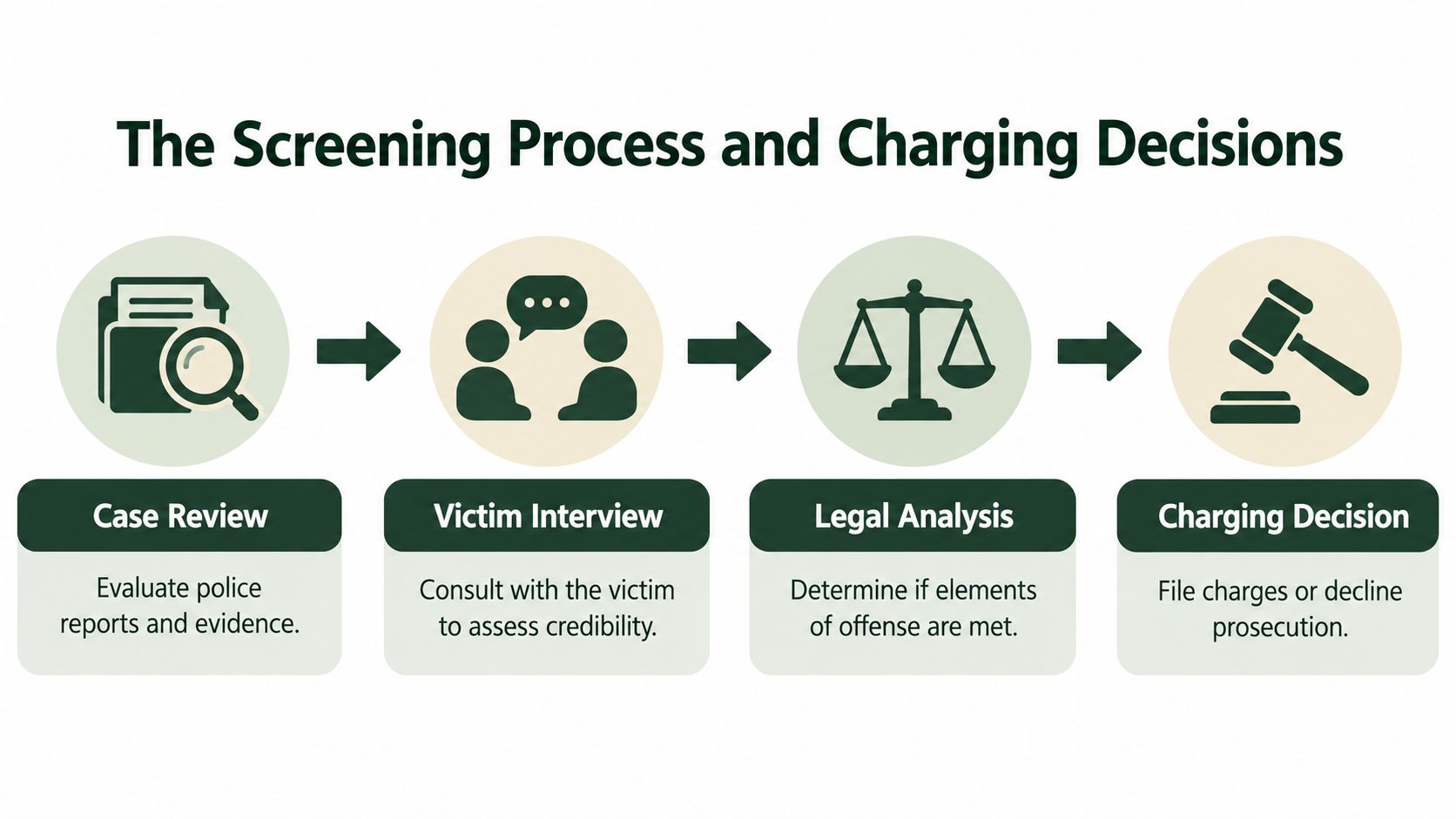
The District Attorney does not approve every arrest. Intake staff and prosecutors examine whether the available facts establish a criminal offense and whether the evidence can be presented in court. The review may include the offense report, photographs, recordings, witness information, medical records, digital communications, and each party's account.
Why the intake decision can change
A reporting person's account matters, but the State evaluates the complete evidentiary picture. The prosecutor may ask whether the evidence identifies the accused, proves the required conduct and mental state, supports the alleged offense level, and can be presented through admissible testimony or records. A police report provides important information. It is not the same as proof beyond a reasonable doubt.
The screening analysis becomes more demanding when the allegation involves stalking, serious injury, strangulation, a weapon, sexual assault, or other severe conduct. As noted in the 2021 annual report referenced earlier, the Family Violence Unit handles matters extending beyond misdemeanor-level disputes. That scope helps explain why the office uses dedicated contact channels instead of sending every matter to a general mailbox.
Historical office-wide figures offer context, not a prediction for one complaint. The benchmark cited earlier describes the broader Criminal District Attorney's Office workload, not the likely outcome of a particular family violence report. It cannot promise acceptance, an arrest, or a conviction.
What a rejection does and doesn't mean
A decision not to file charges may result from insufficient evidence, an unproven legal element, identification problems, conflicting accounts, or the need for further investigation. It does not establish that the incident did not occur. Acceptance of a case also does not mean the State has already proved guilt.
If charges are filed, the matter may be assigned according to the alleged offense. Felony and misdemeanor cases follow different criminal-court paths. Review this Dallas County criminal court guide explaining which district court hears felony matters to understand that distinction.
For the accused, do not try to persuade intake staff with an improvised statement. For the reporting person, correct genuine errors promptly and keep the account accurate. Neither party should treat preliminary prosecutor communication as legal advice, or assume a criminal intake decision resolves custody, divorce, or CPS questions. Consult counsel promptly when both criminal exposure and parental rights are at stake.
Protective Orders and the 90-Day Geographic Rule
A protective order is a civil remedy, even when the underlying conduct may also lead to criminal charges. It can address safety and prohibited conduct through a separate court process. It isn't the same as a criminal conviction, and contacting the DA won't automatically resolve every custody or visitation issue.
Dallas County uses a geographic screening rule for protective-order assistance. The applicant or the accused must live in Dallas County, or the violence must have occurred there. The county also states that, for applications based on recent physical abuse or a threat of imminent danger, the incident generally must have occurred within the previous 90 days. Review Dallas County's protective-order eligibility information.
Apply promptly when safety is the concern
Don't wait until the end of the stated period if you need protection. The 90-day language is a screening rule for the described category, not permission to delay. Other facts and legal grounds can affect what relief is available, and the county's staff or a qualified attorney can help identify the correct path.
The geographic rule can matter when someone leaves another county and comes to Dallas for safety. Moving to Dallas doesn't automatically make every prior incident a Dallas County matter. The applicant's residence, the accused person's residence, and the location of the violence should be documented clearly so intake staff can evaluate the county connection.
Safety first: If the other person is nearby, threatening you, or violating an existing order, use emergency services rather than waiting for a routine intake call.
A civil protective order can also affect family-law strategy. If you have an upcoming temporary-orders hearing, bring the police report, communications, photographs, medical records, and any existing order to your family-law attorney. A Dallas County temporary-orders hearing guide can help you understand why temporary relief may address possession, communication, residence, support, and child-related concerns while the larger case continues.
Do not assume that a protective order automatically determines final custody. The family court still evaluates the child's best interests and the evidence presented in that case. Do not violate an order because the protected person invites contact, either. Ask counsel how to request a lawful change instead of relying on informal messages.
Interplay Between Criminal Charges, CPS, and Family Court
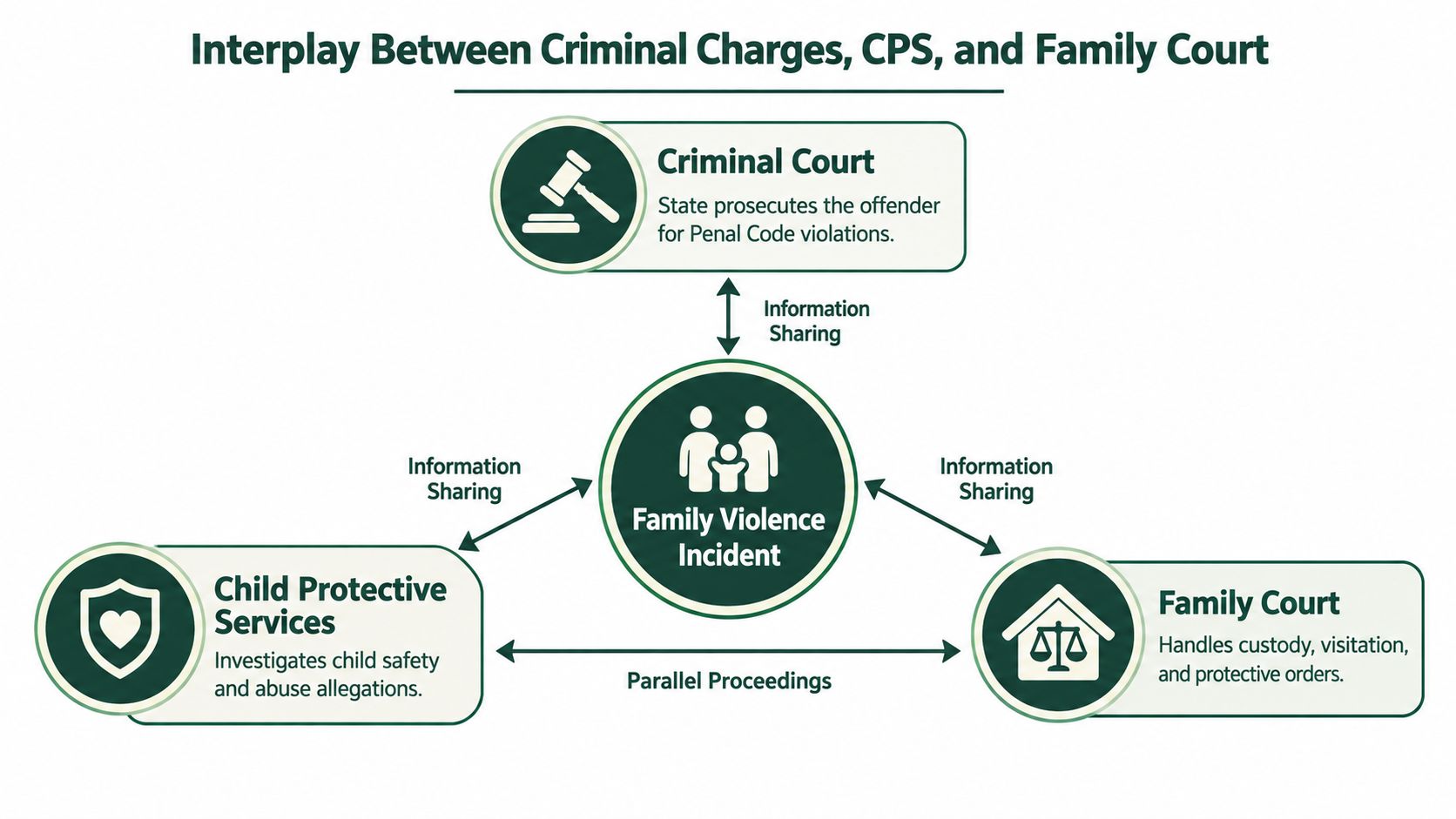
One incident can create three separate legal tracks. The criminal case concerns whether the State can prove an offense. CPS focuses on child safety and allegations of abuse or neglect. The family court addresses conservatorship, possession, support, divorce, and related orders.
The same facts can have different legal effects
A police report may become evidence in a custody dispute. A criminal bond condition may limit contact while a case is pending. A CPS investigation may lead a parent to seek temporary orders, supervised possession, a changed exchange location, or other protective arrangements. The existence of parallel cases doesn't mean one court automatically controls the others.
Family courts generally decide conservatorship and possession under the child's best interests. Allegations of family violence can be highly significant, but a criminal intake decision alone doesn't answer every family-law question. A parent can have no criminal charge and still face serious custody litigation, or face a criminal case while the family court separately evaluates disputed facts.
CPS involvement deserves careful handling. Don't ignore an investigator, coach a child, destroy messages, or assume that silence will make the matter disappear. You also shouldn't give a long unprepared statement without understanding your rights and the potential effect on a criminal or custody case.
Protect the record without creating new problems
Create separate folders for each proceeding. Keep the police report and criminal paperwork together, preserve family-court pleadings and orders separately, and maintain a dated log of exchanges, calls, threats, missed visits, and child-safety concerns. Don't post accusations or explanations on social media. A private message can still become evidence.
If you're the accused parent, comply with every bond, protective-order, and family-court restriction unless a court changes it. If you're the reporting parent, don't use criminal allegations to pressure for unrelated property or financial concessions. Serious safety concerns should be documented and presented through the correct legal channel.
Dallas County's Family Violence Division is formally connected to victim assistance. A county division-chief page identifies Jerry Varney as Administrative Chief of Division 5 and states that he supervises the Family Violence Unit and Victim Assistance Coordinators. See the Dallas County division-chief information. That organizational connection supports a practical conclusion: ask specifically who is handling victim communication, but obtain separate advice for custody, support, divorce, or property rights.
Common Outcomes and Timelines for Family Violence Cases
There isn't one guaranteed sequence after a family-violence report. A case may remain under review, proceed as a misdemeanor or felony, be routed to another division, or move forward while the victim's position changes. The criminal process can continue even when the reporting person no longer wants contact with prosecutors.
Consider a hypothetical Dallas parent whose spouse is arrested after an alleged assault. The arrest may be followed by release conditions that affect communication or residence. The parent then faces a practical family-law problem: school pickup, child exchanges, temporary support, and access to the home may all need attention even though the criminal case hasn't reached a final result.
A second hypothetical involves a serious allegation supported by recordings, photographs, and witness accounts. Intake may route the matter for felony-level review. The case can require additional investigation and formal court proceedings, while the family court separately considers temporary custody and safety arrangements.
What if the reporting person changes position
A victim may later want to reconcile, may fear financial consequences, or may believe the family can resolve the matter privately. Those feelings are common in family-violence cases, but they don't give the victim unilateral control over a criminal prosecution. The State decides whether to proceed based on the available evidence and its charging authority.
Don't destroy evidence or pressure anyone to change a statement. If your account contains an error, correct it truthfully and promptly. If you're the accused, don't contact the reporting person to ask for an affidavit, reconciliation message, or explanation. That contact can create new allegations and may violate a court condition.
Bond conditions deserve separate attention because they can affect both safety and parenting. A no-contact restriction may prevent direct communication about the children, while a court-approved method or third-party exchange may be necessary. Read this guide to Dallas County bond conditions in family-violence cases before assuming that an informal parenting arrangement is allowed.
Plan for a process, not a quick conversation
The right question isn't only, “Will charges be filed?” Ask what orders exist now, what evidence must be preserved, whether a child is exposed to risk, and what family-court action is needed. Criminal and civil matters may develop on different schedules, and a delay in one proceeding doesn't automatically pause the other.
Keep every notice, setting, bond document, protective order, CPS communication, and family-court filing. Missing a court date or violating a written restriction can create problems that are separate from the original incident. A Dallas family-law attorney and a criminal-defense attorney may need to coordinate while preserving the different privileges and objectives in each representation.
Practical Next Steps and When to Hire a Dallas Attorney
If you're seeking protection, start with safety rather than paperwork. Move to a safe location if necessary, tell a trusted person what is happening, preserve evidence without putting yourself at risk, and contact emergency services for immediate danger. Then identify whether you need protective-order assistance, temporary family-court orders, CPS guidance, or all three.
Use a simple action list:
- Preserve the evidence: Save original messages, recordings, photographs, medical records, police information, and witness details.
- Read every order: Identify no-contact provisions, child-exchange terms, geographic limits, and prohibited communications.
- Separate the proceedings: Keep criminal, CPS, protective-order, divorce, and custody documents organized by case.
- Don't negotiate under pressure: Avoid trading a criminal-case position for property, support, or custody promises.
- Get coordinated advice: Ask whether a family-law attorney and criminal-defense counsel should communicate about overlapping facts.
If you're accused, don't give a statement to the DA, police, CPS, or the other parent without first obtaining advice about the specific proceeding. Don't delete texts, contact the reporting person through a friend, or assume that a reconciliation conversation cancels a court restriction. A criminal-defense lawyer addresses the accusation, while a family-law attorney addresses custody, possession, support, divorce, and property consequences.
A private family-law consultation is especially important when children, an existing custody order, an upcoming temporary-orders hearing, relocation, CPS contact, or a high-asset divorce is involved. Business interests, real estate, retirement accounts, separate-property claims, and reimbursement issues shouldn't be surrendered during an emotionally charged criminal case. The Law Office of Bryan Fagan, PLLC offers Dallas family-law and criminal-defense consultations, including assistance with protective-order and family-law issues connected to family violence.
The Law Office of Bryan Fagan, PLLC can help you evaluate the family-law consequences of a Dallas County family-violence matter, including custody, temporary orders, possession, support, protective orders, and divorce concerns. Contact the firm to discuss your situation and identify the next lawful step for protecting your safety, parental rights, and financial interests.
