 Skip to content
The Henry Wade Juvenile Justice Center handles juvenile delinquency cases involving youth who were 10 but less than 17 years old, certain abuse and neglect matters involving the Texas Department of Family and Protective Services, and related domestic-relations cases in which DFPS is a party. It is Dallas County's specialized juvenile-court hub, not a general adult criminal courthouse.
If your child has been arrested, contacted by Dallas County Juvenile Services, or named in a DFPS matter, you may be trying to determine whether the case belongs at Henry Wade, what happens at the first hearing, and whether you can find documents online. Those questions are understandable, especially because delinquency, child-protection, and family-related cases operate in the same building but follow different procedures.
The building is located at 2600 Lone Star Drive in Dallas. Dallas County describes it as the location of juvenile district courts and the district clerk's juvenile-records function. That makes it the county's central juvenile-court hub, rather than a general civil courthouse or an adult criminal facility. Dallas County's Juvenile Division overview identifies the three core categories handled there.
Table of Contents
- What the Henry Wade Juvenile Justice Center Does in Dallas County
- Delinquency, CPS, and Family Cases Compared
- How Juvenile Hearings Move Through the Courthouse
- A Realistic Dallas Scenario From Arrest to Disposition
- Diversion Programs and Specialty Dockets
- Juvenile Records and Online Case Access
- Common Misconceptions About Juvenile Court in Dallas
- Practical Next Steps for Dallas County Families
What the Henry Wade Juvenile Justice Center Does in Dallas County
A parent may arrive at Henry Wade after a child is arrested, while another family is there for a DFPS proceeding involving safety or placement. Both matters may be connected to the same juvenile courthouse, yet the judge is addressing a different legal question in each one. The building is best understood as a shared courthouse for several parts of Dallas County's juvenile and family-law system.
The work there falls into three broad tracks:
- Juvenile delinquency: A case alleging that a youth committed an offense while 10 but less than 17 years old.
- DFPS abuse and neglect matters: A proceeding involving the Texas Department of Family and Protective Services and the protection of a child.
- Domestic-relations cases involving DFPS: A family matter in which DFPS is a party.
A delinquency allegation may describe conduct that would be an offense for an adult. The process still follows juvenile-court rules, with attention to probable cause, detention, the alleged conduct, and the supervision, treatment, or placement that may address the child's situation.
Why the courthouse can feel confusing
The same facility can host a detention hearing for an arrested youth, a child-protection proceeding, or a family-related matter involving DFPS. Those cases may involve different lawyers, agencies, documents, and deadlines. A parent should therefore identify the legal track before assuming that another family's courtroom experience will match theirs.
Henry Wade also supports detention services and juvenile programs. Dallas County explains that detention hearings address probable cause and whether a child should remain detained. They do not decide guilt on the underlying allegation. An initial detention hearing must occur within 48 hours after a youth is brought to detention, and continued detention is generally reviewed every 10 working days or sooner. Dallas County's juvenile-services information describes that hearing structure and review process.
A useful rule is simple: the address identifies the courthouse, not the legal issue. Read the notice, petition, or detention paperwork carefully. Counsel can then explain whether the case concerns delinquency, DFPS protection, or a related family matter.
Henry Wade does not handle every case involving a minor. Adult criminal prosecutions, ordinary civil lawsuits, and unrelated divorce or child-support disputes belong in other courts or offices. A Dallas County custody dispute may proceed in the Family District Courts, while a juvenile case involving DFPS may be heard at Henry Wade. The proceedings can affect one another, but they remain separate cases with separate procedures.
Delinquency, CPS, and Family Cases Compared
A parent can often identify the basic courtroom track by asking who brought the case and what the government is asking the court to decide. Dallas County describes delinquency, DFPS abuse and neglect, and DFPS-related domestic-relations matters as separate functions of the Juvenile Division. Dallas County's Juvenile Division page provides the county's description of that broader role.
| Docket | Who Files | What It Covers | Burden of Proof | Typical Outcome |
|---|---|---|---|---|
| Juvenile delinquency | The government alleges that a youth committed an offense | Alleged conduct by a youth who was 10 but less than 17 | The applicable standard depends on the proceeding and allegation | Release, continued detention, supervision, treatment, or another juvenile-court resolution |
| DFPS abuse and neglect | The Texas Department of Family and Protective Services brings or participates in the matter | Allegations that a child needs protection from abuse or neglect | The applicable standard depends on the specific DFPS proceeding | Orders addressing safety, services, placement, or parental rights |
| DFPS-related domestic relations | DFPS is a party to the family matter | Parent-child and related family issues connected to DFPS involvement | The applicable standard depends on the specific request | Orders concerning protection, possession, access, placement, or related family issues |
The word “family” in a case title doesn't necessarily mean the matter is an ordinary custody dispute between two parents. If DFPS is involved, the court may be addressing child safety, agency involvement, possession, access, or parental rights within a child-protection framework.
For example, a parent in a DFPS case may need advice about services and placement at the same time that the parent is trying to preserve contact with a child. A parent dealing with a separate custody dispute may need a Dallas family-law lawyer familiar with the Dallas County domestic-relations office social-study process, but that does not automatically make the case a Henry Wade matter.
The right legal response depends on the docket. A delinquency lawyer will focus on the allegation, detention, evidence, and possible juvenile disposition. A family-law lawyer handling a DFPS-related matter will focus on safety findings, possession, access, services, and parental rights. When the same family has both kinds of proceedings, communication between the legal teams can prevent inconsistent positions.
How Juvenile Hearings Move Through the Courthouse
A juvenile case may pass through several hearings, each with a different purpose. At the first detention hearing, the judge considers probable cause and whether the child should remain in custody. The hearing does not decide whether the child committed the alleged offense. Dallas County states that this hearing must occur within 48 hours after the youth arrives at detention.
Dallas County identifies three types of detention hearings each day: initial hearings, walk-up hearings, and ten-day hearings. Youth are generally called in alphabetical order by last name. If detention continues, the court usually reviews that decision every 10 working days or sooner. The county's detention-hearing description explains how these hearings differ.
The usual sequence
The route depends on the allegation, whether the child is detained, and decisions by the judge, prosecutor, defense counsel, and family. A parent may encounter these stages:
- Detention hearing: The judge considers probable cause and whether detention should continue.
- Initial or advisory hearing: The child and parent learn more about the formal allegation and upcoming steps.
- Pretrial proceedings: Counsel reviews evidence, discusses possible resolutions, and prepares for a contested hearing when needed.
- Adjudication: The court decides whether the allegation has been established under the juvenile-court process.
- Disposition: After a finding against the youth, the court considers supervision, treatment, probation, placement, or another response.
- Review or modification: The court may later assess compliance or decide whether an order should change.
These stages work like checkpoints. A detention hearing answers whether the child stays in custody. An adjudication addresses responsibility for the allegation. A disposition addresses what should happen afterward. Release from detention does not end the case, and continued detention does not prove the allegation.
A case may also include continuances, service referrals, evaluations, negotiations, and later reviews. That process can extend well beyond the first appearance. Parents should keep every notice, ask what each hearing will decide, and treat a short court date as meaningful rather than routine. The same household may also be dealing with DFPS or a family-court matter, so parents should clarify which proceeding each notice concerns and share relevant information with the appropriate legal team.
A Realistic Dallas Scenario From Arrest to Disposition
Consider a hypothetical Dallas family. Marcus is 15 years old and is picked up by Dallas police after an alleged shoplifting incident at a store in the Galleria area. He is taken for an overnight hold at the Dallas County Juvenile Detention Center while the family waits for information about the first court appearance.
Marcus's parents receive notice and begin trying to understand what will happen. At Henry Wade, the first detention hearing must occur within 48 hours of his arrival at detention. The hearing addresses probable cause and whether Marcus should remain detained, not whether the court has already decided that he committed the alleged shoplifting.
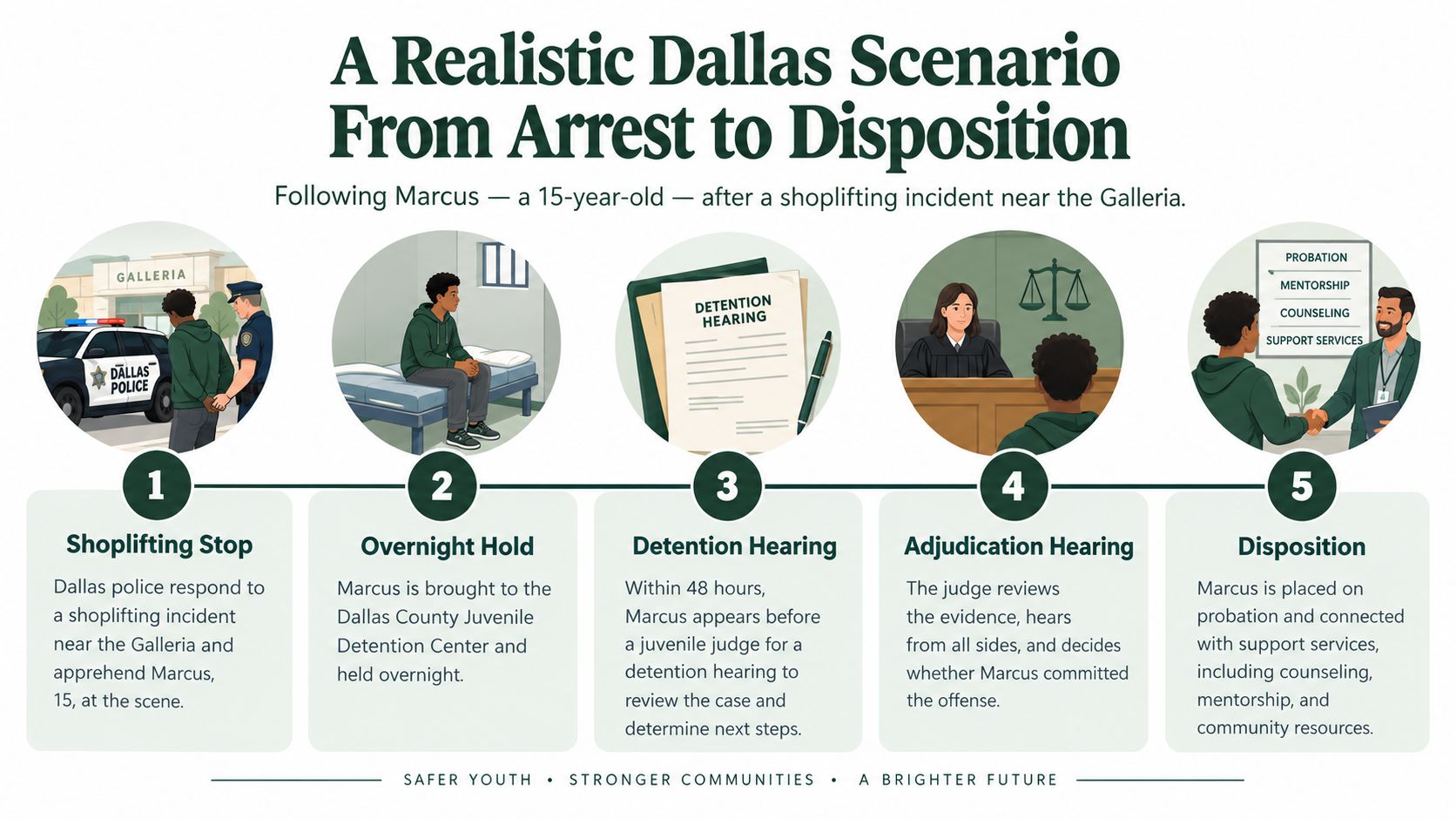
His parents should ask whether an attorney has been appointed or retained, when counsel can meet with Marcus, and what conditions could support release. Depending on the circumstances, the court may consider release, continued detention, or release with conditions such as electronic monitoring. The detention decision is separate from the later adjudication process.
What happens after the first hearing
If Marcus is released, his family still needs to track every notice and comply with every condition. If he remains detained, Dallas County generally reviews continued detention every 10 working days or sooner. The family should also preserve relevant information, including receipts, messages, school records, and the names of people who may have observed what happened.
At adjudication, the court addresses the underlying allegation. Marcus's lawyer may challenge the evidence, discuss a possible resolution, or prepare for a contested hearing. If the case results in a finding against him, the court later conducts disposition, where it may consider probation, counseling, supervision, placement, or other services.
Parents who have also been through an adult arrest may assume the juvenile timeline works the same way. It doesn't. A Dallas County magistrate hearing after an arrest is not a substitute for understanding the juvenile detention and adjudication process.
Diversion Programs and Specialty Dockets
Not every referral follows the same path toward formal court intervention. Dallas County lists diversion programs at Henry Wade for first-time offenders, including a Diversion Male Court, a Mental Health Court, and a Youthful Offenders Court for youth ages 10 to 13. These programs can provide a service-based response for eligible youth rather than sending every matter through the same formal process.
Dallas County identifies the meeting schedule as follows: Diversion Male Court meets Monday evenings, Mental Health Court meets Tuesday evenings, and Youthful Offenders Court meets Wednesday evenings. The county's diversion-program information is the appropriate place to confirm the current program descriptions and access rules.
| Program | Eligibility | Length | Outcome if Completed |
|---|---|---|---|
| Diversion Male Court | Eligible first-time male offenders, subject to program review | Depends on the assigned program and requirements | May move the case toward a diversion-based resolution |
| Mental Health Court | Eligible youth whose needs fit the program | Depends on the treatment and supervision plan | May connect the youth with structured mental-health services and a different case resolution |
| Youthful Offenders Court | Eligible youth ages 10 to 13 | Depends on the court's requirements | May provide a specialized response for younger youth |
Diversion isn't automatic. The child's age, allegation, history, needs, cooperation, and the program's eligibility requirements may all matter. A parent should ask about diversion early, before making assumptions about what a formal petition or adjudication will mean.
The value of an early review is practical. Counsel can help the family understand whether participation requires admissions, services, court appearances, testing, counseling, restitution, or other conditions. The family should also ask what happens if the youth cannot complete a requirement, because the consequences of noncompliance depend on the particular program and documents.
Juvenile Records and Online Case Access
Parents often search the Dallas County case portal after a child is arrested and expect to see the same documents that might appear in an adult case. Juvenile files don't work that way. Dallas County's public information explains that juvenile records are confidential under Texas law and aren't available through the standard public case portal in the same manner as ordinary public cases.
Authorized people, including parents, attorneys, and certain agencies, may be able to access information or documents. Dallas County also explains that juvenile records access is handled through the District Clerk's juvenile records room at Henry Wade, with viewing limited to authorized parties. The Dallas County case-information portal shouldn't be treated as a complete substitute for contacting the clerk or counsel.
A practical records checklist
- Start with authorization: Ask the clerk what identification and relationship documentation are required.
- Contact the attorney of record: Counsel may be able to review documents that aren't available publicly.
- Keep every paper received: Notices, orders, referrals, and program paperwork may not appear in a public search.
- Confirm access before traveling: Procedures and office availability can change, so verify current instructions with Dallas County.
This confidentiality protects the child from broad public exposure, but it can also leave families uncertain about what the court has filed. Parents should distinguish between a limited case summary, a court order, a petition, detention paperwork, and the complete case file. They aren't necessarily the same thing.
Juvenile records can also affect related family-law decisions. If a parent is handling custody, possession, a modification, enforcement, or a DFPS matter, the existence of a juvenile proceeding may become relevant even when the juvenile file itself is confidential. A Dallas family-law resource such as what is filed at the Dallas County Records Building may help explain the difference between family-court filings and juvenile records, but case-specific access questions should go to the clerk or an attorney.

Common Misconceptions About Juvenile Court in Dallas
The most common mistake is assuming that Henry Wade is a smaller version of an adult criminal courthouse. It isn't. The building serves a specialized juvenile system that includes delinquency proceedings, detention reviews, diversion programs, and DFPS-related matters.
A second mistake is treating a detention hearing as a trial. Dallas County says the detention hearing addresses probable cause and continued detention. It doesn't decide guilt on the underlying allegation. A child may be detained while the case continues, or released with conditions while the allegation remains unresolved.
Four assumptions that create problems
- “Every police contact becomes a court case.” A referral may be screened, diverted, or handled through another process. Parents should still take the contact seriously and obtain advice before their child gives additional statements.
- “A juvenile case is public like an adult case.” Juvenile records are confidential, and authorized access is different from public online access.
- “A CPS case and a delinquency case are the same.” They may involve the same child or family, but they address different allegations and different legal objectives.
- “A court date means the final result is near.” Juvenile matters can involve detention reviews, pretrial work, adjudication, disposition, and later supervision or review.
The location can also confuse parents who have an unrelated divorce or custody dispute. A standard Dallas County family-law case doesn't become a Henry Wade case merely because a child is involved. The connection becomes more significant when DFPS is a party or when a juvenile proceeding raises questions about custody, possession, parental supervision, or safety.
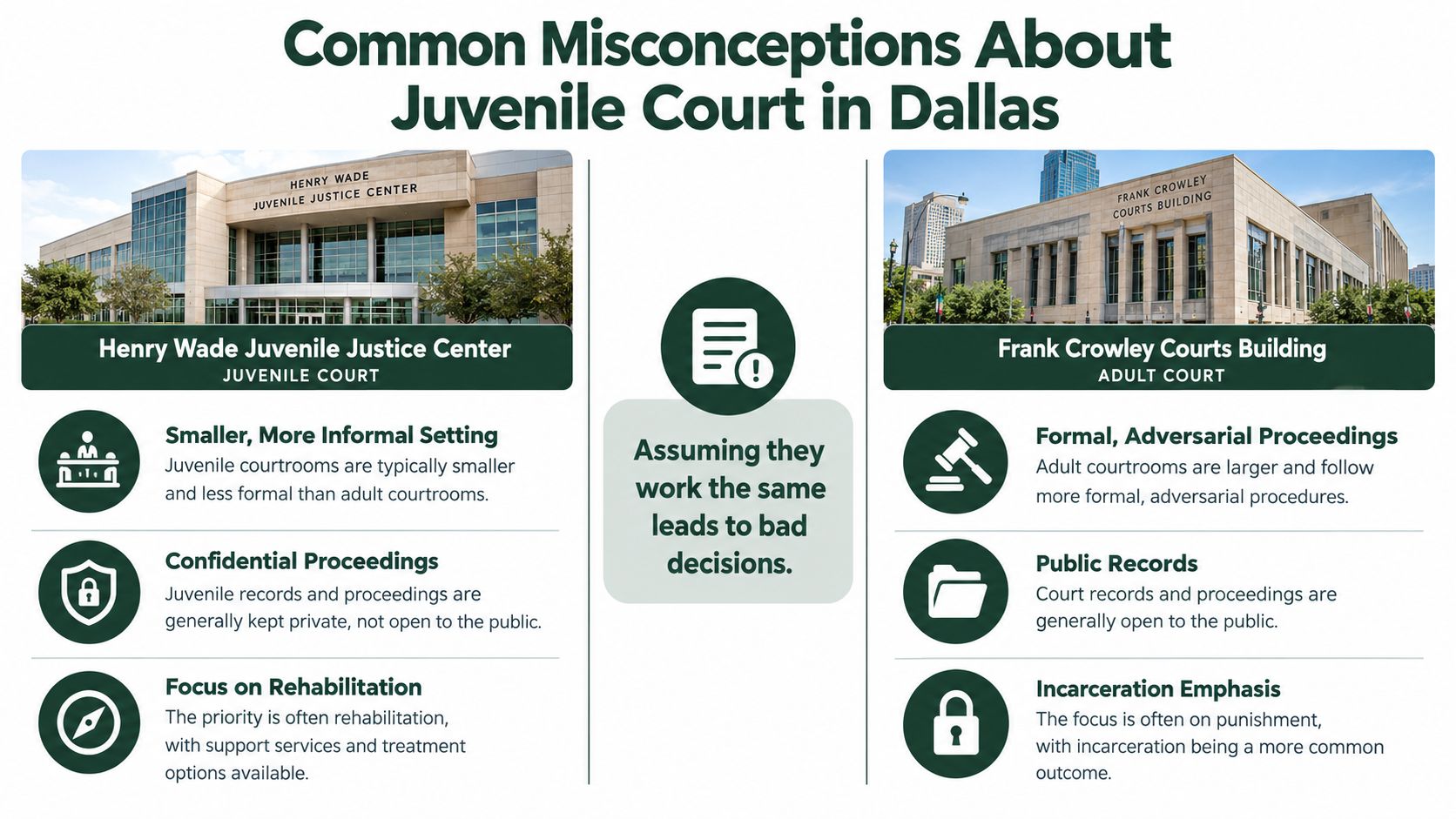
Remember: A juvenile case can affect a family-law case without becoming a family-law case. The lawyers should identify the overlap and protect the child's and parent's positions in each proceeding.
Practical Next Steps for Dallas County Families
If your child has been detained, released with a referral, or named in a DFPS investigation connected to Henry Wade, start by creating a written timeline. Record what happened, when police or a caseworker contacted the family, who was present, what documents were provided, and what court date or program requirement was mentioned.
Don't encourage your child to discuss the facts with friends, post about the matter, or answer repeated questions without legal guidance. A parent should also avoid assuming that a cooperative conversation with probation or a caseworker is informal or consequence-free. The purpose and setting of each conversation matter.
Use this immediate checklist
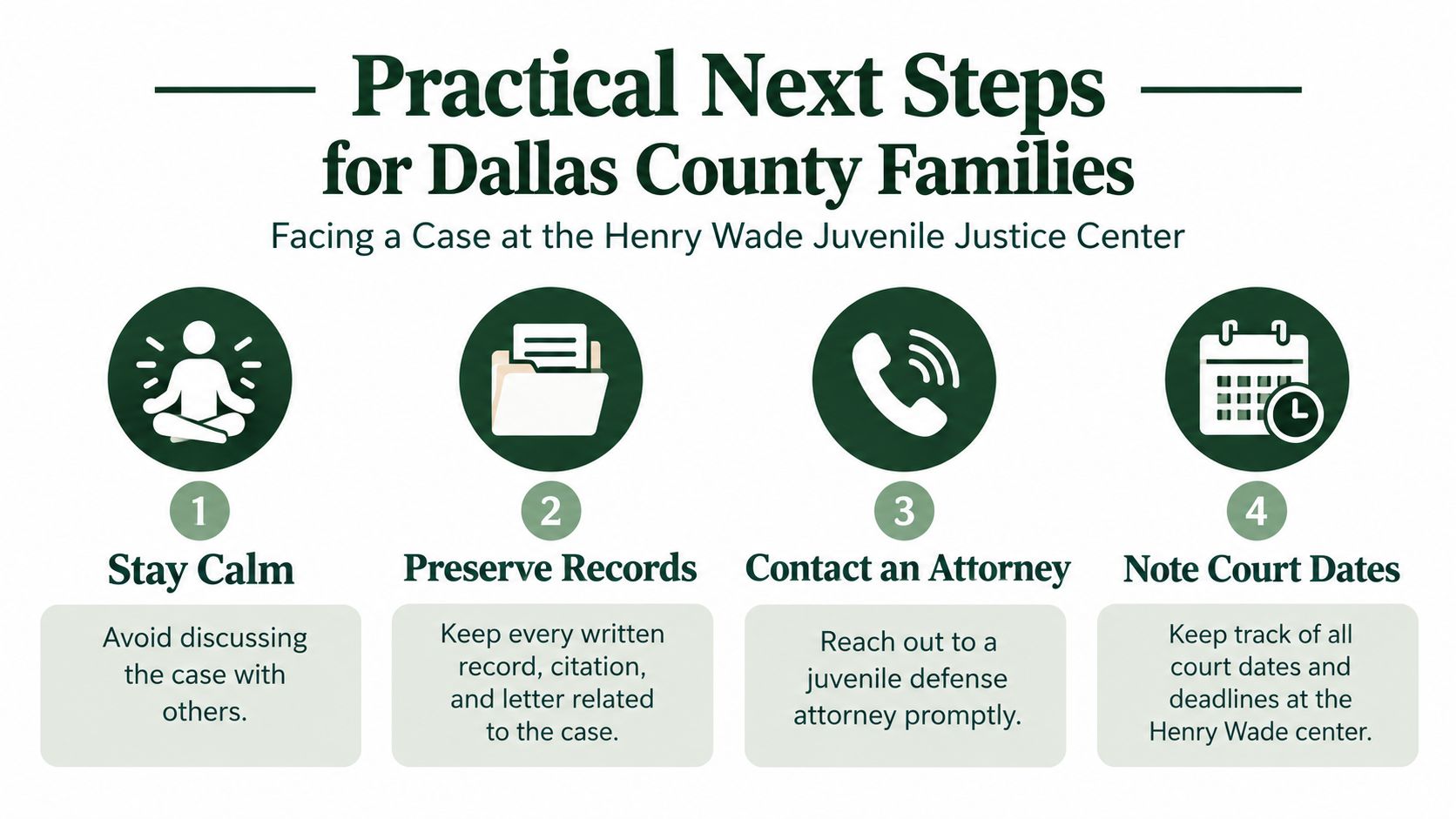
- Preserve the file: Keep citations, notices, letters, texts, school communications, and program documents in one folder.
- Confirm the case type: Determine whether the matter is delinquency, DFPS abuse and neglect, or a domestic-relations case involving DFPS.
- Contact counsel promptly: Ask a Dallas County juvenile attorney about detention, statements, evidence, diversion, and the next hearing.
- Track every date: Confirm hearings and reviews with the appropriate Dallas County office and keep a calendar for conditions and services.
- Look for crossover issues: A delinquency matter may raise custody or possession concerns, while a DFPS case may affect a related SAPCR, meaning a suit affecting the parent-child relationship.
If the family is also facing divorce, child support, a custody modification, enforcement, relocation, paternity, a protective order, or property issues, the juvenile matter should be disclosed to the family-law lawyer. That is especially important in complex Dallas family cases involving business ownership, retirement accounts, separate-property tracing, or other financial disputes, where a juvenile proceeding may create additional scheduling, evidence, or parenting concerns.
The Law Office of Bryan Fagan, PLLC offers information and legal representation for Dallas-area families dealing with juvenile matters, DFPS involvement, custody disputes, and related family-law proceedings. Visit the firm's Dallas resource to request guidance about what happens next and how to coordinate the issues affecting your family.
