 Skip to content
The answer depends on the residence address inside Carrollton, not the mailing city. Carrollton crosses Dallas, Denton, and Collin counties, and Texas generally requires six months of Texas domicile plus 90 days of residence in the county where the divorce is filed.
You may be sitting at a Carrollton kitchen table with a lease, utility bill, or driver's license that says “Carrollton” and still not know which court belongs on your divorce petition. A Dallas County assumption can be understandable, especially for residents near Dallas, but it can also send an otherwise proper case to the wrong district clerk.
The reliable approach is to verify the physical residence address, confirm the residency clocks, and then separate venue, the proper county for filing, from jurisdiction, the court's legal authority over the people and issues in the case.
Table of Contents
- Why Carrollton Does Not Pick a Single County
- How the Three Counties Divide Carrollton
- Texas Residency and Venue Rules for a Carrollton Divorce
- Comparing Dallas Denton and Collin County Filing Systems
- Two Carrollton Hypotheticals That Change the Answer
- A Venue Checklist for Carrollton Residents
- Common Questions Carrollton Filers Ask Next
Why Carrollton Does Not Pick a Single County
“Carrollton divorce which county, Dallas, Denton, or Collin?” is the right question, but Carrollton itself doesn't provide a single answer. The city crosses all three counties, so the county connected to a divorce generally depends on where a spouse lives and whether the Texas residency requirements are satisfied.
The City of Carrollton's official materials identify Dallas, Denton, and Collin counties as part of the municipality. Its demographic breakdown lists approximately 83,615 residents in Denton County, 52,165 in Dallas County, and 764 in Collin County. Those figures come from the city's official election and county resource directory.
That distribution matters because the largest share of Carrollton residents is associated geographically with Denton County, while a substantial portion is in Dallas County and a much smaller portion is in Collin County. A person can use a Carrollton mailing address, attend a Carrollton-area school, work in Dallas, and still need to file in Denton or Collin County.
Practical rule: The mailbox tells you the city. The residence parcel and county designation help identify the venue.
What the county affects
The county can determine which district clerk, courthouse, family district court system, records office, and electronic filing process applies. County lines may also affect where a prior custody order is maintained and which court may retain authority over child-related issues.
The first review should answer four questions:
- Which county contains the filing spouse's physical residence?
- Has that spouse met the Texas six-month and county 90-day residency requirements?
- Does the respondent live in another qualifying county?
- Are there prior family-law orders involving children, support, enforcement, or the marriage?
Texas law does not choose a filing county based on the county most residents associate with Carrollton. It also doesn't use a highway exit, employer location, school district, or courthouse convenience as a substitute for residence.
The rest of the analysis is therefore practical. Verify the address, calculate the residency periods, identify any prior case, and only then select the filing system. That process is more dependable than treating every Carrollton divorce as a Dallas County matter.
How the Three Counties Divide Carrollton
Carrollton is a substantial North Texas community, not an isolated town. The U.S. Census Bureau reported 119,097 residents in the 2010 Census and 133,434 in the 2020 Census, an increase of 14,337 residents, or approximately 12.0%, and estimated 135,456 residents on July 1, 2024, a further 1.5% increase from the 2020 estimates base. The Census Bureau QuickFacts profile for Carrollton provides that population context.
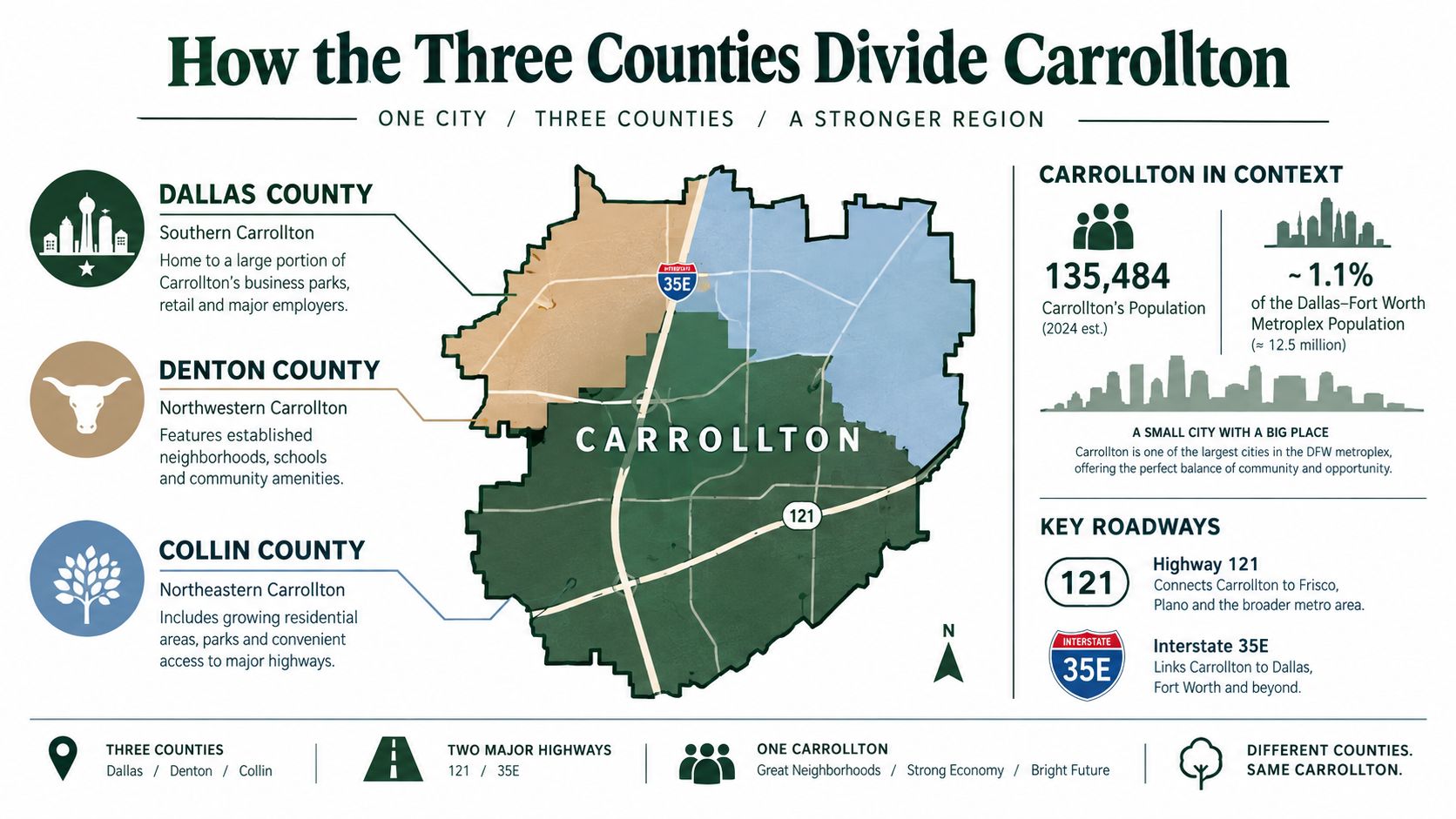
For a working mental picture, think of Carrollton as a city layered over county boundaries rather than as a city contained by one county.
Denton County
The Denton County portion contains the largest share of Carrollton's residents, approximately 83,615 people according to the city's demographic materials. Many readers associate this portion with the broader northern and western areas of the city, including neighborhoods near Interstate 35E and the Hebron Parkway corridor.
That orientation can help you start, but it isn't proof of venue. A particular home or apartment still needs address-level verification.
Dallas County
The Dallas County portion includes southern and southeastern areas of Carrollton near established Dallas-area communities. It contains approximately 52,165 residents, which is a significant part of the city rather than a marginal exception.
A Carrollton address in Dallas County generally points a qualifying divorce filing toward the Dallas County District Clerk and Dallas County family district courts. The Dallas County subcourthouse location guide can help residents understand the county's broader government footprint, but the divorce filing itself belongs with the applicable district-court system.
Collin County
The Collin County portion is much smaller, with approximately 764 residents identified in the city's breakdown. It is associated with the far northern edge of Carrollton near the city's northern boundary.
Highway 121, Interstate 35E, Hebron Parkway, and neighborhood names can provide geographic clues. They cannot replace confirmation of the county attached to the actual residence. This geographic overview is a map-reading aid, not a legal conclusion. The address must be matched to the county before the Texas venue rules are applied.
Texas Residency and Venue Rules for a Carrollton Divorce
Texas Family Code §6.301 provides the basic residency rule for an original divorce petition. One spouse must have been a Texas domiciliary for at least six months and a resident of the county where the petition is filed for at least 90 days. The rule appears in the Texas Family Code residency provision.
In plain language, count backward 90 days from the intended filing date. Then confirm that the filing spouse has lived in the same county throughout that period, while also confirming the separate six-month Texas requirement.
Venue is not jurisdiction
Venue asks, “Which county is the proper place to begin this case?” Jurisdiction asks, “Does this court have legal authority over the parties, the marriage, and the issues presented?”
Those questions often overlap in a straightforward divorce, but they can separate when children or prior orders are involved. A county may satisfy the ordinary divorce venue rule while another court retains continuing authority over child-related matters from an earlier case.
Two basic address examples
Suppose the filing spouse lives in the Dallas County portion of Carrollton and has lived in Texas for at least six months and Dallas County for at least 90 days. Dallas County may be the proper venue, subject to the facts of the case and any other applicable issue.
Now suppose the filing spouse lives in the Denton County portion of Carrollton and satisfies the same residency periods in Denton County. The filing generally points to Denton County instead. The city name remains Carrollton, but the district-court county changes.
If spouses live in different counties, either county may potentially be available if the applicable residence requirements are met. The Texas State Law Library explains the general filing framework in its divorce filing guidance.
The petition should therefore identify the county based on the actual residence, not merely repeat “Carrollton” and assume Dallas. A mailing address alone doesn't establish the correct venue.
Comparing Dallas Denton and Collin County Filing Systems
Once the residence county is verified, the filing process becomes a clerk-and-court matching exercise. Each county has its own district clerk, family district-court procedures, local instructions, and electronic filing pathway.
| County | Primary Carrollton Use Case | Clerk and Filing Notes |
|---|---|---|
| Dallas County | A qualifying residence in the Dallas County portion of Carrollton | File through the Dallas County District Clerk and Dallas County family district-court system. The principal divorce filing location is the George L. Allen, Sr. Courts Building. |
| Denton County | A qualifying residence in the Denton County portion of Carrollton | Use Denton County's district clerk, family-court filing instructions, local forms, and electronic filing system. The relevant courthouse and clerk offices are in Denton. |
| Collin County | A qualifying residence in the Collin County portion of Carrollton | Use Collin County's district clerk, family-court filing instructions, local forms, and electronic filing system. The relevant courthouse and clerk offices are in McKinney. |
Dallas County mechanics
For a qualifying Dallas County case, filings are handled through the Dallas County District Clerk and the George L. Allen, Sr. Courts Building at 600 Commerce Street, Dallas, Texas 75202. Dallas County states that attorneys must file electronically in district courts. Self-represented parties may file paper pleadings at the Pearl C. Smith Civil File Desk on the first floor, west of the George L. Allen building.
Dallas County also offers a Guide and File pathway for an uncontested divorce without children. Eligible self-represented filers can complete an online interview and prepare documents for electronic filing. The county's Dallas County divorce filing information explains the county-specific process.
Denton and Collin County mechanics
Denton and Collin County filings should be matched to the residence county rather than selected because one courthouse seems more convenient. A filer should locate the correct district clerk, review the county's current instructions, confirm the applicable family-court forms, and use that county's electronic filing route.
A self-represented filer may also need to verify whether a document must be filed electronically or may be submitted in person. These details can change, so use the county's current clerk information before submitting an original petition.
For Dallas-specific self-representation materials, the Dallas County District Clerk divorce fee schedule is a useful starting resource. It does not make Dallas the default county. Address verification comes first.
Two Carrollton Hypotheticals That Change the Answer
Two families can both say, “We live in Carrollton,” and still receive different filing answers. The difference may come from the county attached to the home, or from a prior court order involving children.
Scenario A, a Denton County uncontested divorce
Assume both spouses live in the Denton County portion of Carrollton. They have no children from the marriage, no prior family-court orders, and agreement on the divorce terms. They also satisfy the Texas and county residency periods.
Their clean uncontested path points to Denton County, not Dallas County. The fact that Dallas is a familiar local reference doesn't change the residence-based venue analysis. The spouses should use Denton County's district clerk and filing instructions.
If they opened a Dallas County filing because they assumed Carrollton meant Dallas, the clerk and the other spouse could raise a venue problem. That can lead to delay or a transfer rather than giving the couple a faster route.
Scenario B, a Collin County residence with a Dallas custody order
Now assume one parent lives in the Collin County portion of Carrollton. The parent wants to file for divorce, but a Dallas County court previously issued a custody order involving the children. The new divorce's ordinary venue analysis may point to Collin County because of the current residence.
That does not automatically mean the child-related issues belong entirely in Collin County. The Dallas County court that issued the prior order may have continuing, exclusive jurisdiction over the children's case, depending on the orders and procedural history. The parent should identify the prior case number, final order, modification history, and any pending enforcement matter before filing.
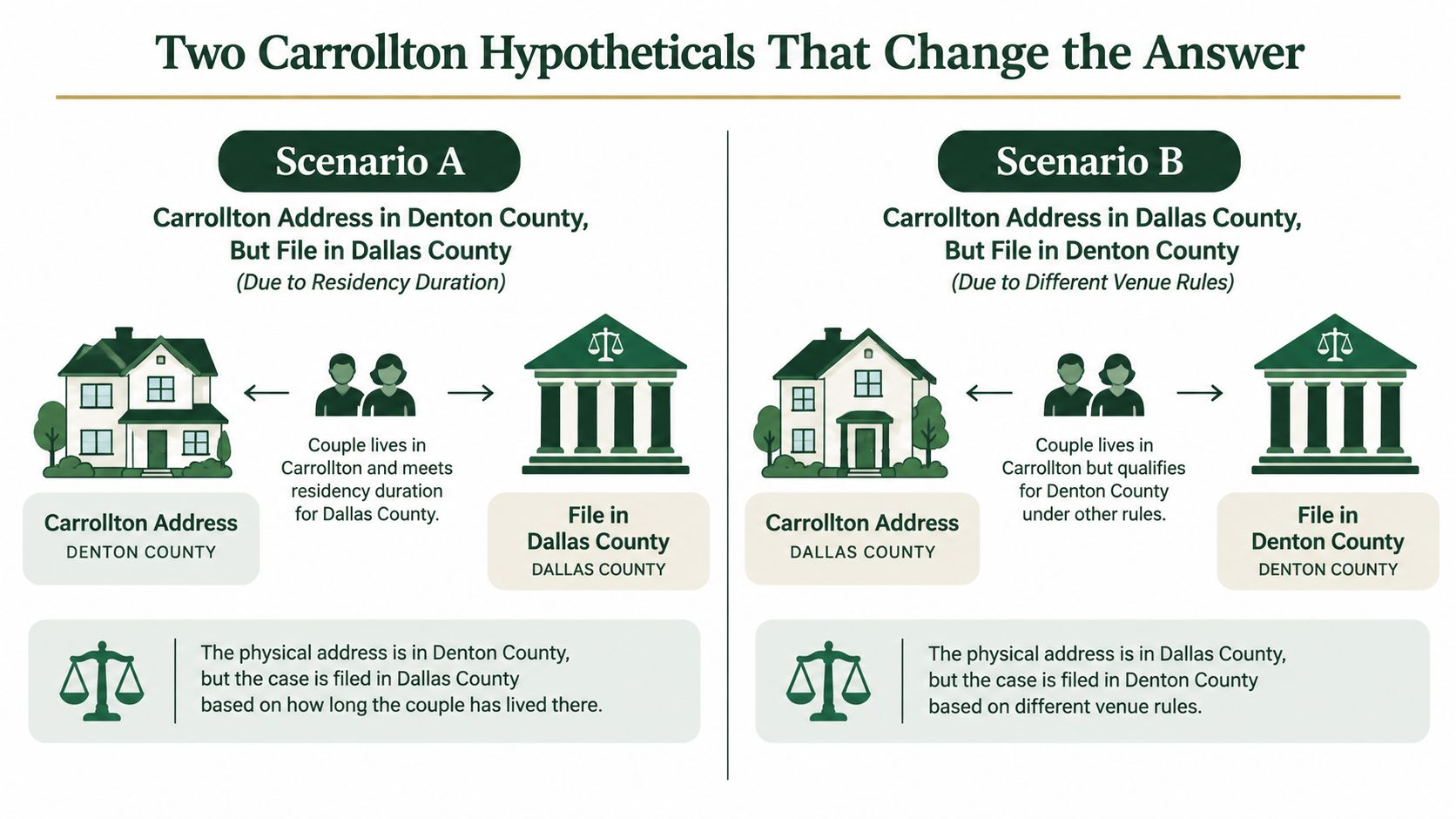
The lesson is not that every divorce and custody issue must remain in one county. The lesson is that a new divorce venue analysis cannot erase an existing child-related jurisdiction analysis. A parent should disclose the earlier case before choosing a filing strategy.
A Venue Checklist for Carrollton Residents
Use this checklist before preparing the petition or opening an electronic filing account. It is designed to catch the address problem before it becomes a court problem.
Identify the physical residence. Check the county parcel record or official address designation for the home or apartment. Don't rely only on the word “Carrollton,” a ZIP code, a school district, or a nearby roadway.
Confirm the Texas residency period. Verify that the filing spouse has been a Texas domiciliary for at least six months. Gather records that may help establish residence if the issue is disputed.
Calculate the county period. Count backward 90 days from the intended filing date and confirm that the filing spouse lived in the selected county during that period. The Texas Family Code residency text is the starting point for this statutory review.
Check the respondent's residence. If the spouses live in different counties, another qualifying county may be available. That choice should be deliberate, not based on whichever courthouse appears closest.
Search for prior family-law cases. Look for custody orders, support orders, enforcement proceedings, modifications, protective orders, or other matters involving the children or marriage. Record the case number and issuing court.
Separate venue from child jurisdiction. Ask whether an existing court may have continuing, exclusive jurisdiction over the children. A divorce petition and child-related claims may require different analysis.
Match the filing system. Select the correct district clerk, courthouse, electronic filing portal, and county-specific instructions. Dallas County self-represented parties can review Dallas County family-law forms and filing resources.
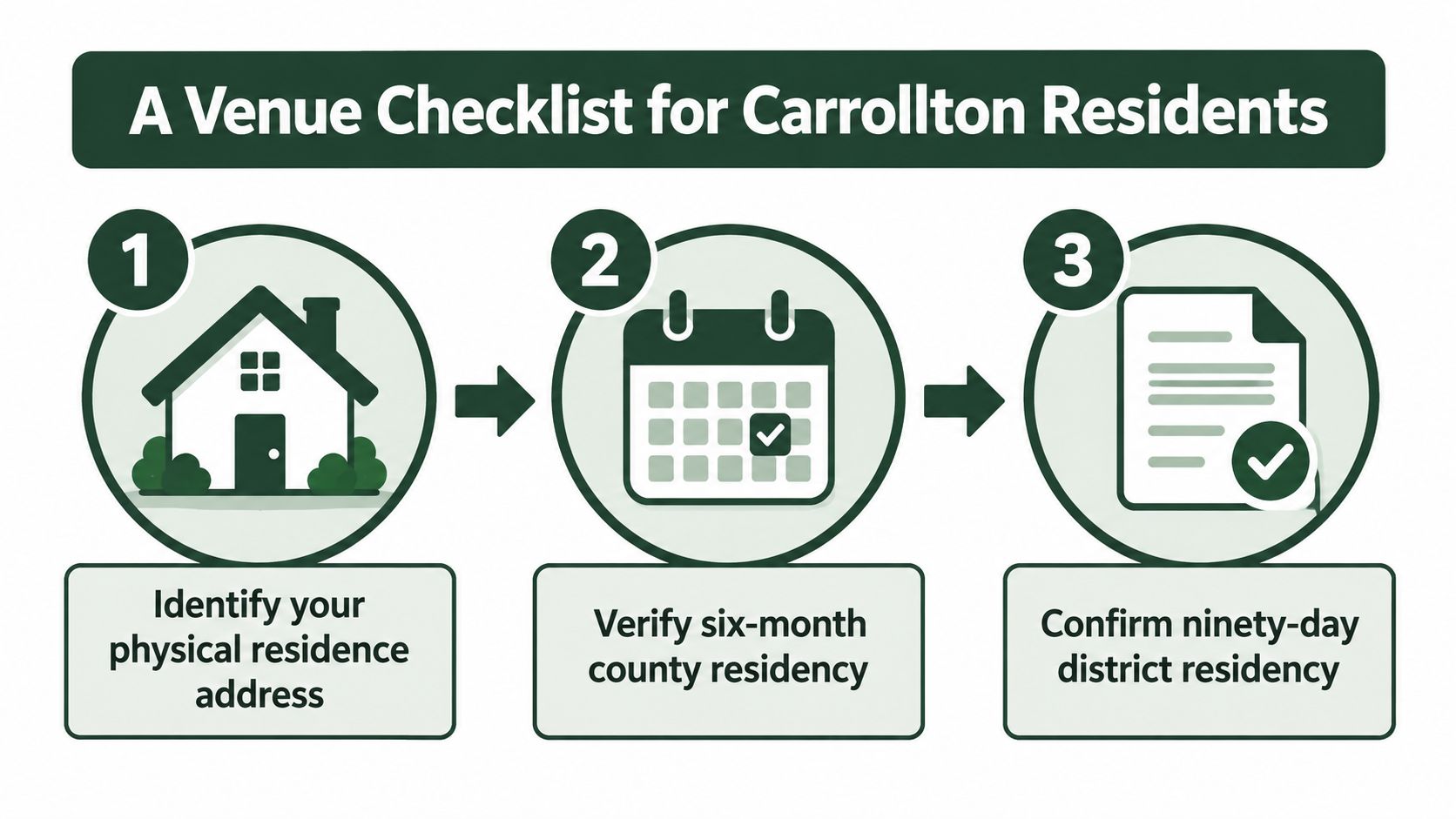
Filing in the wrong county can create objections, delay, or a transfer. A careful address check is usually easier than correcting the filing after the case begins.
Common Questions Carrollton Filers Ask Next
What happens if I move after filing?
Moving to another county during a pending divorce does not automatically move the case. If children are involved, a move may raise a separate jurisdiction question, especially when an existing custody, support, or visitation order identifies a court that continues handling child-related issues.
Is Dallas County the default because Carrollton is associated with Dallas?
No. Carrollton extends across Dallas, Denton, and Collin counties. Verify the street address and county first, then apply the residency and venue facts. Choosing the closest courthouse can lead to an objection, delay, or transfer.
When should I speak with a Dallas family-law attorney?
A consultation before filing can help when children, prior custody or support orders, property in multiple counties, retirement accounts, a business, disputed separate property, relocation, enforcement, or an uncertain residence county are involved. These facts may affect both the proper venue and which child-related claims belong in the petition.
A Dallas family-law office can also explain temporary orders, possession, child support, property division, protective orders, CPS concerns, and post-divorce enforcement. Bring address information, residency dates, and prior case documents, then schedule a consultation to identify the next practical step.
The Law Office of Bryan Fagan, PLLC provides family-law guidance for Dallas County divorce, custody, support, property division, temporary orders, and related proceedings. If you are unsure whether your Carrollton address points to Dallas, Denton, or Collin County, visit The Law Office of Bryan Fagan, PLLC with your residence information and prior court orders ready for review.
