 Skip to content
The most common advice about Dallas County child support payments is also the source of many problems: don't assume the local Dallas office is the place where every payment is finally processed and credited. Dallas County is a local receiving point for payments ordered by the Family and Juvenile Courts, but the operational payment system is centralized through Texas child-support systems and the State Disbursement Unit. That statewide pipeline records payments before they're forwarded to the receiving parent. (Dallas County Child Support FAQ; Texas Attorney General payment guidance)
That distinction matters whether you're paying support, waiting to receive it, trying to prove compliance, or dealing with arrears. A payment can leave your bank account and still fail to post correctly if the wrong case information, payment instrument, or mailing destination is used. The guide below explains the Dallas County child support division payment process in plain English, including income withholding, payment tracking, missing mail, and the point at which a payment problem becomes a court problem.
Table of Contents
- The Hidden Pipeline Behind Dallas County Child Support Payments
- Payment Methods Available in Dallas County
- Setting Up and Managing Income Withholding in Texas
- How Payments Get Credited and Tracked
- Common Mistakes That Delay or Lose Payments
- Dallas County Resources and Next Steps
The Hidden Pipeline Behind Dallas County Child Support Payments
A Dallas County child support payment does not move directly from one parent to the other through a courthouse office. The court order creates the duty to pay, while Texas's centralized child-support system handles the payment record, processing, and distribution. Dallas County's Child Support Office, at the George L. Allen, Sr. Courts Building, 600 Commerce Street, Suite 128, Dallas, TX 75202, serves as a local point of contact for court-ordered support. (Dallas County Child Support FAQ)
The payment path works like a relay. Each part must receive the information it needs before the next part can act:
- The parent pays through income withholding, online payment, mail, cash, phone payment, or another approved channel.
- The payment enters the state child-support system, where it must be matched with the correct case.
- The State Disbursement Unit processes and records the payment.
- The funds are sent to the parent entitled to receive them.
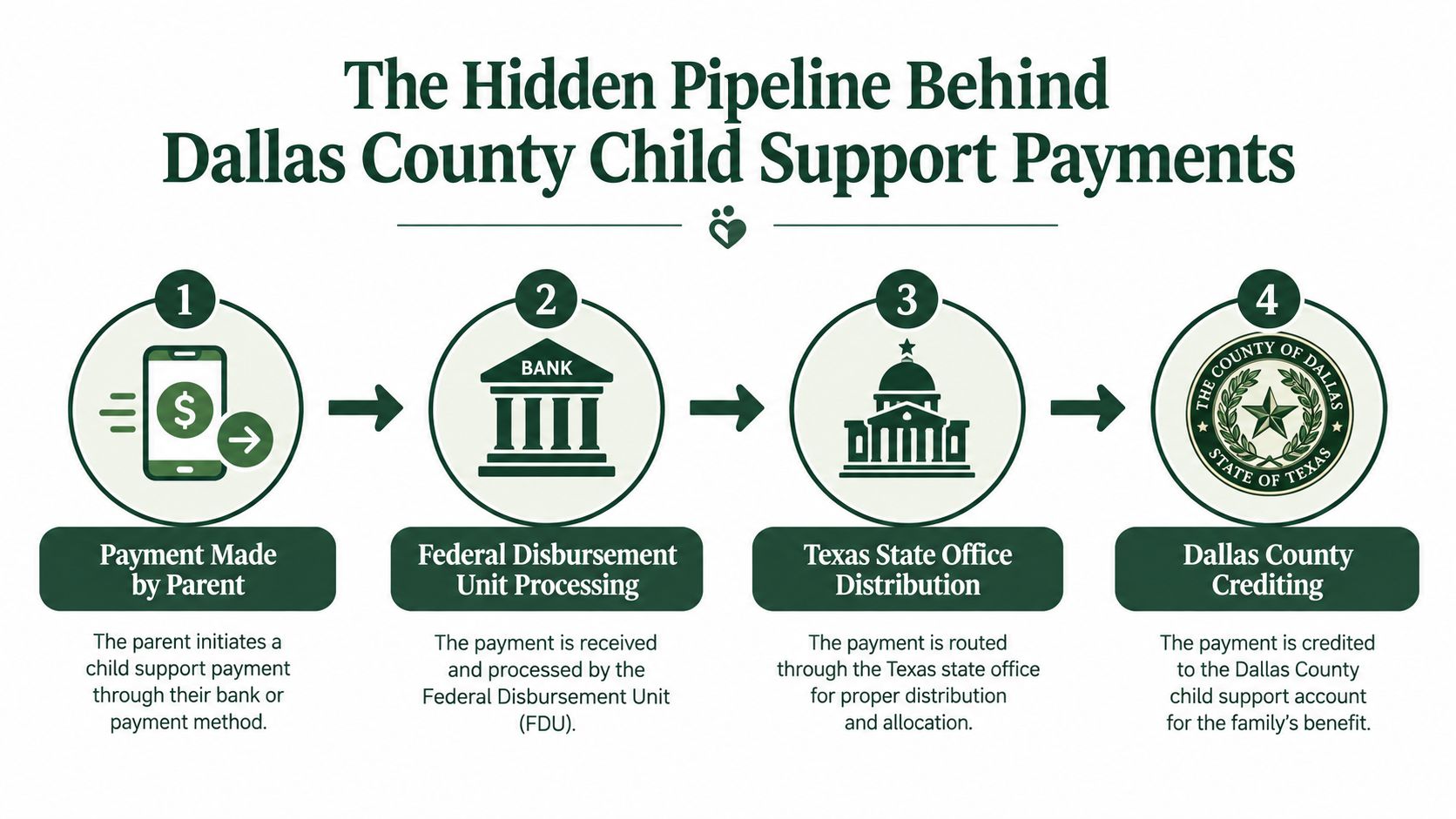
Practical rule: The Dallas courthouse and the State Disbursement Unit are connected parts of the system, but they perform different jobs.
The statewide record shows who paid, which case received the payment, when it was posted, and when it was disbursed. Those details help resolve disputes about arrears or claims that a payment was never made. They also explain why a Dallas County case may involve a San Antonio mailing address. The court case is local, but payment processing follows the statewide pipeline.
This structure applies in divorce, custody, paternity, and enforcement cases. A court order establishes the amount owed, while the payment system accounts for and distributes the money. If the amount is disputed, support is being modified, or nonpayment is alleged, compare the court order with the payment record. A bank statement may show that money left the payer's account, but the state record helps establish whether it reached and posted to the correct case.
Payment Methods Available in Dallas County
Dallas County does not control the entire payment path. A parent may pay locally or online, but the money still enters Texas's statewide child-support system, where payment details are matched, posted, and distributed. Choosing a method means choosing how the payment reaches that pipeline and what proof you can keep.
The Texas Attorney General lists online, phone, mail, cash, wage withholding, and autodraft options. Online registration generally requires the noncustodial parent's name, Social Security number, address for first-time registration, 10-digit OAG case number, and a valid email address. (Texas Attorney General payment methods)
Online and phone payments
The OAG's Smart e-Pay system accepts credit cards, Apple Pay, Google Pay, PayPal, Venmo, and bank autodraft. Enter the case information carefully and save the confirmation. That receipt shows an attempted or completed transaction, while the state record confirms whether the payment was matched and posted to the right case.
Online payment can help a parent who is outside Dallas County, traveling, or trying to avoid mail delays. The payment obligation remains in place if a transaction is rejected, registration is incomplete, or the website has a technical problem. Check the payment status rather than assuming the issue resolved itself.
Mail and in-person payments
The State Disbursement Unit uses a San Antonio mailing address for child-support payments. A Dallas courthouse issued the order, but that does not make the courthouse the correct payment destination. Follow the instructions for the state payment system, and retain the mailing proof, payment details, and case information used.
At the Dallas County office, the county's stated payment options include money order, cash, or cashier's check. Personal checks are not accepted, although certain employer withholding checks may qualify.
| Method | Where to send | Accepted instruments | Timing or processing point | Key restrictions |
|---|---|---|---|---|
| Online or phone | Texas child-support payment system | Cards, digital wallets, PayPal, Venmo, autodraft, and other listed options | Depends on the payment channel and posting process | Registration and case information must match |
| State Disbursement Unit in San Antonio | Use the instrument permitted by the payment instructions | Mailing time and state processing can delay crediting | Do not rely on a Dallas County courthouse address | |
| In person | Dallas County Child Support Office | Money order, cash, or cashier's check | Intake is followed by state processing | Personal checks are not accepted |
| Wage withholding | Employer sends deductions through the required child-support channel | Payroll deduction | Varies by the employer's payroll cycle and remittance process | The parent remains responsible if withholding has not begun |
Keep the payment method separate from the court case itself. If a family-law filing requires information about court costs or filing logistics, the Dallas County District Clerk divorce filing fee schedule addresses that separate process. It does not replace the child-support payment instructions.
Setting Up and Managing Income Withholding in Texas
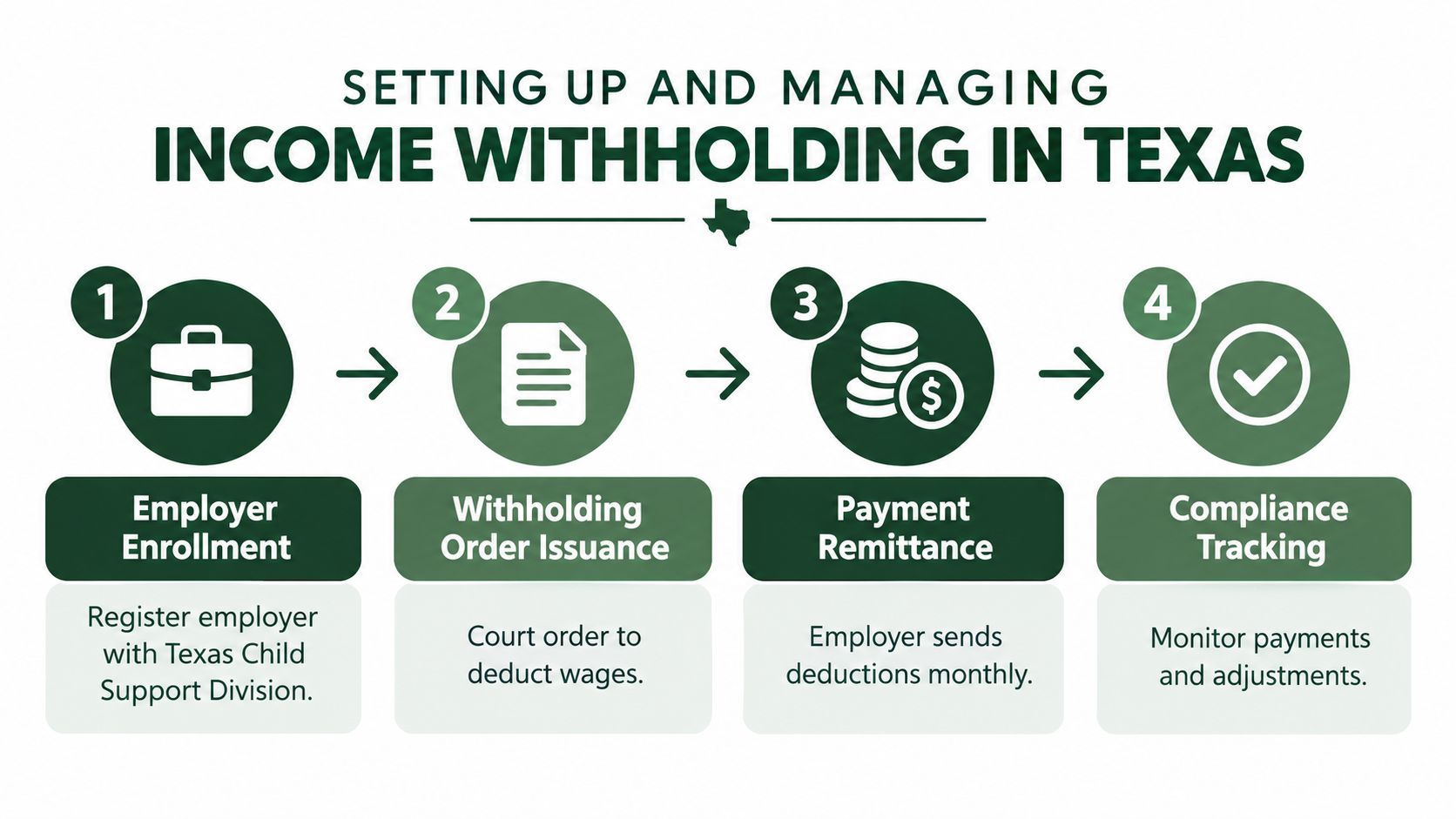
Income withholding is designed to move child support from the employer's payroll system into the official payment pipeline. The process begins with an Order to Withhold Income for Child Support. The employer receives the order, deducts the required support from the employee's paycheck, and sends the deduction to the Child Support Division. The payment is then processed and sent to the custodial parent. (Texas Attorney General wage withholding guidance)
What the employer does
An employer doesn't decide whether withholding applies. The employer follows the withholding order and remits the deduction through the required child-support channel. Payroll staff need accurate identifying information so the deduction is connected to the right parent and case.
The paying parent should review pay stubs after withholding is supposed to begin. Look for the child-support deduction, compare it with the order, and keep copies of the pay records. If the employer hasn't started deducting, contact the appropriate child-support office and employer payroll department rather than assuming the obligation has paused.
What the parent must still do
The OAG states that the parent remains responsible for making payments even if income withholding hasn't started. That means an employer delay can create a serious problem if the parent waits and assumes the payroll deduction will eventually catch up.
A job change can also interrupt withholding. When employment changes, the child-support agency and employer may need updated information before deductions begin at the new workplace. Keep records of the old employer's final deduction, the new employer's information, communications with payroll, and any direct payments made while the transition is being resolved.
The Dallas County pro se family-law forms resource can help self-represented parents locate general family-law paperwork, but forms alone may not resolve a disputed arrearage, incorrect withholding amount, or enforcement issue. Those problems may require a court filing and evidence.
How Payments Get Credited and Tracked
A payment is matched through details such as the OAG case number, payer information, payment date, and amount. The State Disbursement Unit uses those fields to connect the remittance with the correct support account before funds are distributed. Missing or inaccurate information can delay matching, even when the payer submitted the money on time.
Parents should separate three events: payment made, payment posted, and payment disbursed. An online transaction, mailed payment, or payroll deduction may show that money left the payer's hands, while the receiving parent's account still awaits posting. Each payment method follows its own processing path, so a bank withdrawal or pay-stub deduction does not automatically prove that funds have been credited.
Build a payment record
Keep documents that show what was paid, when it was paid, and which case it was intended for:
- Payment confirmation: Save online confirmations, transaction records, and email notices.
- Case identification: Record the correct OAG case number and payer information used with the payment.
- Payroll proof: Keep pay stubs showing withholding and employer records when available.
- Mailing evidence: Retain the money-order receipt, envelope information, and proof of mailing.
- Account review: Check the official payment history instead of relying only on a bank statement.
A mailed payment that does not arrive within 10 business days of posting may qualify for replacement through an affidavit process. Follow the applicable instructions and retain proof of payment before requesting a replacement. Sending a second payment without documenting the first can create a new accounting dispute.
Keep separate obligations clear
A Texas family-law order may include medical support, dental support, spousal support, and fees alongside child support. These obligations can have different instructions, addresses, processing rules, or collection channels. The TexasLawHelp guide to child support in Texas explains how support obligations differ and describes the State Disbursement Unit's role in recording certain court-ordered payments before forwarding them to the receiving parent.
If an order includes child support, medical support, and arrears, do not assume one undifferentiated payment will be allocated exactly as expected. Read the order, follow the agency's payment instructions, and request a payment history that shows how each amount was applied. That record can reveal whether the issue is a missing payment, delayed posting, or allocation to a different obligation.
Common Mistakes That Delay or Lose Payments
Payment delays in Dallas County cases commonly trace back to four avoidable errors: a wrong address, a rejected payment instrument, missing identifying information, or failure to follow up. The legal order may be correct, yet the payment can still stall in the statewide pipeline that connects the local case to the State Disbursement Unit.
Four avoidable breakdowns
- Mailing to the wrong destination: A Dallas parent sends a money order to the courthouse because that is where the order was entered. The courthouse and the SDU do different jobs. Follow the SDU's payment instructions for the case instead of assuming the filing location is the processing location.
- Using a personal check: A parent brings a personal check to the Dallas County office and expects it to be accepted. The county FAQ says personal checks are not accepted there. Use an approved instrument, such as a money order, cash, or cashier's check.
- Failing to update employment or address information: A job change or move can prevent payments, notices, or withholding records from matching the correct account. Update the relevant child-support records and retain confirmation that the change was reported.
- Ignoring a missing mailed payment: A recipient may wait after a mailed payment fails to arrive, then miss the affidavit replacement process. Once the applicable delivery window has passed, gather the receipt and mailing proof, then follow the county's replacement instructions. Sending a second payment first can create a separate accounting problem.
Before you call: Have the OAG case number, payment date, amount, payment method, confirmation or receipt, employer information if withholding is involved, and any notice about arrears available.
Use this self-audit before assuming the payment disappeared:
- Confirm the case number on the payment profile.
- Confirm the destination and accepted payment instrument.
- Check whether payroll deductions appear on the paying parent's pay stub.
- Save each confirmation and receipt.
- Review the official payment history when the payment should have posted.
- Begin the replacement process after a mailed payment passes the stated delivery window.
Dallas County Resources and Next Steps
The Dallas County Child Support Office is located at the George L. Allen, Sr. Courts Building, 600 Commerce Street, Suite 128, Dallas, TX 75202. Its page identifies the local office and the State Disbursement Unit as connected parts of the payment system, so a Dallas case may still depend on statewide processing before funds are credited. (Dallas County Child Support Office)
For online or phone payments, use the Texas Attorney General's payment instructions. The Texas Attorney General payment portal guidance explains the registration details and payment instruments used with Smart e-Pay. Keep the case number and confirmation information together.
Know when the issue belongs in court
Use this decision path:
- The payment was made, but the account does not show it. Check the payment confirmation, allow processing time, and contact the payment system with the case number. The issue may be posting or routing.
- The payment amount or withholding is wrong. Compare the order with the pay stub and withholding notice. If the deduction does not match the order, address the withholding problem and preserve the payroll records.
- The required amount no longer fits the family's circumstances. A payment system cannot change a court order. A material change in income, employment, custody, or the child's needs may require a modification request.
- The other parent claims unpaid support. Gather payment records, notices, receipts, and the official history before deciding whether to respond to an enforcement action or seek court relief.
Parents with a related family case can review the George L. Allen, Sr. Courts Building family-case guide for courthouse information. Confirm current location and filing details before appearing.
Your practical checklist is short: verify the case number, confirm the payment method, ask whether the employer received a withholding order, review payment history, and preserve receipts. For a missing mailed payment, follow the replacement process before sending another payment. For modification or enforcement, discuss the facts with a qualified Dallas County family-law attorney.
The Law Office of Bryan Fagan, PLLC helps Dallas County parents with payment disputes, enforcement, modifications, and related custody or divorce matters. Visit The Law Office of Bryan Fagan, PLLC for family-law resources and consultation information.
