 Skip to content
Dallas County misdemeanor cases are filed through the District Attorney's Intake and Grand Jury Division, prosecuted by the misdemeanor division in the Frank Crowley Courts Building, and recorded by the County Clerk, not the District Clerk. The county's misdemeanor system is organized around 11 county criminal courts that hear Class A and Class B misdemeanors.
You may be standing outside a Dallas courthouse with a bond receipt in one hand and paperwork you don't fully understand in the other. An online search may show no case, or you may have been told to contact a clerk's office without knowing which one. The Dallas County criminal courts at law misdemeanor process becomes easier to follow once you separate the roles of law enforcement, the District Attorney, the County Clerk, and the county criminal courts.
Table of Contents
- Understanding the Dallas County Misdemeanor System
- How Misdemeanor Cases Enter the Court System
- Arraignment and Bond Decisions Explained
- Pretrial Options, Diversion, Pleas, and Discovery
- Misdemeanor Trials and Outcomes in Dallas County
- Sentencing Ranges and Post-Conviction Consequences
- Next Steps and How to Navigate Dallas County Courts
Understanding the Dallas County Misdemeanor System
Suppose a Dallas County resident is arrested or cited for an offense that may become a Class A or Class B misdemeanor. The first instinct is often to search the District Clerk's records or assume the case will proceed through the same system as a felony. That assumption can send the person to the wrong office and make an already stressful situation harder to manage.
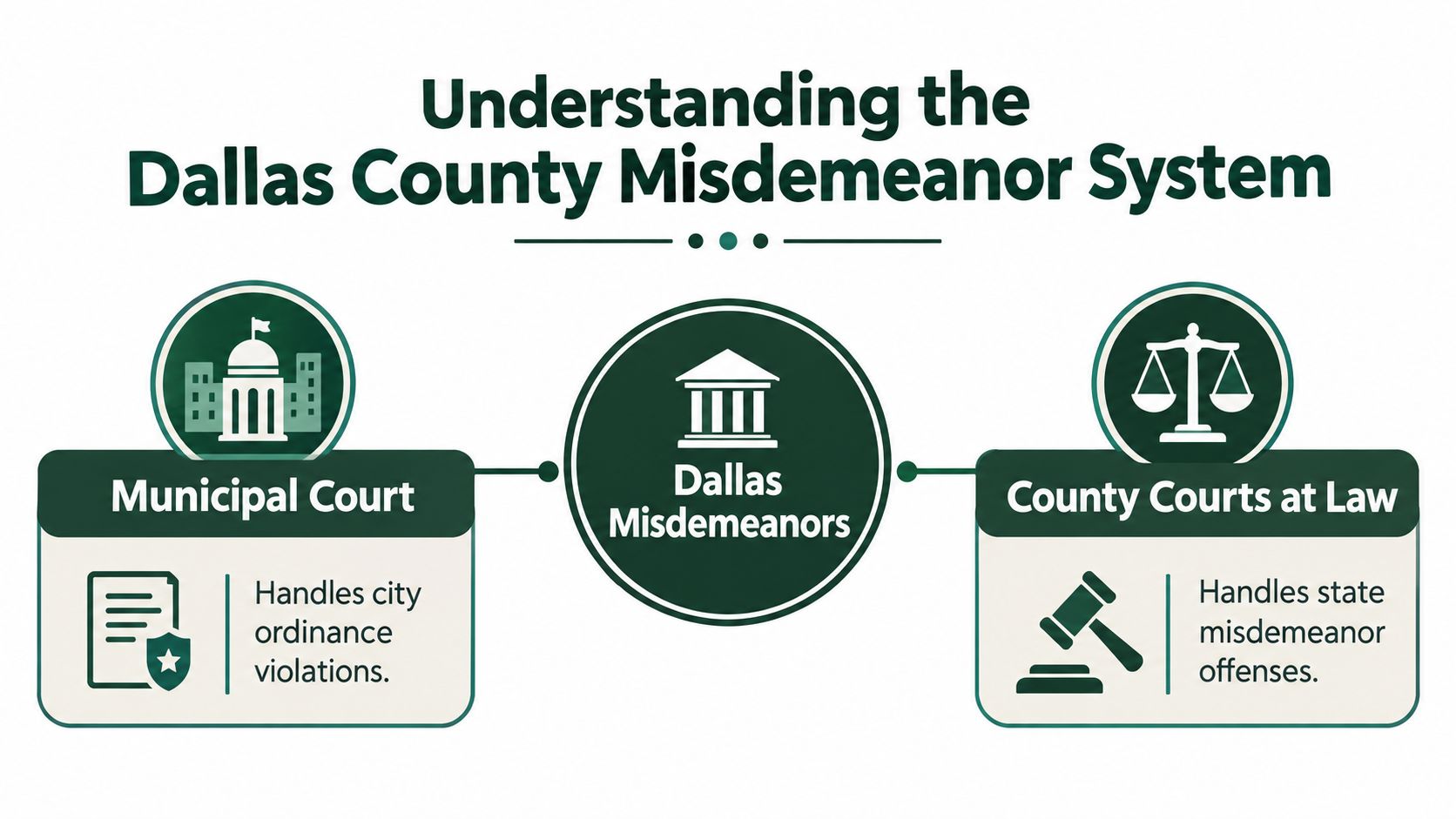
Dallas County uses a dedicated misdemeanor track. The 11 county criminal courts hear Class A and Class B misdemeanors, while the County Clerk, not the District Clerk, maintains the records for those cases. The County Clerk's Criminal Courts Division operates from the Frank Crowley Courts Building at 133 N. Riverfront Boulevard, 2nd Floor, Room A-1, with public counter hours from 8:00 a.m. to 4:30 p.m., Monday through Friday. See the Dallas County Criminal Courts Division information before traveling to the courthouse.
The office distinction that controls your search
A municipal court generally handles city ordinance matters and other municipal-court business. A county criminal court at law handles state Class A and Class B misdemeanor offenses. Those are different court tracks, and a city name doesn't always tell you which county or court system has authority. Cities such as Garland, Mesquite, or Dallas may have municipal matters that aren't filed in the Dallas County criminal courts at law.
Felony records follow a different administrative route through the District Clerk. If you're trying to understand that separate system, the guide to which Dallas County criminal district court hears felony cases provides useful context.
Practical rule: Before requesting records, identify the offense level and court type. The right clerk depends on that classification.
This structure matters even after the case ends. The same office distinction affects where you look for a disposition, request a copy of a court document, or ask about bond paperwork. Once you know that your misdemeanor record belongs with the County Clerk, the courthouse process has a clearer starting point.
How Misdemeanor Cases Enter the Court System
An arrest doesn't automatically mean a publicly filed county criminal case already exists. Dallas County's adult criminal filing pipeline gives the District Attorney's Intake and Grand Jury Division a screening role before a misdemeanor becomes a court-filed matter.
The process generally looks like this:
Law enforcement submits the offense. A law-enforcement agency refers an adult criminal offense to the District Attorney's Intake and Grand Jury Division.
Prosecutors review the referral. The intake division handles matters ranging from Class B misdemeanors through first-degree felonies and capital murder. Screening may determine whether the available information supports filing and what charge is appropriate.
An accepted misdemeanor moves toward filing. When intake attorneys accept a misdemeanor case, they draft the pleadings and file them with the County Clerk's Office.
The court record enters the county system. After filing, the case is connected with the appropriate county criminal court and tracked through the county's records process.
The Dallas County misdemeanor court-identification information shows how formal that tracking system is. Public background-search records use court codes such as MA through MJ for Criminal County Courts 1 through 8. Those codes aren't a substitute for legal advice, but they can help explain why a case record includes an unfamiliar court identifier.
Why a case may not appear where you expect
This pipeline explains why an arrest and a filed case aren't necessarily the same event. A referral may still be under prosecutorial review, or the paperwork may not yet have entered the County Clerk's court-record system. Searching one database and finding nothing doesn't establish that the matter was dismissed or that no action will follow.
The distinction also explains why Dallas County doesn't operate through one generic criminal-court record. The county criminal courts hear Class A and Class B misdemeanors, while county criminal courts of appeals handle appeals from justice-of-the-peace and municipal courts. Each layer has its own function.
If you receive paperwork, preserve every page. Write down the arresting agency, alleged offense, case number if one appears, and any court date. Those details help a lawyer or clerk determine whether you're looking at a municipal matter, a county misdemeanor, or a different type of proceeding.
Arraignment and Bond Decisions Explained
Arraignment is one of the first moments when the case becomes understandable in a courtroom setting. The judge or court addresses the filed charge, confirms the defendant's identity and procedural status, and handles the plea process or other preliminary matters. The exact sequence can depend on the case and the court, so a defendant shouldn't assume that every first appearance will look identical.
Before attending, read the paperwork carefully. Confirm the court, date, location, charge, and any release conditions. Don't discuss the facts of the case with the alleged complainant or potential witnesses without legal guidance, and don't treat a court appearance as optional because an online record is incomplete.
What bond means in practical terms
Bond is the financial or release arrangement that allows a defendant to remain out of custody while the case proceeds, subject to court requirements. Depending on the circumstances, release may involve cash, a surety, or another form authorized by the court. Bond conditions can matter as much as the amount. They may restrict contact, travel, or other conduct, and violating them can create additional legal problems.
Keep every bond document from the moment of release. A receipt that seems unimportant at booking may later be required to recover money after the case is resolved.
Cash-bond refunds require the right documents
Dallas County states that cash-bond refunds and other post-disposition monetary matters are processed only after the case is disposed. The County Clerk requires the original cash-bond receipt. If the request is mailed, the clerk also requires a copy of the payor's identification and a notarized request letter. The county's misdemeanor criminal-court frequently asked questions explains those requirements.
Save the original receipt. A missing document can delay a refund even after the criminal case itself has ended.
For a first-time defendant, the safest approach is simple. Keep the receipt, identification copy, court orders, and disposition paperwork together. If the payor isn't the defendant, the payor may need to take the administrative steps. Ask the County Clerk what it needs before mailing anything, because incomplete paperwork can require another submission.
For a practical look at courthouse logistics, review what happens on your first date at the Frank Crowley Courts Building. That kind of preparation won't determine the legal outcome, but it can prevent avoidable confusion when you arrive.
Pretrial Options, Diversion, Pleas, and Discovery
The period before trial is where many important decisions occur. A defendant may consider diversion, a negotiated plea, litigation over evidence, or a trial. None of those choices is automatically correct. The right path depends on the charge, the available evidence, prior history, eligibility requirements, and the consequences attached to a particular resolution.
Diversion may avoid a conviction, but eligibility controls
A diversion program usually involves conditions such as supervision, classes, counseling, restitution, community service, or other requirements. Successful completion may lead to a dismissal or another favorable disposition, but participation isn't guaranteed and the terms matter. A person should understand what happens if they fail a condition, whether the record can later be sealed or expunged, and whether the proposed resolution creates collateral consequences.
A defendant shouldn't accept diversion merely because it sounds better than trial. Review the written terms and ask how the disposition will appear in the record.
Plea negotiations are decisions, not formalities
A plea bargain can involve a change in charge, a particular punishment recommendation, probation, deferred adjudication, or dismissal of some allegations. The prosecutor's offer is not a court order until the appropriate legal process is completed, and the judge may have a role in accepting or rejecting parts of the proposed resolution.
Before entering a plea, evaluate:
- Evidence strength: What can the State prove, and what evidence supports the defense?
- Record impact: Will the outcome be treated as a conviction, deferred disposition, or dismissal?
- Conditions: What must be completed, and what happens if a condition is violated?
- Collateral effects: Could the result affect work, licensing, housing, immigration, firearms, or future proceedings?
Discovery shows what the State can use
Discovery is the exchange and disclosure of case information and evidence. It may include reports, recordings, photographs, witness information, documents, and other material relevant to the allegations. A defense lawyer uses discovery to test whether the police account, witness statements, physical evidence, and charging documents fit together.
The timing matters because a defendant may make a poor decision without knowing what evidence exists. Don't post about the case, delete messages, or contact witnesses to influence their accounts. Preserve potentially relevant communications and provide them to counsel for review.
A careful pretrial evaluation doesn't promise dismissal or a particular result. It gives the defendant a factual basis for choosing among negotiation, diversion, motions, and trial.
Misdemeanor Trials and Outcomes in Dallas County
A trial is not merely a longer negotiation. It is a formal process in which the State must present admissible evidence and prove the charge beyond a reasonable doubt. The defense can challenge the State's evidence, cross-examine witnesses, present a defense when appropriate, and argue that the required elements weren't established.
A typical contested misdemeanor trial may include jury selection if a jury is involved, opening statements, testimony and exhibits from the State, cross-examination, defense evidence if offered, closing arguments, and deliberation or a judge's decision. The details vary with the charge and the rulings made before and during trial.
Comparing negotiated resolution and trial
| Consideration | Negotiated resolution | Trial |
|---|---|---|
| Control | The parties discuss terms, but the court's role still matters. | The result depends on the judge or jury and the evidence admitted. |
| Evidence testing | The defense may use discovery to negotiate without presenting every issue in court. | Witnesses and exhibits are tested through courtroom procedures. |
| Risk | The defendant accepts the agreed or offered legal consequences. | The defendant faces the risk of an unfavorable verdict, but preserves the right to contest the charge. |
| Preparation | Counsel evaluates terms, conditions, and long-term consequences. | Counsel prepares motions, witnesses, exhibits, objections, and trial strategy. |
A plea can provide certainty about agreed terms, but it may carry consequences that aren't obvious from the sentence alone. A trial can challenge weaknesses in the State's case, but it requires preparation and accepts uncertainty about the outcome.
A trial decision should follow evidence review, not courtroom emotion.
For example, a defendant who believes a witness misunderstood an argument may need to compare the witness's statements with recordings, messages, photographs, and independent testimony. Another defendant may face evidence that makes a negotiated disposition worth serious consideration. Neither person should assume the same approach will work in the other case.
Discuss the strengths, weaknesses, costs, and consequences with a qualified criminal-defense lawyer before entering a plea or waiving trial rights.
Sentencing Ranges and Post-Conviction Consequences
The consequences of a misdemeanor don't end when the judge announces the result. A conviction can affect how a person answers future applications, responds to background checks, seeks professional opportunities, or handles later criminal or family-law proceedings. The impact depends on the offense, disposition, findings, and the person's circumstances.
Texas generally categorizes Class A and Class B misdemeanors differently, with Class A offenses carrying greater potential punishment than Class B offenses. The actual range, available probation, and lawful conditions depend on the charged statute and the facts. Because the supplied Dallas County records do not establish specific punishment amounts or ranges, a defendant should rely on the charging statute and legal advice rather than a generic online chart.

Look beyond the sentence
A disposition may include jail, a fine, probation, deferred adjudication, dismissal, or another court-approved result. Those labels can have different consequences. Deferred adjudication, for example, isn't the same as an acquittal, and completion of conditions doesn't automatically answer every question about record access or future use of the case.
Potential effects can include:
- Employment: An employer may ask about criminal history or require a background check.
- Professional licensing: A licensing board may apply its own disclosure and suitability rules.
- Housing: A landlord or screening company may consider a criminal record.
- Immigration: Certain criminal dispositions can create serious immigration concerns, so noncitizens need advice from a lawyer who understands that area.
- Future proceedings: A prior matter may affect later criminal cases or become relevant in another legal dispute.
The most useful time to ask about these consequences is before accepting a plea. After disposition, options may still exist, but they can be narrower and more dependent on statutory eligibility.
Don't assume that paying a fine or completing probation makes the record disappear. Ask specifically what will be filed, what proof you'll receive, and whether any later record-clearing remedy may apply.
Next Steps and How to Navigate Dallas County Courts
Start with the court paperwork, not a guess based on the courthouse name. Dallas County's misdemeanor criminal-court operations are centered in the County Clerk's system, and the County Clerk's Criminal Courts Division is located in the Frank Crowley Courts Building at 133 N. Riverfront Boulevard, 2nd Floor, Room A-1. Dallas County's contact information also identifies misdemeanor support through the County Clerk and lists County Court at Law No. 1 at the George Allen Courts Building, 600 Commerce Street, Dallas, Texas 75202. Verify the location shown on your notice before attending.
Use the correct record channel
Dallas County states that misdemeanor records are handled by the County Clerk, not the District Clerk. Plain copies of misdemeanor records from 2011 to the present are available online through the Dallas County Court Portal, while certified copies require an email or in-person request.
That distinction helps with several common tasks:
- Locate the case: Search the County Clerk's misdemeanor portal using the information on your paperwork.
- Confirm the result: Look for the disposition and any order that explains how the case ended.
- Request proof: Determine whether a plain copy is sufficient or whether an agency requires certification.
- Protect financial documents: Keep the original cash-bond receipt if a refund may be due after disposition.

Prepare before contacting a lawyer
Gather the citation, bond paperwork, release conditions, court notices, police paperwork, and any messages or documents connected to the allegation. Write a short timeline while the events remain fresh, but don't circulate it publicly or contact witnesses to shape their statements.
If you live in a city that crosses county boundaries, confirm the county and court system rather than relying only on the city name. For courthouse locations outside the main downtown facilities, the guide to Dallas County subcourthouses in Garland, Richardson, and Mesquite may help with general navigation, but your notice controls where you must appear.
A qualified Dallas County criminal-defense attorney can review the charge, explain the procedural posture, evaluate pretrial options, and help protect your rights. Family-law questions, such as custody, support, protective orders, or CPS involvement, may also require separate advice because a criminal allegation can affect related family proceedings without making the two cases identical.
The Law Office of Bryan Fagan, PLLC offers consultations and legal representation for people dealing with Dallas County criminal-defense and family-law concerns, including matters that overlap with custody, protective orders, or parental rights. Visit The Law Office of Bryan Fagan, PLLC to learn about available services and take the next step with your case documents organized.
