 Skip to content
A call from a Dallas County intake officer, a notice that your child is being held, or a letter with a juvenile court date can make the legal process feel impossible to understand. Parents often want immediate answers: Where is my child? When will a judge see the case? What should I bring? Can a juvenile record affect the future?
The Dallas County 304th Juvenile District Court process has several separate stages. Intake, detention, notice, counsel, court appearances, adjudication, and disposition each serve a different purpose. Understanding the order of those events can help you respond calmly and avoid treating the first hearing as though it were the final decision.
Table of Contents
- Understanding the 304th Juvenile District Court
- Jurisdiction and Types of Cases Heard
- Intake, Filing, and Initial Proceedings
- The Detention Hearing Timeline
- Arraignment, Adjudication, and Disposition
- Post-Judgment Steps and Dallas Resources
Understanding the 304th Juvenile District Court
Suppose your child has been taken into custody in Dallas County and you receive paperwork identifying the 304th Juvenile District Court. Your first task is to identify the court and location, not to assume the case will follow the same path as an adult criminal matter or a standard family-law case.
The 304th is a dedicated juvenile court located at the Henry Wade Juvenile Justice Building, 2600 Lone Star Drive, 3rd Floor, Dallas, Texas 75212. Judge Andrea Martin presides over the court. The court administrator and coordinator are listed at (214) 698-4936. Dallas County also lists a district clerk line at (214) 698-4901 and a records-request line at (214) 698-4903. You can review the county's official 304th Juvenile District Court information before traveling to the building or calling.

Why the court assignment matters
Dallas County maintains separate numbered juvenile district courts, including the 304th and 305th. That structure shows that juvenile matters move through a specialized local process rather than the ordinary workflow used for district-court civil or family cases. The county's juvenile department identifies two juvenile district courts, with Judge Andrea Martin in the 304th and Judge Cheryl Shannon in the 305th, supported by associate judges and a detention judge. The county's juvenile department overview describes that structure.
This distinction matters because a parent may otherwise search for information about the George L. Allen, Sr. Courts Building, Dallas County Family District Courts, or an adult criminal court and assume those procedures apply. They don't automatically apply to a juvenile case assigned to the Henry Wade building.
The 304th court's role isn't to decide whether an allegation is true. Juvenile proceedings also involve supervision, rehabilitation, safety, family circumstances, and the child's future needs. The court process is formal, but it isn't identical to an adult criminal prosecution.
Practical rule: Keep every notice, release paper, referral document, and court order together. The court number and cause information will help the clerk, probation department, and attorney locate the correct case.
For a broader explanation of the building and the matters heard there, see this guide to what cases are heard at the Henry Wade Juvenile Justice Center. A parent who understands the correct courthouse and court assignment is already better positioned to ask the right questions.
Jurisdiction and Types of Cases Heard
The term juvenile case covers more than one kind of proceeding. The legal rules, immediate risks, and possible outcomes can differ depending on why the case began. Before focusing on a hearing date, identify the category of case described in the paperwork or by the intake officer.
Delinquency matters
A delinquency case generally involves an allegation that a child committed an act that would be a crime if an adult had committed it. The allegation might involve property, violence, drugs, weapons, theft, or another offense. The accusation alone isn't a finding that the child committed the act.
The court must still address proof, counsel, notice, and the child's opportunity to respond. Parents should avoid trying to resolve the matter informally with an alleged victim, school employee, or investigator before speaking with the child's lawyer. A well-intended conversation can create statements or misunderstandings that later become part of the dispute.
Children in need of supervision
A child in need of supervision, often shortened to CINS, is a different type of juvenile proceeding. It generally concerns persistent conduct problems or non-criminal behavior that brings the child within the juvenile system. Examples may involve serious school problems, running away, or repeated violations of household rules, depending on the facts and applicable law.
The label doesn't mean the child has been convicted of a criminal offense. It does mean the family may face court-ordered services, supervision, attendance requirements, counseling, or other conditions. Parents should read the petition carefully instead of assuming every juvenile filing is a delinquency prosecution.
Abuse, neglect, and related protection matters
Some juvenile proceedings focus on the child's safety rather than an allegation that the child committed misconduct. Abuse or neglect matters can involve parental conduct, supervision, placement, or the need for protective intervention. These cases may overlap with CPS involvement and can affect parental rights, placement, visitation, or services.
The right response depends heavily on the case category. A parent defending a delinquency allegation, a parent responding to a CINS matter, and a parent involved in a protection case may need different advice and different documents.
| Case category | Main question | What parents should identify |
|---|---|---|
| Delinquency | Did the child commit an alleged offense? | The allegation, detention status, and counsel |
| CINS | Does ongoing non-criminal conduct require court intervention? | The behavior alleged and requested services |
| Protection matter | Is the child safe, and what intervention is needed? | CPS involvement, placement, and parental rights |
Dallas County's separate juvenile courts and supporting judicial officers reinforce an important point: the specific assignment and case type matter. The county's juvenile structure is separately identified in its official department materials, rather than being treated as an ordinary district-court docket.
Intake, Filing, and Initial Proceedings
The first stage often happens before a parent sees a judge. Intake personnel collect information, assess the circumstances, decide what should happen immediately, and determine whether the child can be released or whether the matter needs further court attention.
A parent should treat intake as a legal stage, not as a casual conversation. Answer basic identification and contact questions accurately, but don't guess, exaggerate, or offer a long explanation about disputed facts. Ask what paperwork exists, where the child is being held, whether release is being considered, and when the next hearing is expected.
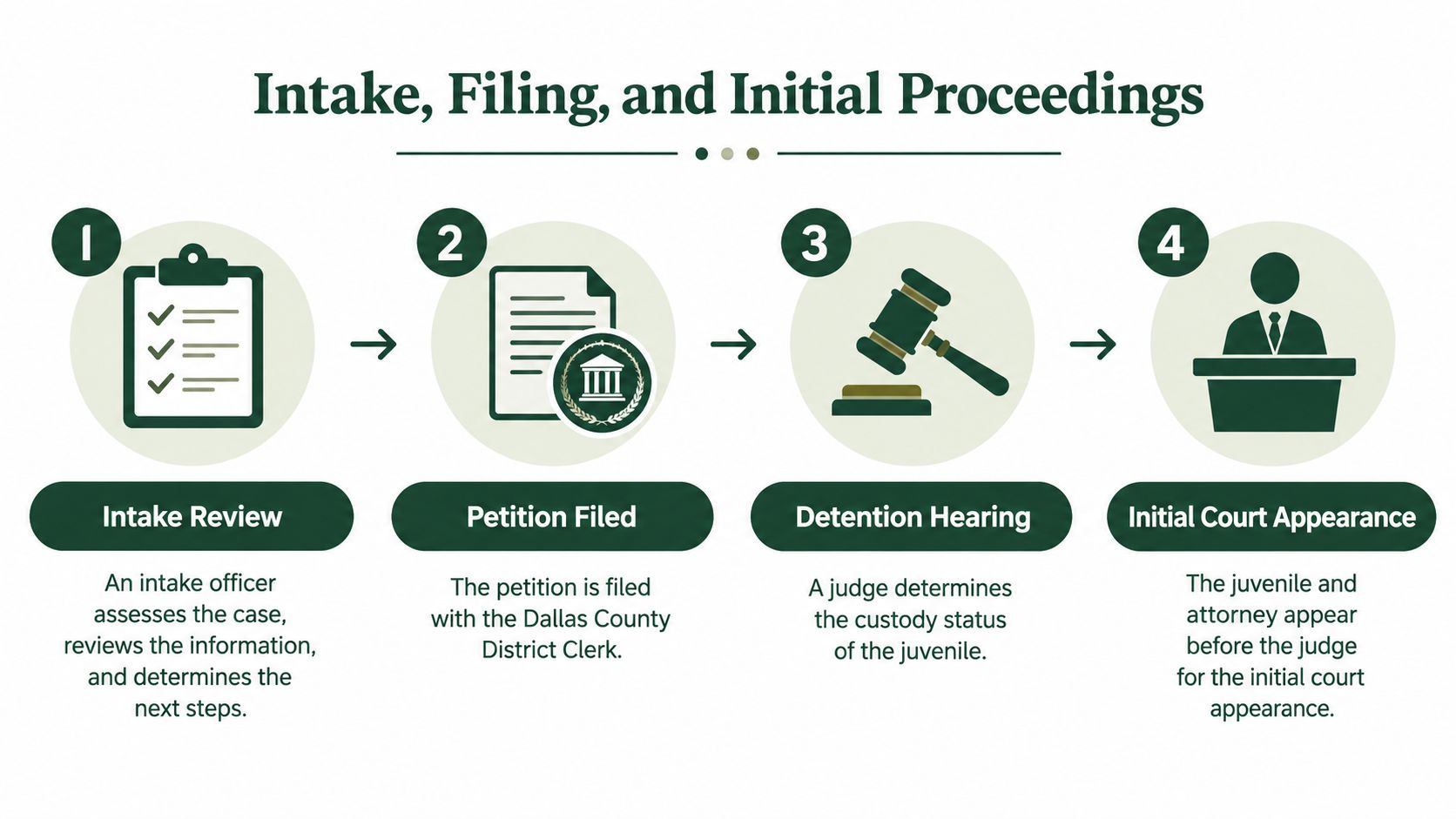
Four stages parents should separate
Intake review comes first. An intake officer may gather the allegation, the child's identifying information, family contacts, school information, and immediate safety details. The officer's work helps determine whether the matter proceeds, whether the child is released, and what information reaches the court.
Filing gives the case a formal legal structure. A petition identifies the allegations and requests court action. Dallas County's records page explains that juvenile records sit within the District Clerk's civil, family, and juvenile records structure. That means parents should use the county clerk system for questions about filings and records, rather than assuming juvenile documents are handled like ordinary public civil filings. The Dallas County records resource is a useful starting point.
Detention review addresses whether the child remains in custody while the case continues. This isn't the same as a final adjudication. The judge is considering immediate custody and legal standards at that stage, not necessarily deciding every disputed fact.
The initial court appearance gives the child and attorney an opportunity to address the court. The exact issues depend on the case, custody status, notice, and documents filed.
Dallas County probation services use interview-based social history reports, validated assessments, and recommendations to the court. Those reports can include family dynamics, school history, and other risk factors. The Dallas County probation services page describes that investigative and supervisory role.
You can use this video as a general visual orientation to the flow of an initial juvenile matter:
Information worth gathering early
Bring or organize school records, medical or counseling information, proof of residence, contact details for caregivers, and documents showing existing court orders. Don't alter records or coach your child about what to say. Instead, give the attorney a complete, private account of what happened and identify information that may need correction.
A parent who cannot reach the child should still call the listed court or clerk contacts and ask how to confirm the case assignment and next event. The Dallas County records building guide can also help explain the county's filing and records environment.
The Detention Hearing Timeline
The detention hearing is often the most urgent event after custody. Consider a parent whose child is taken into custody on a weekday. The family may not know whether the child will come home that night, whether a lawyer has been appointed, or when a judge will review the detention decision.
Texas law requires a detention hearing to be held promptly, no later than the second working day after custody. If custody occurs on a Friday or Saturday, the hearing generally moves to the first working day afterward. The governing rule also requires reasonable notice to the child and, if located, the parents, guardian, or custodian. Read the Texas Family Code detention-hearing provision for the statutory language and qualifications.
The Dallas Juvenile Board plan gives additional local process information. It states that a child taken into custody must be brought to a juvenile processing office without unnecessary delay and can't be detained there for more than six hours. If intake doesn't release the child, the plan describes a detention hearing by the second working day after custody, or by the first working day after a Friday, Saturday, or listed holiday arrest. The Dallas Juvenile Board indigent defense plan should be checked for the plan's wording and current applicability.
A simple timeline example
Assume a child is taken into custody on a weekday and isn't released during intake. The family should expect the detention issue to move quickly. The hearing is not supposed to wait until the entire case is investigated or until a final trial occurs.
Now change the facts. If custody happens on a Friday or Saturday, the working-day calculation doesn't treat the weekend like an ordinary court day. A listed holiday may also affect the calculation. Because calendar details and the exact custody event matter, a parent should confirm the expected hearing date rather than relying on a general internet explanation.
At the hearing, the judge addresses whether continued detention is legally justified. The court may consider information presented by the parties and the requirements governing juvenile detention. This hearing doesn't automatically determine whether the allegation is true or what the final disposition will be.
For a worried parent: Notice may come by a method that isn't the same as a traditional civil lawsuit. Confirm the phone number, email address, mailing address, and caregiver information provided to intake, and tell the court or attorney promptly if those details change.
Parents should arrive prepared to provide accurate contact information and explain practical issues affecting release or compliance. If the child has medication, safety concerns, disability-related needs, or a known conflict with a proposed placement, communicate those facts quickly and truthfully through counsel or the appropriate intake contact.
Arraignment, Adjudication, and Disposition
After the immediate detention question, the case moves through stages that answer different legal questions. Confusion often arises because families hear “court” and assume every appearance is a trial. It isn't.
Arraignment identifies the case
At arraignment, the court addresses the formal allegations and the child's procedural position. The charge or petition is identified, counsel's role is addressed, and the case is placed on a path toward resolution. The child may enter a response through counsel, depending on the proceeding and applicable rules.
Parents should bring the petition and every notice to the attorney. A small difference in the wording of an allegation can change which facts matter. The family should also ask whether the next setting is for a status conference, a contested hearing, adjudication, disposition, or another limited purpose.
Adjudication decides the contested allegation
Adjudication is the juvenile equivalent of determining whether the allegation has been proved. It may involve an agreement, a contested hearing, or another lawful resolution. In a contested matter, the child's attorney examines the evidence and challenges weaknesses in the allegation. The judge then determines whether the legal standard has been met.
A parent shouldn't pressure a child to explain the entire incident in a hallway, text message, or social-media post. The attorney needs a private and complete account, including facts that seem embarrassing or unfavorable. That allows counsel to evaluate defenses, identify witnesses, address inaccurate reports, and advise the child about available choices.
Disposition focuses on what happens next
If the court reaches a finding that supports court intervention, disposition addresses the appropriate response. The court may consider rehabilitation, supervision in the community, services, placement, education, counseling, family support, and compliance conditions. The exact order depends on the case facts and the legal authority involved.
Dallas County's probation process matters at this stage because interview-based social history reports and validated assessments can inform recommendations to the court. Family dynamics, school history, and other documented risk or needs factors may become relevant. Parents should answer probation questions accurately and take requested services seriously, while asking counsel about any concern with the assessment or recommendation.
A useful way to keep the stages straight is to ask three questions:
- Arraignment: What has been filed, and what is the child's procedural position?
- Adjudication: Has the allegation been proved or otherwise resolved?
- Disposition: What supervision, services, placement, or other order follows?
These stages can affect the family's decisions even when the child remains at home. A release doesn't mean the case is over, and a service recommendation isn't necessarily the same as a final court order. Parents should distinguish between a suggestion, a probation condition, and a signed order.
Post-Judgment Steps and Dallas Resources
A court order is not always the end of a juvenile matter. The next question is whether the order is being followed, whether circumstances have changed, or whether a legal error requires review. Parents should preserve the signed order, completion records, probation communications, school documents, and proof of compliance.
Modification may be appropriate when the order or supervision arrangement needs to change, but the available procedure depends on the type of order and the facts. Enforcement may be necessary when a person or agency fails to follow a court requirement. An appeal is a separate process with strict rules and deadlines, and a parent should ask counsel promptly whether review by the Fifth Court of Appeals is available.
Dallas County's juvenile court, probation department, clerk system, and detention resources don't all answer the same questions. Call the correct office for the issue you have, and use the court assignment shown on the paperwork. If you live in Garland, Richardson, Mesquite, or another Dallas County community, a guide to Dallas County subcourthouse locations may help with general county navigation, but it doesn't replace confirming where the juvenile matter itself is scheduled.
Before contacting a lawyer, prepare a short case file containing:
- Court information: The 304th designation, cause information, notices, and hearing dates.
- Custody information: When and where the child was taken into custody and whether release occurred.
- Family information: Current addresses, phone numbers, caregivers, school details, and medical needs.
- Compliance information: Completed services, attendance records, probation instructions, and communications.
- Evidence concerns: Names of witnesses, relevant messages, videos, documents, and facts that may be disputed.
Don't post about the allegation online, contact an alleged victim to argue about the case, or ignore a service or court requirement because the matter feels temporary. A Dallas juvenile case may affect family relationships, school planning, supervision, and later legal decisions, so early, accurate guidance is valuable.
The Law Office of Bryan Fagan, PLLC helps Dallas County families understand juvenile proceedings, related custody and parental-rights concerns, and the court orders that may follow. To discuss your situation and learn what information to gather before the next hearing, visit The Law Office of Bryan Fagan, PLLC.
