 Skip to content
A Dallas County parent may be sitting at home with a CPS notice, trying to understand where their child is, when the next hearing will happen, and whether the child can come home. The first fourteen days after removal move quickly, but the Dallas County CPS removal hearing first fourteen days process isn't limited to a simple choice between immediate return and foster care. A court may consider relative placement, visitation, protective conditions, and services while deciding whether DFPS should continue as temporary managing conservator.
The first hearing is also not a termination trial. It's an early judicial checkpoint where the court reviews the emergency removal, considers current safety, and decides what temporary orders are needed while the case continues. The exact courtroom and setting depend on the assigned Dallas County family district court and the circumstances of the case, so parents should confirm those details rather than rely on assumptions.
Table of Contents
- Understanding the Critical First Hours After a CPS Removal
- The Two-Phase Hearing Process Within 14 Days
- What Happens During the Adversary Hearing
- Possible Outcomes and Temporary Orders
- Essential Preparations for Dallas County Parents
- Finding Legal Help and Local Resources in Dallas
Understanding the Critical First Hours After a CPS Removal
A parent may learn that DFPS took possession of a child through a knock at the door, a phone call, or a message from a relative. The first reaction is often disbelief followed by urgent attempts to argue with the caseworker, call relatives, or sign anything that might bring the child home. Those reactions are understandable. The first hours still require deliberate decisions because statements, documents, and placement information can affect the hearings that follow.
Once DFPS takes possession, the legal clock starts. Texas law generally provides for an initial ex parte emergency hearing on or before the first business day after removal. If the court is unavailable, the hearing must occur on the next available business day and no later than the third business day after the child was taken into possession, subject to the applicable requirements in Texas DFPS guidance on the initial removal hearing.

What temporary managing conservatorship means
DFPS may ask the court to appoint the agency as the child's temporary managing conservator. That appointment gives DFPS authority over temporary placement and care while the court evaluates safety issues. It does not terminate parental rights or determine the final result.
The practical effect is significant. Court orders and DFPS decisions may control contact, medical care, school arrangements, and placement. The parent may need to request visitation, identify relatives, provide records, follow safety conditions, and communicate carefully with the caseworker or counsel. The immediate question is not only whether the child returns home. The court may consider a range of temporary arrangements, including return with conditions, placement with a safe relative, structured visitation, or continued out-of-home placement.
Parents should obtain the petition, temporary orders, hearing notice, and available information about the allegations. Record the names and contact details of DFPS personnel, the child's placement location if disclosed, and every court date or scheduled visit. If a relative or other adult may be a placement option, provide that person's information promptly and explain why the arrangement would be safe and workable.
Dallas County families sometimes confuse CPS proceedings with juvenile delinquency matters because both may involve children and court buildings. The Henry Wade Juvenile Justice Center information helps distinguish the types of cases handled there. A CPS removal case generally requires attention to the assigned family district court, its notices, and its instructions. The building alone does not identify the proceeding or the orders that apply.
Practical rule: Be respectful with DFPS, but do not treat every request as a court order. Before signing releases, agreeing to services, or giving a detailed statement, understand what the request authorizes and speak with counsel when possible.
Preserve every relevant record. Do not delete messages, alter documents, coach the child, or pressure relatives to give statements they cannot support. Gather accurate information, identify safe adults who may assist with placement or visitation, and seek legal help as soon as circumstances allow. The first hours preserve options across several possible temporary orders, not just an immediate return home.
The Two-Phase Hearing Process Within 14 Days
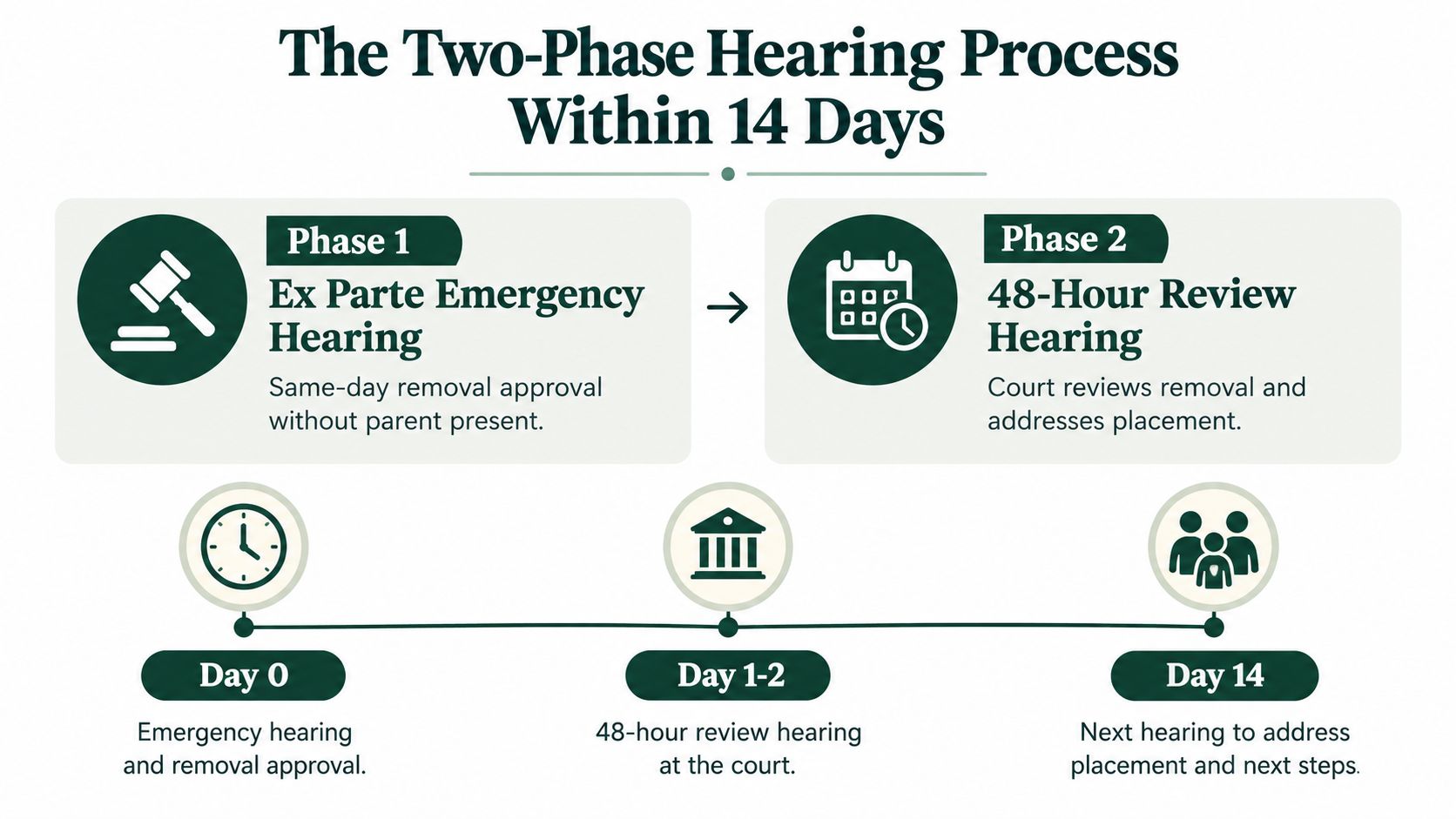
The first fourteen days involve two separate court events. A parent who prepares only for the second hearing may miss information that affects notice, placement, visitation, and the range of temporary orders the judge can consider.
The initial emergency hearing
The ex parte hearing generally occurs on or before the first business day after removal. If the court is unavailable, it should occur on the next available business day and no later than the third business day after the child was taken into possession, subject to the governing requirements described in DFPS policy on emergency hearings.
“Ex parte” means the judge may make the initial decision without the parent present. The court reviews the emergency basis for taking possession and decides whether temporary orders are needed. The hearing is limited. A parent may not yet have had time to collect records, identify witnesses, contact potential placements, or develop a workable safety plan.
Find out whether the judge signed an order, what temporary managing conservatorship arrangement was entered, where the child was placed, and when the adversary hearing is set. If notice is incomplete or the courtroom is unclear, verify the information with the assigned court and Dallas County filing or clerk resources. The date and location should be confirmed rather than assumed.
The adversary hearing by the fourteenth day
The full adversary hearing must occur no later than the fourteenth day after DFPS takes the child into possession, unless the child has already been returned and the temporary order dissolved, or a limited court-authorized extension applies under Texas Family Code section 262.201. The hearing is contested. Parents may challenge the evidence supporting removal and propose a safer, less restrictive arrangement.
The hearing should be approached as a range of possible temporary orders, not just a choice between immediate return and continued separation. Depending on the evidence, the court may consider return with protective conditions, supervision, specified visitation, a relative or fictive-kin placement, or continued DFPS conservatorship with detailed requirements. A credible plan must address the specific safety concern and explain who will do what, where, and under which conditions.
An indigent parent who responds in opposition may be entitled to appointed counsel. The court may postpone the hearing for good cause for up to seven days from the date counsel is appointed so the attorney can review the petition and prepare. A similar postponement of up to seven days may be available to an appearing parent who is not indigent and needs time to retain counsel or prepare with counsel, as described in Texas DFPS guidance on the fourteen-day adversary hearing.
The precise hearing date depends on the court and case circumstances. Confirm the assigned family district court, courtroom, appearance instructions, remote-hearing requirements, and local exhibit or filing procedures. Dallas County courts may handle settings differently. The Dallas County 304th Juvenile District Court process can help explain that court's local process, but the assigned court controls the actual setting and orders.
The fourteen-day hearing is an early checkpoint, not a final termination trial. The judge evaluates whether continued DFPS conservatorship is justified, whether the child can safely return, and which temporary protections can manage the risk while the case proceeds. Preparation should therefore support more than one lawful outcome, with specific conditions the court can adopt immediately.
What Happens During the Adversary Hearing
The adversary hearing focuses on present safety and the necessity of continued removal. The judge isn't deciding every disputed fact in the family's history or conducting the final trial on termination of parental rights. The court is deciding whether the child should remain outside the home under temporary orders and what arrangement best protects the child while the case proceeds.
DFPS usually presents its position through pleadings, witnesses, records, and the testimony of its caseworker or other involved professionals. The parent, through counsel, may challenge the agency's evidence, cross-examine witnesses, present documents, call witnesses, and offer a concrete safety plan. The evidence should address the allegations that caused the removal rather than become an unfocused account of every conflict the family has experienced.
The questions the court must answer
The court will generally consider questions such as:
- Was there an emergency serious enough to justify taking the child into possession?
- Does a present safety concern require the child to remain outside the home?
- Can the concern be addressed through supervision, protective conditions, or another less restrictive arrangement?
- Is a proposed relative or fictive-kin placement safe and realistic?
- What temporary visitation, medical, educational, or communication orders are needed?
- What services or safeguards would address the specific concern identified by DFPS?
The parent's strongest presentation usually connects each piece of evidence to one of those questions. A medical record may clarify an injury or treatment issue. Housing documentation may address where the child would live. A witness may explain who was present and what occurred. A proposed safety plan may show how the parent will prevent the alleged danger from recurring.
Counsel and courtroom preparation
Before the hearing begins, the court must advise an unrepresented parent of the right to retain counsel. An indigent parent who responds in opposition may have a right to appointed counsel. Parents should clearly state their opposition to continued removal and ask about appointment procedures if they can't afford representation.
Counsel also helps with courtroom mechanics. A lawyer can identify weaknesses or inconsistencies in the petition, object when appropriate, question witnesses, organize exhibits, and present alternatives to continued foster placement. A parent who represents themselves should still remain focused, answer questions directly, avoid interrupting, and avoid making accusations that aren't supported by evidence.
The most persuasive request is usually specific. “I want my child back” expresses the goal. “The child can return to this home, with this supervision plan and these protective conditions” gives the court something it can evaluate.
The court must also advise each parent in open court that parental rights may ultimately be restricted or terminated unless the parent can provide a safe environment. That warning reflects the seriousness of the case, but it doesn't mean termination has been ordered or that the adversary hearing is the final decision.
Possible Outcomes and Temporary Orders
The hearing doesn't produce only two possible results. A parent may not obtain immediate reunification but still secure a meaningful improvement in the child's placement or contact. The court may return the child, place the child with a friend or relative, or keep the child in CPS custody while entering temporary orders designed to protect the child and guide the case.
Return home with protections
If the evidence shows that the immediate danger has been addressed, the court may return the child. That return may include protective conditions, supervision, restrictions on contact with another adult, counseling, or other requirements. The parent must understand every condition before leaving court because a return home isn't a license to ignore temporary orders.
The strongest return-home presentation usually includes more than a denial of the allegations. It identifies the safety problem the court is concerned about and offers a workable response. Depending on the facts, that may involve a safe caregiver, removal of an unsafe person from the home, medical follow-up, substance-use treatment, or compliance with a specific protective arrangement.
Relative or fictive-kin placement
If immediate return isn't ordered, a parent may propose placement with a grandparent, adult sibling, other relative, or trusted fictive kin. This can be a better temporary outcome than an unknown placement, but the proposed caregiver must be prepared to accept responsibility and meet the child's needs.
The parent should give DFPS and counsel complete contact information, explain the relationship, and identify any relevant safety information. A relative who is willing but unprepared, unavailable, or unable to provide stable care may not be a viable option. The court needs a specific placement proposal, not merely a name offered in frustration.
Continued CPS placement with meaningful contact
The court may keep the child in CPS custody while setting orders for visitation, child support, services, and protection. Those services can include counseling, substance-use evaluations, drug testing, anger-management treatment, or parenting classes, depending on the facts. Temporary orders may also address the child's placement, medical care, communication, and the parent's responsibilities.
Visitation can be one of the most important practical issues. A parent may seek regular, expanded, or less restricted visits based on the child's safety and the parent's conduct. Compliance with the order matters. A parent who informally agrees to services or contact arrangements without understanding the written order may later face confusion about what was required.
The Dallas County temporary orders hearing resource explains why temporary orders can shape the day-to-day course of a family case. In a CPS matter, “winning” may mean reunification, but it may also mean relative placement, meaningful visitation, or service requirements that directly address the actual safety issue instead of imposing vague obligations.
Texas materials also state that the court must revisit the child's status and permanency plan within 60 days after temporary managing conservatorship is awarded, as explained by TexasLawHelp's CPS information guide. The adversary hearing therefore matters, but it isn't the only review that will affect the case.
Essential Preparations for Dallas County Parents
Preparation should begin as soon as the parent learns that a removal occurred or that an adversary hearing has been scheduled. The goal isn't to create a massive file. It's to collect reliable information that answers the judge's immediate safety questions.
Build a focused evidence file
Start with the court documents and work outward. Save the petition, affidavit, temporary orders, hearing notice, DFPS correspondence, text messages, emails, and placement information. Then gather records that provide context:
- Medical information: Collect relevant medical records, discharge paperwork, prescriptions, appointment confirmations, and provider contact information.
- Housing proof: Organize a lease, utility records, photographs of sleeping arrangements, and information showing who lives in the home.
- Child-related records: Gather school communications, attendance information, counseling records, medical information, and details about the child's daily routine.
- Communication history: Preserve messages with DFPS, the other parent, relatives, schools, doctors, and placement caregivers. Don't edit screenshots or delete unfavorable messages.
- Witness information: Write down the names, phone numbers, and specific subjects of people who personally observed relevant events.
Don't coach the child or ask witnesses to coordinate stories. A truthful, limited account is more useful than a dramatic narrative that creates credibility problems.
Identify placement options immediately
DFPS must conduct due diligence to locate another parent, adult relative, or fictive kin. Its resource guide describes a requirement to search within 14 calendar days after removal and to submit a diligent-search request within 24 hours after receiving a signed or verbal removal order, as stated in the DFPS Finding Families Resource Guide.
Parents shouldn't wait for the agency to discover relatives by chance. Give counsel and DFPS complete names, phone numbers, addresses, and relationships for possible caregivers. Ask those people whether they're willing to be contacted, assessed, and considered for placement. A proposed caregiver should be prepared to explain the child's sleeping arrangements, transportation, school plan, medical support, and relationship with the child.
Confirm representation and notice
DFPS materials state that parents receive notice of the hearing and that the agency must provide information about the case and placement process. Before the adversary hearing, the court must inform an unrepresented parent of the right to retain counsel. An indigent parent who responds in opposition has the right to request appointed counsel.
Use this checklist before the setting:
- Confirm the date and courtroom: Verify the assigned Dallas County family district court, appearance method, and any remote-hearing instructions.
- Address counsel promptly: Ask whether counsel has been appointed, whether an affidavit of indigence is needed, and whether counsel has received the petition and temporary orders.
- Send documents early: Give counsel a short chronology and organized records instead of delivering an unsorted box at the courthouse.
- Prepare a proposed outcome: Decide whether the evidence supports return home, relative placement, or expanded visitation with specific safeguards.
- Follow existing orders: Attend visits, comply with testing or services that are ordered, and document each effort.
Your preparation should be outcome-specific. Evidence for return home may focus on immediate safety and protective conditions. Evidence for relative placement should focus on the caregiver's readiness. Evidence for expanded visitation should show consistent, safe parent-child contact.
Dallas County parents may encounter the George L. Allen, Sr. Courts Building, Dallas County Family District Courts, or other county facilities depending on the assigned case. The building name alone doesn't establish which court has jurisdiction. Confirm the setting through counsel, the court, or the appropriate Dallas County clerk resources.
Finding Legal Help and Local Resources in Dallas
A CPS removal hearing combines emergency procedure, evidence, placement decisions, and family law. A lawyer handling the case should be able to review the petition, explain the temporary orders, address appointment or retention of counsel, prepare witnesses and exhibits, and present a practical safety plan. Parents should ask specifically whether the attorney handles adversary hearings and contested CPS removals, not just general divorce or custody matters.
Local information can come from the assigned Dallas County family district court, the Dallas County District Clerk, DFPS, and legal-aid organizations that evaluate eligibility and availability. Parents should verify current courthouse procedures, filing instructions, remote-appearance rules, and contact information before relying on an online directory.
The immediate action plan is straightforward:
- Secure the paperwork: Obtain the petition, temporary orders, and hearing notice.
- Protect the placement options: Identify relatives or fictive kin and give their information to DFPS and counsel.
- Organize the safety evidence: Collect records that address the specific concern, not unrelated family history.
- Prepare for the hearing: Confirm representation, courtroom instructions, exhibits, witnesses, and the requested temporary outcome.
- Keep complying: Follow every existing order and document visits, services, testing, and communications.
The Law Office of Bryan Fagan, PLLC offers Dallas-based representation for CPS removals and fourteen-day adversary hearings, including presenting evidence and cross-examining witnesses. To discuss the hearing timeline, placement options, and preparation for your case, visit The Law Office of Bryan Fagan, PLLC.
