 Skip to content
A Dallas parent may be trying to understand two emergencies at once. Their spouse or co-parent has been arrested, the children still need to be picked up, and a bond condition may suddenly prohibit contact between the adults. The family may be asking whether the arrested person can return home, speak with the children, attend a custody exchange, or respond to a protective-order or CPS issue.
The short answer to “Dallas County magistrate hearing after arrest, what happens?” is this: the arrested person appears before a magistrate, receives required warnings, learns about the accusation and the right to counsel, and may have bond set or reviewed. The hearing doesn't decide guilt, but its bond conditions can immediately affect divorce, conservatorship, possession, visitation, and other family-law matters.
Table of Contents
- What a Dallas County Magistrate Hearing Is and When It Occurs
- Timing, Location, and Your First Court Appearance in Dallas County
- Your Rights at the Hearing and What the Magistrate Explains
- Bond Types, Conditions, and What Can Change Your Release Options
- Common Mistakes That Harm Families After a Dallas Arrest
- Practical Next Steps After the Hearing in Dallas County
What a Dallas County Magistrate Hearing Is and When It Occurs
Consider a hypothetical Dallas parent arrested after a dispute with the other parent. After booking, the parent may be worried about missing work, losing access to the children, or violating a court-ordered possession schedule. The other parent may be deciding whether to seek a protective order or contact CPS. Before any of those family issues are resolved, the arrested person must go through the first formal court checkpoint, the magistrate hearing.
Texas law requires a person arrested in Dallas County to be taken before a magistrate without unnecessary delay and no later than 48 hours after arrest. The hearing may occur in person or by videoconference under Texas Code of Criminal Procedure Article 15.17. Dallas County materials also connect the hearing with the early screening process for appointed counsel and the required explanation of rights.
What the hearing does and does not decide
A magistrate hearing is not a trial. The magistrate doesn't determine whether the accused committed the offense, weigh every disputed fact, or enter a final finding of guilt. Instead, the court begins the supervised process after arrest and addresses immediate issues such as identity, the accusation, rights, counsel screening, probable cause, and release conditions.
The first appearance also isn't the same as a later arraignment, a full examining trial, a felony indictment, or a trial on the merits. Those stages may arise later, depending on the charge and how the criminal case proceeds. A person should avoid treating release from jail as the end of the case.
Practical rule: Release changes where the person waits for the case. It doesn't erase the accusation or cancel court obligations.
For a parent, the timing matters because a criminal arrest can create a second legal track. A bond condition may restrict contact with a spouse or alleged victim even when a family-court order addresses possession or communication. A parent may need to address an emergency custody exchange, a temporary order, a protective-order proceeding, or CPS contact without taking steps that violate criminal conditions. Dallas residents can review the broader Dallas County criminal court misdemeanor process for context, but family-law consequences require separate attention.
Timing, Location, and Your First Court Appearance in Dallas County
The first appearance usually follows booking rather than occurring at the scene of the arrest. Dallas County practice materials describe the Dallas County magistrate hearing as commonly occurring within about 24 to 48 hours after booking, while Texas law sets the outside limit at 48 hours after arrest and requires that the person be brought before a magistrate without unnecessary delay. The exact schedule can depend on when the arrest and booking are processed and how the local criminal docket is organized.
That distinction helps families plan without assuming an exact appointment time. A person may be held while jail personnel complete processing, while the court reviews the initial information, and while release arrangements are addressed. A weekend, holiday, or processing delay may affect when family members receive reliable information, but the legal deadline remains an outer limit, not a target.
The Dallas County workflow
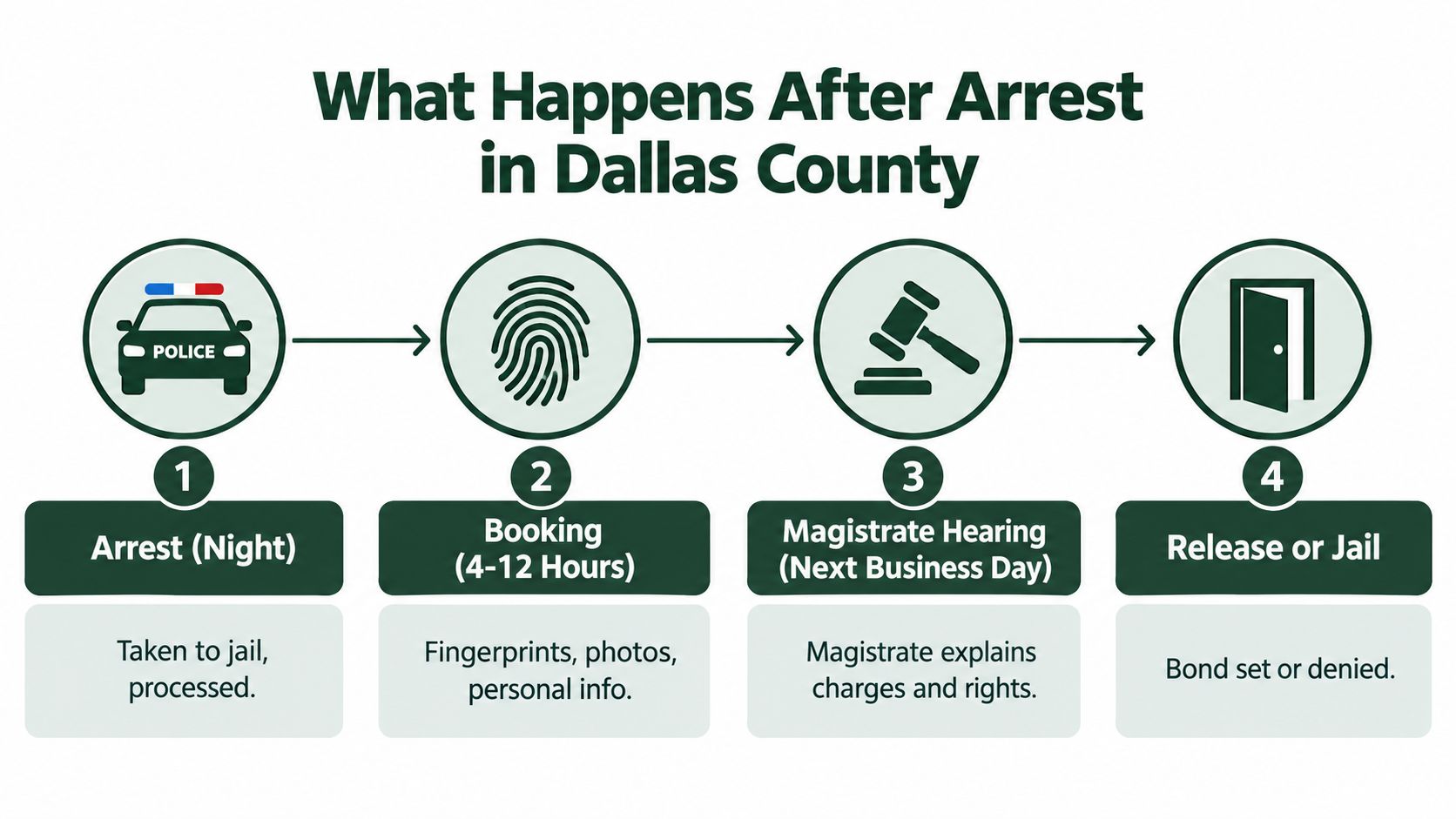
A simplified sequence looks like this:
- Arrest and transport: Officers take the person into custody and transport the person for booking.
- Booking: Jail personnel process identifying information and other intake matters.
- Magistration: A magistrate explains the accusation and rights, addresses counsel screening, and handles the initial release decision or bond review.
- Release or continued detention: The person may leave if the applicable release requirements are satisfied, or remain in custody subject to further proceedings.
The relevant criminal-court setting is different from a hearing in the Dallas County Family District Courts. The first appearance doesn't decide a divorce, child-support amount, conservatorship arrangement, or possession schedule. However, it can produce restrictions that affect how those family cases function in practice.
The Frank Crowley Courts Building guide for a first court date may help a family understand why a later criminal setting isn't necessarily the same event as magistration. Court buildings, departments, and filing procedures serve different purposes. A person shouldn't assume that appearing in one Dallas County court automatically resolves a related family-law emergency.
Why the first appearance affects family decisions
Suppose a parent has an existing possession schedule and the bond order prohibits contact with the other parent. The parent cannot just follow the old exchange routine if doing so would breach the new criminal restriction. The adults may need a lawful communication method, a third-party exchange arrangement, or an emergency family-court request, depending on the orders and facts.
Families should preserve every document received at release, including bond paperwork and any written conditions. The precise wording matters. A vague understanding such as “don't contact the other parent” may not answer whether communication through a relative, a parenting application, or counsel is permitted.
Your Rights at the Hearing and What the Magistrate Explains
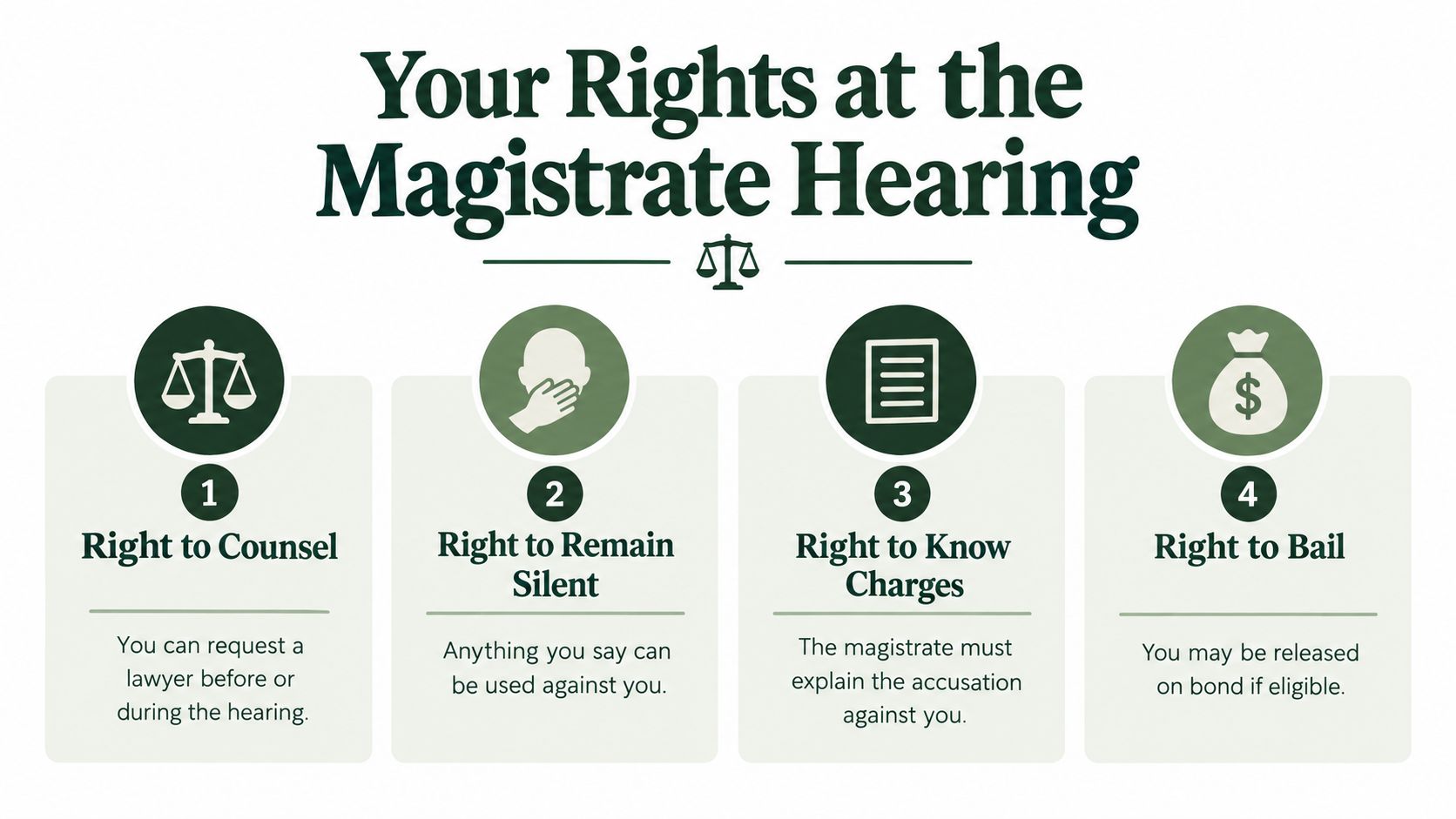
The magistrate hearing gives the arrested person information that affects immediate decisions. Dallas County criminal court plans state that the magistrate must advise the person, in clear language, of the accusation, the right to retain counsel, the right to remain silent, the right to have an attorney present during questioning, the right to terminate an interview, and the right to an examining trial. The person must also be told how to request appointed counsel and receive reasonable help completing the necessary forms if the person can't afford a lawyer, as described in Dallas County indigent-defense materials.
The warnings that matter immediately
Each warning answers a different problem:
- The accusation: The arrested person must receive a clear explanation of what the State alleges. That information helps the person understand why release conditions may be imposed and what later legal advice must address.
- The right to remain silent: The person doesn't have to explain the incident to the magistrate or police in order to preserve family relationships. Statements made during a stressful period can affect the criminal case and may later appear in a family-law dispute.
- The right to counsel: A person may retain a lawyer or request appointed counsel if financially eligible. Counsel can help the person understand the charge, bond conditions, and the risks of discussing facts.
- The right to terminate questioning: The person may end an interview. Ending questioning isn't the same as refusing to comply with a lawful court order, and the safest response to a request for more statements generally requires legal guidance.
- The examining-trial right: This is a separate legal protection and shouldn't be confused with a trial that decides guilt. The initial hearing remains focused on the immediate post-arrest process.
For a parent, these protections have a practical dimension. A parent may feel pressure to call the other parent, apologize, explain what happened, or promise that there won't be another conflict. Those communications can create criminal-case problems, family-court evidence, or an alleged violation of a no-contact condition.
Probable cause and language access
Texas law requires prompt probable-cause review after a warrantless arrest, within 24 hours for a misdemeanor and within 48 hours for a felony. If probable cause isn't determined within the required period, the cited Texas materials state that release on bond must occur under statutory caps, including up to $5,000 for a misdemeanor after 24 hours and up to $10,000 for a felony after 48 hours. The specific application depends on the facts, charge, and governing law, so a family shouldn't treat a deadline as an automatic guarantee of immediate release. The rule and stated caps appear in the Texas indigent-defense plan materials concerning probable-cause review.
A person who doesn't speak English or who is deaf must receive interpreter assistance consistent with Texas law. The point isn't merely courtesy. A person can't make informed decisions about silence, counsel, bond, or family-contact restrictions without understanding what the magistrate says.
A warning only protects a person if the person can understand it and act on it.
Family members should also avoid trying to coach the arrested person through a jail call. Calls may be recorded or monitored, and a relative who means well may unintentionally encourage statements about the incident, the children, or the alleged victim.
Bond Types, Conditions, and What Can Change Your Release Options
Bond answers a narrow but urgent question: under what conditions may the accused leave custody while the case continues? The answer may involve a personal recognizance bond, a cash bond, or a surety bond. These terms describe different release arrangements, but none gives a person permission to disregard court orders or criminal restrictions.
A personal recognizance bond generally allows release based on the person's promise to appear and comply with stated conditions rather than requiring the same kind of financial payment as a cash or surety arrangement. A cash bond requires payment in the form accepted by the court. A surety bond commonly involves a bond company that posts the bond subject to its own agreement and fees. Eligibility and availability depend on the charge, the court's decision, and the person's circumstances.
Conditions can matter more than the amount
The amount of a bond is only part of the release decision. Conditions may address contact, travel, testing, curfews, weapons, residence, or other conduct. A no-contact condition can be especially disruptive when the accused and the alleged victim are spouses, co-parents, or people involved in a pending divorce.
| Release issue | Family-law concern |
|---|---|
| No-contact condition | Direct calls, messages, or child-related discussions may be restricted |
| Travel restriction | A parent may have difficulty following an existing possession schedule |
| Curfew or reporting term | Exchanges, work schedules, and hearings may require adjustment |
| Testing or treatment condition | Missed requirements may create additional criminal consequences |
| Protective-order overlap | Two sets of restrictions may apply at the same time |
A family-court possession order doesn't automatically override a criminal bond condition. If the two orders appear inconsistent, the person should get legal advice before attempting an exchange or sending a message. The other parent also shouldn't assume that a criminal bond condition alone decides long-term custody.
What may change release options
The court may consider the seriousness of the accusation, the person's prior record, whether the person appears likely to flee, and connections to the community. The practical result can vary from one case to another. A person shouldn't promise relatives that release will occur under a particular arrangement before the bond decision and conditions are known.
Violating a condition can lead to serious consequences, including loss of release and renewed detention. For that reason, the person released on bond should read every page, ask about unclear language through counsel, and keep the paperwork available. If a condition prevents contact with a child, the family may need to address the issue through counsel or a family-court filing rather than informal contact.
Common Mistakes That Harm Families After a Dallas Arrest
A Dallas parent named Alex, in a hypothetical example, is arrested after an argument with a co-parent. Alex is released with a no-contact condition. The next morning, the other parent refuses to release the child at the usual exchange, and Alex sends a series of angry messages demanding compliance with the existing possession order.
Alex may believe the messages are about custody rather than the criminal case. That distinction may not protect Alex if the bond condition prohibits direct contact. The messages can become evidence in the criminal matter, a protective-order proceeding, or a custody dispute. A better response is to preserve the existing order, avoid prohibited contact, and obtain legal guidance about a lawful way to address the exchange.
Mistakes that create avoidable risk
- Treating bond as the end: Release is only a change in custody status. Criminal settings, paperwork, and conditions remain active.
- Contacting the other parent directly: Even a message about school, medication, pickup, or child support may create a problem if the order restricts contact.
- Posting about the arrest: Social-media posts, comments, photographs, and private messages can be copied and presented outside their original context.
- Ignoring a protective-order notice: A protective-order case may require a prompt response and separate court attention. The person shouldn't assume the criminal magistrate hearing resolves it.
- Disregarding CPS contact: CPS involvement can affect parental rights independently of the criminal case. A parent should preserve communications and obtain advice before making detailed statements.
- Relying on an old possession schedule: A family order may still exist, but a new criminal restriction can affect how the parent follows it.
The same event can create parallel proceedings. A criminal case may involve bond and prosecution, while a family case addresses temporary orders, conservatorship, possession, support, or protective relief. Those courts don't automatically coordinate every practical detail for the family.
Parents also make mistakes by deleting texts, failing to save call records, or communicating only verbally. Keep a dated record of missed exchanges, attempted contact, school issues, and notices received. Don't alter or manufacture evidence. Preserve the original information and give it to counsel.
Family-law safeguard: Don't use a custody dispute as a reason to test a criminal bond condition.
Waiting can make the problem harder. If a parent misses possession, fails to respond to a temporary-order request, or gives CPS a rushed and inconsistent account, later proceedings may focus on that conduct. Early advice can't guarantee a result, but it can help separate what must be addressed immediately from what should wait until counsel reviews the facts.
Practical Next Steps After the Hearing in Dallas County
Once the hearing ends, the family should create two checklists, one for the criminal case and one for the family-law consequences. Keeping those tracks separate prevents a parent from assuming that a criminal release decision changes custody automatically.
Start with the written paperwork:
- Read every bond condition. Identify restrictions on contact, travel, residence, testing, reporting, and communication.
- Calendar every known setting. Missing a criminal or family-court date can create consequences that are separate from the underlying accusation.
- Preserve records. Save bond documents, messages, call logs, school communications, CPS notices, protective-order papers, and existing custody orders.
- Plan child-related logistics lawfully. If contact is restricted, ask counsel how to handle exchanges, emergencies, school decisions, medication, and communication.
- Get coordinated advice. A criminal lawyer can address the arrest and bond. A family-law lawyer can assess temporary orders, custody, support, protective orders, enforcement, or modification issues.
The next criminal setting may involve further review of the charge, counsel, evidence, and case status. The exact path depends on whether the matter is treated as a misdemeanor or felony and on the facts. A guide to which Dallas County criminal district court hears felony cases can provide general court context, but it won't replace case-specific advice.
Family-law consequences can reach beyond custody. An arrest may affect a pending divorce, temporary orders, child support, possession and visitation, paternity, relocation, property division, or a request for enforcement. In a high-asset divorce, the criminal allegations may also affect access to a business, professional practice, investment records, retirement accounts, or marital property, particularly when the spouses must communicate about finances.
Don't assume the first available solution is permanent. A temporary order, supervised exchange, third-party communication arrangement, or protective condition may need later review as the criminal and family cases develop. The safest next step is prompt legal advice based on the actual paperwork, not assumptions about what the magistrate “must have meant.”
The Law Office of Bryan Fagan, PLLC offers criminal defense assistance for post-arrest matters, including magistration and bond issues, along with family-law guidance involving custody, protective orders, CPS contact, divorce, and possession disputes. If an arrest has created immediate questions about release conditions and family stability, visit The Law Office of Bryan Fagan, PLLC to learn about available next steps and request a consultation.
