 Skip to content
GPS monitoring and no-contact restrictions are common Dallas County bond conditions in a family violence case, and a bond condition can override an existing custody or visitation order for up to 90 days. That means an arrest can immediately affect where you live, how you communicate, and whether you can follow an established parenting schedule.
A parent may be released from a Dallas County jail facility expecting to return home, attend work, and pick up the children as usual. Instead, the release paperwork may prohibit contact with a spouse or co-parent, exclude the person from a home or school, require location monitoring, or impose other supervision. The criminal case and the family law case then move forward at the same time.
These restrictions aren't merely temporary jail rules. They can affect divorce negotiations, temporary orders, possession and visitation, protective orders, child support logistics, and later enforcement disputes. Read every document carefully, follow the strictest applicable restriction, and obtain legal guidance before attempting to change an arrangement.
Table of Contents
- Understanding Your Situation After a Dallas County Family Violence Arrest
- How Bond Conditions Are Set in Dallas County Courts
- Common Bond Conditions in Family Violence Cases
- Types of Bonds and How Conditions Vary
- How Bond Conditions Affect Your Family Law Case
- Modifying Bond Conditions and Seeking Legal Help
- Next Steps for Defendants and Victims in Dallas County
Understanding Your Situation After a Dallas County Family Violence Arrest
Consider a common Dallas County scenario. One spouse is arrested after a late-night argument, while the other spouse remains at the family home with the children. The accused parent expects to handle the school run the next morning because an existing possession order allows it. At magistration, however, the release paperwork includes a no-contact condition and prohibits the accused from going near the residence and school.
The parent may leave custody, but ordinary family life has already changed. A court order from the criminal case can make the existing exchange plan impossible to follow. The alleged victim's request for protected locations may also shape the geographic limits placed on release. Texas law requires the magistrate to give the alleged victim an opportunity to submit a list of places to exclude before imposing a location restriction and requires the magistrate to consider that request. Texas Code of Criminal Procedure article 17.49 authorizes stay-away restrictions and GPS monitoring as bond conditions in family violence cases.

Why the first release decision matters
The initial bond decision often becomes the practical framework for the family's daily life while the criminal case is pending. It doesn't decide custody permanently, but it can control access and communication before a Dallas County Family District Court can address temporary parenting arrangements.
Dallas County's local pretrial guidance lists domestic-violence no-contact orders, curfews, avoidance of certain locations and people, counseling, drug testing, ignition interlock requirements, and GPS-type supervision among possible release conditions. The guidance also states that a judge may increase or reduce supervision later. Dallas County Pretrial Services guidance therefore matters alongside the statewide statutes.
A person facing this situation should understand both proceedings quickly. The Dallas County magistrate hearing after an arrest can affect release, while a family court may need to address temporary orders, custody, possession, support, or protective-order issues separately.
How Bond Conditions Are Set in Dallas County Courts
Bond setting generally begins after arrest and booking. The accused appears before a magistrate, who addresses release and may impose conditions designed to protect the alleged victim or the community. The hearing may occur through Dallas County's criminal process, while later family law proceedings may take place in the Dallas County Family District Courts.
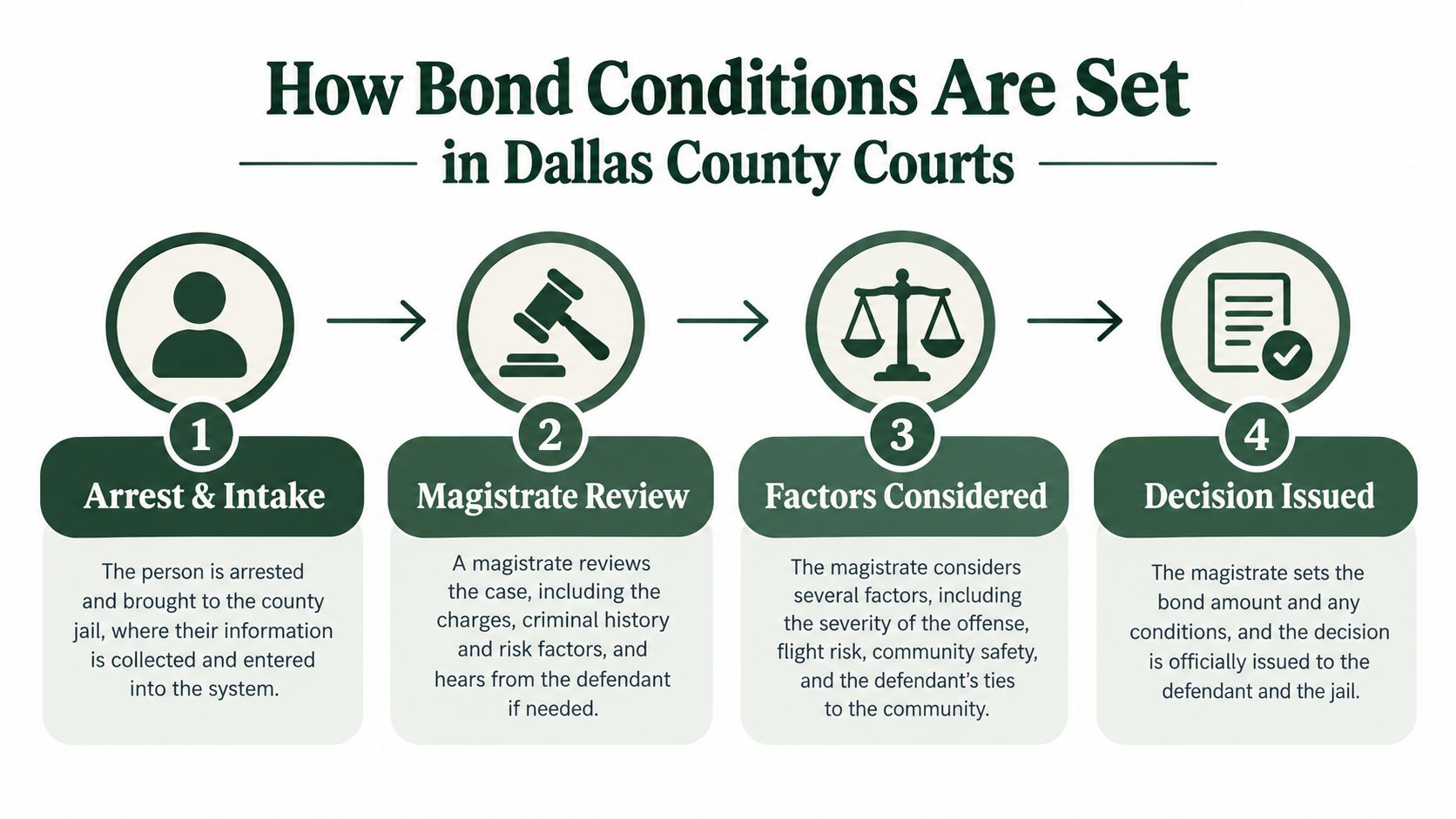
A useful way to understand the process is to separate the decision into four stages:
- Arrest and intake. Law enforcement processes the accused and prepares the information used for the initial appearance.
- Magistrate review. The magistrate considers release and conditions rather than deciding guilt or innocence.
- Safety factors. The court considers the alleged conduct, the relationship, the requested protected locations, criminal history, and community or victim-safety concerns.
- Written decision. The accused receives bond paperwork that controls release and must be followed precisely.
Statewide authority and local practice
Article 17.49 gives a magistrate authority to bar a defendant from a residence, school, workplace, or another specifically described location frequented by the alleged victim. The same statute authorizes GPS monitoring and allows reimbursement of monitoring costs. The magistrate must give the alleged victim an opportunity to identify locations before imposing a location restriction.
Dallas County's pretrial guidance supplies a local list of possible controls, including no-contact orders, curfews, location and person restrictions, counseling, drug testing, ignition interlock, and GPS-type supervision. A judge may later modify conditions by increasing or reducing supervision, so the initial paperwork isn't necessarily the final word.
What the hearing does not decide
A bond hearing doesn't determine whether the accused committed family violence. It also doesn't permanently decide conservatorship, possession, child support, property division, or the outcome of a divorce. Its immediate purpose is release and safety.
That distinction doesn't make the hearing unimportant. A condition that prevents a parent from entering a home or school can create an urgent family law problem. Counsel may need to address criminal bond conditions and request temporary family court relief without assuming that one court's order automatically changes the other court's paperwork.
Common Bond Conditions in Family Violence Cases
Bond paperwork should be read as a set of enforceable instructions, not as a general warning. The wording matters. A restriction against all contact is different from a restriction against threatening or harassing communication, and a stay-away provision may cover places connected to the children even when the accused doesn't live there.
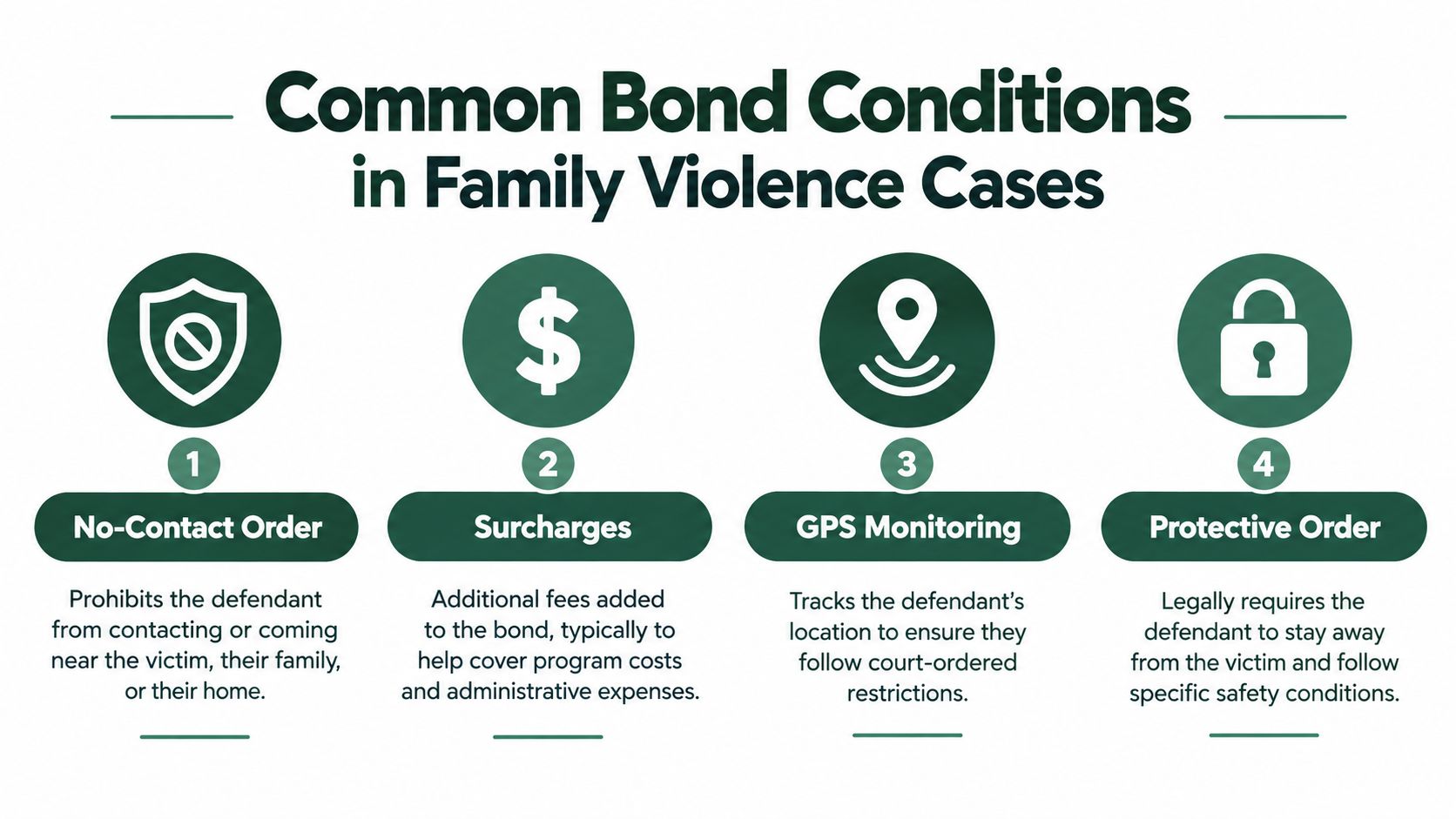
No-contact and stay-away restrictions
A no-contact condition may prohibit calls, text messages, emails, social-media messages, in-person conversations, and indirect communication through relatives or friends. If the parties share children, arranging a pickup through the other parent may still create a problem unless the order expressly permits it or the court modifies it.
A stay-away condition may identify a home, school, workplace, or another location frequented by the alleged victim. The accused should review the exact addresses and boundaries. Accidentally arriving at a shared school event, workplace, or residence isn't a safe excuse to ignore the condition.
GPS monitoring and supervision
GPS monitoring can restrict movement and create records relevant to compliance. The statutory framework permits GPS monitoring as a bond condition and may require reimbursement of monitoring costs under Article 17.49. A person wearing a monitor should understand charging requirements, travel limits, reporting obligations, and the process for technical problems.
Dallas County may also use conditions such as curfews, counseling, drug testing, ignition interlock requirements, and supervision. Each condition serves a different purpose. A person who follows the no-contact rule but misses a required test or ignores a reporting instruction may still face consequences.
Weapons and protective-order issues
The paperwork may include weapons restrictions or require the accused to comply with a separate protective order. Don't assume that the alleged victim can authorize contact or waive a court-ordered restriction. Only the issuing court can change its order.
Practical rule: If two orders appear to conflict, follow the more restrictive instruction until a lawyer or court clarifies the conflict.
The effective approach is to create a written compliance plan immediately. Identify prohibited people and locations, turn off direct communication, use counsel for necessary requests, preserve the order, and ask before taking action that might affect children, housing, employment, or shared property.
Types of Bonds and How Conditions Vary
The financial form of a bond and the behavioral conditions attached to it are related but not identical. A person may qualify for release through a personal bond, cash arrangement, secured or unsecured obligation, or surety arrangement, yet still face strict no-contact, location, monitoring, or counseling requirements.
A personal bond generally relies more on the defendant's promise to appear and comply. A cash or secured arrangement uses money or property as financial security. An unsecured bond may create an obligation without requiring the same upfront security, while a surety bond involves a bond company. The paperwork, eligibility, and availability depend on the case and the court's decision.
Why two people may receive different restrictions
Conditions are individualized. The magistrate may consider the alleged conduct, the relationship between the parties, prior criminal history, safety concerns, requested protected locations, and the practical risks associated with release. The amount of money alone doesn't tell you whether contact or travel will be allowed.
For example, one accused person may be released with a financial bond and no-contact restriction. Another may face GPS monitoring, a curfew, counseling, and location exclusions. Those differences don't establish guilt or innocence. They reflect the court's approach to release and safety based on the information before it.
The accused should identify three separate questions:
- Release question: What must be posted or promised before release?
- Conduct question: What activities, communications, and locations are prohibited?
- Modification question: Which court has authority to change the restriction, and what evidence supports the request?
A bond amount isn't permission to ignore conditions. Paying the financial requirement doesn't cancel a no-contact order, GPS requirement, or stay-away term. For questions about where felony matters are heard, the Dallas County criminal district court structure provides useful orientation, but the bond paperwork controls the accused person's immediate obligations.
How Bond Conditions Affect Your Family Law Case
The most disruptive feature of a family violence bond condition is that it can collide with an existing parenting arrangement. Under Texas Code of Criminal Procedure article 17.40, a bond condition that conflicts with an existing custody or visitation order prevails for up to 90 days. The criminal court's immediate safety restriction therefore can temporarily displace a possession schedule without permanently modifying the family court's final order.
Suppose a parent has weekend possession under an existing order, but the bond condition bars contact with the other parent and excludes the child's school. The parent should not appear for the exchange and argue that the family order authorizes it. That conduct may violate the bond condition and create a new problem in both courts.
The family court consequences
A no-contact condition can require parents to change exchange methods, use a neutral third party, or seek a temporary family court order addressing possession and communication. The family court may need clear information about the criminal restriction before it can design a workable schedule.
The same issue arises in a divorce. A spouse who can't return to the marital residence may need access to clothing, records, medication, business materials, or financial documents. In a high-asset case, the restriction can affect access to a closely held company, investment property, accounts, or records needed for property division. The solution isn't informal self-help. Counsel may need to coordinate a lawful retrieval process or request targeted relief.
Evidence and later disputes
GPS records, messages, call logs, and alleged violations can become relevant in later custody or protective-order litigation. A disputed location overlap may be innocent, but the explanation should be preserved through records rather than emotional messages to the other parent.
A bond violation can also damage settlement discussions. It may lead the criminal court to tighten supervision and give the opposing party a stronger argument for restrictive temporary orders. The Dallas County temporary orders hearing process can become central when the family needs enforceable rules for housing, parenting, support, or property while the criminal case continues.
A criminal bond condition isn't a substitute for a parenting plan, but it can control the family's practical reality until the family court responds.
Modifying Bond Conditions and Seeking Legal Help
Modification requests should be specific. A general statement that a condition is inconvenient is less useful than a concrete proposal explaining why limited contact is necessary, how safety will be protected, and what alternative procedure can work.
A parent may need to request a method for exchanging children, communicating about medical care, accessing shared property, or attending to employment. The request should identify the exact relief sought, such as communication through a documented co-parenting application, contact through counsel, or a one-time supervised retrieval. The court can evaluate whether the proposal addresses safety rather than merely removing an inconvenience.

What to document before asking
Keep the original bond paperwork, monitoring instructions, messages showing attempted contact, work schedules, childcare information, and records of compliance. Don't edit or delete communications. Give the complete record to counsel, including facts that feel unfavorable.
Dallas County's guidance recognizes that a judge may increase or reduce supervision later. That flexibility cuts both ways. A well-supported request may address a genuine logistical problem, but a new alleged violation may prompt stricter conditions.
Watch this explanation of how early release issues can affect the broader case:
Why violations require immediate attention
Under Texas Code of Criminal Procedure article 17.152, after a hearing, a person who violates a family-violence bond condition may be denied release on bail if the court finds by a preponderance of the evidence that the violation involved victim or community safety. The court may consider relationship history, criminal history, and whether an imminent threat of future family violence exists.
Don't contact the alleged victim to explain an accidental encounter, ask for permission, or negotiate a parenting issue. Contact counsel, preserve evidence, and address the problem through the court.
Next Steps for Defendants and Victims in Dallas County
Defendants and victims need different immediate plans, but both should treat the bond paperwork as an active legal document rather than background information.
If you're the defendant
Start with the complete packet issued after release. Mark every prohibited person, address, communication method, reporting requirement, curfew term, and monitoring instruction. Then:
- Preserve the orders: Keep paper and electronic copies available.
- Stop direct contact: Don't respond to calls, texts, social-media messages, or invitations that may violate the order.
- Protect the family-law position: Tell counsel about existing custody orders, school schedules, shared housing, support obligations, and property-access problems.
- Document compliance: Save monitoring records, appointment confirmations, test results, and communications from supervising personnel.
- Coordinate both cases: Criminal counsel and family-law counsel should understand the same restrictions before anyone proposes a parenting or property arrangement.
If you're the alleged victim
Tell the magistrate or counsel which residences, workplaces, schools, and other locations require protection. Ask how to receive notice of release developments and learn whether a protective-order proceeding is appropriate. Keep copies of threatening communications, incident records, and information showing how the restrictions affect safety and the children.
A bond condition may provide immediate protection, but it doesn't resolve custody, divorce, support, property, or long-term protective-order issues. Those matters may require separate action in the Dallas County family courts. The safest strategy for everyone is to address urgent logistics through lawyers and court filings rather than informal agreements.
The Law Office of Bryan Fagan, PLLC offers guidance on Dallas County bond conditions, protective orders, custody, possession, divorce, and related family-law issues. If an arrest has disrupted an existing parenting or household arrangement, visit The Law Office of Bryan Fagan, PLLC to learn about arranging a consultation and addressing both the immediate restriction and the underlying family matter.
