 Skip to content
A Dallas parent may receive a temporary order requiring supervised visitation and still have no clear idea where the first visit will occur, who may monitor it, or how to show the court that supervision is no longer necessary. The order may mention an agency, a neutral adult, or visitation “as arranged and agreed,” while the other parent is asking questions about safety, fees, and scheduling.
The short answer is that Dallas County domestic relations office supervised visitation is part of a court-connected family-law process, not a single countywide program with one universal schedule or price. Your order controls the starting point. The next steps usually involve identifying an acceptable supervisor, completing an intake, documenting visits, and building evidence for any later request to reduce or end supervision.
Table of Contents
- What the Dallas County Domestic Relations Office Does for Supervised Visitation
- When Dallas County Courts Order Supervised Visitation and Who Can Supervise
- How to Request Schedule and Attend Supervised Visitation in Dallas County
- Fees Provider Options and Availability for Dallas Families
- What to Expect During Visits and How to Avoid Common Problems
- Moving From Supervised to Unsupervised Visitation and Your Next Steps in Dallas County
What the Dallas County Domestic Relations Office Does for Supervised Visitation
The Dallas County Domestic Relations Office is a formal public office created by Texas law. Under Texas Human Resources Code Section 152.06331, the office is established by statute and, unless a conflict exists, operates under Chapter 203 of the Texas Family Code with the powers and duties of a domestic relations office.
That legal foundation helps explain what the office is, and what it isn't. It isn't your private attorney, it isn't the judge, and it isn't automatically the provider for every supervised visit in Dallas County. Its role is connected to court-facing family-support services, while attorneys represent parents and private or nonprofit providers may conduct the actual monitored contact.
How the office fits into a Dallas custody case
Supervised visitation commonly appears in a divorce, suit affecting the parent-child relationship, paternity matter, CPS-related case, protective-order dispute, enforcement proceeding, or modification. These matters may be handled through the Dallas County Family District Courts, whose family-law proceedings are associated with the George L. Allen, Sr. Courts Building.
The courthouse system and the Domestic Relations Office serve different functions. A judge issues or modifies the order. The order may identify the type of supervision required, the people who can supervise, the location, communication rules, and conditions for moving toward less restrictive contact. The provider or monitor then applies those requirements during visits and keeps records that may later become relevant.
Parents often misunderstand a referral or office contact as a replacement for a court order. It usually isn't. If your order says a professional agency must supervise, a relative generally can't substitute for that agency without authorization. If the order names a particular provider, changing providers may require agreement, approval, or a new court request, depending on the language.
Practical rule: Read every sentence about supervision, not just the sentence that says visits are supervised.
The same county process can look different from case to case. One family may use a court-connected or nonprofit resource. Another may need a private visitation center. A third may have a trusted adult monitor under carefully written conditions. The first visit, therefore, starts with the wording of the order, not with a general Dallas County schedule.
For background on how related county services can fit into a broader family-law matter, review the Dallas County domestic relations office social study process. A parent who wants to challenge the arrangement, clarify it, or create a transition plan may need to address the issue in the same court handling custody, possession, support, or temporary orders.
When Dallas County Courts Order Supervised Visitation and Who Can Supervise
Texas generally uses supervised visitation when contact with a parent could endanger a child's physical or emotional welfare. The Texas Department of Family and Protective Services describes supervision as a safety intervention that can protect the child and, in some situations, support the parent-child relationship while helping the parent improve protective behavior. The decision should be connected to a safety assessment, not merely to the fact that two parents argue.
A judge may consider allegations or evidence involving abuse, neglect, substance misuse, unsafe people or locations, threats, serious mental-health concerns, domestic violence, or conduct that makes unsupervised contact unsafe. The specific facts matter. Supervision isn't supposed to punish a parent merely because the parents have a poor relationship.
The three common supervisor models
Texas law allows a court to use a family member, neutral third party, or professional agency as the supervisor. Those choices aren't interchangeable in every case.
A family member might be practical when the order permits that person and the individual can protect the child without taking sides. A neutral third party may be a trusted adult with no meaningful conflict between the parents. A professional agency may be required when the safety concerns call for trained staff, controlled facilities, written reports, or more structured monitoring.
The order's wording controls the answer. An order that names a professional center may not permit a parent to select a relative. An order that permits an agreed neutral adult may create more flexibility, but the adults still need to follow every condition and ensure the monitor is willing to intervene if necessary.
Dallas County parents should also distinguish supervised visitation from a monitored exchange. A monitored exchange may involve observing the transfer of the child without observing the entire visit. On-site supervision involves observation during the parent-child contact. A hybrid arrangement may use different safeguards for different portions of the schedule.
If you aren't sure what a Dallas associate judge decided or whether a proposed change requires court action, the guide to what a Dallas County family court associate judge may decide can help you identify the procedural question. It still won't replace review of your actual order.
How to Request Schedule and Attend Supervised Visitation in Dallas County
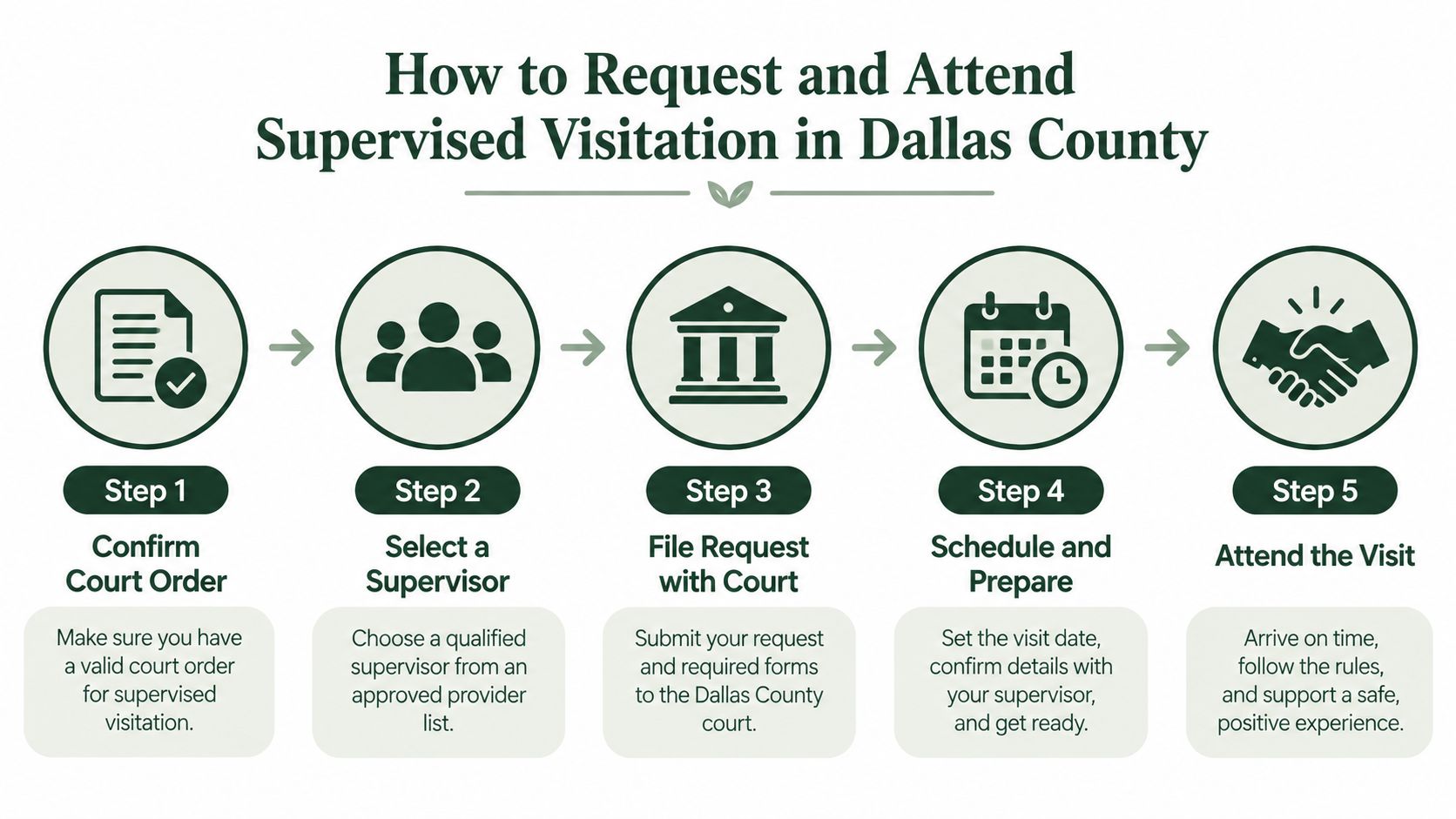
The first supervised visit should be treated as a process with several checkpoints. A parent who skips the order review or provider intake may lose time, misunderstand the rules, or create avoidable documentation problems.
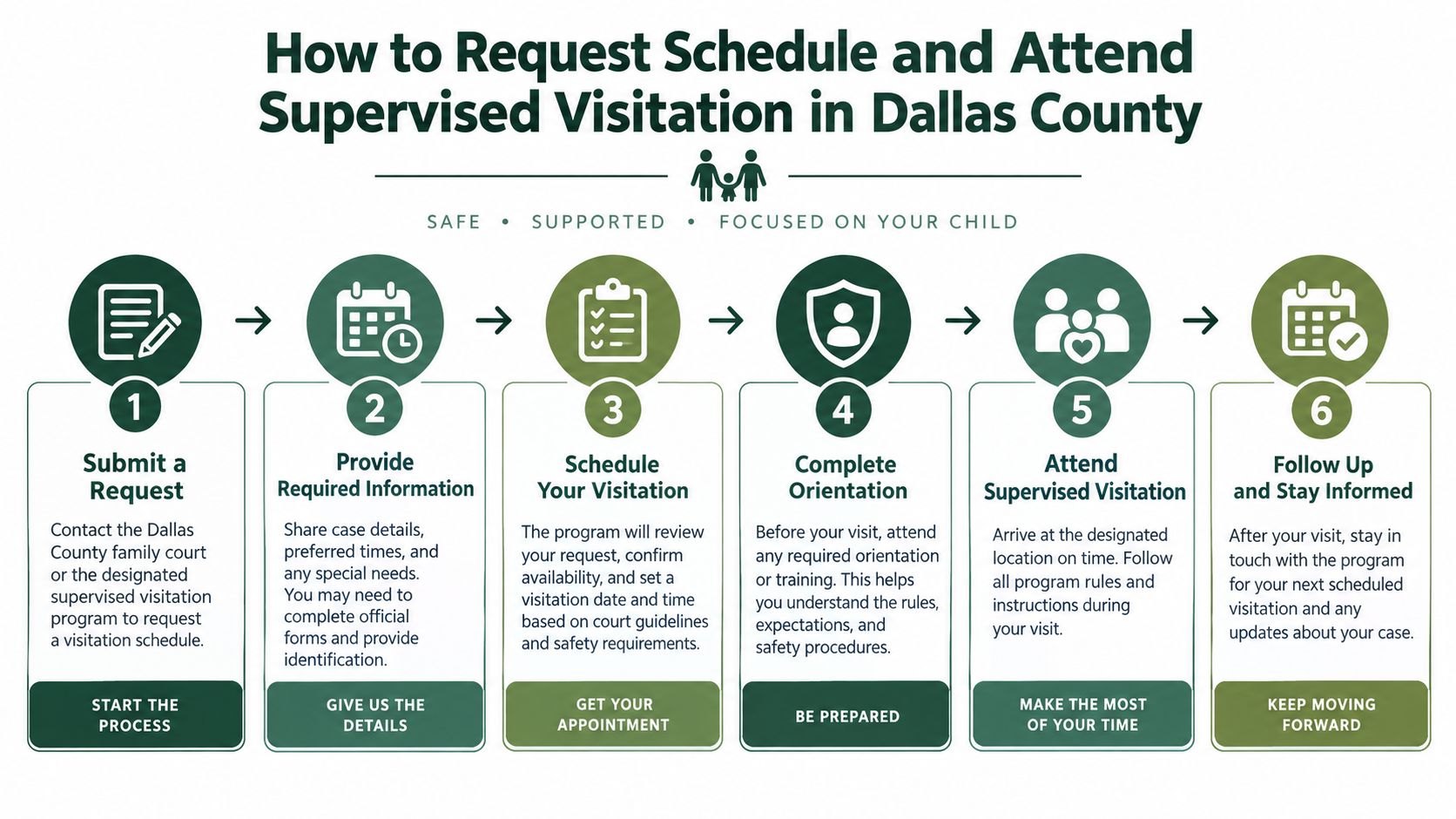
Start with the signed order
Obtain the most recent signed temporary order, final order, modification order, or protective order. Look for language addressing:
- Supervisor identity: Determine whether the order requires a professional agency, allows a neutral adult, or names a specific person.
- Visit setting: Check whether contact must occur at a center, another approved location, or a place agreed upon by the parties.
- Scheduling: Look for fixed periods, advance notice requirements, cancellation rules, or “as arranged and agreed” language.
- Conditions: Identify rules about sobriety, other adults, transportation, gifts, phone use, discipline, overnight contact, and communication.
- Step-down requirements: Find any stated actions or benchmarks for reducing supervision.
If the order is vague, don't assume the provider can rewrite it. A parent may need clarification, agreement in writing, or a modification request. The right option depends on the language and the dispute.
Locate an available provider or monitor
Texas maintains an Access and Visitation directory with supervised visitation providers and related parenting resources. A Dallas parent may also receive a provider name through the court, counsel, CPS, or the order itself.
Call before sending sensitive records. Ask whether the provider accepts your order, has openings, serves your part of Dallas County, requires an intake, permits the proposed monitor, and can explain its cancellation and reporting practices. A provider's availability doesn't change the legal requirements in the order.
Complete intake and prepare for observation
The intake process may require the order, identification, contact information, emergency details, relevant safety information, and payment arrangements. Answer accurately and consistently. Do not minimize a safety concern, but don't use intake as a place to argue the entire custody case.
Texas programs use a structured safety-assessment workflow. They identify safety risks, connect those risks to the supervision level, convert them into measurable parent-behavior goals, and evaluate whether the proposed monitor can remain protective and neutral, as explained in the Texas DFPS visitation best-practice guide.
During the visit, the monitor may directly observe behavior management, alternatives to physical discipline, attachment, communication, nurturance, and the child's reaction. Arrive prepared, follow the provider's instructions, and avoid using the visit to question the child about the other parent.
Keep the first visit simple and compliant
Before the appointment, confirm the arrival location and time, what the child may bring, whether food or gifts are allowed, and how cancellations are handled. Keep communication with the other parent short, factual, and focused on logistics. Save messages and provider confirmations.
A parent who needs a hearing to address an unworkable order or provider dispute should review the process for setting a Dallas County family-court hearing. Don't treat a missed appointment as permission to create a different schedule on your own.
Fees Provider Options and Availability for Dallas Families
Supervised visitation can be difficult to use even when everyone agrees that contact should continue. Dallas-area providers differ in price, intake requirements, location, hours, reporting practices, and available capacity. The cost question should be addressed early because an order can require a professional agency even when a parent cannot comfortably pay for repeated visits.
Current Dallas-area provider information shows a wide spread. One source cites typical Texas private supervision at about $40 to $100 per hour, while a Dallas provider advertises a $150 intake fee plus $65 per hour with a two-hour minimum. Another Dallas-area center states that services may be available at no cost when court-ordered. These figures come from Dallas-area supervised-visitation provider information, and actual charges and eligibility should be confirmed directly with the provider.
Who pays
When a private agency supervises, the visiting parent may be responsible for the agency's fees. The order may allocate costs differently, or the parents may agree to share them. Read the financial language carefully. A parent shouldn't assume that the Domestic Relations Office, the other parent, or the court will automatically cover private charges.
If cost makes the ordered arrangement impossible, collect written information about fees, intake charges, minimum visit requirements, travel, and waitlists. That documentation can support a request for a different provider, a modified arrangement, or another practical solution. It doesn't guarantee that a judge will change the order.
Comparing the available models
| Provider Type | Typical Cost | Availability | When Dallas Courts May Accept |
|---|---|---|---|
| Nonprofit or court-connected center | May be available at no cost when court-ordered | May depend on eligibility and openings | When the order or court referral permits that center |
| Private agency | Private supervision may be about $40 to $100 per hour; one Dallas provider advertises a $150 intake fee plus $65 per hour with a two-hour minimum | Scheduling may be more flexible, but calendars can fill | When the order requires or permits a professional agency |
| Trusted adult monitor | Cost may be limited to agreed expenses | Often depends on the adult's schedule and willingness | When the order permits a family member or neutral third party and the person is acceptable |
What a full calendar means
A provider's full calendar doesn't cancel the order. Ask for a waitlist position, written confirmation of unavailability, alternative locations, and referrals. If the order says visits occur “as arranged and agreed,” that wording may require cooperation, but it can also create uncertainty if the parents cannot agree.
Don't withhold visits or unilaterally switch to an informal monitor because a professional center is inconvenient. Ask a Dallas family-law attorney whether the existing order allows another provider or whether you need court intervention.
What to Expect During Visits and How to Avoid Common Problems
A supervised visit isn't just time spent in the same room. The monitor watches the parent-child interaction and records conduct relevant to safety, caregiving, communication, and the child's response.
Consider a hypothetical Dallas parent who brings a board game, follows the child's lead, redirects frustration without physical discipline, and accepts the monitor's reminder about a boundary. Those behaviors create a different record from a parent who argues with the monitor, criticizes the other parent in front of the child, or pressures the child for information.

What monitors may document
The Texas best-practice approach focuses on direct observation. Monitors may pay attention to:
- Behavior management: Whether the parent sets safe, age-appropriate limits.
- Discipline choices: Whether the parent uses safe alternatives to physical punishment.
- Attachment and communication: Whether the parent listens, responds, and communicates appropriately.
- Nurturance: Whether the parent notices the child's emotional and practical needs.
- Child reaction: Whether the child appears comfortable, fearful, withdrawn, engaged, or distressed.
A missed visit can matter beyond the missed time. Late arrival, repeated cancellations, failure to confirm, or hostile communication may complicate the record even when the parent believes the visit itself would have gone well. If an emergency occurs, notify the provider and the other parent promptly, then preserve the documentation.
Build a reliable record
One compiled research summary reported that 83% of families in a visitation-center program had at least one visit versus 28% under traditional visitation methods, and 48% of families were reunified versus 29% in traditional supervision programs. The figures appear in the compiled research summary on supervised visitation. The same source describes the overall research field as limited and heterogeneous, so these figures shouldn't be treated as a promise about an individual Dallas case.
A useful habit: Keep a private timeline of scheduled visits, attendance, provider communications, reports, completed services, and questions that remain unresolved.
A parent seeking less supervision later will usually need more than a general statement that visits went well. Consistent attendance, calm conduct, compliance with the order, and specific documentation can help show progress. The provider's report is only part of the record, but it may help the court evaluate whether the original safety concern has changed.
Moving From Supervised to Unsupervised Visitation and Your Next Steps in Dallas County
Ending supervision usually requires a deliberate legal and practical plan. A Texas order imposing supervised visitation for child safety must identify the specific steps needed to reduce supervision. That language is the roadmap, but the parent still must complete the steps and present evidence showing why the restriction should change.
Recent Texas guidance also emphasizes that a parent generally pursues a modification and shows a material and substantial change in circumstances. The exact analysis depends on the order, the child's best interest, the original safety concern, and the evidence available. Completing a service or attending visits may help, but no single accomplishment automatically ends supervision.
Build a step-down proposal
A court-ready plan should connect each requested change to the safety concern:
- Identify the original risk. State what the supervision was designed to prevent.
- Document changed circumstances. Gather provider reports, attendance records, completed services, treatment information when legally appropriate, and evidence of stable compliance.
- Propose a gradual change. Depending on the facts, the request might involve a different monitor, less restrictive location, longer unsupervised periods, or another transition supported by the order and evidence.
- Address safeguards. Explain transportation, communication, exchanges, other adults, discipline, and what happens if a concern arises.
- Request the right relief. A modification changes the arrangement. Clarification addresses unclear language. Enforcement addresses a violation. These are different legal purposes.
Eligibility to seek modification isn't the same as operational readiness. A parent may have a legally arguable change but still lack a provider record, safety plan, or reliable evidence. Conversely, strong compliance doesn't guarantee that the court will remove restrictions.
Dallas family district court proceedings are associated with the George L. Allen, Sr. Courts Building at 600 Commerce Street in Dallas. Before filing, compare your current order with the records from every visit and identify whether the requested change affects custody, possession, child support, protective conditions, or another part of the case.
Gather the signed order, provider records, written communications, service-completion documents, and a practical transition proposal. Then discuss the facts with a qualified Dallas family-law attorney who can assess whether clarification, enforcement, modification, or another filing fits your situation.
The Law Office of Bryan Fagan, PLLC offers Dallas family-law guidance for parents dealing with supervised visitation, custody modifications, enforcement, temporary orders, and related child-support or protective-order issues. To review your order and discuss a documented path toward safer, less restrictive visitation, visit The Law Office of Bryan Fagan, PLLC and request a consultation.
