 Skip to content
A Dallas County DRO social study is a court-ordered custody investigation handled through Family Court Services, and it cannot begin until a judge signs an order. In that process, the evaluator looks at the parents, the child, each relevant home, and outside sources of information so the court can get a recommendation about the child's best interest.
If you're reading this, you may have just heard the words “social study” in a temporary orders hearing, from your lawyer, or from the other parent's attorney. Many parents assume it means a quick interview or a home check. In Dallas County, it's more structured than that, and it sits directly inside the evidence-gathering part of a custody case.
That matters because social studies often show up when parents disagree about conservatorship, possession, or where a child should primarily live. In plain terms, the court wants more than two competing stories. It wants a clearer picture of the child's daily life, each parent's home, and whether the allegations in the case hold up when someone neutral investigates them.
Table of Contents
- What a Dallas County DRO Social Study Is and Why Courts Order It
- How the Dallas County Domestic Relations Social Study Process Works Step by Step
- What the Social Study Report Contains and How Dallas Courts Use It
- How to Prepare for Your Interviews Home Visits and Collateral Checks
- Common Mistakes That Hurt Your Social Study Outcome
- Mistake one is making the whole interview about the other parent
- Mistake two is pressuring the child to sound loyal
- Mistake three is hiding a bad fact instead of explaining it
- Mistake four is treating county contacts and appointments casually
- Mistake five is forgetting that your records need to match your story
- Mistake six is confusing fairness with sameness
- Timeline Cost and What Happens After the Report Is Filed
- Dallas County Contacts Filing Notes and When to Get Legal Guidance
What a Dallas County DRO Social Study Is and Why Courts Order It
A familiar Dallas County hearing goes like this: one parent says the child is doing well in their home, the other says the child is not safe or stable there, and the judge has two sharply different stories with no clear way to test them from the bench. Instead of guessing, the court may order a social study so a neutral investigator can gather facts outside the courtroom.
Under Texas Family Code Chapter 107, a social study is a court-directed custody investigation used in cases involving conservatorship, possession, access, and related child-focused disputes. The current framework grew out of earlier Texas Family Code changes reflected in the historical Texas family law materials.
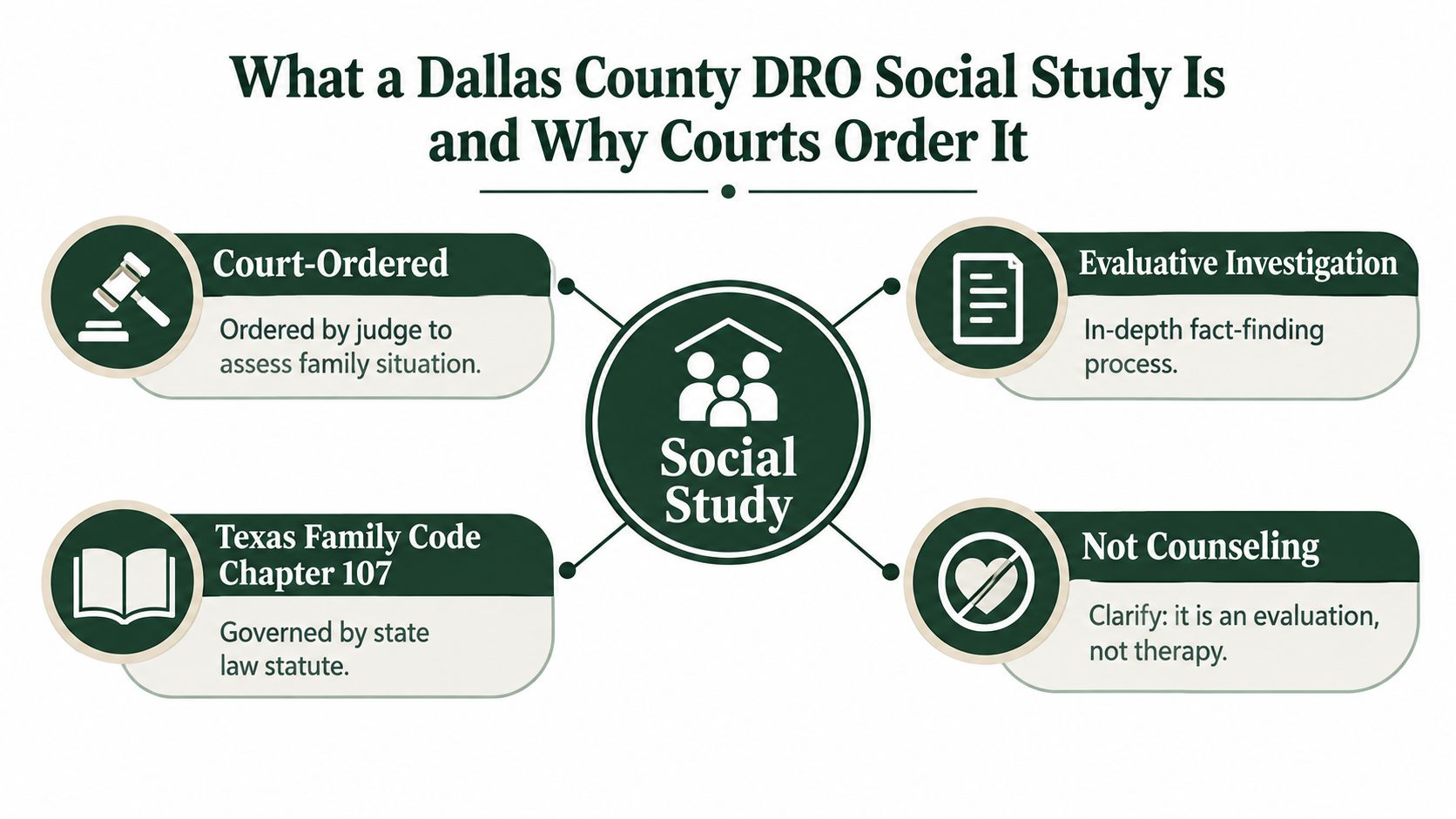
It gives the court a field investigation of family life
In plain English, the judge is asking for a closer look at real life. Court hearings are like snapshots. A social study works more like a documented home-and-family check that pulls together interviews, observations, records, and outside contacts so the court has more than competing testimony.
In Dallas County, that local process matters. The case does not get sent out for a generic Texas custody review. It usually runs through the county's Family Court Services workflow, which means the order comes from the court first, intake is handled through Family Court Services at 600 Commerce Street, and fee collection is handled through the Child Support Office before the investigation gets underway.
If your case is in front of an associate judge, it also helps to understand what a Dallas County family court associate judge decides, because associate judges often handle the hearings where this kind of order is discussed.
Practical rule: Treat a social study like evidence being built for your custody case.
Why judges order one
Judges usually order a social study when the child's best-interest picture is cloudy. That often happens when parents disagree about who should make major decisions, where the child should live most of the time, whether a parenting schedule is working, or whether claims about safety, supervision, routines, or conflict are true.
The goal is not to give either parent a service. The goal is to give the court a tested factual record. That is why parents are often surprised by how formal the process feels. The investigator is not acting as a therapist, mediator, or coach. The investigator is gathering information for the judge.
Dallas County's own process also makes clear that this does not start on a parent's request alone. A signed court order is required before Family Court Services begins its part of the work, as noted earlier in the Dallas County Family Court Services and Child Support Office FAQ.
That timing shapes strategy. By the time a social study is ordered, the court has usually decided that the usual back-and-forth between parents is not enough. The judge wants independent fact development before entering final custody orders.
How the Dallas County Domestic Relations Social Study Process Works Step by Step
A lot of parents hit this point after a hearing and wonder what happens next. You have a court order in hand, you know a social study is coming, and now the case shifts from courtroom arguments to fact-gathering.
That shift helps to understand. The judge has pressed pause on deciding final custody details until someone gathers information in a structured way.
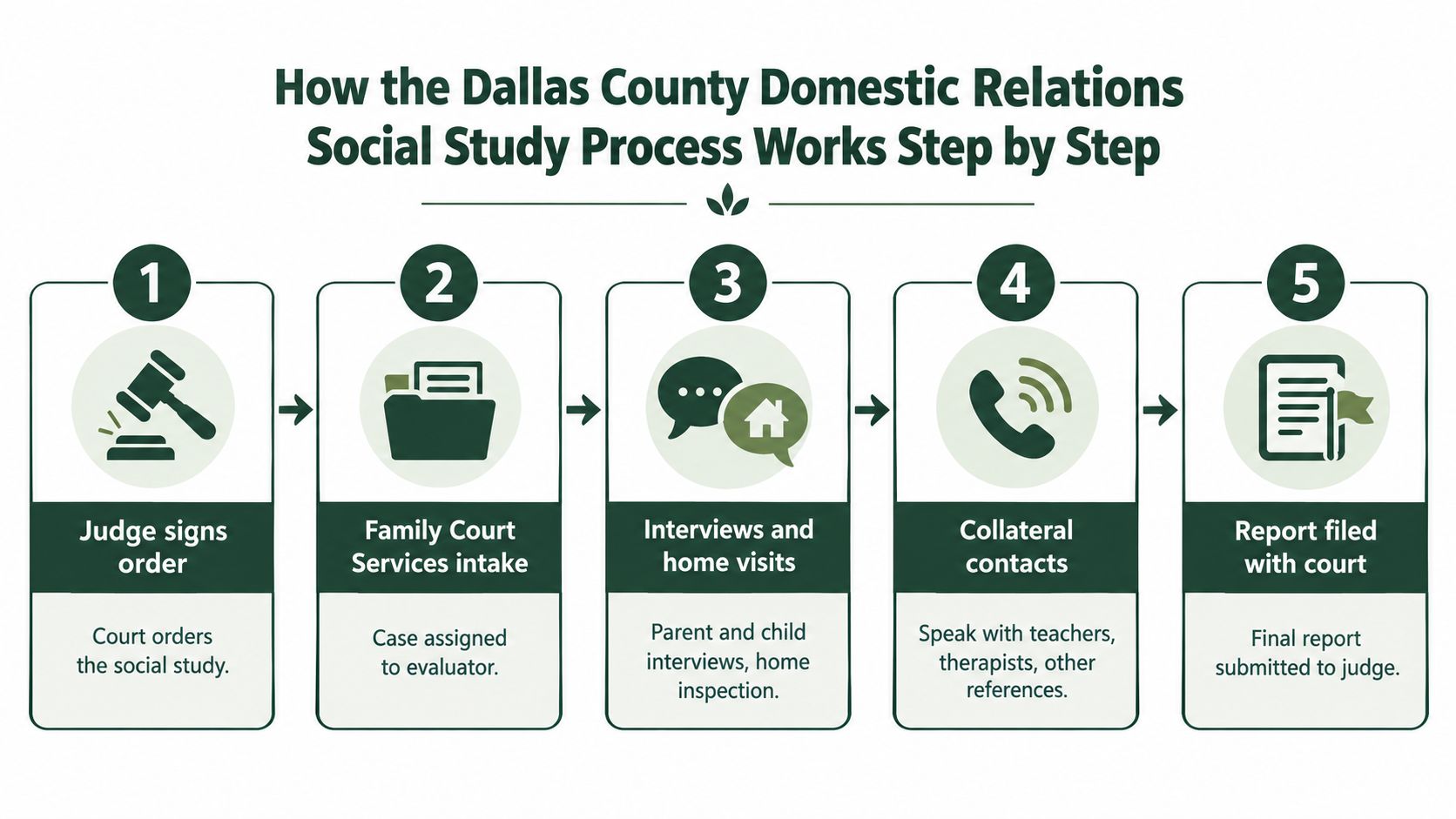
Step 1 begins with a judge's order
The Dallas County process starts only after the court signs an order for a social study. Until that happens, Family Court Services does not open the matter as part of the county workflow.
The order acts like a set of instructions. It tells everyone involved that the study is now part of the evidence-building process in the custody case, and it may also set deadlines or identify the issues the evaluator needs to examine.
Step 2 moves through county intake and fee handling
After the order is signed, the case does not jump straight to interviews. In Dallas County, there is an intake track tied to Family Court Services at 600 Commerce Street, Second Floor, inside the Dallas County Government Center.
Parents often miss this part because it feels administrative. It matters anyway. The county uses Family Court Services for the social study process, and fee collection is handled through the Child Support Office, as noted earlier. So the workflow usually includes more than waiting for someone to call. It includes getting routed into the county system and dealing with payment instructions connected to the order.
That county-specific setup is one reason Dallas cases can feel formal from the beginning.
Step 3 includes interviews with parents and children
Once intake is underway, the evaluator begins gathering information required for a social study under Texas Family Code Chapter 107. The statute provides the basic structure. Each parent is interviewed personally. A child age four or older is interviewed in a developmentally appropriate way. Each child is also observed, even if the child is too young for a meaningful interview.
For parents, that usually means separate meetings rather than one joint conversation. The evaluator may ask about daily routines, school, discipline, medical care, communication problems, past conflict, and each parent's concerns about the other home.
For children, the interview is not a vote. The evaluator is not asking a child to decide the case. The goal is to gather information at the child's level and to observe how the child relates to each parent.
Step 4 checks the story against outside information
A social study works like a fact-check, not just a listening session. The evaluator compares what each parent says with other available information.
Texas law allows the evaluator to gather collateral-source information and to evaluate each requested home environment unless the court says home conditions are not disputed. Collateral sources can include teachers, doctors, counselors, or other adults with relevant knowledge. Depending on the case, the process may also include background checks tied to criminal history or prior abuse and neglect concerns involving adults in the home, as described in the Texas social study practice summary.
This is the part that catches parents off guard. A strong interview does not carry the day by itself. Consistency matters more. If a parent describes one reality and records or outside contacts describe another, the gap can affect how the evaluator views the whole case.
Step 5 ends with a report filed with the court
After the interviews, observations, home review, and collateral checks are finished, the evaluator prepares the written report for the court. Chapter 107 requires the report to be filed by the deadline set in the case.
That deadline gives the whole process its pace. Missed appointments, late paperwork, or failure to provide names and contact information for collateral sources can slow the study and create avoidable problems. Parents do better when they treat each request from the evaluator the way they would treat a court deadline.
What the Social Study Report Contains and How Dallas Courts Use It
Parents often expect the report to read like a scorecard. It usually reads more like a case map. The evaluator organizes what each parent said, what the evaluator observed, what outside sources confirmed, and what those facts suggest about the child's day-to-day needs.
The judge receives that written report after the Dallas County social study is completed. The report matters because it pulls a scattered family dispute into one document the court can review. It is still only one piece of the evidence. The judge can agree with it, disagree with parts of it, or give it more or less weight depending on the rest of the case.

What usually appears in the report
In plain terms, the report answers a few practical questions. How is this child doing. What does each home look like in real life. Which parent appears able to meet the child's needs consistently. Are there safety concerns, stability concerns, or credibility problems the court should pay attention to.
A Dallas County social study report commonly includes:
- Background information about the parents, the child, and the history of the case
- Each parent's account of parenting roles, concerns, schedules, and decision-making
- Information about the child including needs, routines, school issues, health issues, and observed interactions with each parent
- Home environment findings describing the living situation and whether it appears appropriate for the child
- Collateral information from teachers, counselors, doctors, relatives, or other adults with relevant knowledge
- Concerns affecting best interest such as conflict, poor communication, instability, untreated mental health issues, substance abuse concerns, or past family violence if those issues are part of the case
- Recommendations on conservatorship, possession, access, or conditions the court may want to consider
That last part is what catches many parents off guard. The report usually does not stop at description. It often gives the court a recommendation about what arrangement appears to serve the child's best interest.
How to read the recommendation
A recommendation is not a final order. It is closer to a trained investigator handing the judge a labeled file and saying, "Here is what I found, here is what concerns me, and here is what I think fits this child."
That distinction matters.
If the evaluator recommends one parent have the exclusive right to determine the child's primary residence, the judge still decides whether to adopt that view. If the evaluator recommends a possession schedule with safeguards, the court still weighs testimony, documents, and any other court-appointed input before ruling. If your case also includes an amicus attorney, it helps to understand the difference between those roles. This guide on Dallas County amicus attorney appointment and cost explains that separate part of the process.
How Dallas courts tend to use the report
In a contested Dallas County custody case, the report often becomes a working tool for the court. Judges may use it to test each parent's claims against a neutral investigation, especially where both parents tell very different stories about the same events.
For example, one parent may say exchanges are always chaotic because the other parent is irresponsible. The other parent may say the first parent creates conflict at every pickup. The social study report gives the judge a structured way to compare those claims with interviews, records, home observations, and collateral information. That does not end the dispute by itself, but it can narrow the court's focus to the issues that matter most.
The report can influence temporary orders, settlement discussions, trial preparation, and final orders. It may also shape what questions get asked in court. If the report identifies a concern about supervision, school attendance, a parent's judgment, or the child's emotional adjustment, expect that issue to receive careful attention later in the case.
A useful way to think about the report is this. It is the court's organized snapshot of the family at a specific point in time. Judges know snapshots are not perfect. They still matter because they show patterns, and patterns usually drive custody decisions more than isolated excuses.
How to Prepare for Your Interviews Home Visits and Collateral Checks
A Dallas parent often reaches this stage with one worry running in the background. What if I say the wrong thing, my house is not perfect, or a teacher says something I cannot control?
The better frame is simpler. The social study is a fact-checking process. In Dallas County, Family Court Services is trying to understand how your child lives, who meets daily needs, and whether each parent's account matches the records and outside contacts. Your job is to make that review easier to follow.
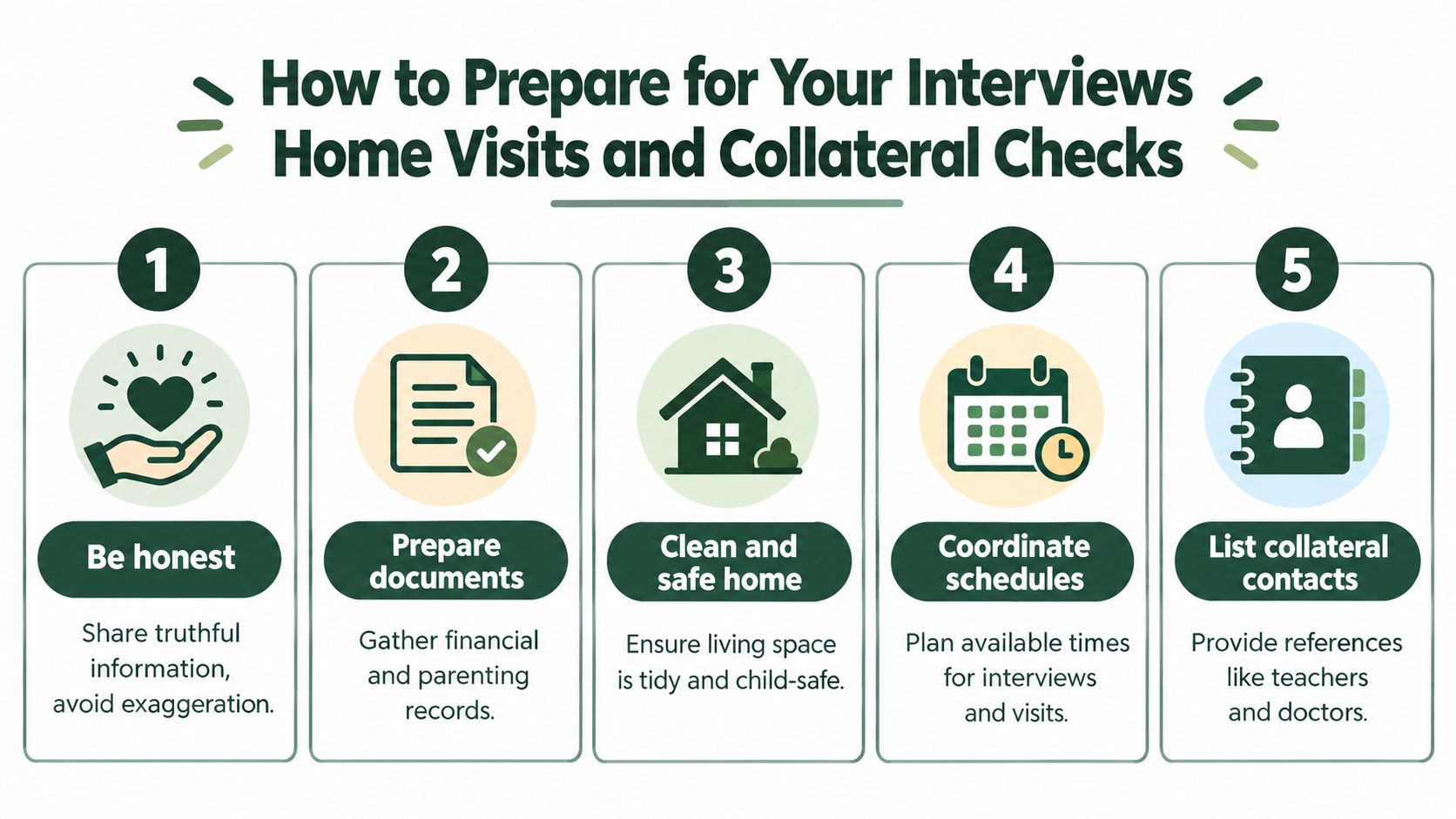
Start with your own interview
Your interview works a lot like an oral timeline. The evaluator is listening for routine, judgment, and consistency. A parent who can calmly explain school mornings, medication, homework, meals, bedtime, and exchanges usually gives the evaluator something useful to test against documents and collateral contacts.
Prepare in a practical way:
- Write out the child's normal schedule: school, daycare, pickups, activities, medical care, counseling, and bedtime
- Organize records by topic: school notices, report cards, medical information, counseling records if they are appropriate to share, calendars, and parent communications
- Be ready for hard facts: if there was a missed pickup, an old arrest, a housing gap, or a work problem, explain it directly and explain what changed
- Use examples: “I help with reading every night” is weaker than “We read for 20 minutes after dinner, then I sign the school reading log”
Details matter because they are easier to verify.
If your case has Dallas County logistics in the background, keep those straight too. Watch for notices from Family Court Services at 600 Commerce Street, Second Floor, and make sure any fee step that runs through the Child Support Office is handled on time. A missed intake step can create avoidable delay even if you are otherwise prepared.
Prepare your child without coaching
Children do best with very little instruction. The safest message is short. Tell the child to tell the truth, listen carefully, and answer in their own words.
That is enough.
Parents often get into trouble by trying to reduce uncertainty. They rehearse answers, test the child with questions about the other parent's home, or ask the child to report back after the meeting. To an evaluator, that can sound less like support and more like pressure.
A better approach is steady and boring. Keep the child's normal routine. Do not turn the interview into a family event. Do not suggest the child has to protect you, choose a side, or help the judge.
Treat the home visit as a daily-life check
The home visit is usually less about decoration and more about whether the space works for a child. A clean but ordinary apartment can present well. A large house with obvious safety problems, unclear sleeping arrangements, or constant adult chaos can raise concern.
Use this checklist before the visit:
| Focus area | What parents should think about |
|---|---|
| Sleeping arrangements | Does the child have an appropriate place to sleep, with bedding and enough privacy for the child's age? |
| Basic safety | Are medicines, firearms, sharp objects, and other hazards stored safely? |
| Daily living | Is there space for meals, bathing, homework, and normal supervision? |
| Household members | Can you clearly explain who lives in the home, how often they are there, and what role they play in the child's life? |
You do not need a model home. You need a home that makes sense.
If another adult lives there, expect questions about that person. The evaluator may want to know how long they have been in the home, whether they help with childcare, and whether there are any safety concerns or criminal history issues you should have already disclosed.
Choose collateral contacts who know the child's real life
Collateral contacts are outside people the evaluator may check with to test what each parent says. Good contacts are specific and informed. A teacher, counselor, coach, daycare provider, or pediatric provider often helps more than a loyal friend who only knows your side of the conflict.
Pick people who can answer questions like these:
- How is the child doing at school or in activities?
- Who usually communicates with you about the child?
- Have you observed attendance issues, behavior changes, or stress?
- Does one parent reliably handle appointments, forms, or follow-up?
Before listing someone, ask yourself a simple question. Does this person know the child's daily functioning, or do they just support me emotionally? The first type is usually more useful in a Dallas County social study.
The Law Office of Bryan Fagan, PLLC has published general Dallas family law information that some parents use for background reading. Use outside reading carefully. It should help you stay organized, not turn your interview into a script.
Common Mistakes That Hurt Your Social Study Outcome
A parent can walk into the Dallas County process convinced, "If I just tell my side clearly, the evaluator will see the truth." Then the interview turns into a running list of complaints, a missed call from Family Court Services goes unanswered, and a social media post undercuts what the parent said in person. None of that means the parent does not love the child. It means the record now raises questions that did not need to exist.
A social study works a lot like a fact-checking process. The evaluator is comparing what each parent says with what shows up in interviews, records, home observations, and collateral contacts. Parents usually hurt their own case when they treat the process like a chance to vent instead of a chance to show steady, child-centered judgment.
Mistake one is making the whole interview about the other parent
Dallas evaluators need useful information about the child's daily life. If every answer becomes a speech about the other parent's failures, the evaluator gets less detail about your routines, decisions, and parenting judgment.
Specific concerns are more persuasive than broad labels. "He missed the child's therapy appointments in March, and the counselor can confirm it" is easier to evaluate than "He never cares about the child." One gives the evaluator something concrete to test. The other sounds like conflict.
This is a common place where parents get tripped up. They think strong emotion shows seriousness. In a social study, clear facts usually help more than anger.
Mistake two is pressuring the child to sound loyal
Children rarely speak in polished adult language unless an adult put that language there. If a child suddenly uses phrases that sound like court pleadings or grown-up accusations, that can raise concern about coaching.
Keep your guidance plain:
- Tell the child to tell the truth.
- Do not rehearse answers.
- Do not ask the child to choose sides.
- Do not ask the child to report back about the other parent's home.
A child should not feel responsible for the outcome. That burden is too heavy, and evaluators are trained to notice it.
Mistake three is hiding a bad fact instead of explaining it
A past arrest, a CPS investigation, substance abuse treatment, unstable housing, or an old protective-order issue may feel embarrassing. Parents sometimes hope the topic will never come up. In this setting, that choice often backfires.
Dallas social studies are built to compare statements with outside information. If a difficult fact exists, the safer path is usually to address it directly, explain the timing, and show what changed. A parent who says, "I had a problem three years ago, I completed treatment, and here is what my life looks like now," often appears more credible than a parent who denies the issue until records force the point.
The problem is not always the old event. The problem is concealment.
Mistake four is treating county contacts and appointments casually
This mistake has a Dallas County angle that parents sometimes miss. Once the court orders the social study, the process does not run on guesswork or informal timing. You may be dealing with Family Court Services for intake at 600 Commerce Street, scheduling steps with the evaluator, and fee collection through the Child Support Office under the county workflow discussed earlier.
If you miss calls, ignore paperwork, show up late, or delay payment issues without explanation, it can make you look disorganized or hard to work with. Life happens. Cars break down, work shifts change, children get sick. The key is prompt communication and documentation.
A short, calm message helps. State the problem, propose a new time, and keep proof that you responded.
Mistake five is forgetting that your records need to match your story
Credibility often turns on consistency. If you say you handle school communication, but the school only hears from the other parent, that mismatch matters. If you say your home is calm, but your texts are full of threats or insults, that matters too.
Parents often focus only on the interview room. The evaluator is looking at a wider picture. Text messages, emails, school records, medical records, attendance history, and statements from third parties can all confirm or weaken what you say.
A good rule is simple. If you would be uncomfortable seeing it discussed in a Dallas courtroom, do not send it, post it, or create it during the social study period.
Mistake six is confusing fairness with sameness
Some parents believe they have to prove they are the "better" parent in every category. That is not usually how this process works. The evaluator is looking at the child's needs, each parent's decision-making, each home's stability, and whether the child can be protected from adult conflict.
That means small imperfections do not usually sink a case. What causes trouble is a pattern of poor judgment. Ongoing hostility, impulsive communication, refusal to cooperate with reasonable requests, or failure to put the child's routine first can carry more weight than whether your house is prettier or your interview style is smoother.
The strongest presentation is often the most ordinary one. A parent who is honest, prepared, calm, and focused on the child usually gives the evaluator something solid to rely on.
Timeline Cost and What Happens After the Report Is Filed
A common Dallas County surprise happens after the court signs the social study order. Parents expect a quick interview process, then a fast answer. The process is usually slower. Scheduling, document collection, home visits, collateral contacts, and the county payment workflow can stretch the process out, especially when parents live in different homes, raise competing concerns, or have trouble coordinating dates.
The easiest way to understand the timeline is to picture an airport checkpoint. Your case does not move from one straight line to a finished report. It moves through several stations. The court orders the study. Family Court Services at 600 Commerce handles intake and the study work. The Child Support Office handles fee collection in the local process. Then the evaluator gathers information, writes the report, and files it with the court. A delay at any station can slow the rest.
Cost matters too. In many cases, the parents are ordered to split the social study expense. In Dallas County, payment is tied to the county process rather than handled casually between the parties, so families should pay close attention to deadlines and instructions connected to the Child Support Office and Family Court Services. If payment issues are not resolved early, the study can stall before the evaluator finishes the work.
What happens after the report is filed
Once the report is filed, treat it like a roadmap, not a final verdict. Judges often give social study reports real weight, but the report does not automatically decide conservatorship, possession, or decision-making rights.
Your next step depends on what the report says and what stage your case is in. Common responses include:
- Read it for facts first: Check names, dates, school details, medical history, and who said what. A recommendation may matter less if it rests on a factual mistake.
- Review it with your lawyer if you have one: A lawyer can help separate a frustrating opinion from a point that affects evidence or courtroom strategy.
- Use it to evaluate settlement: Some cases settle after the report because both parents can finally see how a neutral professional viewed the family dynamic.
- Prepare a focused response if needed: If the report leaves out important records, relies on wrong assumptions, or misstates events, gather documents and witnesses that address those points directly.
- Get ready for a hearing or trial: The report may influence temporary orders, final orders, or the questions each side asks in court.
A weak response is emotional. A strong response is organized.
If you are still waiting for the report, use that waiting period well. Keep following temporary orders, keep communication child-focused, and keep your records in order. Once the report lands in the file, the case often starts moving faster than parents expect.
Dallas County Contacts Filing Notes and When to Get Legal Guidance
A Dallas County social study has a local paper trail. If you miss one stop in that chain, your case can stall even when you are otherwise doing everything right.
In Dallas County, the process usually runs through three practical checkpoints. The court signs the order. Family Court Services handles the social study work at 600 Commerce Street, Second Floor, Dallas, Texas 75202-4606. The Dallas County Child Support Office commonly handles fee collection tied to Family Court Services. That split can confuse parents because the office gathering payment may not be the office doing the interviews or preparing the report.
Your case may also touch the Dallas County Family District Courts, the Dallas County District Clerk, and hearing locations such as the George L. Allen, Sr. Courts Building or the Frank Crowley Courts Building. If the report is finished and your next question is how to get in front of the judge, this guide on setting a hearing through a Dallas County family court coordinator helps explain that step.
Filing details matter here. Parents often assume that paying a fee, dropping off papers, and waiting for a court date all happen in one place. In Dallas County, those tasks can involve different offices with different roles. It helps to keep copies of the order requesting the social study, proof of payment, any intake paperwork, and any notice you receive about interviews or deadlines.
Legal guidance is often useful before a problem grows. A short meeting with a Dallas family law attorney can help when:
- The court has just ordered a social study and you need to understand the local process
- Your case involves family violence, substance abuse concerns, CPS history, relocation, or a protective order
- The report appears to rely on wrong facts, missing records, or one-sided collateral information
- You expect a contested temporary-orders hearing, final trial, modification, or enforcement action after the report
Venue questions also deserve attention. Some mailing addresses say Dallas, while the correct court is in a different county. The court with authority over your case depends on the actual county, the existing orders, and where the case was filed, not just the city listed on an address.
If you're facing a social study in a Dallas custody case, The Law Office of Bryan Fagan, PLLC offers guidance on Dallas County family court procedure, custody disputes, temporary orders, modifications, and related next steps. To learn more about the process and your options, visit The Law Office of Bryan Fagan, PLLC.
