 Skip to content
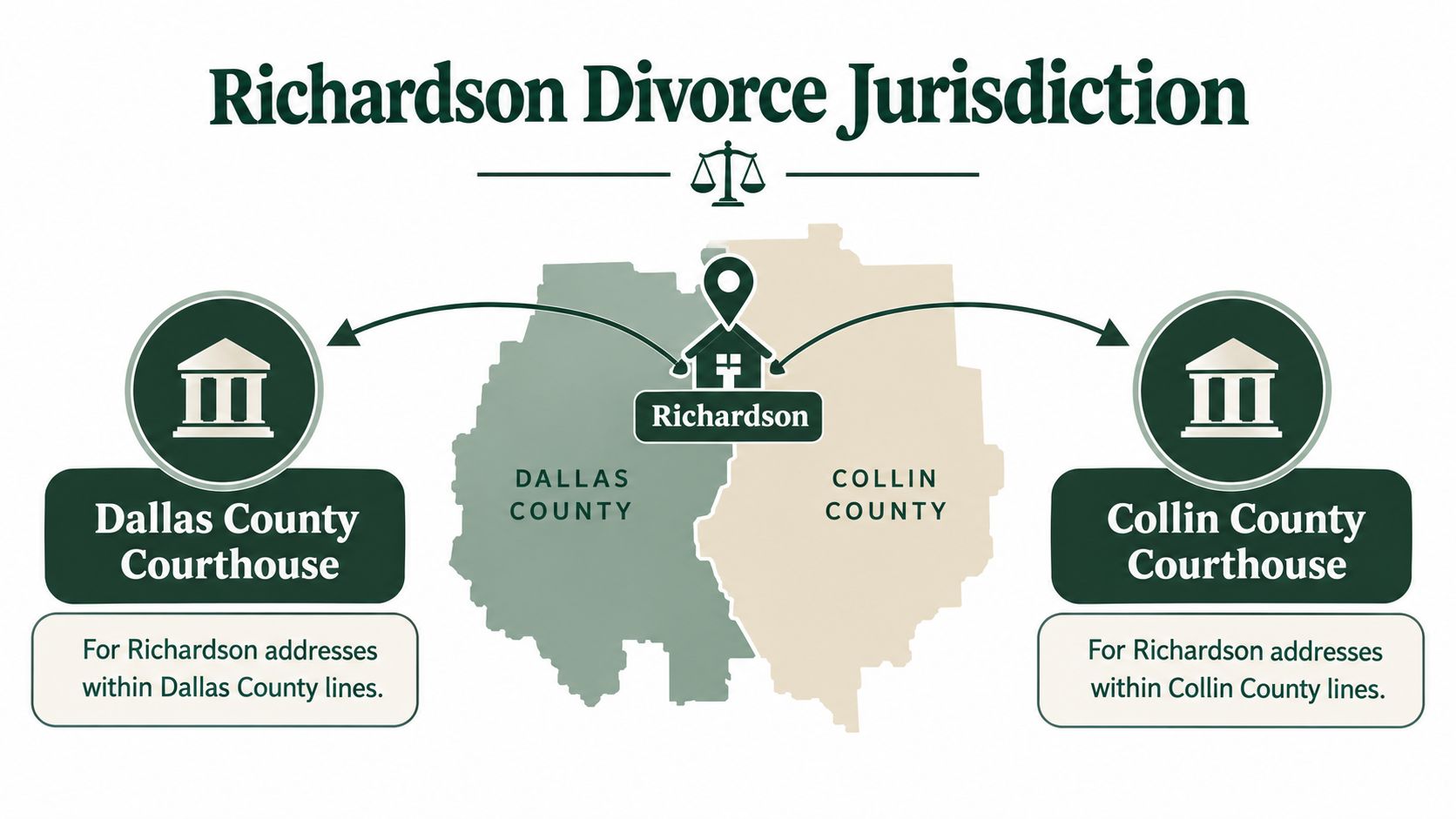
A Richardson divorce is filed in Dallas County when the qualifying residence is in Dallas County, and in Collin County when the qualifying residence is in Collin County. The correct venue depends on the residential address and residency duration, not just the city name.
A spouse may live in Richardson, search for “Richardson divorce court,” and receive results for two different county court systems. That isn't an error. Richardson crosses the Dallas and Collin County line, so the first practical task is identifying the county tied to the legally significant residence before preparing or submitting a divorce petition.
Table of Contents
- Which County Is the Correct Venue for a Richardson Divorce
- How Texas Residency and Venue Rules Determine Your Filing County
- Dallas County Versus Collin County Court Resources and Filing Logistics
- How to Verify Your County Before Filing a Divorce Petition
- Common Mistakes When Choosing Between Dallas and Collin Counties
- Practical Next Steps After Identifying the Correct County
- Frequently Asked Questions About Richardson Divorce Venue
- Can spouses living in different counties still pursue one divorce?
- Do the children's current residence determine the divorce county?
- What happens if the other spouse claims the case was filed in the wrong county?
- Should I speak with a Dallas family lawyer before submitting the petition?
- Does the county determine the outcome?
Which County Is the Correct Venue for a Richardson Divorce
Consider a spouse living near the northern edge of Richardson. The mailing address says Richardson, but the home may be in Collin County. Another Richardson resident, only a short distance away, may properly file in Dallas County. The city label alone doesn't answer the venue question.
Richardson is divided between Dallas County and Collin County. The city covers approximately 28.6 square miles, with about 18.2 square miles, or roughly 63.6%, in Dallas County, and approximately 9.2 square miles, or 32.2%, in Collin County. The remaining difference reflects rounding. The Texas State Historical Association's Dallas County information also illustrates the practical significance of the division. In the cited historical period, Richardson had about 104,037 residents, including 70,654 living in Dallas County.
The city and county serve different purposes
The city identifies a community. The county generally identifies the local court system and filing location for a divorce. A Richardson resident whose qualifying residence is in Dallas County will generally work through Dallas County district courts and the Dallas County District Clerk. A resident whose qualifying residence is in Collin County will generally use Collin County district courts in McKinney.
The legal question isn't just where a person receives mail. Texas venue rules look at qualifying residence, domicile, and the circumstances of both spouses. The petitioning spouse or responding spouse may have a residence that supports filing, but the statutory requirements must be satisfied.
Practical rule: Treat “Richardson” as the starting point for research, not the final answer. Verify the actual county before selecting forms, court information, or filing instructions.
Dallas County is the larger population market around Richardson, but Collin County is also substantial. The U.S. Census Bureau's county comparison reports 2,613,539 residents in Dallas County and 1,064,465 in Collin County on April 1, 2020. Those figures explain why both counties have established court resources, but population size doesn't decide an individual case. The residence and Texas venue requirements do.
How Texas Residency and Venue Rules Determine Your Filing County
Texas Family Code §6.301 generally requires at least six months of domicile in Texas for either the petitioner or respondent and at least 90 days of residence in the county where the petition is filed. The Texas Family Code residency provision is the starting point for evaluating a Richardson divorce venue.
That rule creates two separate questions. First, has either spouse satisfied the Texas residency requirement? Second, has the relevant spouse lived in the proposed filing county long enough? A Richardson address may answer neither question by itself if the address is misidentified, the person recently moved, or the parties' circumstances involve a temporary absence.
Domicile, residence, and the address on the petition
In everyday conversation, people often use “home,” “address,” and “residence” interchangeably. A divorce filing may require closer attention. The court needs reliable facts about where a spouse lives and whether that residence supports the chosen county.
For example, a spouse may have moved from Dallas County to Collin County recently. The city may still be Richardson, but the county may have changed. Another spouse may work in Dallas, own property in both counties, or spend time in more than one location. Those facts don't automatically determine venue, but they can make an address-level review necessary.
The same analysis applies when spouses live in different counties. A qualifying residence in one county may support filing there even if the other spouse lives elsewhere, but children, existing orders, competing proceedings, and venue objections can change the practical analysis.
Exceptions and objections matter
Military-residency rules and temporary absences can affect how residency is evaluated. A spouse's absence from a home doesn't always resolve whether the person has abandoned a Texas domicile. Similarly, a respondent may challenge venue if the petition is filed in a county that doesn't satisfy the applicable requirements.
That doesn't mean every cross-county situation becomes a major dispute. It does mean a filer shouldn't choose a county based solely on convenience, a ZIP code, or a search result. A person comparing related county-boundary questions may also review this explanation of divorce venue in Carrollton and the Dallas, Denton, and Collin County lines.
Before filing, write down the actual residential addresses, the dates each spouse began living in the relevant county, and any facts involving military service, temporary relocation, prior family cases, or children. If those facts don't point clearly to one county, legal advice before filing can prevent a venue issue from becoming the first dispute in the case.
Dallas County Versus Collin County Court Resources and Filing Logistics
Once the county is identified, the practical path becomes more concrete. Dallas County and Collin County use different courthouse locations, clerk resources, and local filing instructions. The underlying Texas divorce law remains statewide, but the administrative steps can differ.
For Dallas County, divorce filings and family-record matters go through the Dallas County District Clerk at the George L. Allen, Sr. Courts Building, 600 Commerce Street, Dallas. Dallas County states that attorneys must e-file district-court pleadings. Self-represented litigants may submit paper pleadings at the designated civil filing desk.
Collin County family cases are handled through district courts at the Russell A. Steindam Courts Building, 2100 Bloomdale Road, McKinney. Collin County's official court pages identify individual district courts and provide court-specific contacts and forms.
Local filing differences at a glance
| Aspect | Dallas County | Collin County |
|---|---|---|
| Primary family filing system | Dallas County District Clerk and Dallas County district courts | Collin County district courts and local clerk resources |
| Courthouse location | George L. Allen, Sr. Courts Building, 600 Commerce Street, Dallas | Russell A. Steindam Courts Building, 2100 Bloomdale Road, McKinney |
| Attorney filing method | Attorneys must e-file district-court pleadings | Use the applicable Collin County court and clerk instructions |
| Self-represented filing | Paper pleadings may be submitted at the designated civil filing desk | Follow the court-specific local forms and filing directions |
| Docket and forms | District Clerk and assigned family district court resources | Individual district court pages and county court contacts |
The county doesn't change the importance of service, waivers, proposed orders, or finalization requirements. It changes where the case is lodged and which local office provides procedural information. A person who files in Dallas County should not assume that a Collin County form, contact process, or courthouse instruction applies without checking.
Richardson residents should also avoid confusing a county courthouse with a nearby subcourthouse. A nearby location may provide useful county services, but the filing instructions for a divorce still need to be confirmed with the appropriate district clerk. The Dallas County subcourthouse information for Garland, Richardson, and Mesquite can help with local courthouse orientation, but it doesn't replace county and court verification.
The useful sequence is simple: identify the county, identify the district court system, then confirm the current filing method and forms directly with that county's official resources.
How to Verify Your County Before Filing a Divorce Petition
Don't rely on a street-name assumption or a general map. Richardson's county boundary is commonly described as running roughly around Campbell Road and Spring Valley Road, but that description is only a starting point. A specific home, apartment complex, or recent move still requires address-level verification.

Use this checklist before selecting the county on a petition:
Confirm the full residential address. Use the physical address where the spouse lives, not only a mailing label, work address, or general Richardson ZIP code.
Check the county boundary through an official property-tax appraisal district. A property record can help identify the county associated with the home. It should be treated as a verification source, not as the entire legal venue analysis.
Compare county election registration information. County voter-registration records may help confirm which county recognizes the residential address.
Contact the appropriate clerk if the boundary is unclear. Ask which county's district court resources apply to the address. A clerk can provide procedural information, though clerk personnel generally can't decide disputed legal questions for you.
Create a residency timeline. Record when each spouse began living in the county. The address and the 90-day county residency requirement must be considered together, not separately.
Check for complications. Note recent moves, temporary absences, military service, an existing custody or support order, a prior divorce case, or a spouse living in another county.
The final check is whether the selected county is supported by the facts of the parties, not merely whether the home is somewhere within the Richardson city limits. If the information conflicts, pause before filing and obtain a venue analysis.
Common Mistakes When Choosing Between Dallas and Collin Counties
A common mistake begins with a reasonable shortcut: “The address says Richardson, so I'll choose the Richardson court.” There is no single Richardson county court for divorce. The filer must identify whether the residence is in Dallas County or Collin County.
Another shortcut is assuming that every southern Richardson address belongs to Dallas County or every northern address belongs to Collin County. Geographic descriptions can help narrow the search, but they don't replace verification. Apartment developments, nearby boundary lines, and recent moves can make an address-specific check necessary.
Cross-county spouses create a different question
Suppose one spouse lives in Dallas County and the other lives in Collin County. That doesn't automatically prevent a divorce filing, but the petitioner must determine which county satisfies the applicable residency facts. If the parties have children, the children's location may matter to custody-related proceedings and existing orders, even though it doesn't by itself answer the divorce venue question.
A recent move can create another problem. A spouse may have lived in Dallas County for a long time but moved to Collin County shortly before filing. Choosing Dallas County because it feels more familiar could invite a venue objection if the statutory county residency requirement isn't met. Temporary absences, military assignments, and the parties' actual domicile can require a more careful review.
A county choice made for convenience can become expensive when the other spouse challenges venue after the petition is filed.
Filing in the wrong county doesn't necessarily end the divorce. It can, however, create a transfer request, additional briefing, delay, or other avoidable expense. The effect depends on the facts and the procedural posture of the case, so there isn't a universal correction that applies to every filing.
If a petition has already been submitted and you now question the county, do not file a second petition in the other county. Gather the filing information, residence history, service status, and any response or venue objection, then ask a Texas family lawyer to evaluate the proper procedural response.
Practical Next Steps After Identifying the Correct County
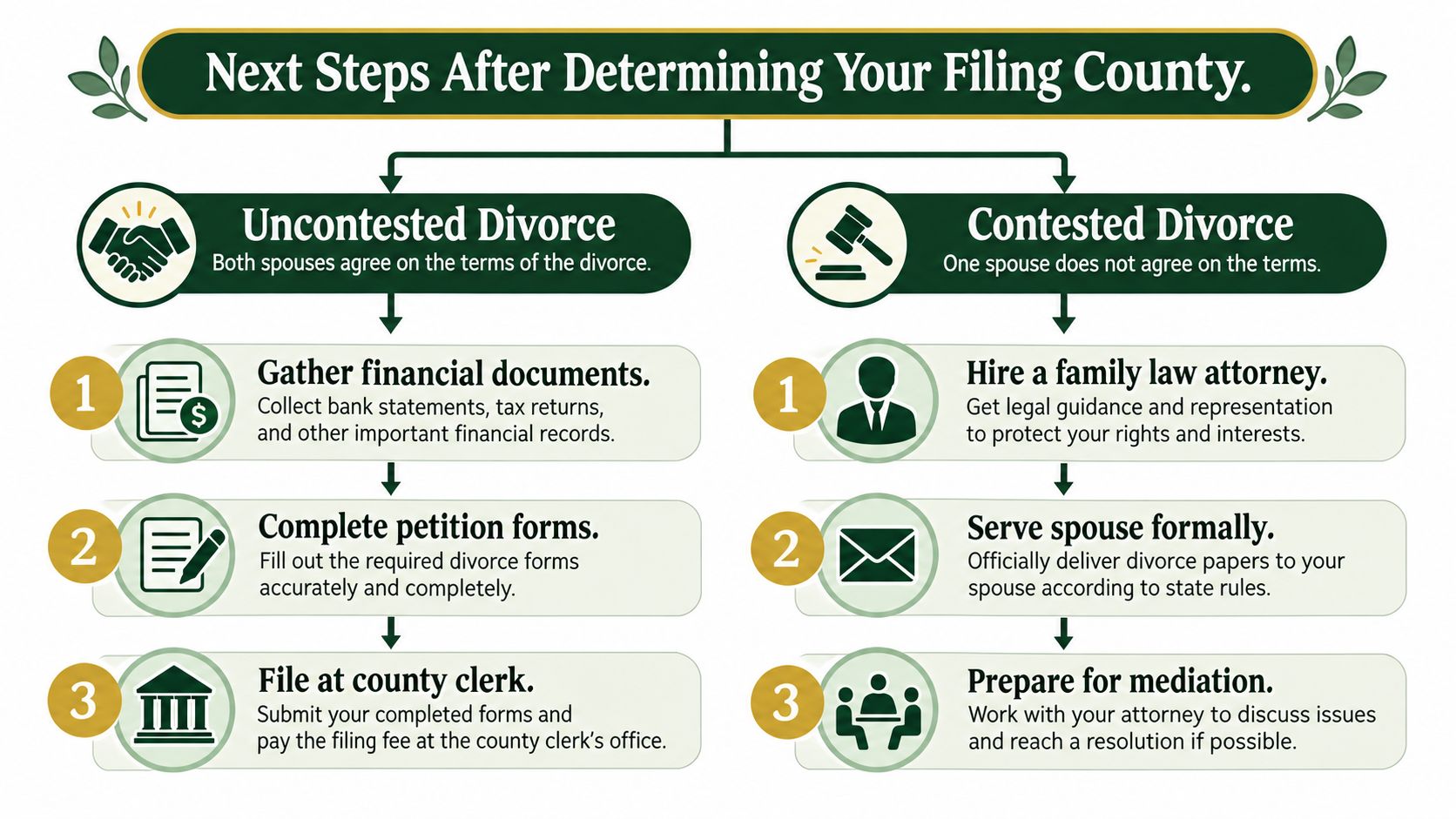
After confirming the county, separate the filing decision from the larger divorce strategy. An uncontested case may require careful paperwork and coordinated signatures. A contested case may involve service, temporary orders, discovery, mediation, property tracing, or a trial plan.
Start with the case category
For an uncontested divorce, spouses generally need to identify their agreements about property, debts, support, and, if applicable, children. The petition and proposed final decree must accurately reflect those agreements. A rushed form can create post-divorce disputes even when both spouses initially agree.
For a contested divorce, preserve financial records and identify immediate concerns. Temporary orders may address support, access to children, possession of property, or payment of expenses while the case is pending. Protective-order or safety concerns require prompt attention and should not be treated as ordinary scheduling disagreements.
In a case involving children, Dallas County's pro se materials identify additional documents, including proof of service or a waiver, a proposed final order, an affidavit of testimony, and the Information on Suit Affecting the Family Relationship form. When child support is ordered, an employer's order to withhold is also required. The Dallas County District Clerk divorce filing fee schedule and related filing information can help a prospective filer locate current county-specific information.
Account for timing and financial complexity
Texas divorce cases generally can't be finalized until the statutory waiting period expires. Dallas County states that the shortest completion time is 61 days, and its self-represented instructions explain that the petition must remain on file for 60 days before finalization. The waiting period runs from filing, not from service or agreement. The Dallas County civil frequently asked questions also identifies service or a waiver, approval of the proposed decree by an associate judge, and a final court appearance or prove-up as steps that may be required.
A disputed case can take substantially longer. Business ownership, professional practices, investment property, retirement accounts, stock compensation, separate-property tracing, reimbursement claims, hidden assets, and high-income households can change the work needed to reach a reliable property division. Those issues often require complete financial records and a plan for valuation, characterization, and implementation.
Consider legal guidance before filing if the spouses disagree about children, support, property, debt, relocation, or safety. A Dallas family lawyer can also help when the county is uncertain, the other spouse lives elsewhere, or an existing order affects the case.
Frequently Asked Questions About Richardson Divorce Venue
Can spouses living in different counties still pursue one divorce?
Yes, living in different counties doesn't automatically prevent spouses from pursuing the same divorce. The petitioner must identify a county supported by the applicable Texas residency and venue rules. The analysis may become more involved when one spouse recently moved, one spouse is temporarily absent, or the parties have children and existing family-law orders.
Do the children's current residence determine the divorce county?
Not automatically. The children's location can be highly relevant to custody, conservatorship, possession, support, and existing-order issues, but it doesn't replace the divorce venue analysis. The filing county still must be supported by the parties' qualifying residence and applicable Texas procedure.
What happens if the other spouse claims the case was filed in the wrong county?
The spouse may raise a venue objection or request transfer. The court's response depends on the facts, the pleadings, and the procedural stage. A transfer issue can delay progress and create additional expense, so address verification and a residency timeline are worthwhile before filing.
Should I speak with a Dallas family lawyer before submitting the petition?
Legal guidance is especially useful when spouses live in different counties, a move occurred recently, a military or temporary-absence issue exists, children are involved, or the parties dispute property or support. It can also help a business owner, professional, executive, or high-income spouse protect financial records and address complex assets before an agreement is finalized.
Does the county determine the outcome?
No. Dallas County and Collin County use different local court resources, but the county doesn't guarantee a particular result. The facts, applicable Texas law, evidence, agreements, and procedure shape the case.
The Law Office of Bryan Fagan, PLLC provides divorce representation and guidance on determining the appropriate filing jurisdiction, including Dallas and Collin County matters. Visit The Law Office of Bryan Fagan, PLLC to review Dallas family-law resources and request help evaluating your Richardson address, residency timeline, and next filing step.
