 Skip to content
Dallas County Dispute Resolution Center mediation fees are based on dispute type and ability to pay and can be free for court-referred cases, while private Dallas mediation typically costs $100-$200 per party at community providers and $650-$1,300+ per party privately, with fees shared equally unless agreed otherwise. The amount you owe depends on which mediation track applies, who referred the case, the session length, and whether additional expenses are involved.
You may be looking at divorce papers, a custody modification, or a proposed mediation order and wondering whether “mediation” means a free county service or a private appointment that costs each side hundreds or thousands of dollars. That confusion is understandable because Dallas County public ADR services and private family-law mediators operate under very different pricing structures.
For a Dallas family, the practical questions are straightforward: Is the case court-referred? Is the mediation through the Dallas County Dispute Resolution Center? Is the fee based on income? Or did the attorneys select a private mediator? The answers determine what happens next and what you should budget.
Table of Contents
- What Dallas County Dispute Resolution Services Mediation Means for Your Case
- How Dallas County Sets Mediation Fees and Who Qualifies for Low Cost Options
- Court Referred Free Mediation Versus Private Mediation Costs in Dallas
- Who Pays When Payment Is Due and What Extra Costs to Expect
- How to Request and Schedule Dallas County Mediation Step by Step
- What Dallas Family Law Mediation Costs Mean for Divorce Custody and Property Cases
- Common Pitfalls Next Steps and When to Talk to a Dallas Family Law Attorney
What Dallas County Dispute Resolution Services Mediation Means for Your Case
Consider a Dallas County parent facing a custody modification. The parents disagree about possession, school exchanges, and child support. One parent believes mediation is free because the case came through the court. The other receives a private mediator's fee proposal and assumes the county program must be unavailable. Settlement discussions stall while both sides try to understand which price applies.
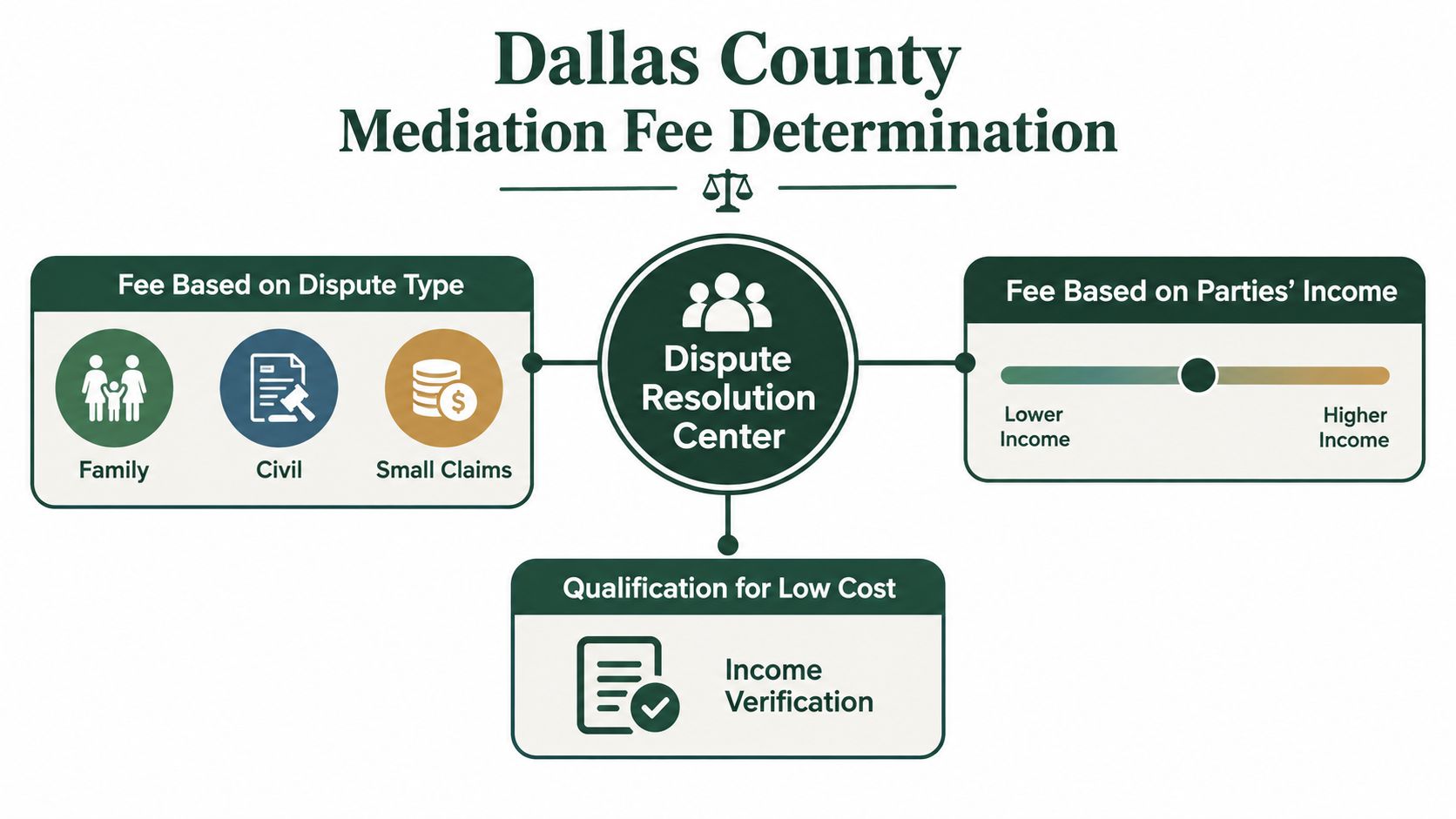
That situation reflects the central issue with the Dallas County dispute resolution services mediation fee. Dallas County doesn't use one universal, fixed rate for every mediation. The county's Dispute Resolution Center bases fees on the type of dispute and the parties' ability to pay, while court-referred cases may qualify for free services through the county center. Private mediation follows the mediator's own schedule.
Dallas County's program is designed as a subsidized dispute-resolution service, not as a standard market-rate private mediation calendar. The county describes its ADR program as a way to provide low-cost dispute resolution and help relieve pressure on court dockets. Dallas County's ADR FAQ explains that the fee depends on the dispute and the parties' ability to pay.
Family mediation can address issues in divorce, custody, child support, possession and visitation, paternity, enforcement, and modifications. It can also help parents negotiate temporary arrangements or resolve implementation disputes after a final order. Mediation gives the parties an opportunity to create an agreement, but it doesn't replace legal advice, guarantee settlement, or remove the need for a court order when the parties can't agree.
The referral source changes the answer
A Dallas County Family District Court may order parties to attend mediation before a final trial. That court-related requirement is different from choosing a private mediator voluntarily. The Dallas County local rules on mediation before final trial can help explain why mediation may appear in the litigation schedule.
The courthouse location also matters practically. A case connected with the Dallas County Family District Courts may involve filings and scheduling associated with the George L. Allen, Sr. Courts Building, but mediation itself may occur at the county center, a private office, or virtually. The order or referral should be reviewed carefully before anyone assumes the service is free.
Practical rule: Identify the provider and referral source before discussing the amount. “Mediation” describes the process, not a single price.
How Dallas County Sets Mediation Fees and Who Qualifies for Low Cost Options
Dallas County's Dispute Resolution Center uses a sliding approach rather than treating every family case like a private full-day mediation. The two central questions are what kind of dispute is involved and what the parties can afford. That structure explains why two Dallas County families may receive different fee information for mediation.
The county's FAQ states that fees are based on dispute type and ability to pay. It also provides an ADR office contact for people who have questions about fees or eligibility. You should ask the office directly about the current requirements for your case because program details may change.
Start with the county program
Use this sequence when determining whether a low-cost option may apply:
Confirm the dispute category. Tell the ADR office whether the matter involves divorce, custody, child support, possession, enforcement, or another dispute type. The category can affect how the program evaluates the request.
Identify the referral. Ask whether the case was referred by a Dallas County court, whether the referral is voluntary, or whether you're seeking mediation independently. A court referral can be significant when determining eligibility for county services.
Ask about ability-to-pay information. The program may need information about the parties' financial circumstances before determining the fee. Don't assume that a court referral automatically means every mediation is free or that income information is irrelevant.
Confirm the payment instructions. Ask whether payment is required before scheduling, before the session, or under another arrangement. Get the answer in writing when possible.
The county's public-interest model differs from private pricing because ADR centers may be supported through filing-fee surcharges, county or city funding, or grants. Texas court guidance on dispute resolution resources describes those possible funding structures. Public funding helps explain why a county program can reduce out-of-pocket costs for qualifying parties without establishing a private-market rate.
What to ask the ADR office
Have your cause number, court information, dispute type, referral order, contact information, and any available financial eligibility documents ready. Ask whether both parties must apply, whether the center handles family-law matters like yours, and whether virtual or in-person attendance changes the process.
A low-cost county program may be appropriate for a relatively focused custody or support dispute. A complicated divorce involving disputed property, business records, retirement assets, or safety concerns may require legal preparation even if the mediation fee itself is reduced.
Court Referred Free Mediation Versus Private Mediation Costs in Dallas
Search results often combine public county services, community mediation, and private family-law mediation. Those are separate tracks. The price comparison below uses the fee information available from Dallas-area resources and should be treated as a guide for identifying the category, not as a quote for your case.
| Fee Track | Typical Cost Per Party | When It Applies | Key Considerations |
|---|---|---|---|
| Court-referred county mediation | Free for qualifying court-referred cases | A case is referred through the Dallas County Dispute Resolution Center | Confirm that your referral and case type qualify, and ask about scheduling |
| Community mediation provider | $100-$200 per party, according to Dallas Bar community resources | A separate Dallas-area community mediation service is used | This is not the same as every Dallas County ADR referral; verify provider, eligibility, and session terms |
| Private shorter-session mediation | About $385-$600 per party | The parties select a private mediator for a shorter session | Ask about duration, virtual or in-person format, extra time, and travel |
| Private full-day mediation | About $1,500-$4,000 per party | The dispute requires a longer private session | Complex custody, property, or financial issues may require more preparation and time |
| Local family-law private schedule | $650 per party for a half-day, or $1,300 per party for a full day | A private Dallas-area family mediator uses this schedule | Extra hourly charges may apply if the session continues beyond the selected period |
The community-provider range of $100 to $200 per party appears in Dallas Bar community resources describing a separate Dallas-area mediation provider. Dallas Bar community legal resources should not be treated as a universal Dallas County price list.
The broader private-market ranges, approximately $385 to $600 per party for shorter sessions and $1,500 to $4,000 per party for full-day sessions, reflect local private listings summarized in the available Dallas-area fee information. Private mediators may also add charges for in-person attendance, travel, work outside the county, longer hearings, or additional time. The headline rate may therefore not equal the final bill.
Choosing based on the dispute, not only the rate
For a focused possession disagreement, a county referral or lower-cost community option may be practical if it's available and the parties can prepare efficiently. A high-conflict custody case may require more time, attorney participation, or safety planning.
A property-heavy divorce can be different. Business valuation, tracing separate property, dividing retirement assets, analyzing investment real estate, or addressing reimbursement claims may make a private full-day session more realistic. Paying more doesn't guarantee agreement, but inadequate time or preparation can make a low headline price less useful.
Who Pays When Payment Is Due and What Extra Costs to Expect
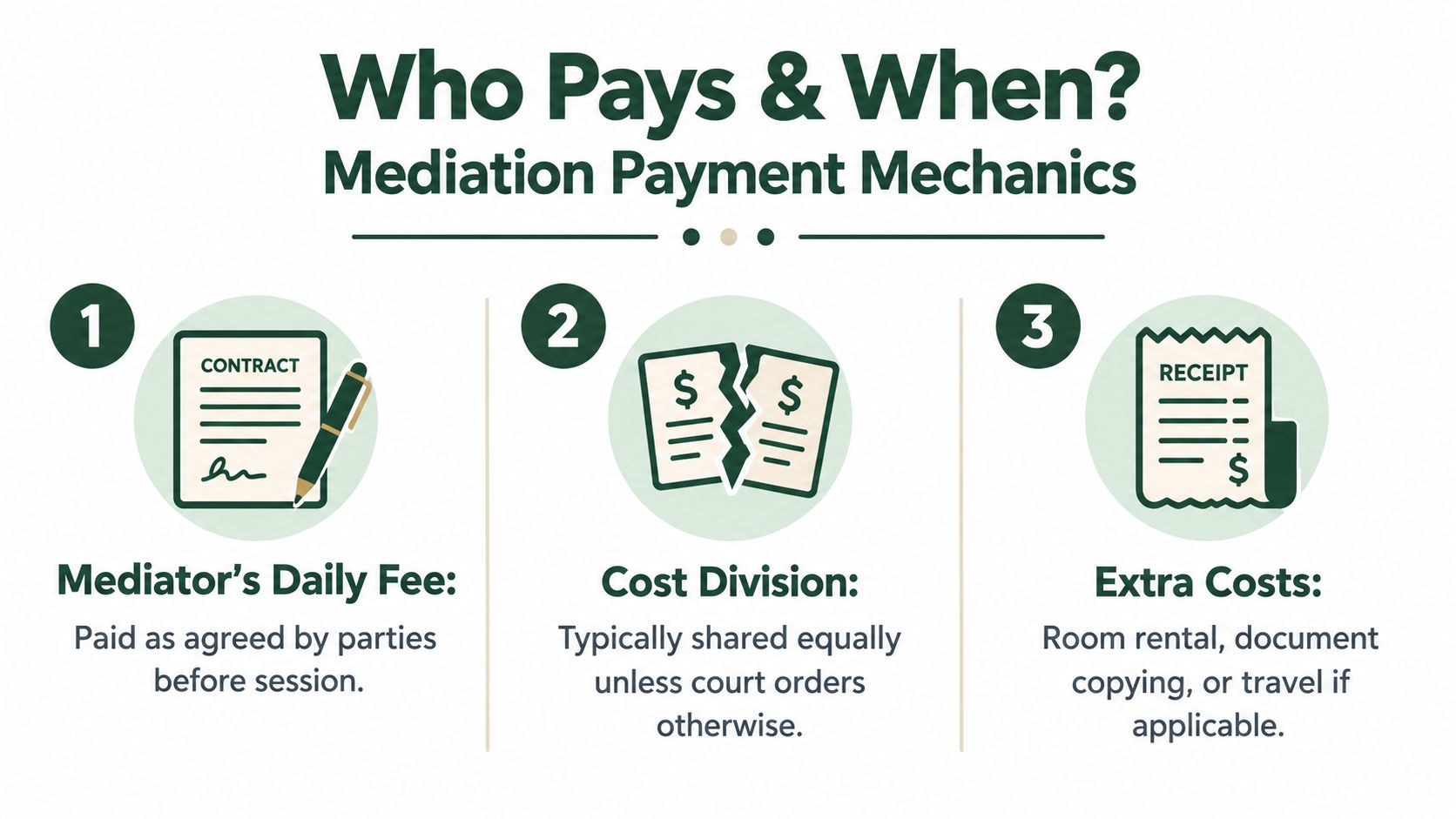
The mediator's rate is only one part of the financial question. Dallas County's ADR rules state that a mediator's daily fee, if agreed in advance, must be paid before each mediation day. The same rules say mediator fees and related mediation expenses are ordinarily shared equally unless the parties agree otherwise. Dallas County's mediation rules provide the governing fee-allocation reference for the county process.
“Shared equally” doesn't necessarily mean each party will pay exactly half of every expense in every case. The parties may agree to another allocation, and a court order or mediation agreement may address responsibility differently. Read the order and mediation terms together before making assumptions.
The practical payment checklist
Before the session, confirm:
- The daily fee: Ask whether the mediator charges by the day, half day, hour, or another unit, and confirm what “day” includes.
- The due date: Dallas County rules address payment before each mediation day when the daily fee was agreed in advance. Private mediators may use their own written terms.
- The allocation: Verify whether the parties split the cost equally or whether the agreement assigns a different share.
- The session format: Ask whether virtual and in-person sessions carry different charges.
- The extension policy: Confirm the hourly rate or other charge if the parties need more time.
- The expense policy: Ask whether travel, room use, copying, technology, or other requested services cost extra.
Witnesses, expert advice, and proof materials requested during the mediation can affect the effective total. In a high-asset divorce, a financial expert's assistance may matter more than a modest difference in the mediator's base rate. In a custody case, organizing records and preparing a workable parenting proposal may reduce wasted time.
Financial concerns should be raised before the session, not after a missed payment deadline. If one party says they can't afford the fee, counsel can discuss whether the county program, a different provider, a cost-sharing arrangement, or another scheduling option is appropriate. Questions about court-appointed professionals and related expenses may also require reviewing Dallas County resources such as information about amicus attorney appointment and cost.
How to Request and Schedule Dallas County Mediation Step by Step
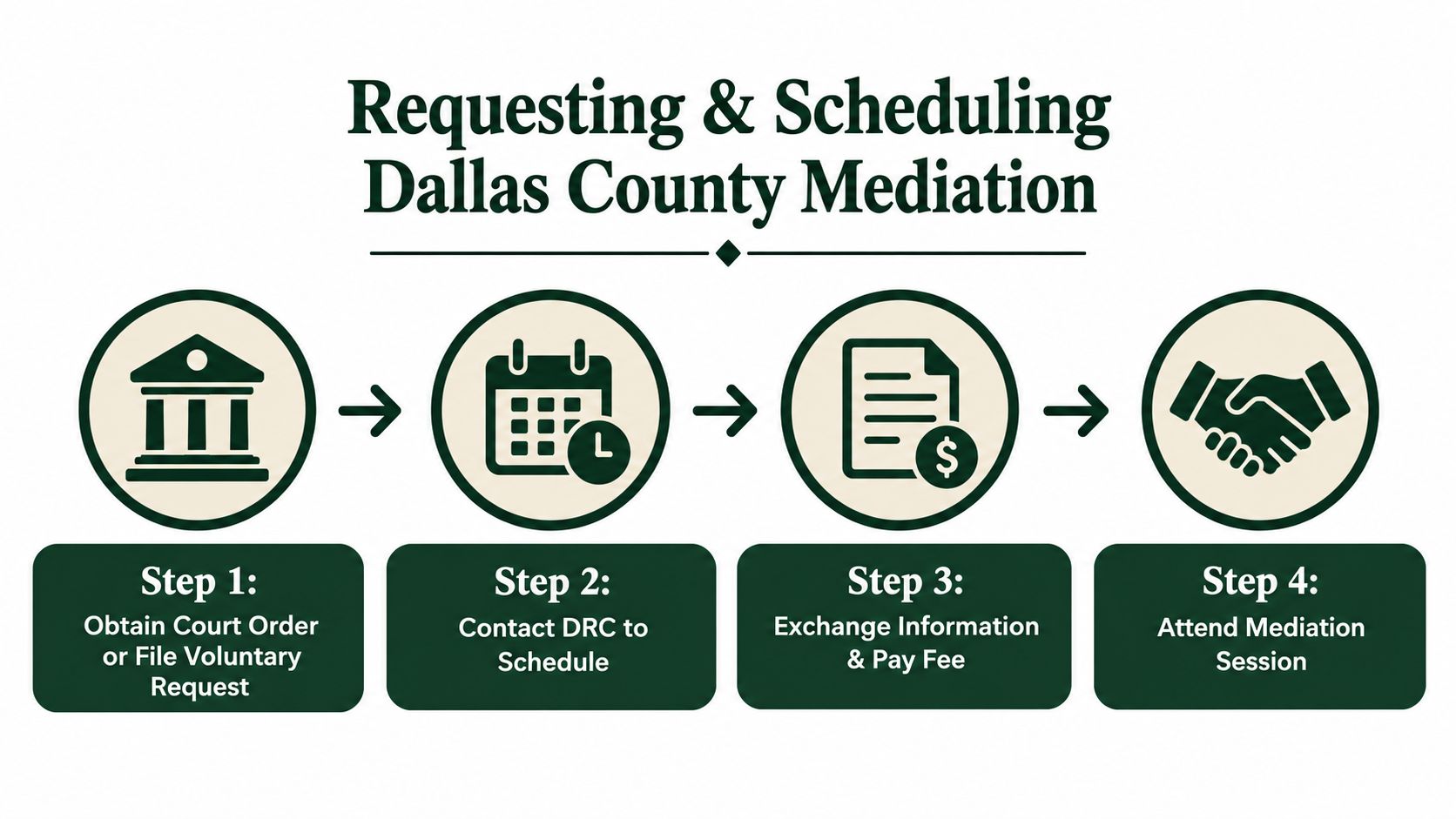
The process usually begins with either a court referral or a voluntary request. The exact instructions can depend on the case, the order, the provider, and current county procedures, so verify details with the Dallas County ADR office and the Dallas County District Clerk rather than relying on an old form or informal advice.
Four steps to a scheduled session
Step 1, identify the authority for mediation. Review the court's order, docket information, or attorney correspondence. If mediation is required before a final trial, confirm the deadline and any provider restrictions stated in the order or local procedure.
Step 2, contact the appropriate office or provider. For a county referral, contact the Dallas County ADR office or Dispute Resolution Center using current county information. For private mediation, the attorneys or parties typically coordinate directly with the selected mediator.
Step 3, provide case and fee information. Have the cause number, court, names of the parties, dispute type, referral information, and contact details available. Ask how ability to pay is evaluated, what documents are required, and when payment must be made.
Step 4, reserve a date and prepare. Confirm whether the session is virtual or in person, who must attend, how exhibits or settlement proposals should be exchanged, and what happens if someone needs an interpreter or accommodation.
Dallas family cases may be tied to dockets at the George L. Allen, Sr. Courts Building, but mediation scheduling isn't the same as a court hearing date. A mediation appointment can involve separate calendars and a different location. Keep the court deadline visible while comparing available dates.
Preparation prevents avoidable delay
Bring the current pleadings and orders, a concise list of disputed issues, relevant financial records, proposed possession schedules, child-support information, and a realistic settlement position. For a divorce involving property, organize deeds, account statements, business records, retirement information, and documents supporting separate-property claims.
For a CPS, protective-order, or high-conflict custody matter, discuss safety concerns and communication limits with an attorney before scheduling if possible. Don't send sensitive records casually or assume that mediation is appropriate for every issue.
Common scheduling problems include waiting too long to request a session, failing to identify a court deadline, assuming a private mediator is part of the county program, and overlooking the need for additional time. Ask the ADR office and the District Clerk to confirm current filing and scheduling information because county procedures can change.
What Dallas Family Law Mediation Costs Mean for Divorce Custody and Property Cases
Cost should follow case design. A parent seeking a temporary possession schedule or a focused child-support modification may not need the same private mediation format used for a divorce involving a closely held company, multiple properties, retirement assets, and disputed separate-property tracing.

For example, suppose two parents disagree about exchanges and school-year possession but largely agree on income and expenses. A county or lower-cost mediation track may provide a useful setting if the case qualifies and both parents arrive with specific proposals.
Now consider a business-owner divorce. The parties may need to analyze company books, compensation, ownership interests, real estate, retirement accounts, debt, and claims that certain assets are separate rather than community property. A Dallas-area private family-law fee schedule lists $650 per party for a half-day and $1,300 per party for a full day, with additional hourly charges if more time is needed. The published Dallas-area family mediation fee schedule illustrates why complex cases can require a larger private budget.
A higher fee may be reasonable when the alternative is an underprepared session that ends before the parties address the key financial questions. It still doesn't guarantee settlement. The parties should evaluate whether they have enough records, whether experts are needed, whether decision-makers will attend, and whether the mediator has enough time to work through the disputed issues.
The same analysis applies to child custody cases involving relocation, allegations of family violence, CPS involvement, or repeated enforcement disputes. Safety and enforceability matter more than choosing the cheapest appointment. A proposed agreement should be specific enough to implement and consistent with the court's authority.
This video may help readers understand how mediation fits into family-law preparation:
For family cases involving temporary orders, a domestic-relations social study, or complicated parenting questions, review the available Dallas County domestic relations office social study process before assuming mediation alone will address every issue.
Common Pitfalls Next Steps and When to Talk to a Dallas Family Law Attorney
The most expensive mediation mistake is often not choosing the wrong provider. It's arriving without knowing what you agreed to pay or what the session must accomplish.
- Assuming every county mediation is free: Confirm whether your case is court-referred and whether the Dispute Resolution Center has accepted it under the applicable program.
- Confusing public and private providers: Ask for the provider's legal name, fee schedule, eligibility rules, and scheduling contact.
- Ignoring the per-party wording: A fee quoted “per party” applies to each side, not to the case as a whole.
- Missing the payment requirement: Confirm when the fee is due, especially when the mediator's daily fee must be paid before the mediation day.
- Overlooking extra time: Ask what happens if the session runs longer than scheduled.
- Failing to prepare financial proof: Business records, retirement statements, property documents, and tracing evidence can affect both settlement value and mediation time.
- Treating a mediated agreement as self-executing: Make sure the written agreement and resulting court order accurately state possession, support, property division, and enforcement terms.
Before scheduling, write down the provider, referral source, dispute type, fee per party, payment deadline, session length, format, cancellation terms, and possible additional expenses. If you can't afford the stated amount, raise the issue promptly with the ADR office or your attorney. Waiting until the mediation date may leave fewer practical options.
Legal advice becomes especially useful when the dispute involves enforcement, a modification, a protective order, CPS, relocation, paternity, adoption, hidden assets, business ownership, retirement accounts, or a possible appeal to the Fifth Court of Appeals. A mediator remains neutral and can't advise either side what decision protects that person's legal position.
For Dallas residents who need help understanding the fee track, preparing settlement terms, or evaluating whether mediation is appropriate, The Law Office of Bryan Fagan, PLLC offers family-law consultations and representation through its Dallas office, including assistance with divorce, custody, support, property division, and post-order disputes. Visit The Law Office of Bryan Fagan, PLLC to review family-law resources and request a consultation about your situation.
