 Skip to content
Amicus attorney fees in Dallas County are not fixed statewide. The court sets them case by case using local reasonable-and-customary rates, usually requires a cost deposit when the appointment is made, and can later reallocate fees based on the parties' ability to pay.
If you're in the middle of a custody fight in Dallas, that answer probably doesn't calm you down yet. Most parents want to know two things right away: Why is this lawyer involved in my family at all, and how expensive is this going to get? Those are fair questions. In Dallas County family cases, an amicus appointment is a formal court process with real paperwork, published fee tracking, and sometimes significant financial consequences.
The helpful part is that Dallas families do not have to guess in the dark. Texas law gives judges a framework for appointing and paying an amicus attorney, Dallas County uses appointment forms that show how controlled the process is, and the Dallas County District Clerk publishes records that let you see how these fees are handled in actual local cases.
Table of Contents
- What an Amicus Attorney Actually Does in a Dallas Family Case
- When a Dallas County Court Will Appoint an Amicus Attorney
- How the Dallas County Appointment Process Works
- How Costs, Fees, and Deposits Are Set
- What Dallas Families Actually Pay
- Fee Waivers, Reallocation, and Who Really Pays
- Alternatives, Common Mistakes, and Next Steps
What an Amicus Attorney Actually Does in a Dallas Family Case
A common Dallas custody scene looks like this: a parent in Lake Highlands or East Dallas gets a call from a lawyer they never hired, and that lawyer wants school records, counseling information, and a time to talk about the children. The first reaction is usually confusion, then frustration.
That lawyer may be an amicus attorney. In plain English, the amicus is a lawyer appointed to help the court evaluate the child's best interest in a family case.
The amicus is not your lawyer
This trips up a lot of parents.
An amicus attorney does not represent either parent. The amicus also is not automatically the same thing as a child's attorney ad litem. Those are different roles. The amicus serves the court's decision-making process in a child-related dispute.
Under Texas Family Code Section 107.001, the role centers on protecting the child's best interest. In a Dallas County case, that often means the amicus becomes the court's independent fact-gatherer and evaluator in the child-related part of the lawsuit.
Three core tasks usually matter most:
- Reviewing the file: The amicus may study pleadings, prior orders, affidavits, and records already filed in the case.
- Interviewing people: That can include the parents, the child, and sometimes other people with relevant information.
- Giving recommendations: Those recommendations may address conservatorship, possession, access, or services the family may need.
What parents usually see in practice
If an amicus is appointed in a contested Dallas custody case, you should expect direct contact. That may include requests for records, scheduling interviews, or follow-up questions about daily routines, school attendance, counseling, or allegations one side raised.
Practical rule: Treat every amicus contact the way you'd treat a court setting. Be prompt, accurate, and respectful.
The amicus may also raise practical child-focused concerns that neither parent likes hearing. For example, in a case involving sharp conflict during exchanges, the amicus may recommend supervised visitation, counseling, or another service aimed at reducing risk and stabilizing the child's routine.
What an amicus does not do
An amicus attorney is not there to become your courtroom champion.
They generally do not:
- Argue your personal position as your attorney
- File motions just to advance one parent's agenda
- Replace a separate child representative if the court appoints one
- Make the final custody decision
That last point matters most. Parents sometimes panic because they think the amicus “decides the case.” The amicus can carry weight, especially in a hard-fought conservatorship or modification suit, but the judge decides.
When a Dallas County Court Will Appoint an Amicus Attorney

A Dallas parent walks into a temporary-orders hearing expecting the judge to choose between two stories. Instead, the judge says the court may appoint an amicus attorney to gather better information before bigger custody decisions are made. That often catches parents off guard, especially when they have not seen the local paperwork yet or heard how the cost question fits into the decision.
In Dallas County, an amicus appointment usually comes up when the judge believes the child's situation needs an independent check of the facts. The court is asking for more than affidavits, screenshots, and competing accusations. It wants a child-focused investigation from a lawyer appointed for that purpose.
Situations that commonly lead to appointment
A judge is more likely to appoint an amicus when the case has too much smoke for the court to rely on pleadings alone. In plain terms, the court may need another set of trained eyes because the usual parent-versus-parent presentation does not give a reliable enough picture.
Common examples include:
- High-conflict custody disputes: Both parents want primary decision-making rights or very different possession schedules, and the conflict itself may be affecting the child.
- Abuse or neglect allegations: One parent says the child is being harmed, exposed to danger, or left in an unsafe environment.
- Mental health concerns: The case raises serious questions about a parent's stability, treatment compliance, or day-to-day functioning.
- Substance abuse concerns: The judge needs something more reliable than accusation on one side and denial on the other.
- Nonparent involvement: A grandparent or another adult has become central to where the child lives or who provides daily care.
Modification cases can trigger appointment too.
A prior order may have worked for years, then school problems, repeated police calls, relapse concerns, or a sudden relocation dispute changes the picture. In that setting, the court may decide it needs an amicus before adjusting conservatorship or possession.
What the judge weighs before appointing one
Texas law gives the court authority to appoint an amicus, but the decision is not automatic. The judge must also consider the likely cost and the parties' ability to pay reasonable fees under Texas Family Code Section 107.023.
That cost piece matters more than many parents expect. In Dallas County, the appointment question is usually two questions tied together: does this case need an amicus, and does the file support putting that expense on one or both parties?
That is where the local Dallas angle becomes important. County appointment materials show a controlled process, not a casual one. Some Dallas family-court forms require a current application on file unless the parties agree to a particular appointment. That tells families something practical. The court is not treating amicus appointments like a routine box to check. It is tying the legal authority to actual forms, actual approval steps, and later, actual fee entries in the clerk's records.
If your case is before an associate judge at the early stage, it helps to understand what a Dallas County family court associate judge can decide before an amicus issue reaches the district judge.
The court may appoint an amicus on a party's request or on the court's own motion. A request helps frame the issue, but the judge still decides whether the appointment is justified.
A realistic Dallas example
Suppose parents in North Dallas are fighting about whether a child should move with one parent after worsening school issues and mental-health concerns. Each parent files sworn statements blaming the other. The judge may conclude that reading filings alone is like trying to finish a puzzle with several pieces missing.
An amicus can be appointed because the court wants a clearer picture before making or changing custody orders. And in Dallas County, that decision usually leads straight into paperwork, deposits, and fee allocation questions that are addressed in the appointment order itself.
How the Dallas County Appointment Process Works
Once the court decides an amicus is appropriate, the process becomes much more concrete. Parents stop dealing with an abstract idea and start seeing real forms, signed orders, and district clerk entries in the case file.
Near the front end of the process, Dallas families usually encounter a written appointment order like this:

How the appointment starts
An amicus appointment may begin with a party's request or with the judge raising the issue on the record during a hearing. In Dallas County, local forms also show that the court expects a controlled application process for appointments rather than casual, automatic selection.
The 256th District Court application for appointment as amicus is especially revealing. It states that some private-action cases are eligible only when one or both parties are unrepresented due to financial hardship, and it expressly says the volunteer attorney understands that no fees will be paid by the parties or Dallas County for those services under that program, according to the 256th District Court amicus application form.
What the signed order usually does
The appointment order is the key document. It typically identifies the amicus attorney, defines the appointment, and sets the initial financial terms.
In practical terms, parents should expect the order to address:
- Who was appointed
- What the amicus is authorized to do
- What deposit or other fee arrangement the court is requiring at the start
- How payment issues may be revisited later
Once the order is signed, the district clerk dockets it in the case. That filing becomes part of the paper trail.
What happens after the order is entered
The amicus then begins working the case. That usually means reviewing the case materials, contacting the lawyers or unrepresented parties, requesting records, and scheduling interviews.
If you want a plain-English overview of how lawyers often explain this process to parents, this video gives a useful starting point:
What to look for in your Dallas County file
If you're trying to understand what has already happened in your case, focus on these items in the court file:
- The appointment order: This tells you the lawyer's role and the payment structure the court put in place.
- Fee materials or billing records: These may show what work has been claimed or approved.
- Interim filings connected to the appointment: Depending on the case, there may be later paperwork addressing the amicus's work or compensation.
A practical step many parents overlook is checking the Dallas County District Clerk's online portal to confirm the order was entered and see whether later fee-related filings appear on the docket. That won't answer every question, but it often clears up basic confusion fast.
How Costs, Fees, and Deposits Are Set
You walk out of a Dallas custody hearing thinking the hard part was the appointment itself. Then the next question lands fast: Who pays this lawyer, how much, and when?
In Dallas County, those answers usually come from two places working together. Texas law gives the judge the rules. The appointment order and clerk records show how those rules get applied in an actual case file.
The rule the court starts with
As noted earlier, Texas Family Code Sec. 107.023 requires the court to weigh three practical questions. Can the parties pay reasonable fees? Does the child's need for an amicus justify the added expense? What amount is reasonable compensation for this kind of work in Dallas County?
The same statute also allows the court to require a cost deposit when the amicus is appointed and, if needed, additional deposits before final hearing. That is the legal engine behind the numbers parents see on the order.
A simple way to read that rule is this: the judge is not pulling a number out of thin air, and the judge is not using one statewide flat fee either. The court is matching the expected work to local rates, the family's finances, and the needs of the case.
How that turns into a real payment setup
The appointment order usually spells out the starting mechanics. It may assign each parent a share of the initial deposit, set out whether the amicus will bill against that deposit, and leave room for later adjustments if the case becomes more work than expected.
The deposit works like a retainer in other legal matters. It gives the amicus funds to begin reviewing records, contacting the parties, and preparing for hearings without waiting until the end of the case to be paid.
That matters because amicus work can expand fast. A case that begins with one dispute over possession may grow into school-record review, counselor contacts, home interviews, emergency hearings, or trial preparation.
| Factor | Source | Effect on Cost |
|---|---|---|
| Reasonable and customary Dallas County fees | Texas Family Code Sec. 107.023 | Ties compensation to local market rates, not a single statewide amount |
| Each party's ability to pay | Texas Family Code Sec. 107.023 | Can affect how the court divides deposits and later fees |
| Whether the child's interests justify the expense | Texas Family Code Sec. 107.023 | Helps the court decide how broad the appointment should be |
| Deposit required at appointment, with possible later deposits | Texas Family Code Sec. 107.023 | Creates an upfront payment obligation and allows the court to add funds if the work grows |
| Local fee tracking in Dallas County | Dallas County appointment fee reporting page | Shows that appointment fees are recorded and reviewed as part of the case process |
Why Dallas County paperwork matters
Parents often hear the statute but never see how it plays out locally. Dallas County gives you a more concrete picture because the district clerk maintains appointment-fee reporting materials, including the Dallas County appointment fee reporting page.
That local paper trail matters for two reasons. First, it shows that amicus compensation is handled through regular court administration, not informal side arrangements. Second, it gives families a real-world frame of reference for how fees and hours may appear once a case is underway.
One more point helps avoid confusion. The first deposit is usually the opening number, not the final number. If the amicus's assignment becomes broader, the court can increase deposits or reallocate responsibility later, consistent with the statute and the paperwork already in the file.
What Dallas Families Actually Pay
A parent in Dallas often hears “amicus attorney” and immediately asks the question that matters at home: “Are we talking hundreds of dollars or tens of thousands?” The honest answer is both can happen, depending on how much work the amicus has to do and how hard the case becomes to resolve.
The easiest way to understand the numbers is to separate court-related charges from the amicus lawyer's actual time. They are connected, but they are not the same thing.
The low end, the benchmark, and the high end
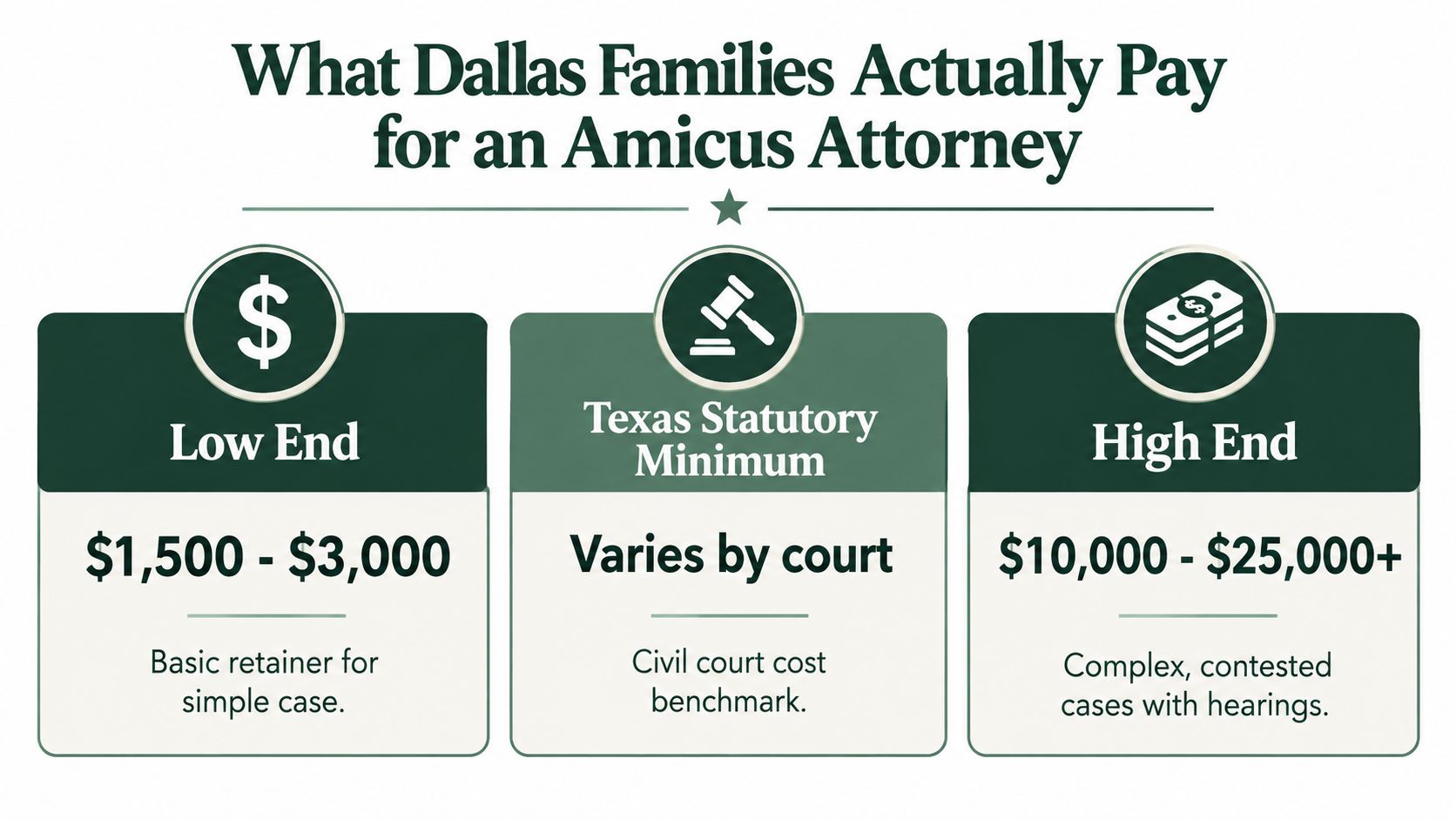
Dallas County's local paperwork gives families something more concrete than a vague warning that “fees may apply.” As noted earlier, county appointment-fee materials and clerk reporting show that appointment costs are tracked as part of the court file. Texas court-cost materials also include a specific $250.00 civil-court-cost reference for cases in which the attorney requests to participate. That figure is not the full amicus bill. It is better understood as one piece of the case's cost structure.
The clerk's local fee records also show real amicus payments at lower amounts in some cases. For example, the July 2025 approved fee details report reflects an Amicus Attorney appointment fee of $380.00 and another $920.00 amicus fee entry with billed hours recorded in the same report, as shown in the July 2025 approved fee details report.
Those figures help for one reason. They show that some appointments stay relatively contained.
At the other end of the range, a published Dallas-based appellate case shows how large an amicus award can become after heavy litigation. In one Fifth Court of Appeals opinion, the court records an amicus attorney fee award of $27,396.50, reflecting work the trial court found reasonable and necessary in a contested family dispute, as shown in the Fifth Court of Appeals opinion.
Why the range is so wide
An amicus fee works a lot like hiring any professional by the task rather than by a flat sticker price. If the amicus only reviews basic filings, attends a few hearings, and helps the court with a limited issue, the bill may stay closer to the lower examples in Dallas County records. If the amicus has to interview parents, speak with the child, review medical or school records, address emergency allegations, and testify or appear at multiple hearings, the total can rise fast.
Three common patterns explain the spread:
- Limited or volunteer-style situations: Some appointments involve little paid work, and a small group may qualify for special programs or limited-fee arrangements discussed earlier.
- Standard contested custody cases: These often involve an initial deposit and later billing for time spent.
- High-conflict cases: Allegations of abuse, repeated enforcement fights, relocation disputes, or long evidentiary hearings usually produce the biggest amicus bills.
If you are comparing court-appointed lawyer costs in different Dallas court settings, this guide to Dallas County heirship proceeding attorney ad litem cost shows why probate-style appointments and family-law appointments can produce very different fee patterns.
The practical takeaway for budgeting
Parents should budget for two stages. First comes the up-front amount ordered early in the case. Second comes the final total, which may end lower or much higher depending on what the amicus has to do.
So if you are trying to plan, use the local Dallas numbers as reference points, not promises. The clerk forms, fee reports, and the Fifth Court of Appeals example all point to the same practical truth. In Dallas County, amicus cost is real, documented, and highly dependent on the amount of conflict and investigation in your case.
Fee Waivers, Reallocation, and Who Really Pays
A lot of parents hear “court-appointed” and assume the county covers it. In most private Dallas family cases, that's not how this works.
The court can shift the burden between the parties
Texas law allows the court to consider ability to pay when setting amicus fees and costs. That means one party does not always pay half. In some cases, the judge may split the cost. In others, the judge may assign more of the cost to the higher-earning parent, or even all of it.
That issue can come up at the time of appointment or later if the financial picture changes.
A few common examples help:
- One parent has far more income: The court may require that parent to carry most or all of the deposit so the appointment can happen.
- Both parties have similar means: The court may divide the obligation more evenly.
- A parent shows genuine financial hardship: The court may revisit allocation rather than insisting on an unrealistic equal split.
What cannot happen
Texas law also says an amicus attorney may not be required to serve without reasonable compensation, and amicus-related costs, fees, or expenses cannot be awarded against the state, a state agency, or a political subdivision under Texas Family Code Section 107.024.
That rule matters in Dallas County because it answers a very practical question. If the parties are in a private family case, they should not assume Dallas County or another public entity will absorb the bill.
How parents ask for a different allocation
If the current payment structure is unrealistic, the usual path is to bring the issue back before the court with updated financial information. That may include a motion, a sworn financial statement, and supporting records showing income, expenses, and why the original split is no longer fair or feasible.
Reality check: Ignoring the fee order is usually the worst response. If the allocation is unworkable, ask the court to address it.
Parents already dealing with filing costs often find it useful to compare those obligations with other court expenses. This guide to the Dallas County District Clerk divorce filing fee schedule can help put the amicus expense in the broader context of family-court budgeting.
A point that surprises many Dallas parents
The judge's power over cost allocation is ongoing. If one party's conduct expands the amicus's work, or if new financial information comes to light, the court may revisit who should bear the burden before the case ends.
Alternatives, Common Mistakes, and Next Steps
An amicus appointment is not the only tool available in a Dallas custody case. Sometimes it is the right tool. Sometimes another process, or a combination of processes, addresses the underlying problem more efficiently.
Alternatives that may fit some families better
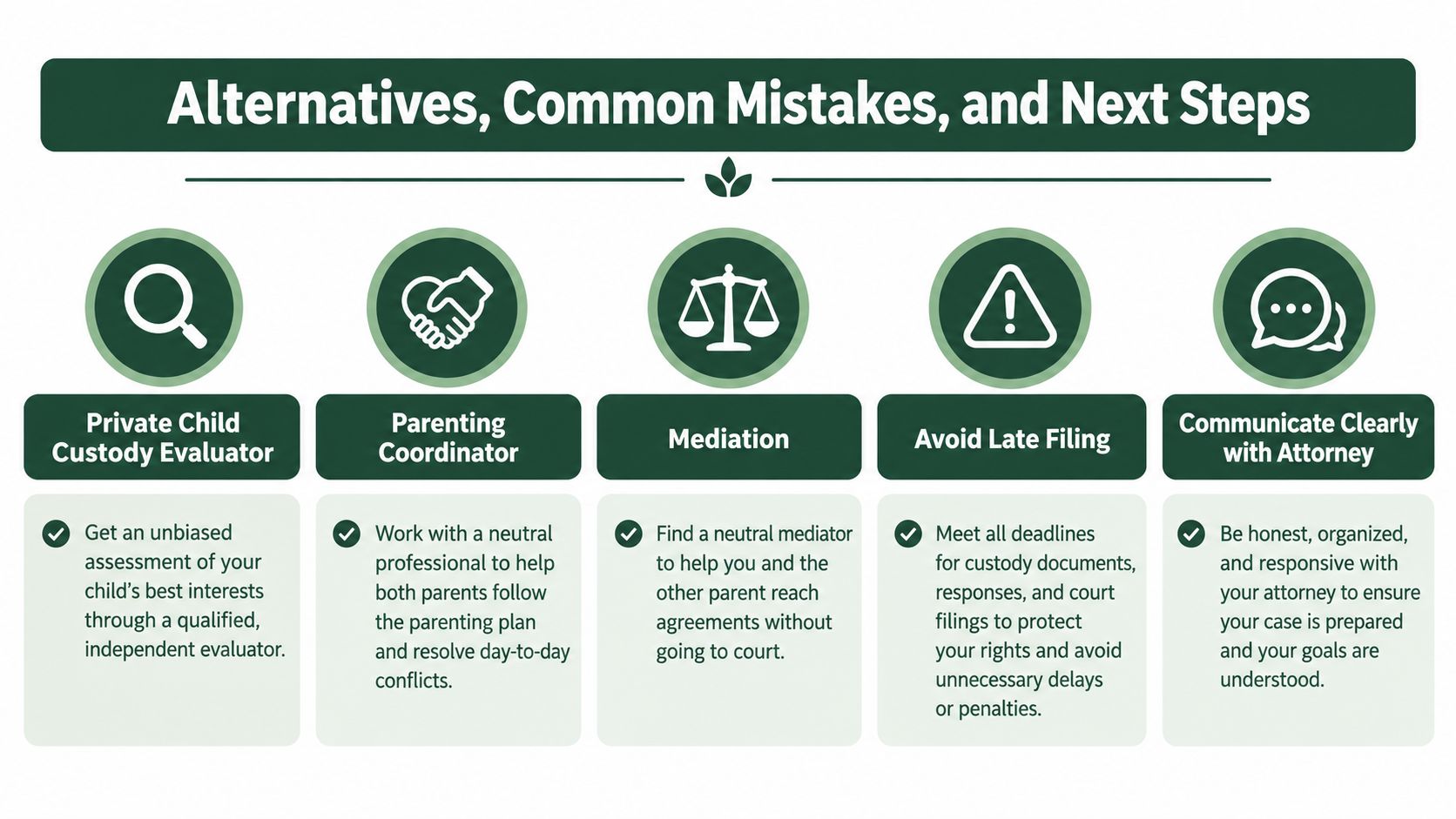
A court or the parties may consider other options depending on the dispute:
- Private child custody evaluator: Useful when the case needs a deeper investigation into parenting, household dynamics, or child functioning.
- Parenting coordinator: Sometimes helpful when the order exists but the parents keep colliding over day-to-day implementation.
- Mediation: Often valuable when the problem is communication and mistrust, not lack of information.
- Attorney ad litem: In some cases, the legal need is different from an amicus role.
Mistakes that make amicus situations harder
Parents usually get into trouble in one of three ways.
First, they treat the amicus like an enemy and stop cooperating. Second, they ignore financial orders because they assume the court will sort it out later. Third, they fail to update the court when their income or living situation changes and then act surprised when the original allocation still controls.
Those mistakes can spill into bigger family-law problems, especially in modification, enforcement, relocation, or protective-order disputes where credibility matters.
A practical Dallas checklist
If an amicus has been appointed, or one is being requested, take these steps:
- Confirm the docket: Check with the Dallas County District Clerk and make sure you have the correct signed order.
- Gather financial records: Income information, expense records, and anything showing ability or inability to pay may matter.
- Read the appointment order closely: Focus on the scope of the appointment and any deposit requirement.
- Respond promptly to amicus requests: Delays often look worse than parents think.
- Bring questions to counsel early: Cost allocation disputes are easier to address before they turn into compliance problems.
Keep a copy of the appointment order with your hearing materials. Many parents remember the argument in court but not the exact wording of the order that controls them afterward.
For Dallas parents, local detail matters here. A case in the Dallas County Family District Courts can move quickly on interim issues, and confusion about what the amicus was authorized to do often creates unnecessary conflict. If your case involves children, money, and a contested court process all at once, getting case-specific legal advice early usually costs less than cleaning up misunderstandings later.
If you want an individualized estimate of what an amicus appointment may mean in your divorce, custody, modification, or other Dallas County family case, gather your orders, recent pleadings, and financial information before speaking with a local family-law attorney.
If you're dealing with a custody case in Dallas County and an amicus attorney has been appointed or requested, The Law Office of Bryan Fagan, PLLC can help you understand the order, the likely cost issues, and the next procedural steps in your case. The firm handles Dallas family-law matters involving custody, divorce, modifications, enforcement, and related court disputes, and you can learn more or request a consultation through The Law Office of Bryan Fagan, PLLC.
