 Skip to content
A trial date is approaching in your Dallas County divorce, custody, support, enforcement, or modification case. You want a jury, but the paperwork raises two immediate questions: Is the deadline 30 days or 14 days before trial, and which fee should you pay at the clerk's window?
The safest practical answer is to act as though the earlier deadline controls. Dallas County materials use a 30-day benchmark for requesting a jury and paying the fee, while Texas Rule of Civil Procedure 216 contains a separate 14-day deadline in the circumstances described by the rule. The written demand and the required fee, or a properly filed Statement of Inability to Afford Payment of Court Costs, should be handled well before trial.
Table of Contents
- Why This Question Matters for Dallas County Families
- The Deadline Rules and What They Actually Mean
- What a Proper Jury Demand Looks Like
- Where and How to File in Dallas County
- The Fee, the Statement of Inability, and Which Number Applies
- What Happens If You File Late or Get the Fee Wrong
- Your Next Step Before the Trial Date
Why This Question Matters for Dallas County Families
A parent in a Dallas County SAPCR case receives a final trial setting while still gathering school records, messages, and financial documents. The parent wants a jury, but the case already has a crowded schedule of temporary orders, discovery, mediation, and pretrial work. The jury request cannot be treated as another item to handle at the courthouse on trial day.
The paperwork is a case-preservation step. A demand must be written, filed in the correct case, served on the other parties, and paired with the applicable jury fee or a valid filing concerning inability to pay court costs. The specific deadline and payment amount require separate checking against the current trial setting, court orders, and Dallas County clerk instructions. The statewide family-law guidance cited in this article describes the basic jury-demand process, including the written request and fee requirement. See TexasLawHelp's explanation of family-law juries.
Why the setting matters
Family cases may involve divorce property division, child custody, child support, possession and visitation, enforcement, relocation, paternity, protective orders, or modifications. A case can remain factually unfinished even though the court has assigned a final setting. That is why waiting for every discovery dispute or settlement discussion to end can leave too little time to preserve the jury request.
A properly filed demand keeps the jury issue in the case. Without one, the matter ordinarily proceeds before a judge rather than a jury. That choice can affect how disputed custody facts, property characterization, reimbursement claims, or support issues are presented and decided.
Treat the demand like reserving a place on the trial calendar. Confirm the setting, prepare the filing, check the fee or inability-to-pay paperwork, serve the other parties, and file before the earliest applicable deadline.
Two errors often appear together. A litigant may submit the demand after the usable filing window, or may file it without the required payment or a valid Statement of Inability to Afford Payment of Court Costs. Either defect can support a waiver argument, even when the underlying custody or property dispute remains substantial.
The Deadline Rules and What They Actually Mean
The timing language causes confusion because readers often compare different versions of Texas rules, court forms, and local guidance. Texas Rule of Civil Procedure 216 addresses a written jury demand made a reasonable time before trial and states that, in the rule's operative setting, the demand must be made no later than 14 days before trial. The rule also allows a late demand to be excused only when the judge finds good cause. The Texas Rules of Civil Procedure should be checked with the current trial order and local clerk instructions.
Dallas County's own self-help material takes a more conservative approach. It tells family-court users to request the jury and pay the jury fee at least 30 days before trial. That local benchmark gives a litigant more protection than waiting for the outer edge of the statewide rule.
Comparing the timing concepts
| Rule or source | What it says | Practical Dallas effect | Safe-harbor target |
|---|---|---|---|
| Texas Rule of Civil Procedure 216 | A written demand must be filed a reasonable time before trial, with the rule identifying a 14-day deadline in the applicable setting. | Waiting until the final window creates a waiver dispute if the filing, service, payment, or docket posture is questioned. | File earlier than the minimum whenever possible. |
| Texas family-law guidance | A family-case demand is described as due at least 30 days before the final trial date. | This is the conservative planning point for divorce, SAPCR, modification, and enforcement cases. | Treat 30 days as the working deadline. |
| Dallas County self-help materials | Request the jury and pay the fee at least 30 days before trial. | Local users should follow the county's earlier instruction rather than rely on the last possible day. | File at or before the 30-day benchmark. |
| Trial-setting and pretrial orders | The court's specific orders may control the preparation process and require earlier action. | A later order or changed setting can create a new date to review, but it doesn't automatically cure a missed demand. | Read every setting and pretrial order immediately. |
“Reasonable time” isn't a dependable invitation to wait. It means the demand should be filed early enough for the court and opposing parties to know that the case will be tried to a jury, not raised as a last-minute surprise.
A continuance also deserves careful attention. A new trial date may change the calculation, but you shouldn't assume that a reset automatically restores a waived jury right. Review the continuance order, any pretrial order, and the docket, then confirm the demand and fee posture with the clerk and the court's procedures.
The safest Dallas County approach is simple: use the 30-day benchmark as the target, and never allow the filing to drift inside the 14-day Rule 216 deadline without legal guidance.
What a Proper Jury Demand Looks Like
A jury demand should look like a formal filing in the existing family case, not a letter to the judge. Use the same cause number, court designation, and party names that appear on the petition, answer, counterpetition, or latest court order.
For a divorce, the style may use “In the Matter of the Marriage of.” For a custody or parent-child case, it may use “In the Interest of.” The court number belongs in the caption. Place the title “Demand for Jury Trial” directly beneath the caption.
The filing should identify the issues
The body should state that the party demands a jury trial on all issues that are triable by right, or identify the specific issues if the request is limited. In a family case, the issues may involve divorce-related property disputes, characterization or tracing, reimbursement claims, conservatorship, possession, child support, or other matters the law permits a jury to decide. A jury doesn't decide every judicial function in a family case, so the wording should fit the pleadings and requested relief.
Adaptable language might read:
Demand: Respondent demands a trial by jury on all issues triable by right in this cause and requests that the demand be noted on the docket. Respondent tenders the applicable jury fee or files a Statement of Inability to Afford Payment of Court Costs.
The signature block should identify the party or attorney, include the mailing address, telephone number, email address, and any required attorney identification information. An attorney should include the bar number. A self-represented litigant should sign the filing personally.
A short certificate of service can state:
I certify that a true and correct copy of this Demand for Jury Trial was served on all other parties or their counsel of record in accordance with the Texas Rules of Civil Procedure on [date].
[Signature]
Filing details can affect acceptance
Use the formatting required by applicable Dallas County local rules and clerk instructions, including the required 2-inch top margin on the first page when that local requirement applies. Serve every other party and preserve proof of service just as you would for a post-answer motion.
Before filing, check the caption, cause number, court, signature, service language, and jury request. A technically neat document filed in the wrong case number won't preserve the right in the correct proceeding.
Where and How to File in Dallas County
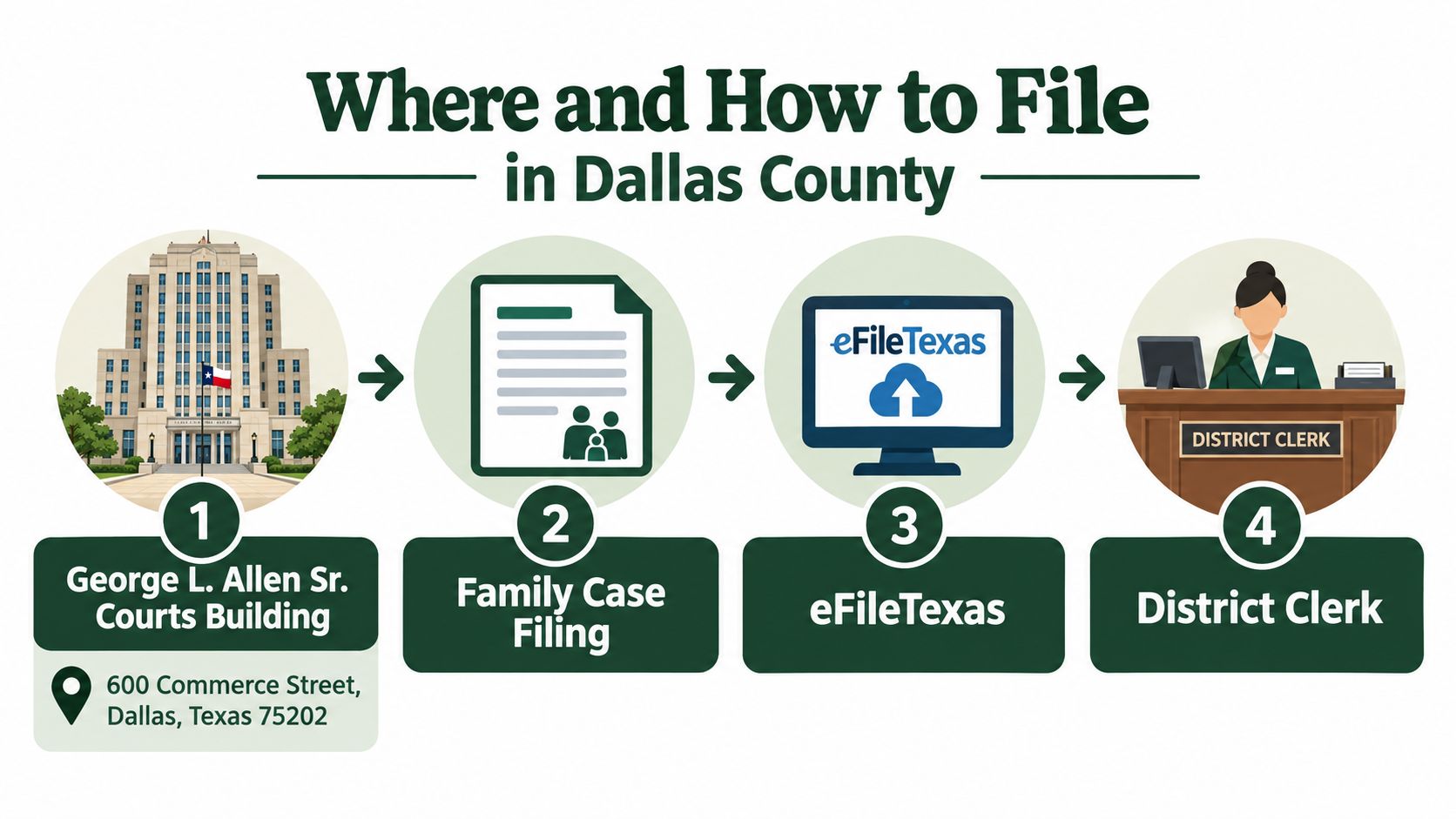
Dallas County family-case filings are handled through the Dallas County District Clerk. The George L. Allen, Sr. Courts Building is located at 600 Commerce Street, Dallas, Texas 75202. Confirm current counter procedures before traveling, because filing channels, hours, and payment instructions can change.
Attorneys generally use eFileTexas for electronic filing. A self-represented litigant may use the available electronic process, file at the clerk's counter, or use an accepted mail method. The demand must be submitted under the same cause number and court as the divorce, SAPCR, modification, enforcement, or other family case.
A practical filing sequence
- Confirm the case record. Review the latest docket and trial-setting order. Verify the cause number, court, parties, and trial date.
- Prepare the demand. Use the existing caption, title the document clearly, state the jury request, sign it, and include service information.
- Handle the fee or inability filing. Pay the applicable amount through the clerk's approved method, or file a sworn Statement of Inability to Afford Payment of Court Costs.
- Preserve proof. Obtain a file-stamped copy, confirmation of electronic filing, or conformed copy, and save the payment receipt or accepted inability-to-pay filing.
Dallas County's self-help information identifies a $22 jury fee unless a party files a Statement of Inability to Afford Payment of Court Costs, while other Texas family-law materials identify different family-case fee amounts. That conflict is why you should verify the amount for your particular case and filing venue before submitting payment. The Dallas County family court coordinator resource can help explain related setting and coordination questions, but it isn't a substitute for confirming the clerk's current fee instructions.
For in-person filings, ask whether the clerk has accepted both the demand and fee record. For electronic filing, confirm that the filing was accepted rather than merely submitted. A rejected envelope may not preserve a deadline.
The Fee, the Statement of Inability, and Which Number Applies
A Dallas County filer may see $5, $10, $22, or $84 and reasonably assume one of those numbers is the answer. They refer to different charges, courts, or stages of the jury process. The number printed on a general family-law handout may not be the amount the District Clerk requests for your particular case.
Older Texas family-law guidance describes a $10 district-court fee and a $5 county-court fee for a jury demand, unless the party files a hardship statement. Other Texas civil-procedure materials and Dallas County self-help information refer to a $22 jury fee. The Dallas County jury-demand form also references an $84 impaneling amount in certain local civil settings. That later charge is different from the fee connected with the initial written demand.
Match the number to the charge
| Fee amount | What it describes | When it may be paid | What to verify |
|---|---|---|---|
| $10 | Texas family-law guidance for district-court matters | With the demand | Whether current Dallas County instructions use it for your case |
| $5 | Texas family-law guidance for county-court matters | With the demand | The assigned court and current fee schedule |
| $22 | Texas civil-procedure materials and Dallas County self-help references | At the demand stage in the settings covered by those materials | Whether it applies to your family case |
| $84 | Dallas County materials referring to jury impaneling | Later, when the jury is impaneled in covered settings | Whether it is a later charge rather than the initial demand fee |
The practical answer is to confirm the amount with the Dallas County District Clerk before paying. The Dallas County District Clerk divorce filing fee schedule may clarify related filing charges, but it does not replace case-specific confirmation of the jury-demand amount. Ask which figure applies to your cause number, court, and filing stage.
The inability-to-pay option
A properly completed and filed Statement of Inability to Afford Payment of Court Costs can substitute for the required fee. It does not extend the jury-demand deadline. Treat the demand and the statement like two pieces that must arrive together: both need to be filed within the required period, and the opposing party may have procedural rights to contest the statement.
Do not rely on an online form meant for another court or another type of jury charge. Ask whether the quoted amount covers the initial demand, later impaneling, or a separate filing category. Keep the clerk's response, payment receipt, accepted statement, and file-stamped documents with your case records.
What Happens If You File Late or Get the Fee Wrong
A late or defective filing can lead to waiver of the jury right. Under Texas Rule of Civil Procedure 216, a demand that misses the applicable deadline may be excused only if the judge finds good cause. A late fee can create a separate problem, even when the written demand was filed on time.
Good cause isn't automatic. The court may consider the litigant's diligence, whether the delay caused surprise, the history of continuances or resets, and whether allowing the late demand would disrupt the trial process. A verified motion with a supporting affidavit may be necessary, but filing that request doesn't guarantee that the judge will excuse the delay.
Common filing failures
- Wrong payment: The litigant pays only one amount, pays a charge intended for a different court, or doesn't confirm whether the fee was accepted.
- Wrong case: The demand is filed under a different cause number, court, or related proceeding.
- Missing jury language: The document is labeled generally as a motion or notice but doesn't clearly demand a jury trial.
- Incomplete service: The opposing party or counsel isn't served, or the filing lacks proof of service.
- Assuming a reset fixes everything: A new trial date doesn't necessarily restore a waived right or eliminate the need to review the demand.
If the trial date moves, obtain the new order and recalculate immediately. Review the Dallas County reset and continuance information for family cases and confirm the demand's status rather than relying on an assumption that the original filing remains sufficient.
If you discover a problem, act promptly. Gather the rejected filing notice, receipt, docket history, trial-setting orders, and communications showing what happened. Those records help a lawyer evaluate whether a correction, renewed demand, or good-cause motion is procedurally available.
Your Next Step Before the Trial Date
Use this checklist today:
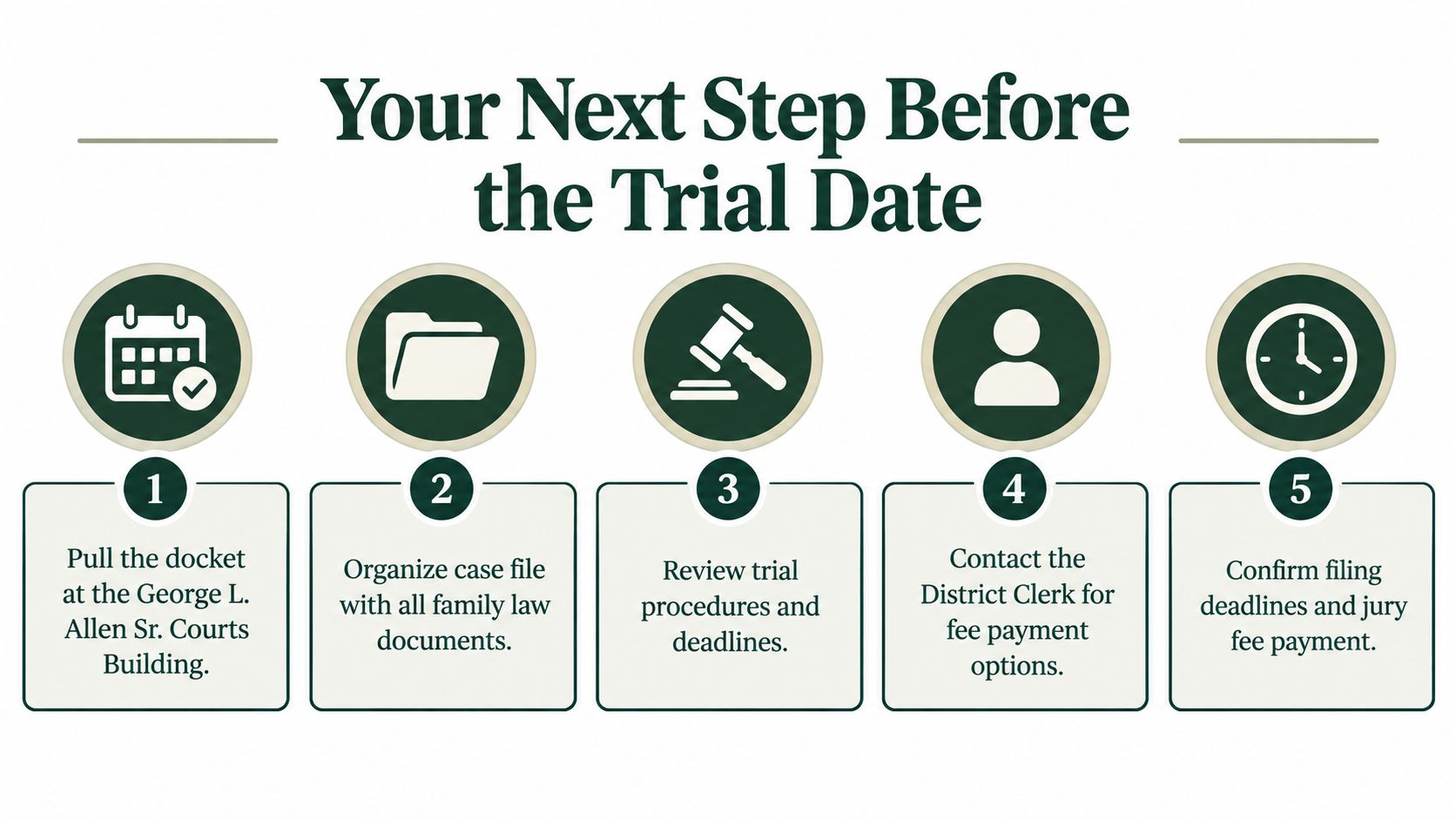
- Pull the docket. Review the record through the Texas Judicial Branch portal or at the George L. Allen, Sr. Courts Building. Confirm the current trial setting and court.
- Calendar both dates. Mark the conservative 30-day Dallas County benchmark and the 14-day Rule 216 deadline from the applicable trial setting. Treat the earlier practical date as your filing target.
- Prepare the document. Build the caption from the existing case, title the filing Demand for Jury Trial, include the operative request, sign it, and prepare proof of service.
- Verify the payment. Ask the Dallas County District Clerk which fee applies to your court and case. If you can't afford the fee, prepare a sworn Statement of Inability to Afford Payment of Court Costs instead.
- Preserve acceptance. Obtain a file-stamped copy, electronic acceptance, payment receipt, and proof that every party was served.
For current counter hours, payment methods, and filing instructions, contact the Dallas County District Clerk directly or visit the clerk's public counter. The Dallas County Law Library self-help desk may provide general legal-information resources, while a family-law consultation can help evaluate whether a jury is appropriate for the specific custody, support, property, or enforcement issues in dispute.
The demand and fee, or the inability-to-pay filing, must reach the clerk before the applicable deadline, not on the trial date. If you want help checking the Dallas County setting, preparing the paperwork, and confirming the fee, request a jury-demand packet before filing.
The Law Office of Bryan Fagan, PLLC offers Dallas family-law consultations and can help self-represented parties evaluate jury-demand timing, fee questions, and trial preparation in divorce, custody, support, enforcement, and property cases. Visit The Law Office of Bryan Fagan, PLLC to request help from the firm's Dallas office before a filing deadline passes.
