 Skip to content
You may be staring at a Dallas County family hearing date right now and realizing one ugly fact. You can't safely walk into court if you won't fully understand what's being said, or if the judge won't fully understand you.
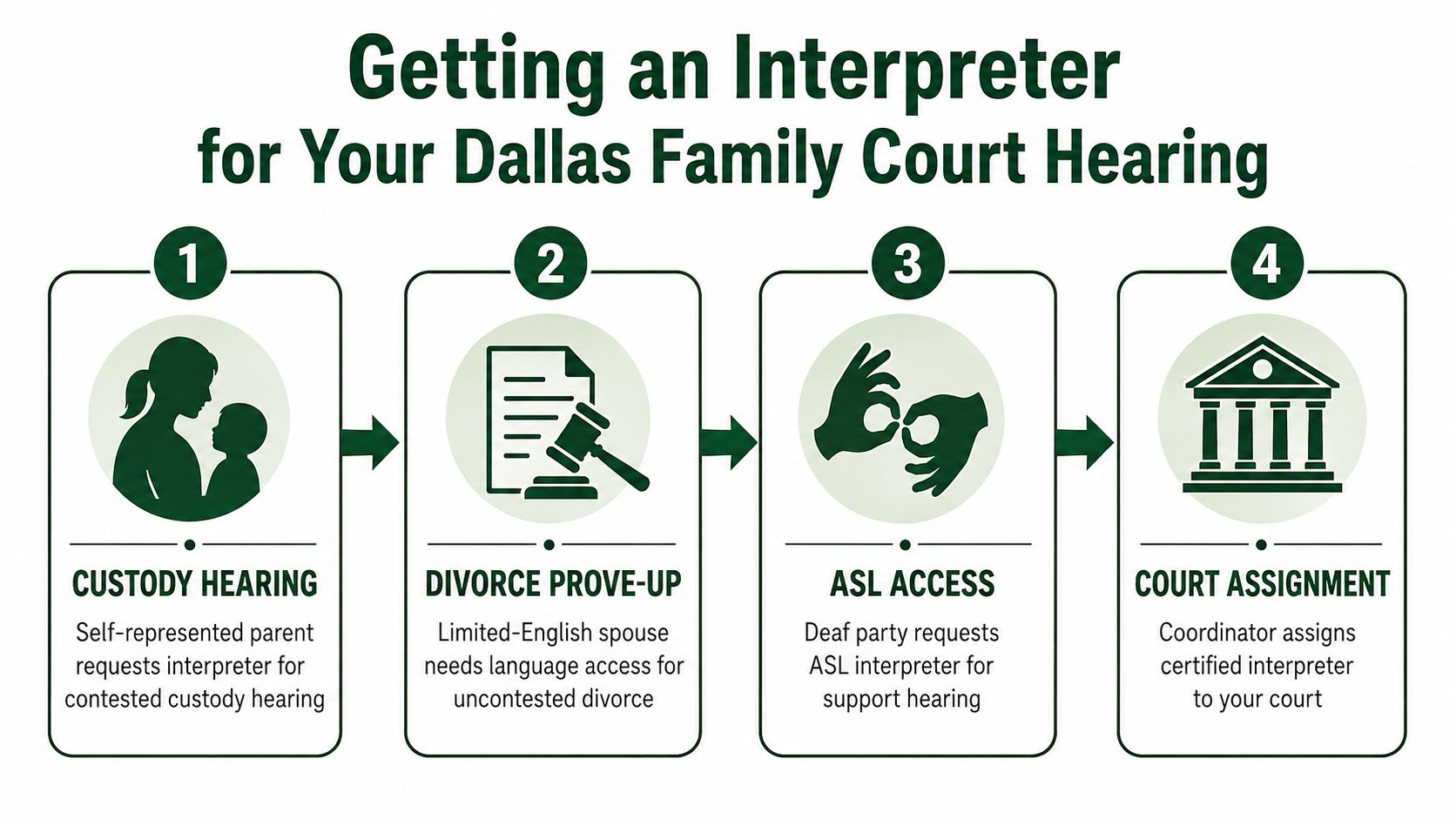
That comes up in real family cases every day. A parent has a contested custody hearing at the George L. Allen, Sr. Courts Building. A spouse needs an interpreter for an uncontested divorce prove-up. A party in a protective-order matter needs ASL or CART to follow the hearing. If that's your situation, act early. Don't assume the court will handle it for you.
A Dallas County interpreter request for a family court hearing usually starts with a written request to the assigned court coordinator, not with a casual statement at the clerk's counter on hearing day. You need your case number, the court number, the hearing date, and the exact language or accommodation you need. Then you need to send the request early enough for that court's notice rules.
Table of Contents
- Getting an Interpreter for Your Dallas Family Court Hearing
- Your Right to a Court Interpreter Under Texas Law
- Where and How to File the Interpreter Request
- Deadlines and Notice Rules in Dallas County
- Who Pays for the Interpreter and How Costs Are Handled
- Sample Request Language and Common Mistakes to Avoid
- What to Do If Your Request Is Denied or Delayed
Getting an Interpreter for Your Dallas Family Court Hearing
Texas does give you a real path to language access in family court. If you need an interpreter for a divorce, custody case, child support hearing, modification, enforcement action, temporary orders hearing, paternity case, or protective-order matter in Dallas County, the process is available. But it's not automatic, and that's where people get burned.
Most self-represented parties wait too long. They think the judge will see the issue and solve it at the hearing. That's a mistake. You drive the timeline. Once the hearing is set, you should treat interpreter arrangements as part of your hearing prep, just like service, exhibits, and notice.
Start with the coordinator, not guesswork
In Dallas County family court, the practical first move is usually simple. Find the assigned court coordinator for your court and send a written request that identifies:
- Your case number
- The exact court handling the case
- The hearing date and time
- The hearing type
- The language or accommodation needed
If your case was transferred between family courts, double-check that you're contacting the current court, not the one that handled an earlier setting.
Practical rule: If you're waiting until the week of the hearing to ask for an interpreter, you're already late unless your court says otherwise.
What you need to handle first
Before you send anything, gather the basics:
- Court assignment: Make sure you know whether your case is in a Family District Court, an associate court, or another assigned docket.
- Case style: Use the exact case style from your paperwork, such as a divorce, SAPCR, modification, or enforcement case.
- Hearing posture: Contested and uncontested settings are often handled differently.
- Format: Confirm whether the hearing is in person, by Zoom, or by telephone.
That's the difference between a request that gets scheduled and one that sits in somebody's inbox.
Your Right to a Court Interpreter Under Texas Law
Texas law is stronger on this issue than many people realize. In civil cases, including family-law cases, Texas Government Code section 57.002 says a court must appoint a licensed court interpreter for a person who can hear but does not comprehend or communicate in English when a party files a motion for appointment in a civil proceeding. The statute also addresses certain hearing-impaired individuals and certified CART providers when needed under Texas Government Code section 57.002.
That matters in Dallas divorces, custody suits, support cases, modifications, enforcement cases, CPS matters, and family-law appeals. Interpreter access in those cases is not a favor from the court. It is part of court procedure when the proper request is made.
What Chapter 57 means in a Dallas family case
Texas court guidance also makes clear that licensed court interpreters can be appointed in civil matters on a party's motion or at a witness's request, and that this applies in counties with populations of 50,000 or more, which includes Dallas County, according to the Texas courts interpreter FAQ.
In plain English, that means:
| Case Type | Statute | Who's Entitled | Who Pays |
|---|---|---|---|
| Civil family case | Texas Government Code Chapter 57 and section 57.002 | A party who can hear but does not comprehend or communicate in English, when a motion is filed; also witnesses in the settings covered by Texas court guidance | Cost handling can vary by court and party status |
| Civil family case involving hearing-related accommodation | Texas Government Code section 57.002 | Certain hearing-impaired individuals and a certified CART provider when needed | Cost handling follows the court's appointment process |
| Criminal case | Texas court guidance recognizes interpreter appointment in criminal matters | Parties and witnesses under the applicable criminal procedure framework | This article focuses on family court, where Dallas practice questions are different |
The right exists, but the court still needs usable information
A coordinator can't schedule an interpreter from a vague email that says, “I need help in court.” Give the court enough to act on the request.
Full case number and exact case style
The coordinator uses this to find the case on the docket and make sure the request matches the right file.Assigned court
In Dallas County, you need the specific court handling the hearing. If your matter moved from one court to another, confirm the current assignment before you send anything.Hearing date, time, and type
Temporary orders, final prove-up, enforcement, status conference, custody trial setting, and CPS dockets don't all work the same way. The hearing type affects scheduling.Language or accommodation needed
Be exact. If you need Spanish, say Spanish. If you need ASL or CART, say that. If a dialect issue matters, include it.Your role in the case
Tell the court whether the person needing the interpreter is the petitioner, respondent, witness, or another participant whose role the court needs to know.How the hearing will be held
State whether the setting is in person, by Zoom, or by telephone. That affects whether remote interpretation is even realistic.
The court can't fix what you don't clearly identify. Most delays happen because the request is incomplete, not because the law is unclear.
Deaf and hard-of-hearing parties need to be specific too
If you are deaf or hard of hearing, don't let the request get reduced to “needs assistance.” Ask for the communication method you use. If that is ASL, say so. If CART is the better fit, say that.
Family members are not a substitute for a qualified court interpreter. In a family-law hearing about child custody, possession, child support, property division, or enforcement, the communication needs to be reliable enough for testimony, objections, and judicial findings. That's especially true when the hearing affects final orders.
Where and How to File the Interpreter Request
Dallas County practice is messier than most online guides admit. There isn't one single path that fits every family court. There are four realistic channels, and each one fits a different situation.
The best first path for most family hearings
The usual starting point is the assigned court coordinator. Dallas County civil court guidance tells litigants to contact the court coordinator assigned to the case for translation and interpreter services, and Dallas County family court policies also route requests through the coordinator process under the court's local procedures in the Dallas County family court policies.
That makes coordinator contact the practical default for most divorce, custody, support, modification, and enforcement hearings.
| Channel | Best For | Typical Turnaround | Cost to Party | Key Limit |
|---|---|---|---|---|
| Court coordinator email or call | Most scheduled family hearings | Depends on the court and notice given | May vary by court and party status | You must contact the correct court |
| In-person clerk contact | Basic filing support or direction | Varies | Filing issues may apply depending on what you submit | The clerk usually is not the person who schedules the interpreter |
| Written motion filed with the court | When you need a formal ruling or the coordinator route stalls | Slower than a simple coordinator email | May involve filing-related costs depending on the filing method | You still need the judge or court to act |
| Texas Court Remote Interpreter Service through the coordinator | Short, non-contested, non-evidentiary matters in certain languages | Depends on availability and scheduling | The state service may be available without the same local cost issues in the qualifying setting | Not every hearing qualifies |
When a formal motion makes more sense
If your hearing is already on a docket and you need a ruling, or if the coordinator hasn't responded, file a written motion. That creates a record. In family law, records matter. They matter in protective orders, in enforcement cases, and in appeals to the Fifth Court of Appeals.
If you need help understanding who handles hearing settings and coordinator contact for your specific court, this guide on Dallas County family court coordinator hearing procedures is a useful companion.
Remote service is an option, not a shortcut
For the right hearing, ask the coordinator whether the court can use the Texas Court Remote Interpreter Service. Don't ask for it as if you can book it yourself through a consumer app. The coordinator still controls the court-side process.
Deadlines and Notice Rules in Dallas County
Eligibility is only half the issue. Timing is the other half.
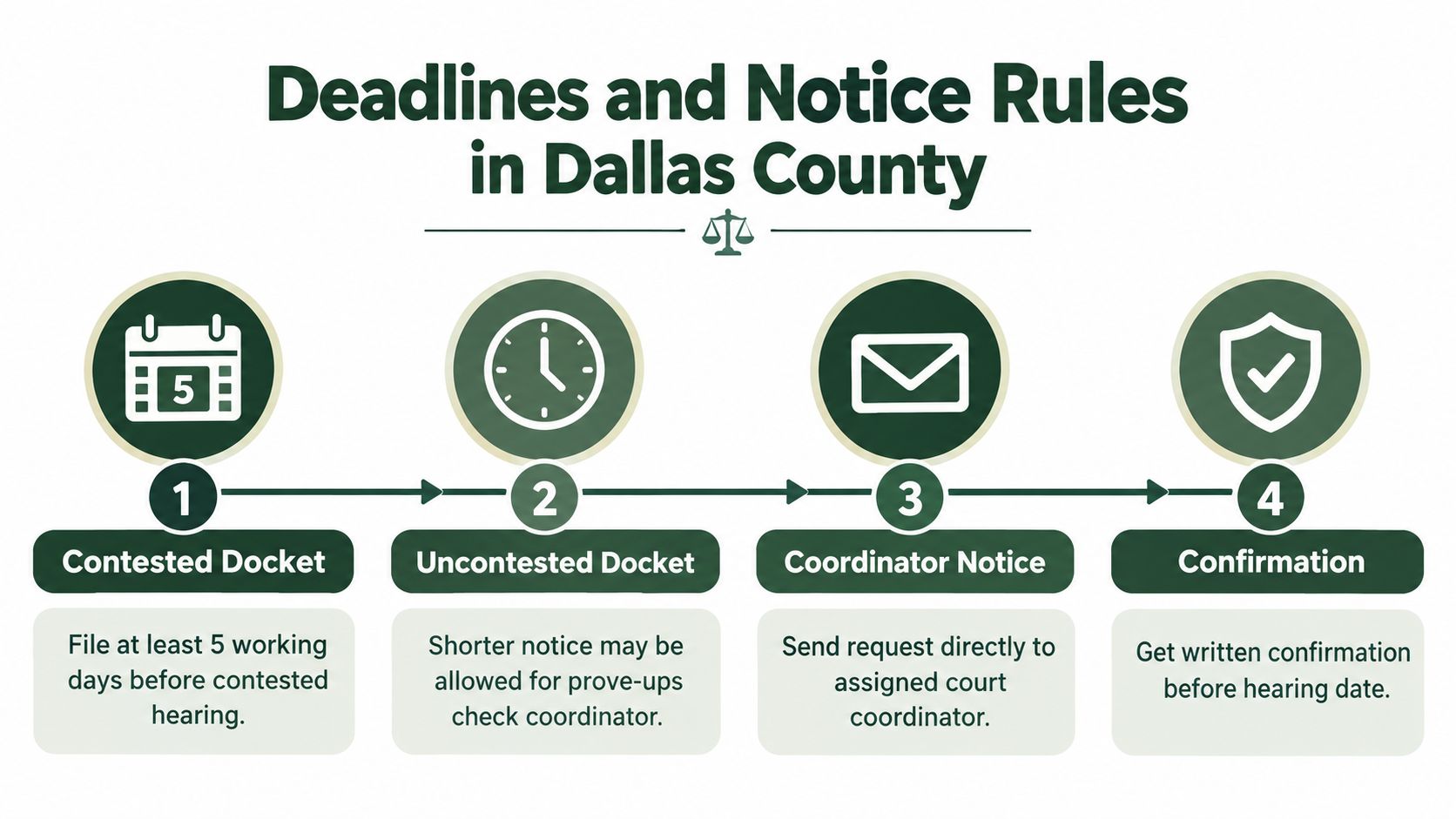
Dallas County family-court procedures are not uniform, but at least one family district court policy requires an interpreter request by email to the coordinator at least 5 working days before a contested hearing for indigent parties, and an updated policy for uncontested hearings requires at least 7 working days' notice. The same policies require cancellation 24 hours before the hearing, and failure to cancel can lead to interpreter fees being assessed to one or both parties under the Dallas County interpreter request policy.
The deadlines that actually matter
Treat the coordinator's receipt date as the key date. Not when you drafted the email. Not when you meant to send it. When the court got it.
- Contested family hearings: Some Dallas County policy materials require at least 5 working days notice.
- Uncontested family settings: Some updated local policy materials require at least 7 working days notice.
- Cancellations: Some courts require cancellation at least 24 hours before the hearing.
What happens if you miss the deadline
If you ask late, the court may not have an interpreter ready. Then you may be forced to request a continuance instead of moving forward.
Get written confirmation from the coordinator before the hearing. Silence is not confirmation.
If your hearing resets, settled cases and canceled prove-ups still need a cancellation notice. Otherwise, you can create a fee problem for yourself.
Who Pays for the Interpreter and How Costs Are Handled
This is the part most generic guides dodge. In Dallas County family court, cost is not handled the same way in every courtroom.
One major gap between general Texas guidance and Dallas County practice is that local court pages are not uniform. Some materials suggest the usual “request it about a week ahead” approach, but that doesn't answer who pays, whether the request is free, or whether a court-specific rule requires a deposit. That local inconsistency shows up in the Dallas County family court procedures materials.
Represented parties may be required to pay
In the 302nd District Court's docket control order, if a litigant is represented by counsel and requests an interpreter, the interpreter cost will be charged as court costs against the requesting party, and the litigant must deposit the appropriate fee payable to Dallas County before the hearing under the 302nd District Court docket control order.
That should get your attention if your case involves lawyers on both sides, a contested divorce, a business-owner property dispute, a custody modification, or a support enforcement hearing. Don't assume “the court pays” just because this is family court.
Indigent parties and practical cost questions
Texas self-help guidance for family-court litigants says you should notify the coordinator or administrator at least one week before the hearing, that best practice is to request the interpreter when setting the case for final hearing, and that a motion for a language interpreter should be filed, set for hearing, and served on the other side according to TexasLawHelp family court guidance.
If you are self-represented and cannot afford costs, raise that issue early and in writing. Don't wait until you're standing in the courtroom. The court needs enough notice to sort out both scheduling and cost handling.
Remote, in-person, and hearing-related accommodations are not interchangeable
The Texas Court Remote Interpreter Service adds an important option. The state service shows that Spanish, French, Portuguese, and German interpretation can be provided by state-licensed court interpreters for non-contested, non-evidentiary matters of about 30 minutes or less, by phone or video, when scheduled in advance or on demand if available under the Texas Court Remote Interpreter Service.
That does not mean every family hearing should be remote. A final prove-up might fit. A brief status setting might fit. A hotly disputed temporary-orders hearing with testimony and exhibits usually calls for more planning.
| Mode | Languages/Tools | Typical Lead Time | Best Suited For |
|---|---|---|---|
| In-person licensed court interpreter | Spoken-language interpretation arranged by the court | Earlier is better because local scheduling varies | Contested hearings, testimony-heavy matters, longer settings |
| Remote state interpreter service | Spanish, French, Portuguese, and German by phone or video in qualifying settings | Advance scheduling is best, though on-demand may be available if available | Non-contested, non-evidentiary matters of about 30 minutes or less |
| ASL interpreter or CART | Sign-language interpretation or real-time transcription accommodation | Usually needs more planning because the court must arrange the provider | Deaf or hard-of-hearing parties and witnesses who need effective communication |
If you're also budgeting for the rest of your case, including filing and post-filing expenses, this page on the Dallas County District Clerk divorce fee schedule helps place interpreter cost questions in the bigger picture.
If cost matters in your case, ask two direct questions in writing. “Will I need to deposit funds before the hearing?” and “Will interpreter fees be taxed as court costs?”
Sample Request Language and Common Mistakes to Avoid
Most delays come from bad requests, not hard cases. Keep the first email short and complete.
A simple email to the court coordinator
Subject: Interpreter Request for Family Hearing in Cause No. [case number]
Dear Court Coordinator,
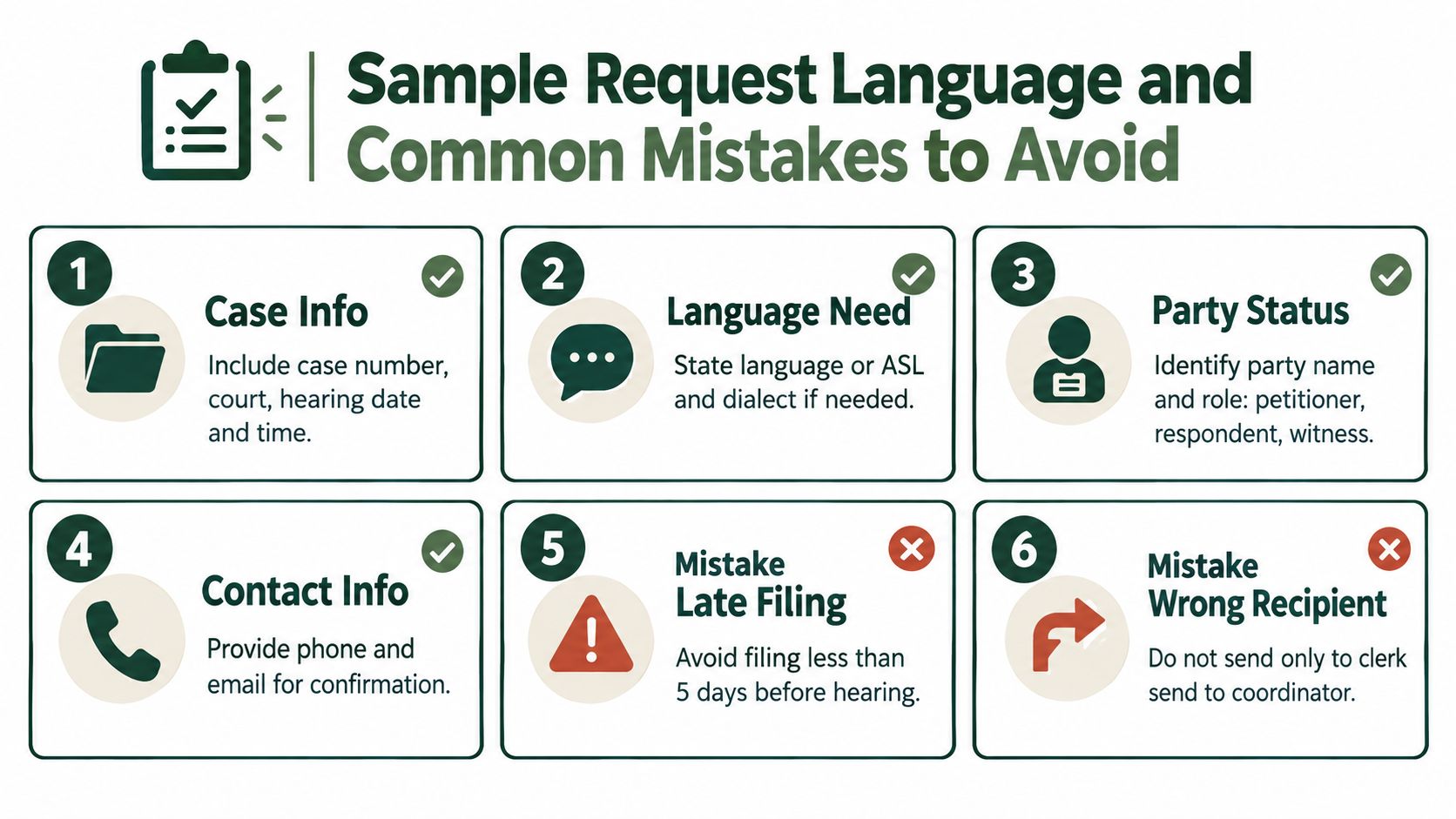
I am requesting a court interpreter for the hearing in Cause No. [case number], [full case style], pending in the [court name and number]. The hearing is set for [date] at [time]. The person needing the interpreter is [name], the [petitioner/respondent/witness]. The language or accommodation needed is [language, dialect, ASL, or CART]. My understanding is that the hearing will be held [in person/by Zoom/by telephone].
Please confirm whether the request has been received and whether any additional motion, deposit, or paperwork is required.
Thank you,
[Your name]
[Your phone number]
[Your email]
A fuller motion when you need a formal court record
Title it Motion for Appointment of Court-Certified Interpreter. Include the case caption, identify the hearing date, state the language or accommodation needed, explain who needs it, request appointment of a qualified interpreter, add a certificate of service, and submit a proposed order.
If you need starter materials for self-represented filing, this guide to Dallas County pro se family law forms can help you organize the paperwork.
Mistakes that keep getting people in trouble
- Late request: Sending it too close to the hearing.
- Missing language detail: “Interpreter needed” is too vague.
- No case number: The court can't place the request.
- Wrong recipient: Sending it only to the clerk instead of the assigned coordinator.
- No format detail: Failing to say whether the hearing is in person or remote.
- No cancellation: Forgetting to withdraw the request after a reset or settlement.
What to Do If Your Request Is Denied or Delayed
Do not just show up and try to “work it out” in the hallway. If the interpreter wasn't provided, you need to make a record.
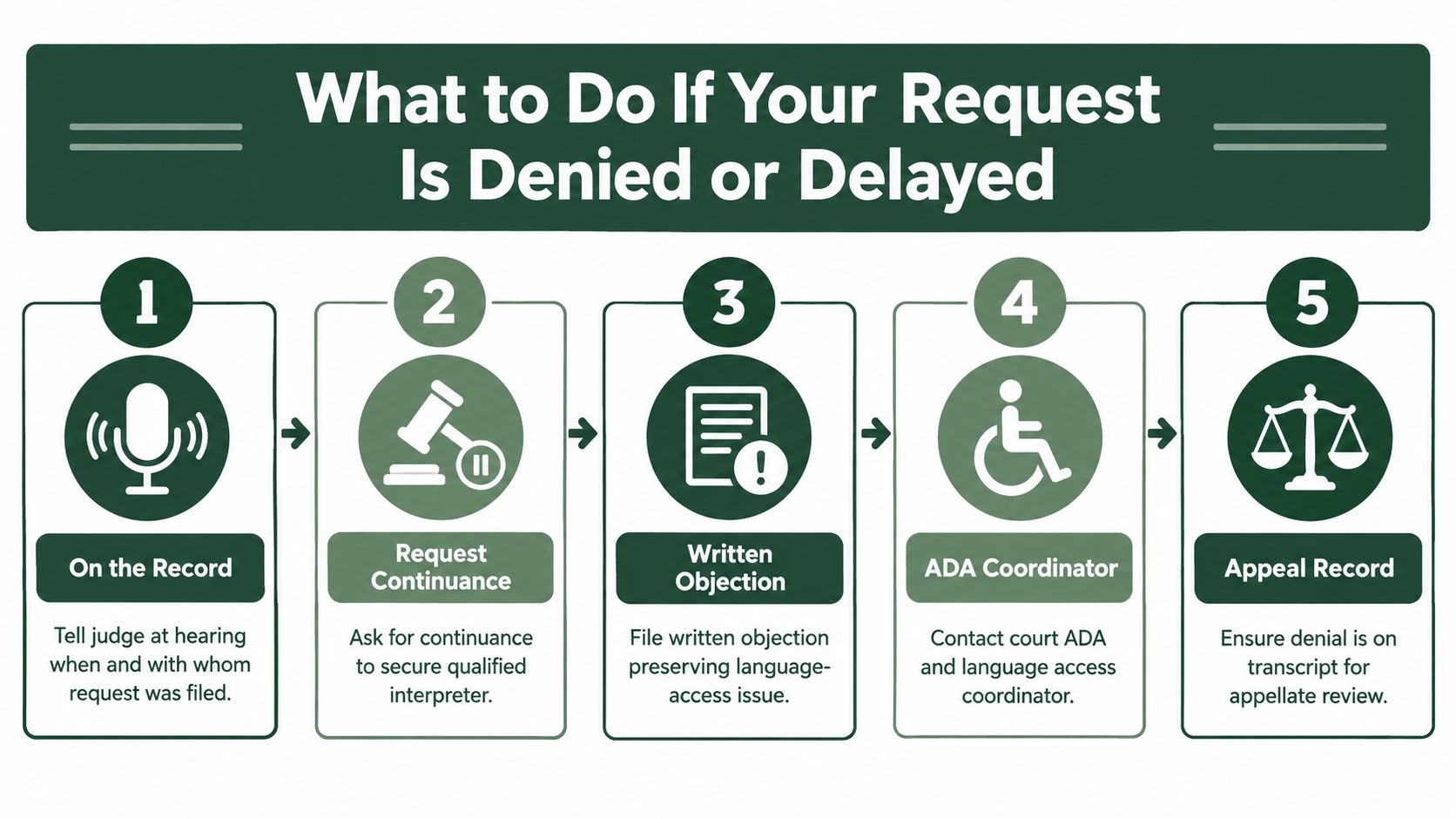
At the hearing, tell the judge plainly that you requested an interpreter, say when you requested it, identify who received the request, and explain that no interpreter was provided. Then ask for a continuance. That is usually smarter than stumbling through a hearing you cannot fully understand.
Put everything in writing
After the hearing or attempted setting, send a written follow-up to the coordinator. Attach the original request. Ask whether the issue was lack of notice, missing information, payment, provider availability, or court procedure.
If the court says no interpreter could be located, ask whether the court can reset the hearing and whether a remote option can be used if the hearing type fits.
Use a motion when informal follow-up goes nowhere
If the coordinator route stalls, file a verified motion asking the judge or associate judge to appoint an interpreter under Chapter 57 and reset the matter if necessary. In a custody fight, support enforcement case, or final divorce prove-up, preserving the issue matters. So does showing that you asked in a timely, documented way.
For deaf or hard-of-hearing parties, be equally direct. If the problem involves the failure to provide an effective communication accommodation, say so in writing and identify the accommodation originally requested.
Courts fix documented problems faster than verbal complaints. Keep the email chain, the filed motion, and any hearing transcript reference.
Don't proceed blindly if the hearing affects final rights
That is especially important in family cases with lasting consequences. A misunderstood temporary order can shape possession and child support. A bad prove-up can affect your final decree. A missed enforcement issue can turn into bigger litigation later.
If your case is already complicated, or if the hearing involves custody, relocation, protective orders, retirement assets, separate-property claims, business ownership, or enforcement, getting legal help before the hearing is often cheaper than trying to undo a bad record later. One option for case-specific guidance is The Law Office of Bryan Fagan, PLLC, which handles Dallas County family-law matters and can help evaluate hearing preparation, filings, and court procedure issues tied to interpreter requests.
If you're trying to get an interpreter lined up for a Dallas family hearing, The Law Office of Bryan Fagan, PLLC offers help with the practical side of the case, including motions, hearing settings, and Dallas County family-court procedure. If you want guidance that connects the interpreter issue to the rest of your divorce, custody, support, or enforcement matter, visit The Law Office of Bryan Fagan, PLLC.
